Carnatic music
Carnatic music is the classical tradition of South India, built on raga, tala and the kriti, and shaped in the Thanjavur region and in Madras.
Karnataka, around 1484
South Asian family
Born
around 1484
Karnataka
Subgenres
14
Documented branches
Links
28
Genres it drew on or shaped
Tempo
65-105 BPMLineage
Family tree
Grew out of
Karnataka
Carnatic music
Led to (14)
Timeline
Era by era
From the first sparks to today. Select a dot to read the story behind it.
- Dasas and the melakarta scheme
1484 to 1760
- The Trinity
1761 to 1847
- From courts to the public
1848 to 1926
- The Madras season and the sabha
1927 to 1965
- Records, the UN and fusion
1966 to 1996
- Global stage and social debate
1997 to today
Eras
Moments
- 1 Dasas and the melakarta scheme, 1484 to 1760
- 2 The Trinity, 1761 to 1847
- 3 From courts to the public, 1848 to 1926
- 4 The Madras season and the sabha, 1927 to 1965
- 5 Records, the UN and fusion, 1966 to 1996
- 6 Global stage and social debate, 1997 to today
around 1484
Dasas and the melakarta scheme
Purandara Dasa sets the teaching system and Venkatamakhin lays out the 72 melakarta ragas in 1660, giving South Indian music its grammar.
- 1484Purandara Dasa shapes the teaching systemThe Kannada saint-composer (c. 1484-1564) is called the father of Carnatic music for the graded lessons he formulated.
- 1660Venkatamakhin outlines the 72 melakartasHis classification of parent ragas still frames how Carnatic ragas are named and taught.
around 1761
The Trinity
Syama Sastri, Tyagaraja and Muthuswami Dikshitar, all linked to Tiruvarur and Thanjavur, compose the kritis that still fill most concerts.
- 1762Syama Sastri is born in ThiruvarurThe eldest of the Trinity is born in the temple town that also gave birth to Dikshitar.
- 1767Tyagaraja is bornThe future composer of about 720 kritis is born in Tiruvarur, and later settles in Thiruvaiyaru.
- 1776Muthuswami Dikshitar is bornThe youngest of the Trinity is born in Tiruvarur and later writes about 500 kritis, mostly in Sanskrit.
- 1846Tyagaraja Aradhana begins at ThiruvaiyaruMusicians gather yearly at the saint's memorial to sing his Pancharatna Kritis in chorus.
1848
From courts to the public
Court musicians such as Veene Sheshanna carry the repertoire on, Madras grows into the main centre, and notation is printed in 1904.
- 1904Sangita Sampradaya Pradarshini is publishedThe first complete printed notation of Dikshitar's kritis helps fix the written tradition.
1927
The Madras season and the sabha
The December conference of 1927, the Music Academy (1928) and the Tamil Isai Sangam (1943) build a public concert culture around stars like Ariyakudi and M. S. Subbulakshmi.
- 1927First Madras music conferenceThe December 1927 gathering starts the annual Madras Music Season.
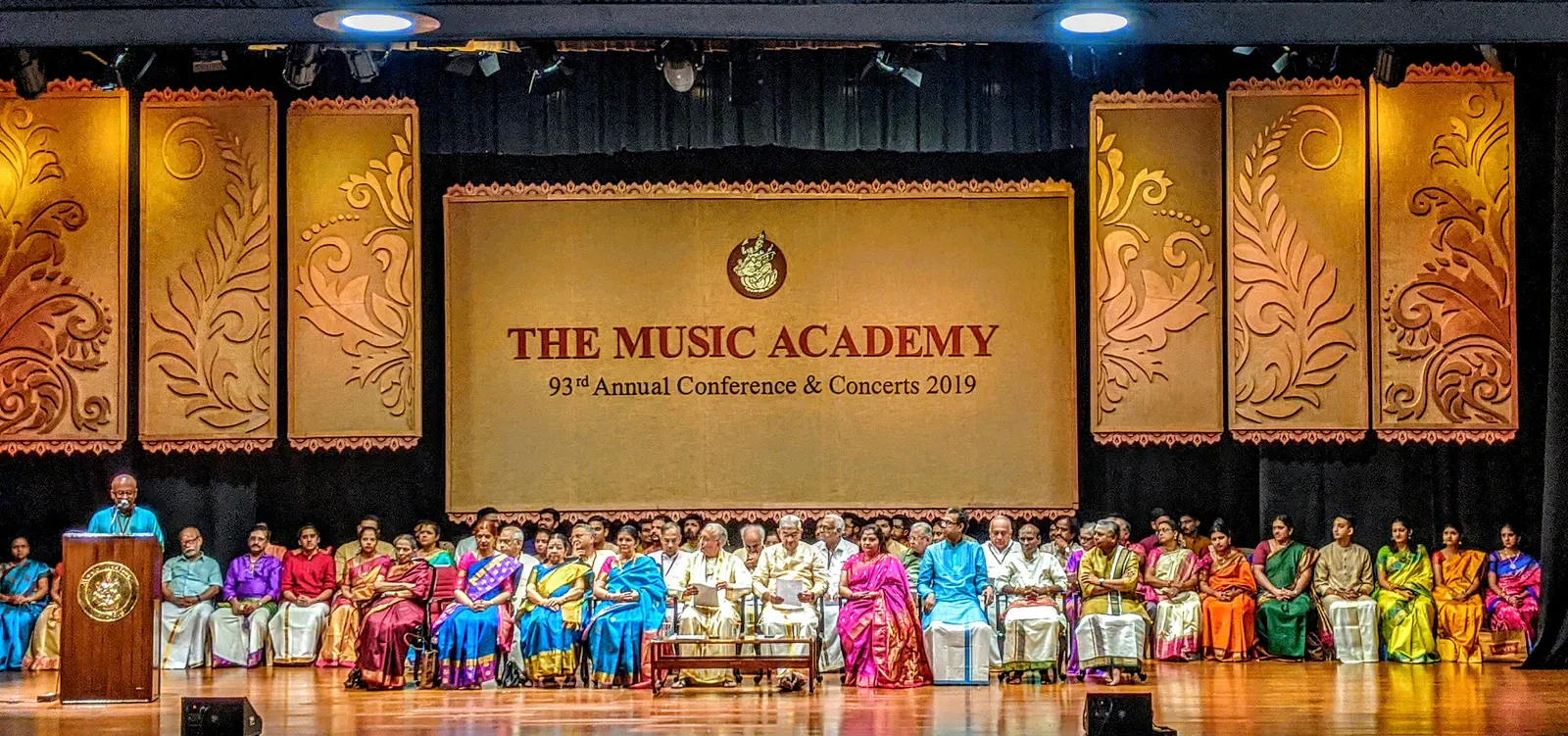
- 1928Madras Music Academy is foundedFounded on 18 August 1928, it soon runs the leading conference, awards and concert hall.
- 1938Ariyakudi wins the Sangita KalanidhiThe vocalist behind the modern kutcheri format receives the Academy's top title.
- 1943Tamil Isai Sangam is foundedSir Annamalai Chettiar sets up an association and college to promote Tamil music.
- 1947Semmangudi becomes the youngest Sangeetha KalanidhiAt 39 he takes the title, a record that still stands.
- 1962Music Academy opens its present hallThe T. T. Krishnamachari Hall opens on 20 December 1962; Nehru had laid the foundation stone in 1955.
- 1963M. S. Subbulakshmi records the Venkateswara SuprabhatamCut on 21 June 1963 for the Gramophone Company, it becomes a daily wake-up hymn in homes and temples.
1966
Records, the UN and fusion
Subbulakshmi sings at the United Nations in 1966, HMV discs spread the repertoire, and Shakti and Rama Sreerama take Carnatic phrasing to jazz and world-music audiences.
- 1966Subbulakshmi sings at the United NationsShe is the first Indian performer at the UN General Assembly, in October 1966.
- 1966Palghat Mani Iyer is honoured as Sangeetha KalanidhiHe is the first mridangist to receive the Academy's title.
- 1968Subbulakshmi is the first woman Sangeetha KalanidhiThe Music Academy gives her its highest title.
- 1975Shakti records for ColumbiaJohn McLaughlin, L. Shankar, Zakir Hussain and Vikku Vinayakram mix Carnatic rhythm with jazz.
- 1994U. Srinivas releases Rama SreeramaThe electric mandolin album on Real World takes Carnatic improvisation to world-music listeners.
1997
Global stage and social debate
Remember Shakti, Pi's Lullaby and streaming widen the audience while T. M. Krishna and others press the tradition on caste and access.
- 1997Remember Shakti is formedMcLaughlin revives the band with U. Srinivas and tours the world.
- 1998Subbulakshmi receives the Bharat RatnaShe is the first musician given India's highest civilian honour.
- 2013Pi's Lullaby is nominated for an OscarBombay Jayashri's Tamil lullaby for Life of Pi is nominated for Best Original Song.
- 2016T. M. Krishna wins the Magsaysay AwardThe award cites his use of art to heal social divides; he speaks openly on caste in Carnatic music.
- 2024Shakti wins a GrammyThis Moment takes Best Global Music Album, the band's first studio record in 46 years.
Listening path
Anthems
The records that built the sound, grouped by the part they played. Thumbnails come from YouTube; the player loads only when you press play.
- 01
Tyagaraja, 1838 · Saregama
Tyagaraja's Pancharatna kriti in raga Sri, sung in chorus at the Thiruvaiyaru Aradhana, is the best known work of the repertoire that defines the tradition.
Start hereOrigin - 02
Muthuswami Dikshitar, 1896 · Saregama
Dikshitar's Sanskrit kriti in raga Hamsadhvani opens countless concerts and shows the Trinity's second voice.
Origin - 03
M. S. Subbulakshmi, 1963 · Saregama
Recorded for HMV in 1963, her Sanskrit wake-up hymn moved Carnatic singing from concert halls into daily life across India.
Start hereBreakthrough - 04
M. S. Subbulakshmi, 1980 · Saregama
C. Rajagopalachari's Tamil song of thanks, published in 1967 and recorded by Subbulakshmi around 1980, is now a fixture of devotional programmes.
Anthem - 05
M. S. Subbulakshmi, 1966 · Saregama
Sung by Subbulakshmi at the United Nations in 1966, this peace hymn put Carnatic voice before a global audience.
Start hereCrossover - 06
Shakti, 1976 · Columbia Records
Shakti pairs Carnatic violin and ghatam with jazz guitar and tabla in a live track from the band's first run.
Crossover - 07
U. Srinivas, 1994 · Real World Records
A mandolin ragam-tanam-pallavi on Real World shows the form working for listeners outside the concert hall.
Crossover - 08
Bombay Jayashri, 2012
A Carnatic vocal sung in a Hollywood film score; the song was nominated for an Oscar in 2013.
Crossover - 09
T. M. Krishna, 2017
A protest song on Chennai's polluted wetlands shows the tradition used for social and environmental comment.
Revival
Facts
| Family | South Asian |
| Origin | Karnataka, India |
| Emerged | Codified 16th-18th century, ancient roots |
| Status | Active |
| Tempo | 65 to 105 BPM |
| Meter | Tala cycles, often 8-beat adi tala |
| Subgenres | 14 |
Carnatic music is the classical music of South India, sung and played in Tamil, Telugu, Kannada, Malayalam and Sanskrit across Tamil Nadu, Karnataka, Andhra Pradesh and Kerala.
Its core is the kriti, a composed song that performers expand through improvisation inside a raga (melodic framework) and a tala (rhythmic cycle). Its repertoire was set between the 16th and 19th centuries, and its concert life centres on Chennai.
Origins
The tradition has roots older than any surviving score, in temple hymn, Tamil devotional song and Sanskrit treatises on melody and rhythm. The Vijayanagara empire gave it court and temple patronage. The Kannada saint-composer Purandara Dasa, who lived from about 1484 to 1564, is called its father for the graded lessons he set, from scale exercises to simple songs, that pupils still learn.
In 1660 Venkatamakhin outlined 72 parent ragas, the melakartas, each defined by a fixed set of seven notes. Other ragas descend from them, which is why Carnatic musicians can learn ragas by family.
North and South Indian classical traditions share an ancient base and began to separate in the 12th and 13th centuries. The northern branch absorbed Persian and Central Asian influence and became Hindustani classical music. The southern branch kept Sanskrit and regional-language texts, a stronger attachment to composed songs and the heavy ornament of gamaka.
Thanjavur and Tiruvarur, 1760-1847
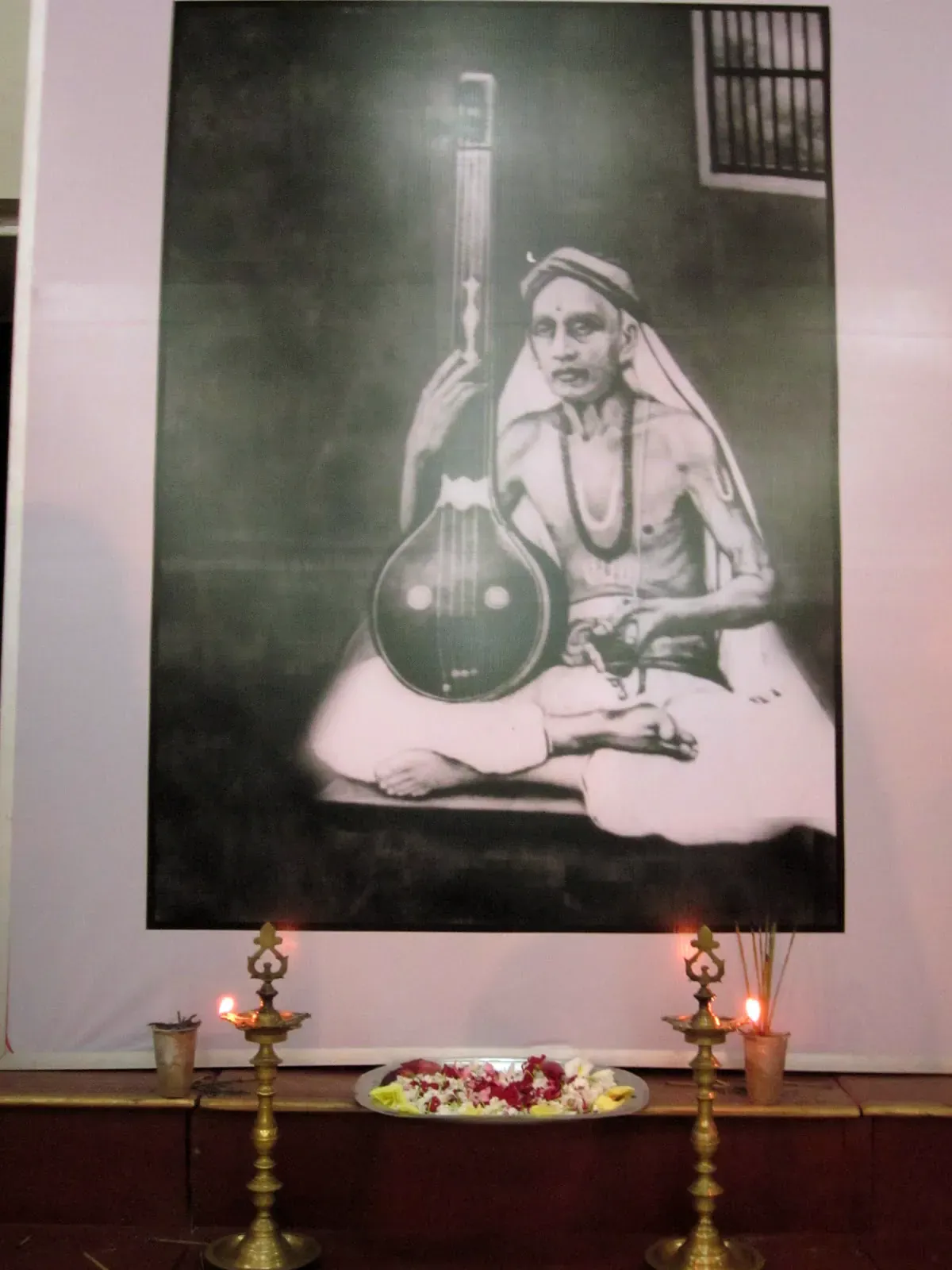
The decisive generation was born in the Kaveri delta, the temple region of Thanjavur. Syama Sastri (born 1762), Tyagaraja (1767) and Muthuswami Dikshitar (1776) were all born in Tiruvarur. Together they are called the Trinity, and their kritis fill most concerts today.
Tyagaraja, who later settled in Thiruvaiyaru, left about 720 kritis, mostly in Telugu. Dikshitar wrote about 500, mostly in Sanskrit. None composed for a paying hall. They wrote as devotion and teaching, and pupils memorised the songs.
The first Aradhana at Thiruvaiyaru, held at Tyagaraja’s memorial in 1846, turned remembrance into a yearly gathering where musicians sing his five Pancharatna Kritis in chorus.
Madras, 1848-1926
As princely courts weakened, musicians moved to the colonial cities, above all Madras. Court musicians such as Veene Sheshanna carried the repertoire through the century. Printing fixed the written tradition: Sangita Sampradaya Pradarshini, the 1904 notation of Dikshitar’s kritis, remains a reference for performers. Most music still stayed in temples, homes and patrons’ halls.
Madras, 1927-1965
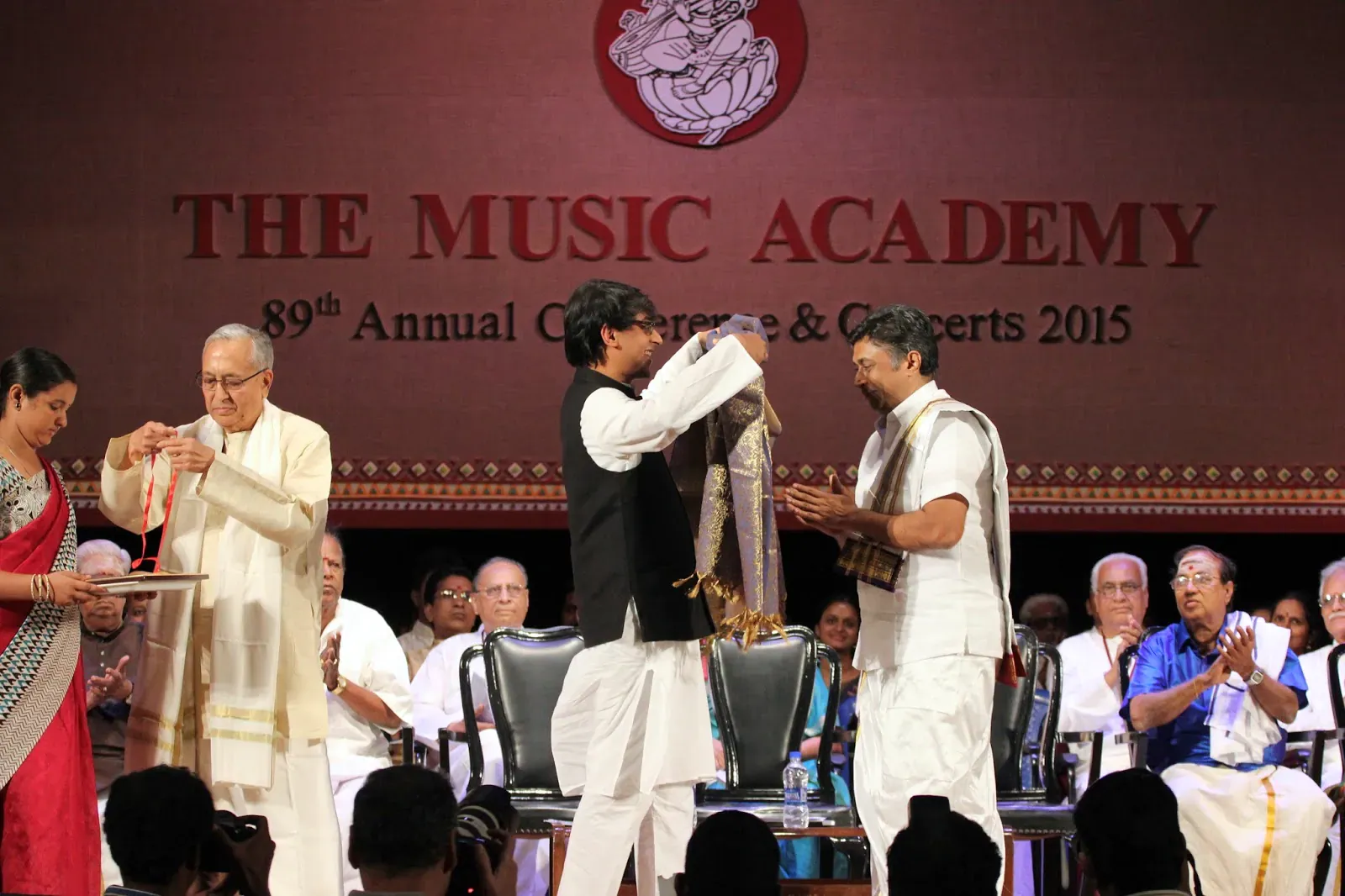
A conference in Madras in December 1927 began the annual Madras Music Season. The Music Academy followed on 18 August 1928 and soon ran the leading conference, a concert calendar and the Sangita Kalanidhi, the field’s highest title. The Tamil Isai Sangam, founded in 1943 by Sir Annamalai Chettiar, pressed for songs in Tamil alongside the Telugu and Sanskrit canon.
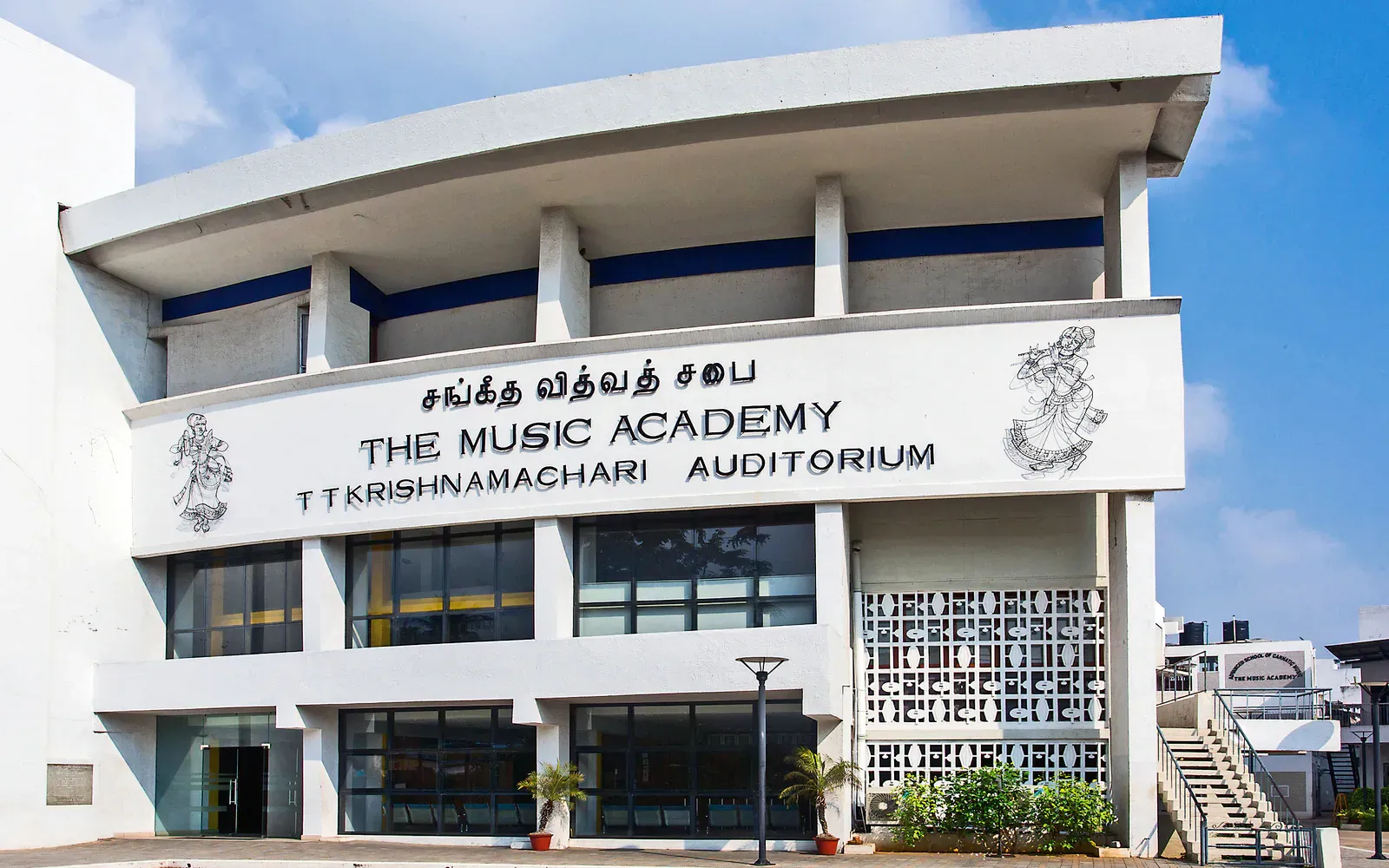
The modern concert, the kutcheri, took shape in these years. Ariyakudi Ramanuja Iyengar, who received the Sangita Kalanidhi in 1938, is credited with the standard order: a technical varnam, a run of kritis with improvised alapana, niraval and kalpanaswaram, a main item built on a ragam-tanam-pallavi, a percussion solo and a short light piece to close. Semmangudi Srinivasa Iyer became the youngest Sangita Kalanidhi, at 39, in 1947.
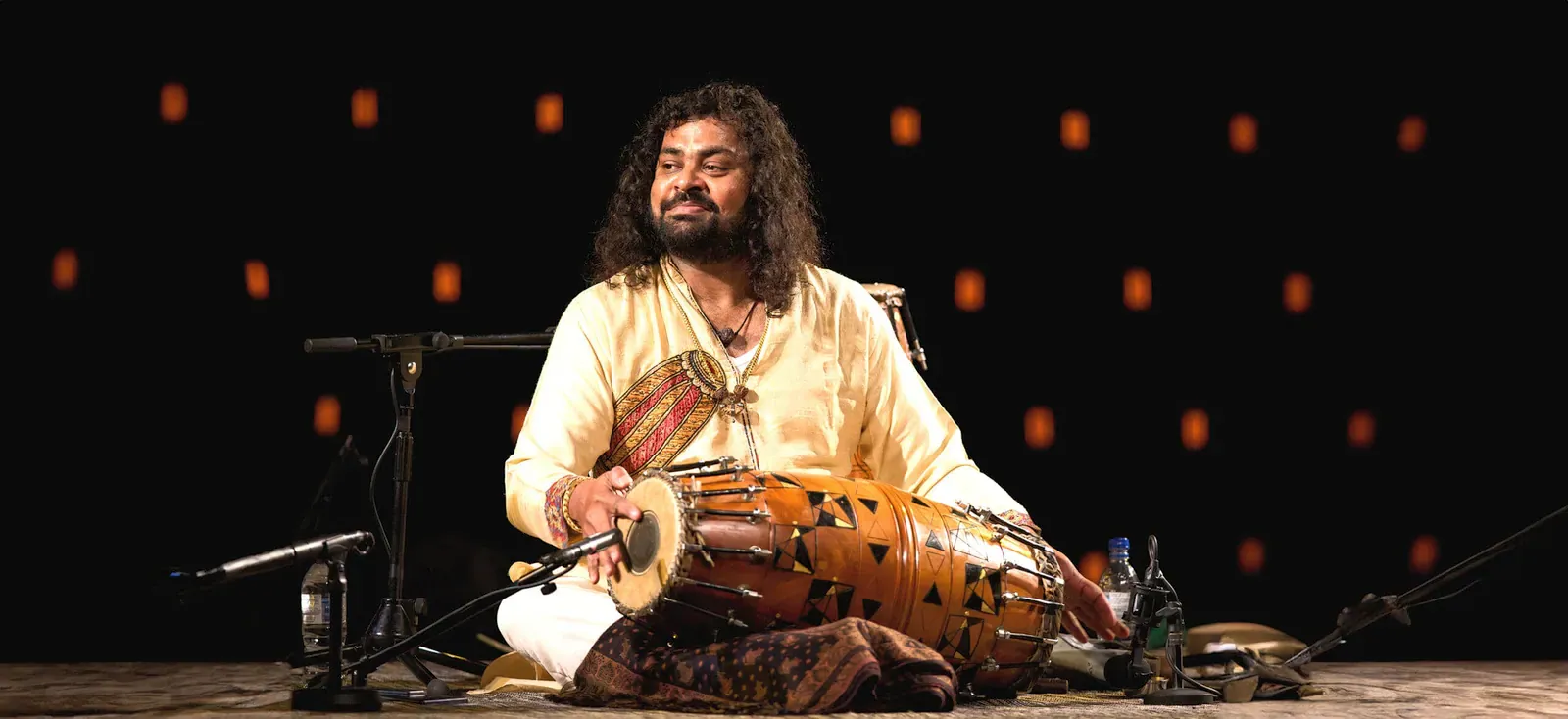
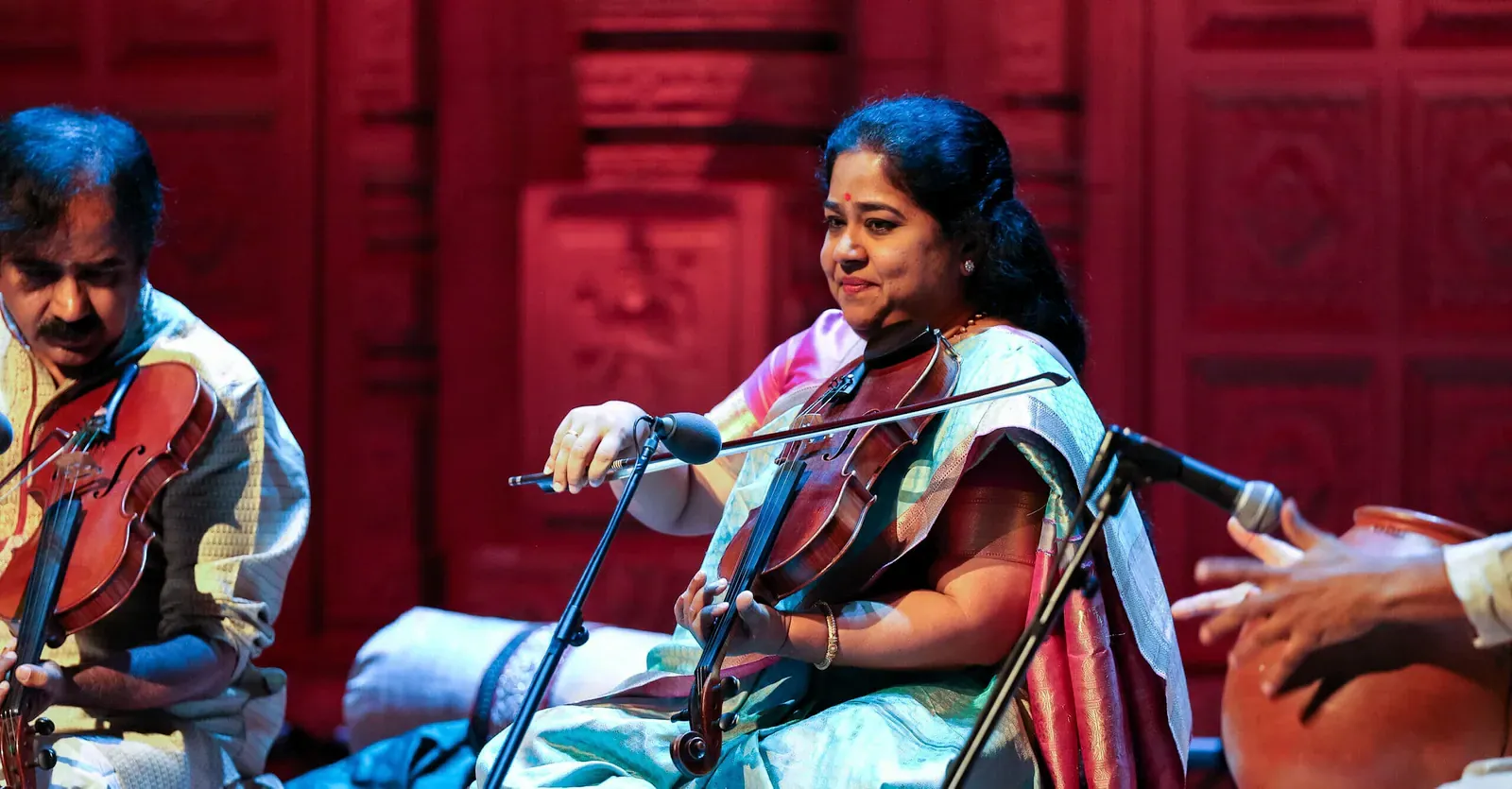
The ensemble is small: a lead voice or instrument, a violin that echoes and answers, a mridangam drum and a tambura drone. Palghat Mani Iyer turned the mridangam from timekeeper into a running commentary on the melody, and in 1966 he became the first mridangist given the Academy’s title.
Records and the world, 1966-1996
In October 1966 M. S. Subbulakshmi sang at the United Nations General Assembly, the first Indian performer there. Two years later the Academy named her its first woman Sangita Kalanidhi. She had already carried Carnatic singing into daily life: her Venkateswara Suprabhatam, recorded for the Gramophone Company on 21 June 1963 and now issued by Saregama, became a morning hymn in homes and temples. She received the Bharat Ratna in 1998.
In the 1970s the tradition met jazz. Shakti, led by the guitarist John McLaughlin with the violinist L. Shankar, the tabla player Zakir Hussain and the ghatam player Vikku Vinayakram, recorded for Columbia. In 1994 U. Srinivas released Rama Sreerama on Real World, a full ragam-tanam-pallavi on electric mandolin.
Global stage, 1997 onward
McLaughlin re-formed the band as Remember Shakti in 1997 with Srinivas. Its album This Moment won the Grammy for Best Global Music Album in 2024, the band’s first studio record in 46 years. Bombay Jayashri’s Tamil lullaby for the film Life of Pi was nominated for an Oscar in 2013. The label Charsur released her album Shravanam in 2000 and made studio-recorded Carnatic releases a regular market.
Characteristics
Three things set the idiom apart. Gamaka bends, shakes and slides the notes, so one scale can sound entirely different in two ragas. The composition is the anchor: a kriti with pallavi, anupallavi and charana sections, from which improvisation grows. The tala is a cycle kept by hand claps and finger counts, and the common adi tala has eight beats.
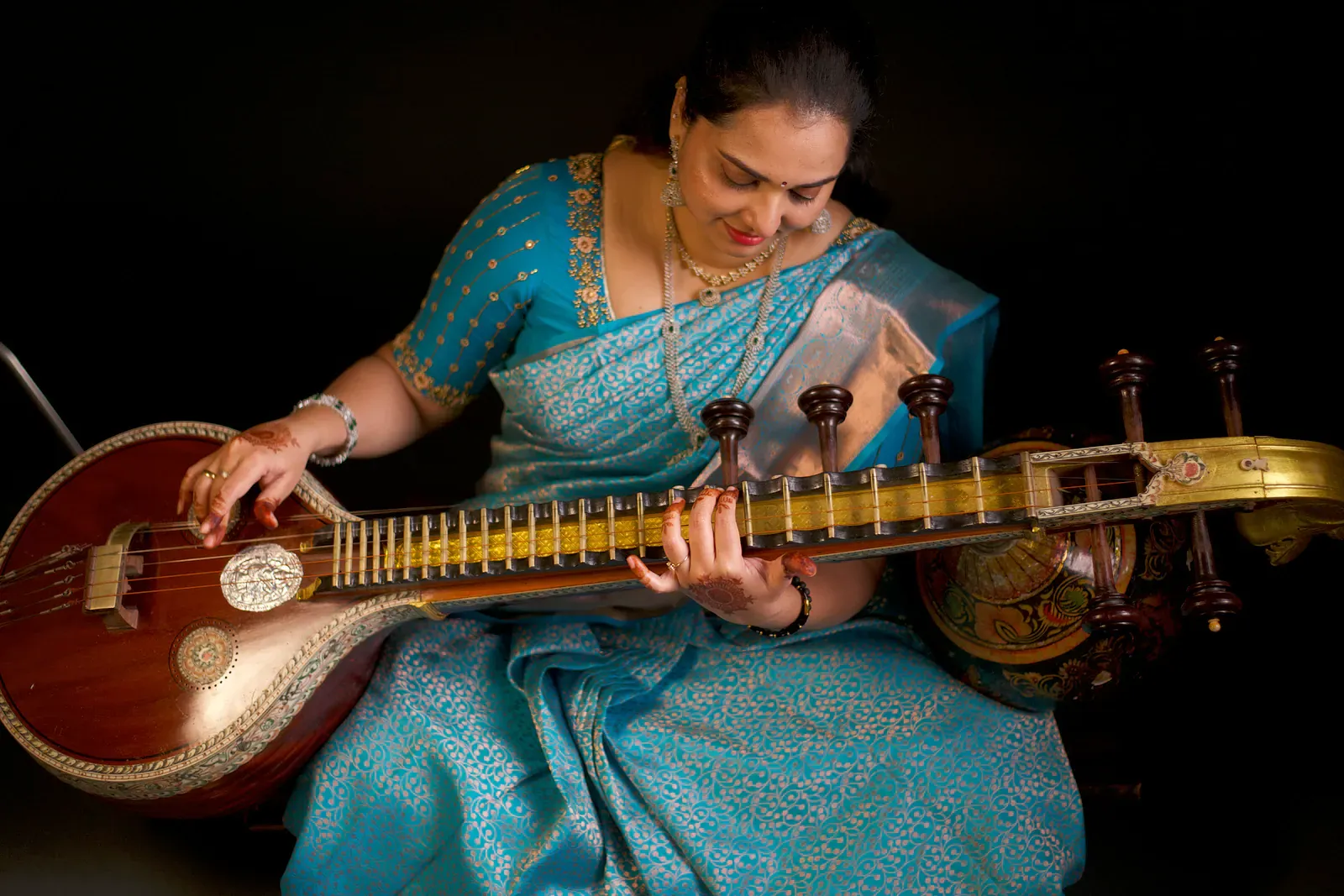
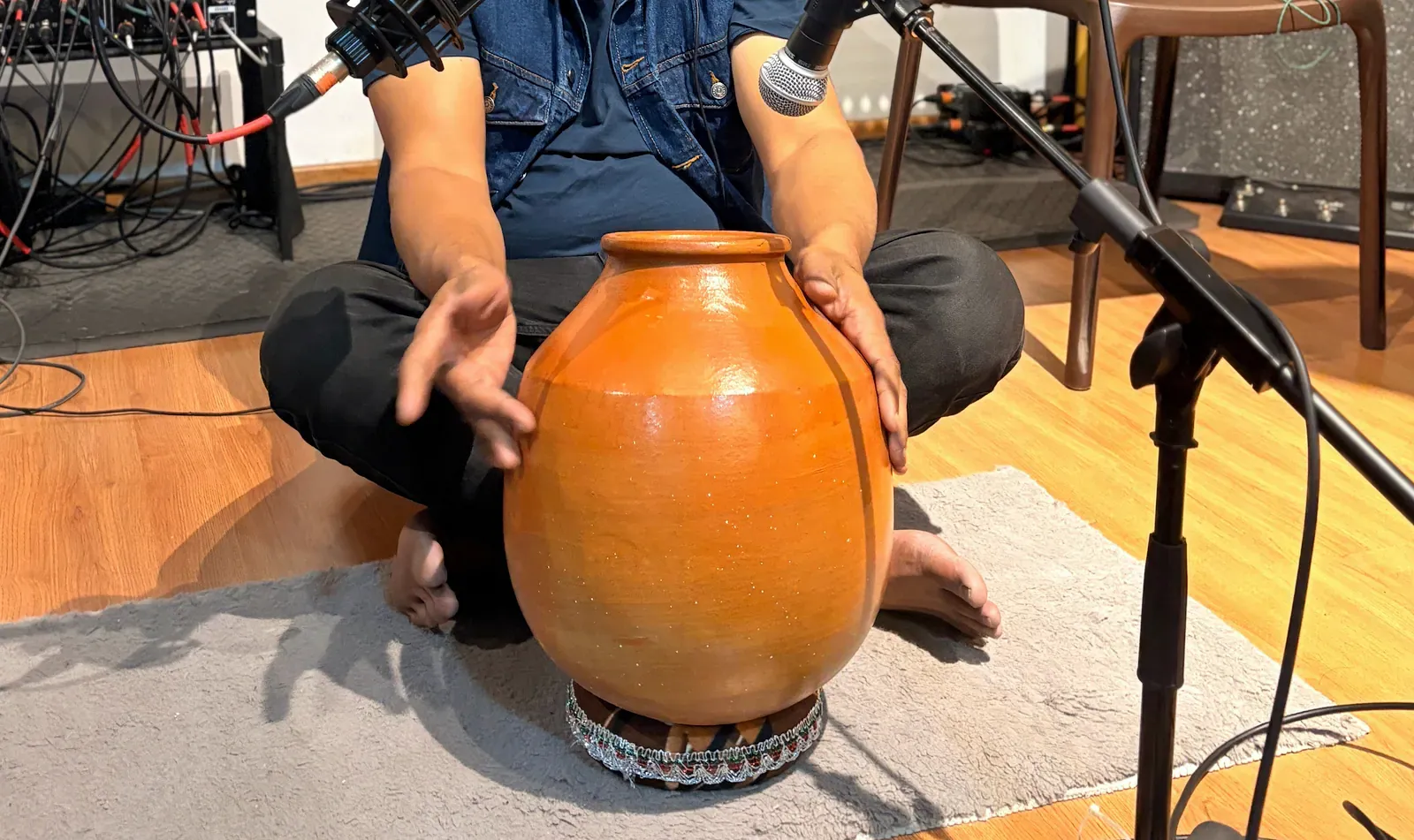
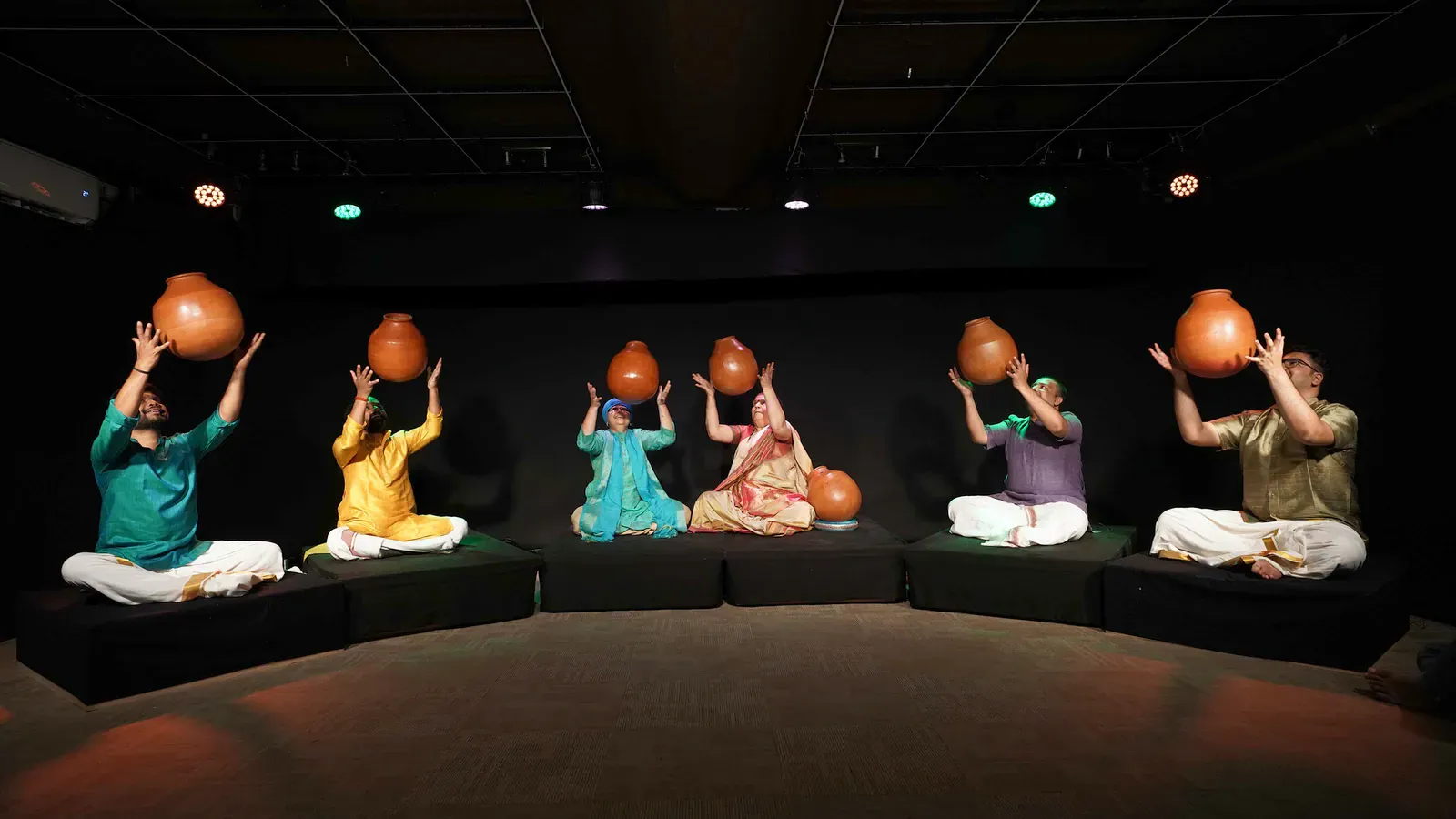
A tambura holds the tonic throughout, and every note is judged against it. Lyrics are devotional or philosophical, mostly in Telugu, Sanskrit, Tamil and Kannada. Instruments include the veena, violin, flute, mridangam, ghatam, kanjira, morsing and, since Srinivas, the electric mandolin. In the tani avartanam, the percussion solo, the mridangam and its partners take over for several minutes.
Mainstream success
Carnatic music never entered the pop charts. Its hit is a recording that reaches millions of homes, and Subbulakshmi’s Suprabhatam is the clearest case, played at dawn across South India for decades. Cinema was a second channel: Sevasadanam (1938) was Subbulakshmi’s film debut, and Sankarabharanam (1980), a Telugu film scored by K. V. Mahadevan, brought Carnatic song to mass audiences.
Crossover took other routes: Shakti in the 1970s, Srinivas in the 1990s, the Life of Pi lullaby in 2012. Streaming has added listeners abroad.
Notable recordings
- Sri Venkatesa Suprabhatam, M. S. Subbulakshmi (1963), the dawn hymn of South India.
- Rama Sreerama, U. Srinivas (1994), a mandolin ragam-tanam-pallavi on Real World.
- Shravanam, Bombay S Jayashri (2000), a Charsur studio album of devotional Carnatic song.
- Pi’s Lullaby, Mychael Danna with Bombay Jayashri (2012), a Carnatic vocal in a Hollywood score.
- Chennai Poromboke Paadal, T. M. Krishna (2017), a Carnatic-style song about Chennai’s wetlands.
Culture
Teaching is guru-shishya: a pupil learns by ear from a teacher, beginning with simple geethams and varnams. The December season, also called Margazhi, fills Chennai’s halls from morning to night, and sabhas, the membership societies that host concerts, include some formally registered as early as 1900. The same compositions serve Bharatanatyam, whose recitals use padams, javalis and tillanas from the Carnatic canon.
Caste and gender sit at the centre of present-day debate. For generations access to the repertoire and the best platforms favoured a narrow set of communities. T. M. Krishna, who received the Magsaysay Award in 2016, speaks openly on this, including in his book A Southern Music: The Carnatic Story (2013).
Legacy
The Trinity’s songs remain the core of nearly every concert, and the Madras season, the sabha circuit and the Academy are models for other classical communities. Diaspora teachers run schools whose pupils return to perform in Chennai. The ideas of raga, tala and improvised response to a composed song also show in jazz, film scoring and fusion.
Misconceptions
Carnatic and Hindustani music have nothing in common. Both come from one ancient system of raga and tala and share concepts and many raga names. They diverged through different patronage and language.
Carnatic music is improvised. It is built around fixed compositions. Improvisation happens inside a raga and tala, and most of a standard concert goes to composed kritis.
The Trinity founded the tradition. They gave it its best-loved songs. The teaching system came from Purandara Dasa two centuries earlier, and the raga scheme from Venkatamakhin in 1660.
Frequently asked questions
What is the difference between Carnatic and Hindustani music?
Carnatic music is the classical tradition of South India and Hindustani music that of the north. The southern style centres on composed kritis, uses heavy gamaka and favours the violin, veena and mridangam. The northern style gives more room to long improvised unfolding and uses the sitar, sarod and tabla.
What instruments are used in Carnatic music?
The core instruments are the veena, violin, flute, mridangam, ghatam, kanjira, morsing and tambura. The electric mandolin joined them through U. Srinivas.
What is a kutcheri?
A kutcheri is a Carnatic concert. Its standard order of varnam, kritis, ragam-tanam-pallavi, percussion solo and closing piece took shape in Madras in the 1930s.
Who are the Trinity of Carnatic music?
They are Tyagaraja, Muthuswami Dikshitar and Syama Sastri, all born in Tiruvarur in the 18th century. Their songs form the core repertoire of a concert.
What is the Madras Music Season?
It is the annual run of concerts and conferences held in Chennai from mid-December into January. It began with a conference in December 1927.
Sound
Sound sheet
Anatomy of a track
| # | Part |
|---|---|
| 1 | Varnam: technical opening piece |
| 2 | Kriti series: song, alapana, niraval, kalpanaswaram |
| 3 | Ragam tanam pallavi: the main improvised item |
| 4 | Tani avartanam: percussion solo |
| 5 | Tillana or devotional light piece |
| 6 | Mangalam: closing blessing |
Signature sounds
- Tambura drone on the tonic
- Gamaka ornaments on every note
- Pallavi, anupallavi, charana song form
- Violin echoing the singer line by line
- Mridangam and ghatam answering the melody
- Lyrics in Telugu, Sanskrit, Tamil or Kannada
Drums and percussion
- Mridangam
- Ghatam
- Kanjira
- Morsing
Techniques
- Gamaka
- Alapana
- Niraval
- Kalpanaswaram
- Tani avartanam
- Konnakol
Keys and modes
Sri. Raga of Tyagaraja's Pancharatna kriti Endaro Mahanubhavulu.
Nata. Raga of the first Pancharatna Kriti.
Arabhi. One of the five ghana ragas of the Pancharatna Kritis.
Varali. One of the five ghana ragas of the Pancharatna Kritis.
Gaula. One of the five ghana ragas of the Pancharatna Kritis.
Tuning
The tonic (sruti) is set by the performer's range and held by a tambura drone; the ear works with 22 sruti intervals.
Vocals
Sung with heavy ornamentation in Telugu, Sanskrit, Tamil, Kannada or Malayalam, backed by a tambura drone and violin.
Scenes
Where it happened
Where and when the sound lived: one bar per city on a shared timeline.
Asia
North America
Active scenes
Peak 4, 1966-2025
Birthplace of the Trinity composers, set in the Thanjavur temple region.
Home of Tyagaraja's memorial and the yearly Aradhana where Pancharatna Kritis are sung together.
Capital of the tradition: the Madras Music Academy, many sabhas and the December season.
Subbulakshmi's 1966 UN concert opened global audiences to Carnatic song.
Venues and places
Chennai, 1928 to today. Alwarpet hall where the December conference is held and the Sangita Kalanidhi is awarded.
Chennai, 1927 to today. Annual December-January run of concerts at the Academy and sabhas across the city.
Thiruvaiyaru, 1846 to today. Yearly gathering at Tyagaraja's memorial where musicians sing the Pancharatna Kritis together.
New York, 1966 to today. Where Subbulakshmi performed in October 1966.
Culture
Culture markers
- Pancharatna chorus at the Aradhana
Hundreds of musicians sing the five Pancharatna Kritis together at Tyagaraja's memorial each year.
Ritual - Margazhi (December) season
Chennai's concert season, with daily morning-to-night programmes across its sabhas.
Ritual - Guru-shishya teaching
Pupils learn compositions orally from a teacher, starting with simple geethams and varnams.
Ritual - Bharatanatyam repertoire
Padam, javali and tillana from the Carnatic canon form the music of Bharatanatyam recitals.
Dance
Media
Key media
- 1904Sangita Sampradaya Pradarshini
by Subbarama Dikshitar. First complete printed notation of Dikshitar's kritis.
Book - 1938Sevasadanam
by K. Subramanyam. M. S. Subbulakshmi's film debut.
Film - 1945Meera
by Ellis R. Dungan. Subbulakshmi starred and sang in this Tamil film; its song Kaatrinile Varum Geetham remains famous.
Film - 1980Sankarabharanam
by K. Viswanath. Telugu film with K. V. Mahadevan's score that brought Carnatic song to mass audiences.
Film - 2012Life of Pi
by Ang Lee. Its score carries Bombay Jayashri's Pi's Lullaby.
Film - 2013A Southern Music: The Carnatic Story
by T. M. Krishna. A vocalist's history and critique of the tradition.
Book
Glossary
Terms on this page
Unmetered, rhythm-free exploration of a raga before a song.
Oscillation or slide on and between notes that gives each raga its character.
Improvisation using the note names (sa, ri, ga...) that ends on the song's chosen beat.
The main vocal form, built from pallavi, anupallavi and charana sections.
Melodic variation on one line of a song's lyric, kept within the tala.
A melodic framework of notes, ornaments and phrases; Carnatic music has 72 parent (melakarta) ragas.
A repeating rhythmic cycle kept by hand gestures; adi tala has eight beats.
Percussion solo in which the mridangam and its partners take over near the end of a concert.
South Asian family