Chinese folk song
Chinese folk song is the body of Han regional songs, from mountain songs and short tunes to Yan'an adaptations and the trained folk voices of gala television.
China, around 1563
East Asian family
Born
around 1563
China
Subgenres
12
Documented branches
Links
6
Genres it drew on or shaped
Tempo
70-120 BPMLineage
Family tree
Grew out of
China
Chinese folk song
Led to (13)
Timeline
Era by era
From the first sparks to today. Select a dot to read the story behind it.
- Regional tunes and the first export
1563 to 1899
- Travelling players and Western ears
1900 to 1937
- Collectors, Yan'an and the people's songs
1938 to 1979
- Conservatory voices and the gala stage
1980 to today
Eras
Moments
- 1 Regional tunes and the first export, 1563 to 1899
- 2 Travelling players and Western ears, 1900 to 1937
- 3 Collectors, Yan'an and the people's songs, 1938 to 1979
- 4 Conservatory voices and the gala stage, 1980 to today
around 1563
Regional tunes and the first export
Short tunes such as Mo Li Hua circulate in the Jiangnan towns and in northern villages. A British diplomat copies one into Western notation in 1793 and Europe prints it in 1804.
- 1563Earliest known Mo Li Hua lyricsScholars date the first lyrics to the Wanli period (1563 to 1620); the tune is usually placed in the Qianlong reign.
- 1793Mo Li Hua copied into Western notationJohn Barrow of the Macartney mission writes the tune down; he publishes it in Europe in 1804.
- 1804Mo Li Hua is printed in EuropeBarrow notes it as one of the most popular songs in China, giving it wide circulation abroad.
- 1896Qing officials use Mo Li Hua as a stand-in anthemUsed in Europe until the official anthem was adopted in 1911.
1900
Travelling players and Western ears
Itinerant musicians play Mo Li Hua across China, Qing officials in Europe used it as a stand-in anthem from 1896, and Puccini quotes it in Turandot in 1926.
- 1926Turandot quotes Mo Li HuaPuccini builds the leitmotif of the title princess on the tune, taken from a music box.
1938
Collectors, Yan'an and the people's songs
Wang Luobin publishes his first western-style song in 1938. Folk melodies get new words in Yan'an, the yangge movement spreads in villages, and stage singers carry the songs to national audiences.
- 1938Wang Luobin publishes The Girl from DabanchengHis first Xinjiang-inspired song, published in Lanzhou; he later publishes about 700 such songs.
- 1940The new yangge movementThe Communist Party adapts the northern village dance into a mass rally form with new words.
- 1943Nanniwan set to a northern Shaanxi melodyLyrics by He Jingzhi, music by Ma Ke, built on a traditional folk melody of northern Shaanxi.
- 1956Guo Lanying sings My MotherlandThe soprano becomes best known for this patriotic song and for Nanniwan.
1980
Conservatory voices and the gala stage
Conservatory-trained singers such as Peng Liyuan and Song Zuying make folk song a television staple, take it to Vienna and Washington, and earn degrees in ethnic folk singing.
- 1980Peng Liyuan wins a Beijing prize for Yimeng songsA performance in Beijing brings her first national notice with two Shandong songs.
- 1982Mo Li Hua joins a UNESCO list of recommended songsThe Jiangnan tune is placed on the list as a representative Chinese melody.
- 1990Song Zuying sings Little Back Basket on the Spring Festival GalaShe appears on the gala every year for 24 years, until 2013.
- 1997Mo Li Hua plays at the Hong Kong handoverIt is played again at the Macau handover in 1999.
- 2003Song Zuying sings in the Golden Hall of the MusikvereinHer November 2003 solo concert in Vienna follows the 2002 Sydney Opera House concert.
- 2009Hua'er enters the UNESCO intangible heritage listThe mountain song of Gansu, Ningxia and Qinghai is named to the Representative List.
- 2011Mo Li Hua is censored onlineAfter the 2011 Jasmine protests, videos of officials singing it are removed and searches are blocked.
Listening path
Start listening
A short path from an easy way in to the deep end. Thumbnails come from YouTube; the player loads only when you press play.
- 01
彭丽媛, 1988
A Shandong mountain tune, one of the two songs that first brought Peng Liyuan notice.
- 02
宋祖英, 1999
The song she sang on the 1990 Spring Festival Gala.
- 03
宋祖英, 2003
A gala favourite sung in the bright, fast folk-song style of her stage repertoire.
Facts
| Family | East Asian |
| Origin | China |
| Emerged | Ancient, from Shijing/Yuefu traditions |
| Status | Active |
| Tempo | 70 to 120 BPM |
| Subgenres | 12 |
Chinese folk song is the collective name for the regional songs of the Han majority, sung in dialect across villages, towns and mountain roads and built mostly on pentatonic melodies.
Its roots reach back to the ancient collections of poetic songs, and it split into dozens of local types with names such as shan’ge, xiaodiao and xintianyou. In the twentieth century collectors, revolutionary song writers and conservatory singers recast the tunes for national audiences, so the genre now lives in two registers: the unaccompanied village song and the trained solo voice with a folk orchestra.
Origins
The idea that songs of ordinary people deserve a place in the record is very old. The Classic of Poetry holds many folk songs dating from about 800 BC to about 400 BC, and almost every emperor sent officers to collect songs as a way of reading the mood of the people.Bone flutes from Jiahu in Henan are about 9,000 years old, and by about the seventh century BC a pitch system built on a five-note scale had been worked out from a cycle-of-fifths theory.
What the written record cannot show is how the songs sounded in the fields. Han folk music is heterophonic, so players and singers deliver slightly different versions of one melodic line at the same moment, and percussion supports most songs, dances and storytelling. Melodies slide between tones in a way that echoes the tonal language, and silences are treated as part of the line, which gives even a simple song a poem-like shape.
Regional types
Chinese folk song is an umbrella, not a single style. Shan’ge, the mountain song, is the ballad-like song of rural provinces. Its branches include hua’er of Gansu, Ningxia and Qinghai, sung without accompaniment and added to the UNESCO list of intangible heritage in 2009, and xintianyou and shanqu of Shaanxi and Shanxi. Xintianyou, literally “rambling in the sky”, was first sung by porters who carried goods to distant regions, and Lan Huahua is its best known example.
Xiaodiao, the short tune, belongs more to towns. It usually has several stanzas with uniform phrase structures. Village festivals add the dance of yangge. Related pages cover the nearby traditions of Chinese opera and Chinese instrumental music, which share the pentatonic base and some of the same instruments within the wider East Asian family.
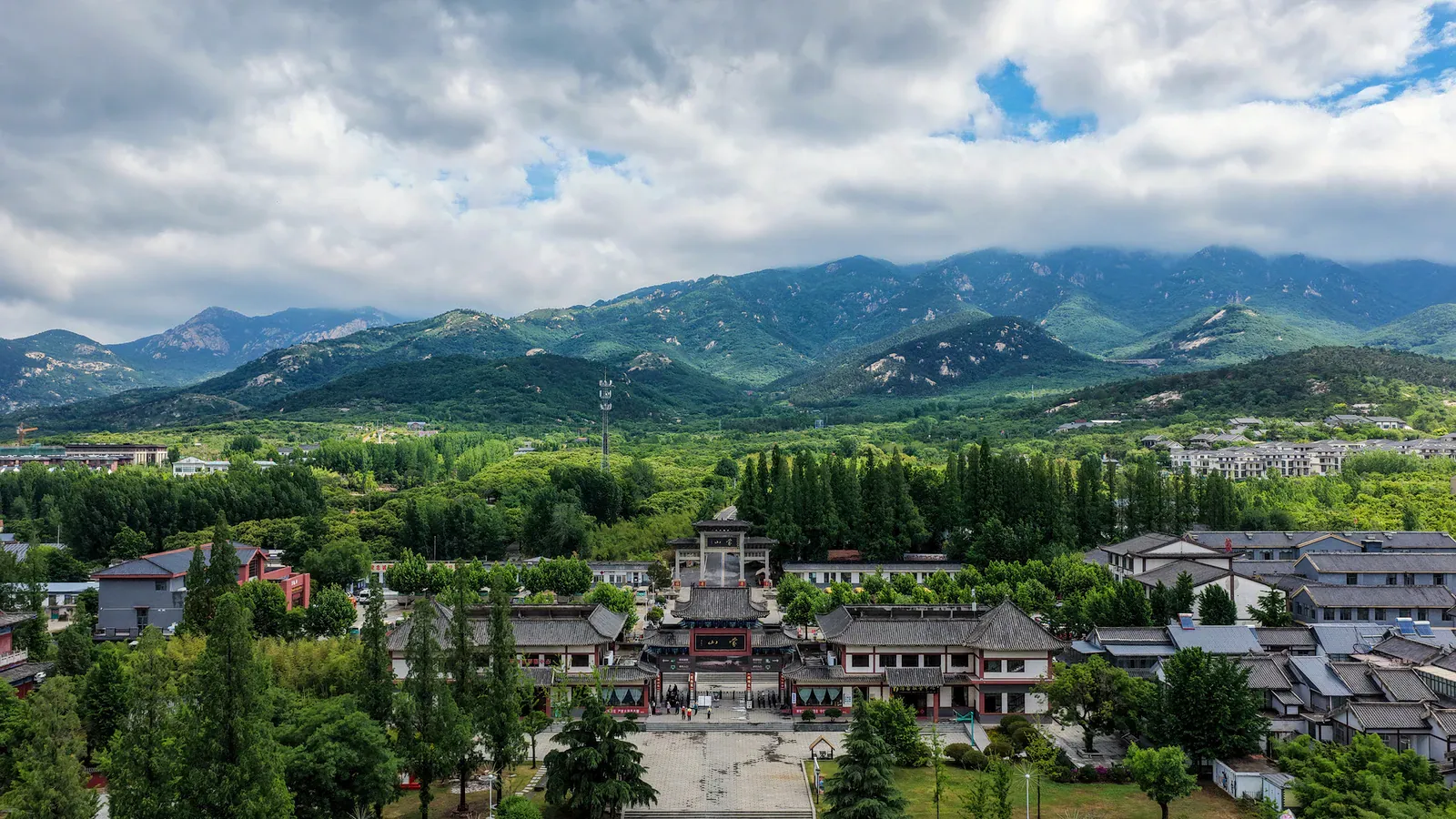
Mo Li Hua, Jiangnan, 1563 to 1926
The most travelled Chinese folk tune is Mo Li Hua, “Jasmine Flower”, a xiaodiao from the Jiangnan region around Suzhou, Shanghai and Hangzhou. It is usually dated to the Qianlong reign of the eighteenth century, though the earliest known lyrics appear in the Wanli period, between 1563 and 1620. One version describes a custom of giving jasmine flowers in the southern Yangtze delta, another a fear of plucking the flower. In the north the tune goes by other names such as La Mei Hua, “waxed plum blossom”.
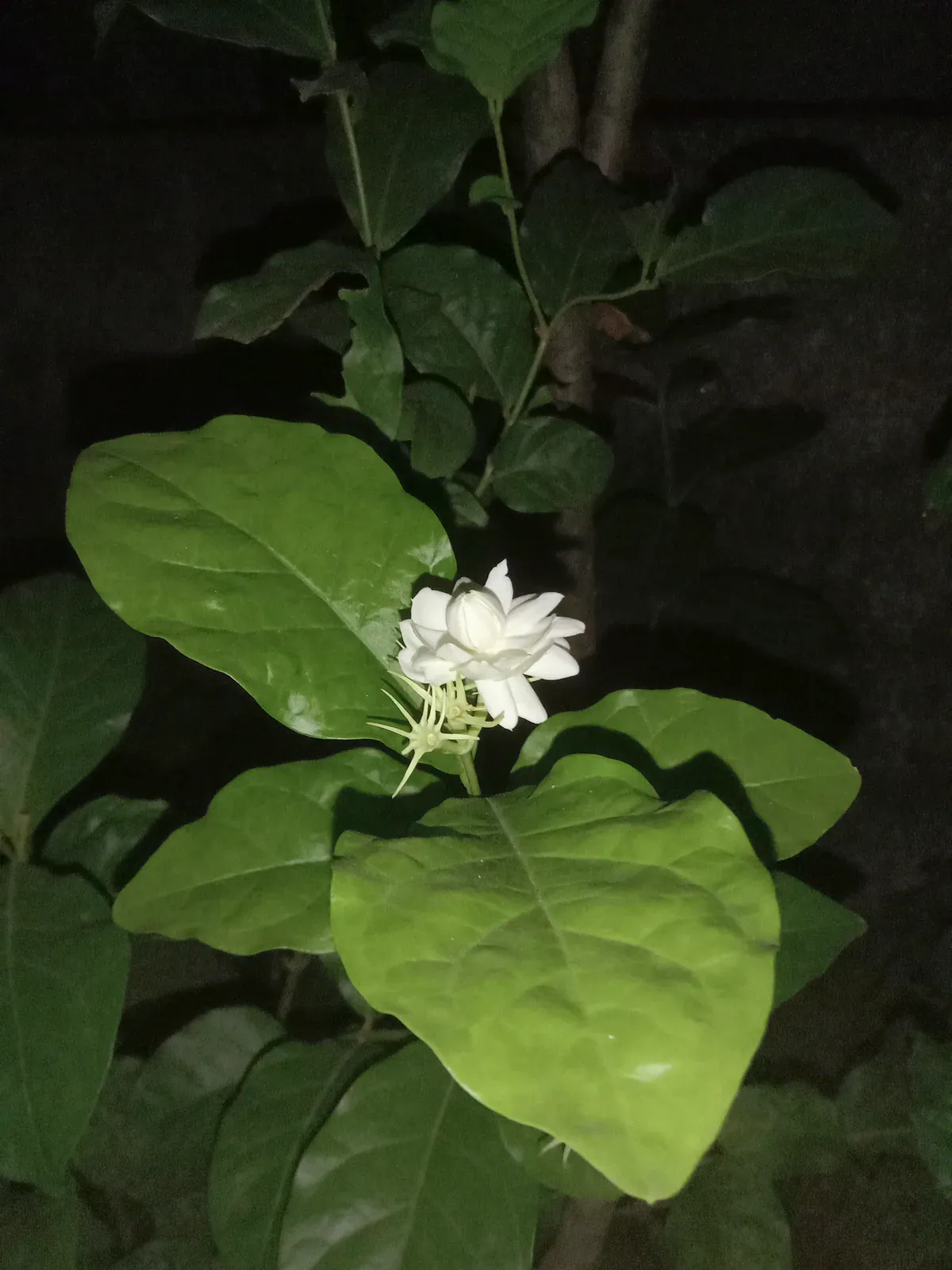
The tune left China early. The British diplomat John Barrow, a member of the Macartney mission to the Qianlong court, wrote it in Western notation in 1793 and published it in Europe in 1804 as one of the most popular songs in China. From 1896 Qing officials in Europe used it as a temporary national anthem, until the state adopted a different anthem in 1911. Giacomo Puccini then used it as the leitmotif of the title princess in Turandot, which dates from 1926; the melody reached him through a music box. It was placed on a UNESCO list of recommended songs in 1982 and played at the Hong Kong handover.
Collectors and Yan’an, 1938 to 1979
The next turning point came from people who wrote songs down and rewrote them. Wang Luobin, born in Beijing, moved to the northwest and published his first Xinjiang-inspired song, The Girl from Dabancheng, in Lanzhou in 1938. Over more than fifty years in the region he published about 700 songs in that style, adapting Uyghur, Kazakh, Hui and Qinghai tunes into Mandarin songs. Two of them, Faraway Place and The Crescent Moon Rises, were chosen as Chinese classics of the twentieth century in 1993, three years before his death.
Yan’an gave the genre a political use. In 1943 the song Nanniwan, with lyrics by He Jingzhi and music by Ma Ke, was commissioned to celebrate a farming brigade and set to a traditional melody of northern Shaanxi. It became the signature piece of the singer Wang Kun. In the same decade the Communist Party organised the new yangge movement, simplifying the northern village dance into a pattern of three quick steps forward, one back and a pause, and giving it new words and props such as a sickle in place of the old umbrella.
After 1949 the soprano Guo Lanying carried the folk-derived repertoire onto the national stage, becoming best known for My Motherland in 1956 and for Nanniwan. She retired from the stage in 1982 and went on teaching at the China Conservatory of Music.
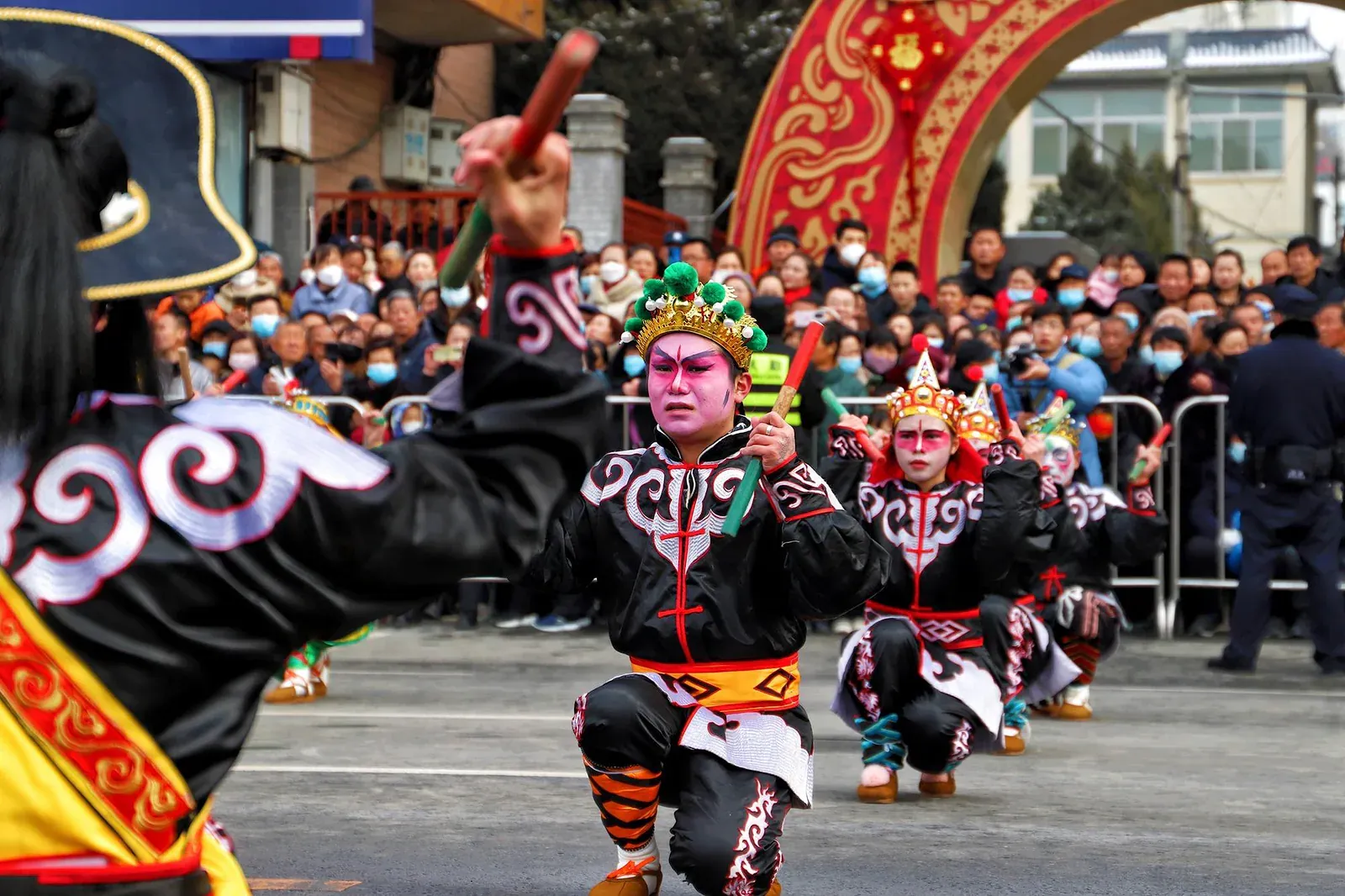
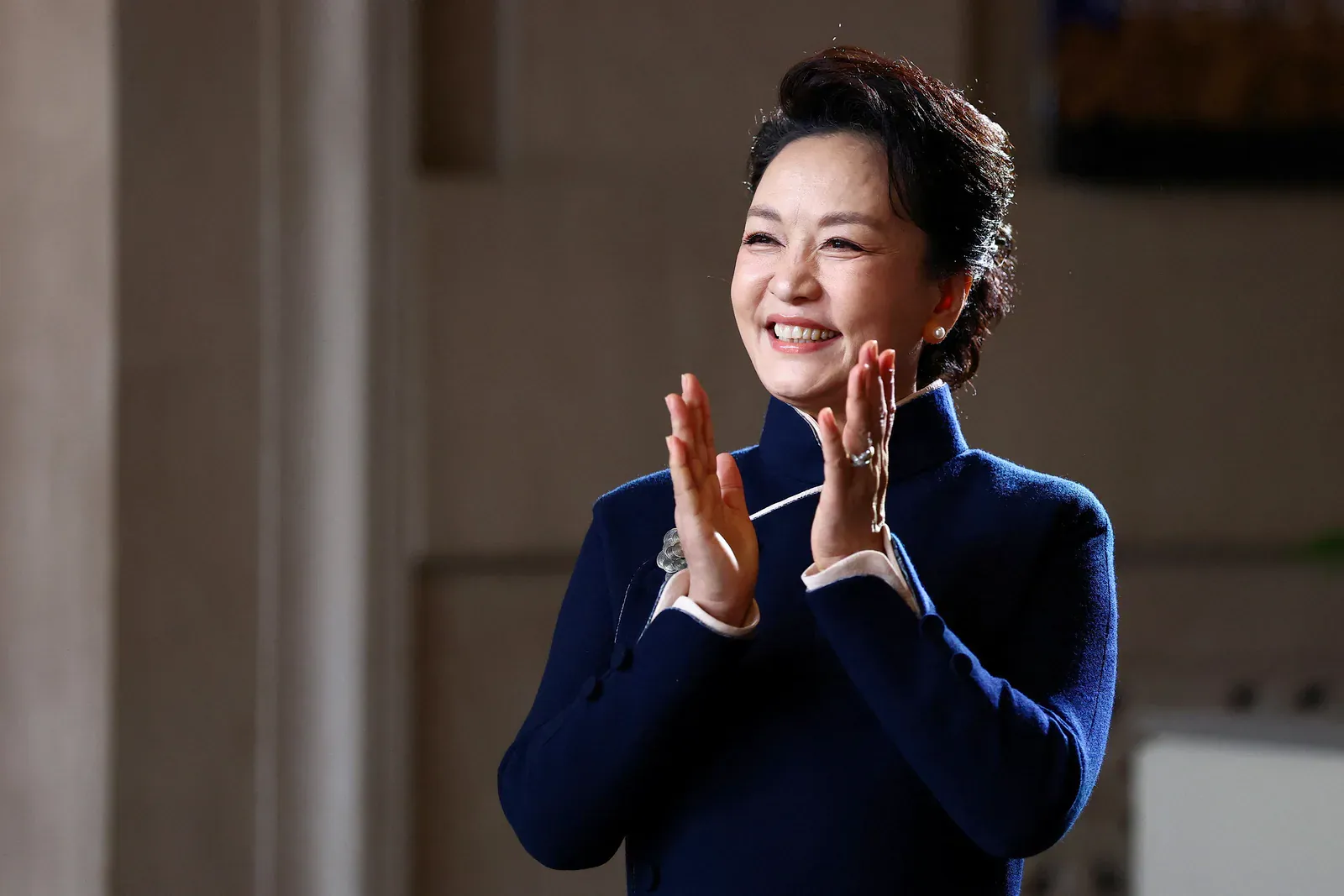
Conservatory voices, 1980 to the present
From 1980 the repertoire passed to trained solo singers. Peng Liyuan, a native of Yuncheng County in Shandong, entered an arts school in 1977 to specialise in folk vocal music. In 1980 she won an Excellent Prize in Beijing for Baoleng Tune and My Hometown, Mt. Yimeng. After she entered the China Conservatory of Music in 1981 and studied under Jin Tielin and Guo Lanying, her songs on the national television gala of 1982 made her known across the country.
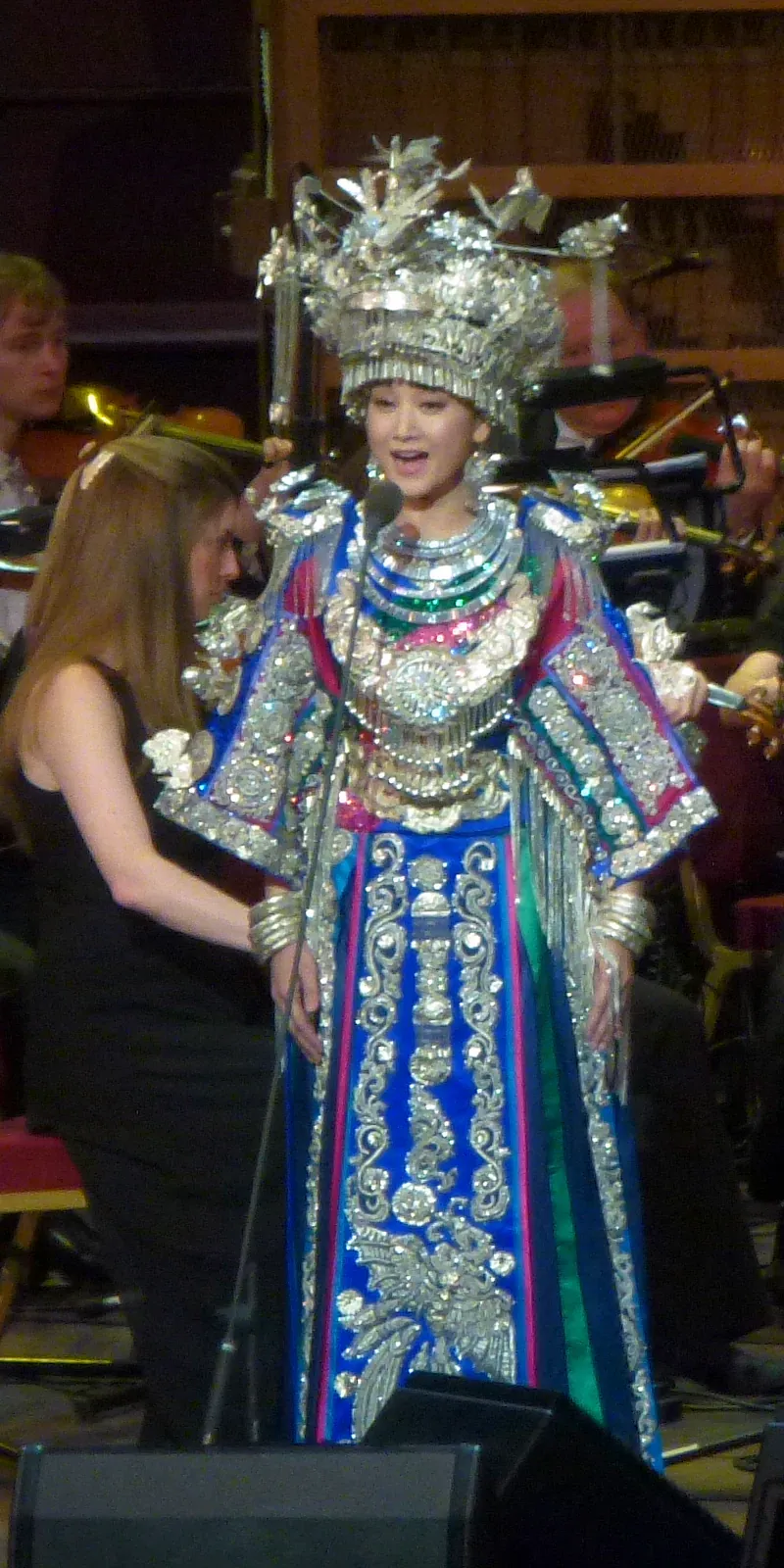
Song Zuying, born into a Miao farming family in Guzhang County, Hunan, followed a similar path. She joined the county opera troupe in 1981 without formal training and began studying with Jin Tielin after a national competition win in 1988. She sang Little Back Basket on the Spring Festival Gala in 1990 and returned to the gala every year until 2013. A solo concert at the Sydney Opera House in December 2002 made her the first Chinese or Asian singer to give one there, and the Golden Hall of the Musikverein in Vienna followed in November 2003. Her 2005 album of film songs earned a Grammy nomination for Best Classical Crossover Album. In 2012 she completed China’s first doctorate in ethnic folk singing.
Characteristics
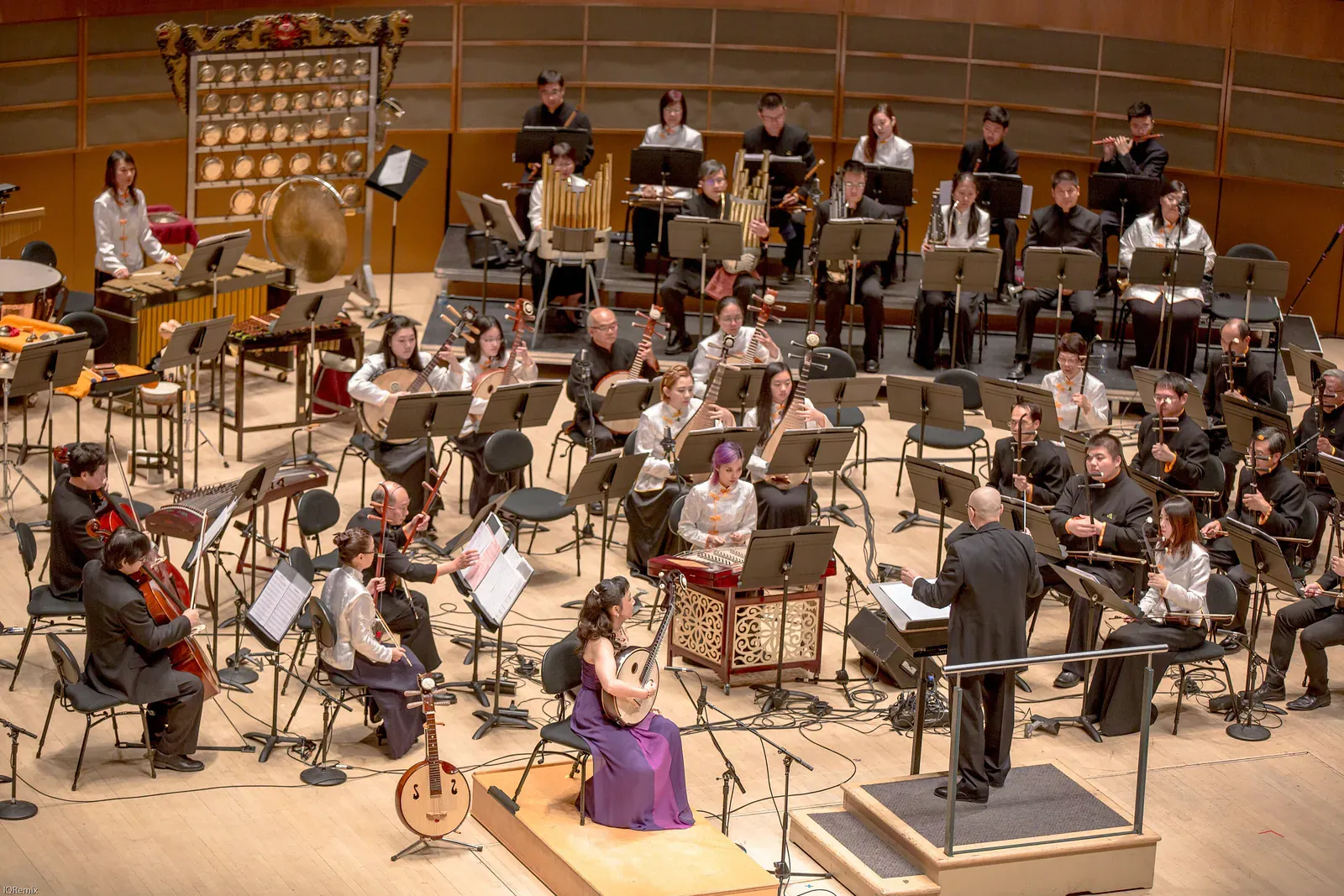
Whatever the register, a typical song keeps one tune and changes the words stanza by stanza. Phrases are of equal length, the melody sits inside a five-note scale, and regional versions of one tune differ in lyrics and contour rather than structure, as the several variants of Mo Li Hua show. In village settings the singing is solo or unaccompanied; on stage it is a trained voice over a folk orchestra.
Mainstream success
Folk song reached the mainstream through broadcast. The Spring Festival Gala made singers such as Song Zuying household names,. A revival of revolutionary songs in the mid-1990s brought Nanniwan back in new arrangements, and Cui Jian had already made a rock version in 1987. Mo Li Hua was even sung in Mandarin by Celine Dion in a 2013 television duet with Song Zuying.
Culture
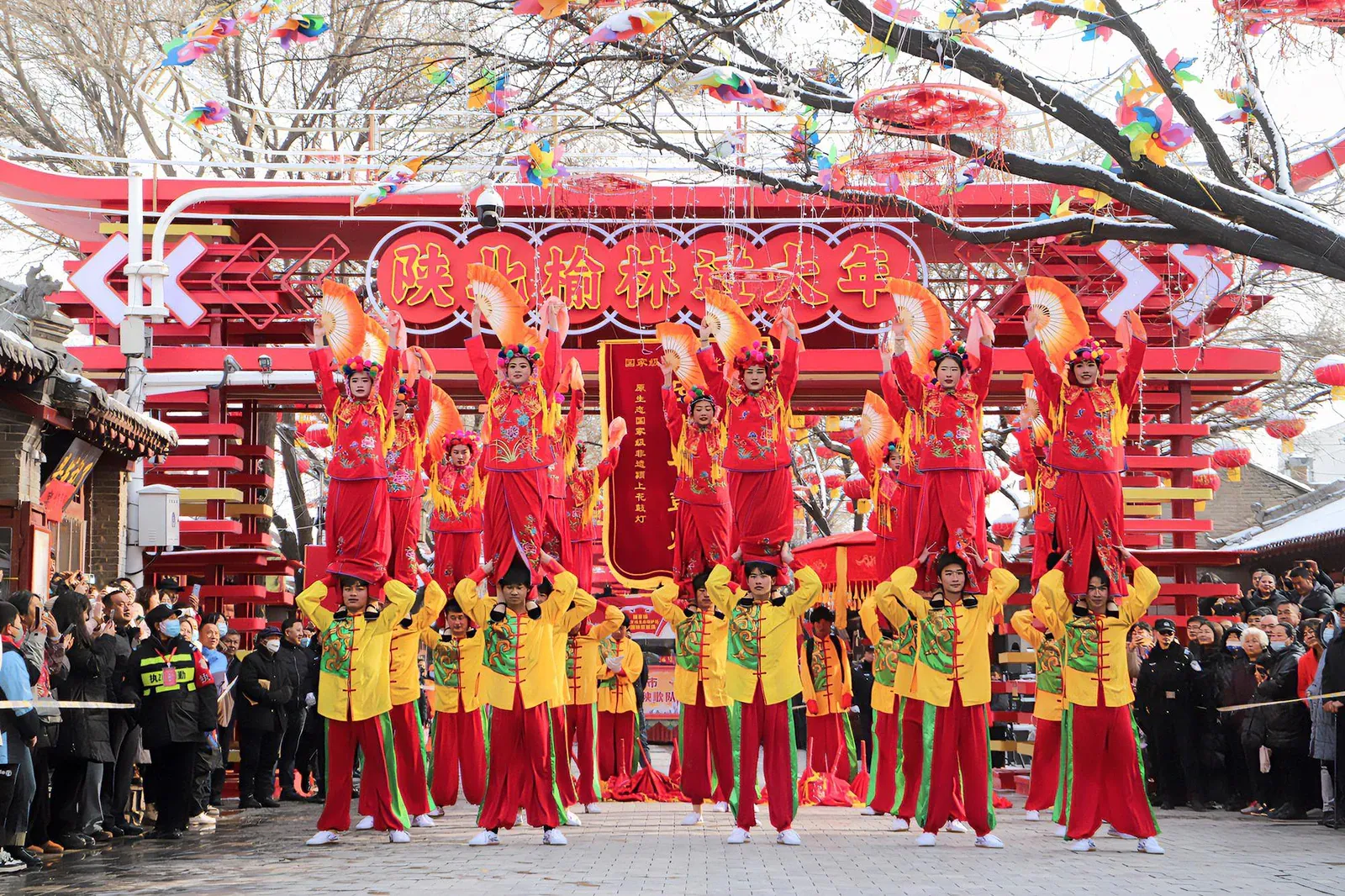
The genre is tied to festival and dance. Yangge crowds fill northern streets at the new year, with dancers in red and green costumes, a waist drum, a trumpet and a gong, and older people especially join in. Reform yangge shows how quickly a village form can serve a political purpose, and Miao silver costume, worn by Song Zuying abroad, carries regional dress onto the national stage.
Legacy
Chinese folk song gave China its best known tunes abroad and set the template for the conservatory-trained folk voice. Mo Li Hua remains an emblem of national culture and is the civilization theme for China in a 2016 strategy game. The tune also showed how fragile that emblem is: it was censored online after the 2011 Jasmine protests.
Misconceptions
Folk songs are not all anonymous and ancient. Many popular titles have named authors who adapted older melodies: Nanniwan dates from 1943 with credited lyricist and composer, and Wang Luobin published his versions under his own name.
Mo Li Hua is not Puccini’s. The tune was copied into Western notation in 1793, more than a century before Turandot, and Puccini quoted it from a music box.
Folk song is not only a rural, unaccompanied art. Xiaodiao circulated in urban areas, and the best known performers today are conservatory-trained soloists with doctoral degrees in folk singing.
Frequently asked questions
What is Chinese folk song?
Chinese folk song is the set of regional Han songs such as mountain songs and short tunes, usually pentatonic and strophic, later adapted for stage singers and orchestras.
What is the most famous Chinese folk song?
Mo Li Hua, or Jasmine Flower, a Jiangnan short tune dated to the Qing dynasty with earlier lyrics from the Ming era, is the Chinese folk song best known worldwide.
What is shan’ge?
Shan’ge, or mountain song, is the ballad-like Chinese folk song of rural provinces; hua’er and xintianyou are two of its regional types.
Who are the best known Chinese folk song singers?
Peng Liyuan and Song Zuying, both trained in folk vocal music at conservatories, are the best known modern performers; Guo Lanying and Wang Kun carried the repertoire in the generation before.
Sound
Sound sheet
Anatomy of a track
| # | Part |
|---|---|
| 1 | Verse repeated with new words (multi-stanza) |
| 2 | Instrumental interlude (optional) |
Signature sounds
- Pentatonic melody with uniform phrase lengths
- Several regional versions of one tune
- Trained solo voice over folk-orchestra accompaniment
Techniques
- Heterophony
- Tonal slides
- Strophic multi-stanza form
- Meaningful silences
Keys and modes
Pentatonic scale. Five-note scales shape most Han folk melodies.
Vocals
Solo voice in the trained ethnic folk style taught in conservatories, or unaccompanied in mountain songs.
Scenes
Where it happened
Where and when the sound lived: one bar per city on a shared timeline.
Asia
Active scenes
Peak 2, 1943-2025
Where Wang Luobin published his first western-style song and began collecting and adapting songs of the northwest.
Base of the song Nanniwan, set to a northern Shaanxi folk melody, and of the yangge reform movement.
Culture
Culture markers
- Yangge
Street dance with waist drum, trumpet and gong, popular with older people in northern China.
Dance - Reform yangge
In the 1940s the Communist Party turned the dance into a rallying form with sickle props.
Ritual - Miao silver costume
Song Zuying sings in a silver headdress and embroidered Miao robes on international stages.
Fashion
Media
Key media
- 1965The East Is Red
by Wang Ping. Song and dance epic that spread revolutionary adaptations of folk melodies.
Film
Glossary
Terms on this page
Northwestern mountain song of Gansu, Ningxia and Qinghai, sung without accompaniment.
Mountain song, a ballad-like rural folk song type with regional subtypes.
Short tune, a multi-stanza form with uniform phrase structures popular in urban areas.
Shaanxi song style meaning rambling in the sky, first sung by porters.
Northern village dance accompanied by drum, trumpet and gong, folded into song events.
East Asian family