Contemporary worship music
Contemporary worship music is pop-styled congregational song led by a worship band, from Maranatha and Vineyard to Hillsong, Chris Tomlin and Bethel.
United States, United Kingdom, France, Australia, 1958
Religious family
Born
1958
United States, United Kingdom, France, Australia
Subgenres
4
Documented branches
Links
14
Genres it drew on or shaped
Tempo
70-120 BPMLineage
Family tree
Timeline
Era by era
From the first sparks to today. Select a dot to read the story behind it.
- From Taizé chants to Jesus music
1950 to 1979
- Praise choruses and church labels
1980 to 1995
- Global anthems
1996 to 2009
- Collectives and streaming
2010 to today
Eras
Moments
- 1 From Taizé chants to Jesus music, 1950 to 1979
- 2 Praise choruses and church labels, 1980 to 1995
- 3 Global anthems, 1996 to 2009
- 4 Collectives and streaming, 2010 to today
around 1950
From Taizé chants to Jesus music
Taizé draws young worshippers with simple modern chants, British youth songbooks such as Youth Praise appear in 1966, and Calvary Chapel starts Maranatha! Music in 1971.
- 1950Taizé draws young worshippersThe ecumenical community in France attracts youth of many denominations with worship songs set to modern melodies.
- 1964The Joystrings appear on British televisionThe Salvation Army gospel pop group plays Christian beat music in uniform.
- 1966Youth Praise is publishedMichael Baughen and the Jubilate Group compile one of the first collections of simple songs for church singing.
- 1971Calvary Chapel founds Maranatha! MusicThe nonprofit outreach promotes folk-rock hymns and worship songs of the Jesus people; its first release is The Everlastin' Living Jesus Music Concert.
1980
Praise choruses and church labels
Hillsong in Sydney, the Vineyard in California and Integrity's Hosanna! series publish simple chorus-and-bridge songs that spread through the charismatic churches.
- 1983Hillsong's worship team starts in SydneyThe collective that later releases as Hillsong Live and Hillsong Worship begins making music at the church.
- 1985Vineyard releases its first worship albumsWorship Songs of the Vineyard 1 and 2 start a series of a dozen volumes that spreads the church's songs.
- 1987Integrity Music is foundedThe company later publishes the Hosanna! series and Hillsong's early albums.
- 1987Graham Kendrick writes Shine, Jesus, ShineThe British praise song later ranks tenth in a BBC viewers' poll of favourite hymns.
- 1994Delirious? record I Could Sing of Your Love ForeverThe Cutting Edge recording becomes a modern worship classic.
1996
Global anthems
Shout to the Lord, the Passion conferences and Chris Tomlin's How Great Is Our God carry the form from charismatic congregations into mainstream evangelical churches worldwide.
- 1996Shout to the Lord albumHillsong's first album with Integrity's Hosanna! Music series carries the Darlene Zschech song across the world.
- 1997Passion Conferences begin in AustinLouie Giglio and Chris Tomlin start the student gatherings that become a major source of worship songs.
- 2004How Great Is Our God on ArrivingThe song by Chris Tomlin, Jesse Reeves and Ed Cash wins Song of the Year at the 2006 Dove Awards.
- 2008Hillsong's Healer scandalA pastor who wrote the song Healer is exposed for falsely claiming to have cancer; the track is pulled from a Hillsong album.
2010
Collectives and streaming
Church music labels such as Hillsong, Bethel and Maverick City Music release live albums that chart widely, and a modern hymn movement answers critics of shallow lyrics.
- 201110,000 Reasons (Bless the Lord)Matt Redman and Jonas Myrin's song goes on to win two Grammy Awards in 2013.
- 2013Hillsong United release OceansThe song appears on the album Zion and later has live versions from Madison Square Garden and the Sea of Galilee.
- 2015Bethel launches its Artist CollectiveThe Redding church's music group expands to artists from other ministries and adds Cory Asbury.
- 2017Reckless Love is releasedCory Asbury's single from Bethel Music appears in October and reaches an album in January 2018.
- 2018What a Beautiful Name wins a GrammyHillsong Worship take Best Contemporary Christian Music Performance/Song.
Listening path
Start listening
A short path from an easy way in to the deep end. Thumbnails come from YouTube; the player loads only when you press play.
- 01
Chris Tomlin, 2004
The studio song that spread the praise-band sound through mainstream evangelical churches.
- 02
Matt Redman, 2011
A slow, singable anthem that won two Grammys and shows the genre's reflective side.
- 03
Hillsong UNITED, 2013
A dynamic build from quiet verse to a stadium bridge, from Hillsong's youth band.
- 04
Hillsong Worship, 2016
The Grammy-winning live recording that took the genre to its biggest audience.
- 05
Cory Asbury (Bethel Music), 2017
A Bethel Music release showing the streaming-era sound of the charismatic scene.
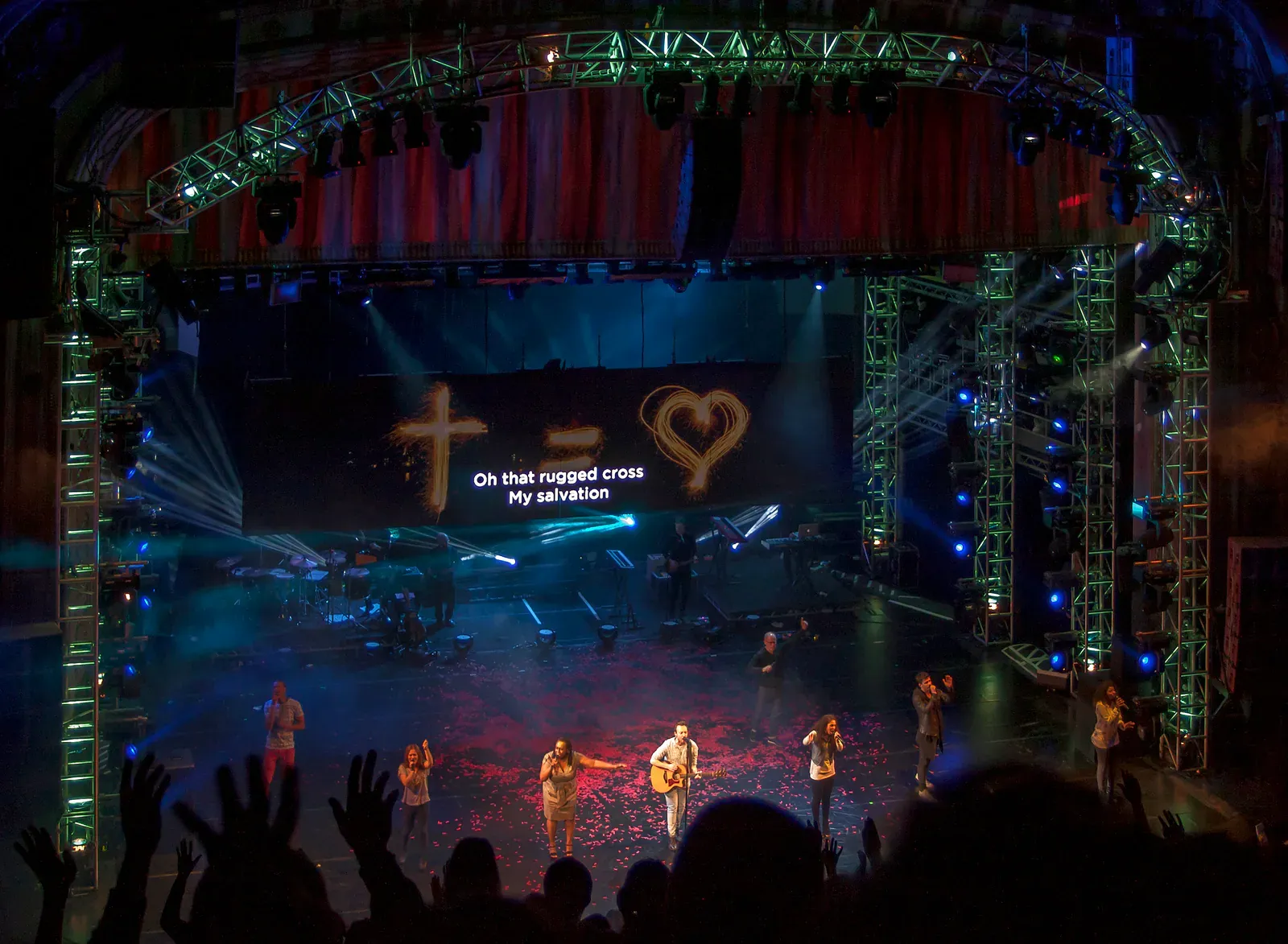
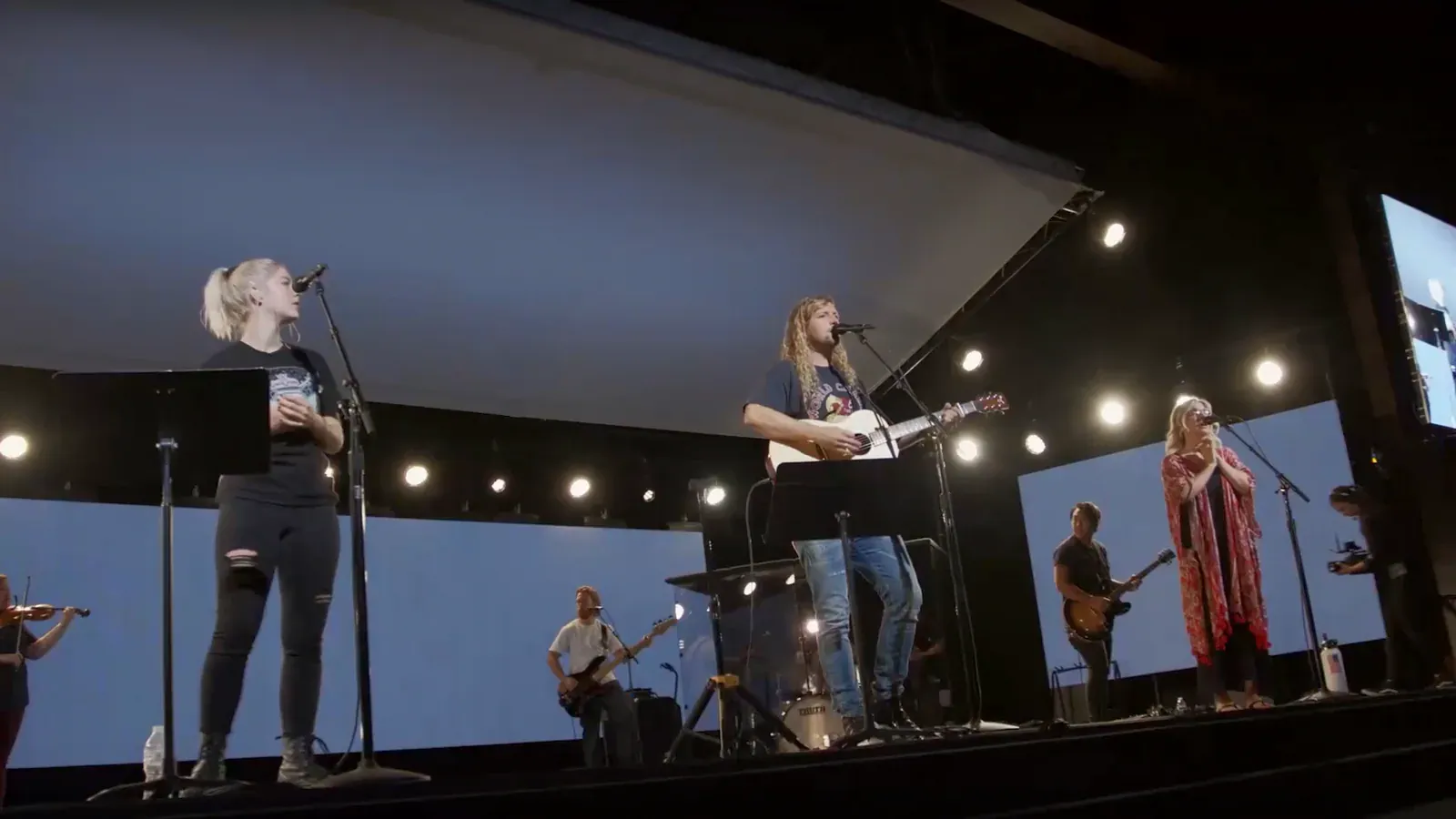
Contemporary worship music, also called praise and worship music, is pop-styled song written for congregations to sing in church services. A worship band or praise team leads it, with a guitarist or pianist at the front, and its lyrics speak to God in the first and second person (“I” and “You”).
It grew out of youth-oriented church music of the 1950s and 1960s, spread through the Jesus movement and the charismatic churches, and by the 1990s had become common in charismatic and non-denominational congregations, and in some Catholic ones. It belongs to the religious family and descends from hymnody.
Origins
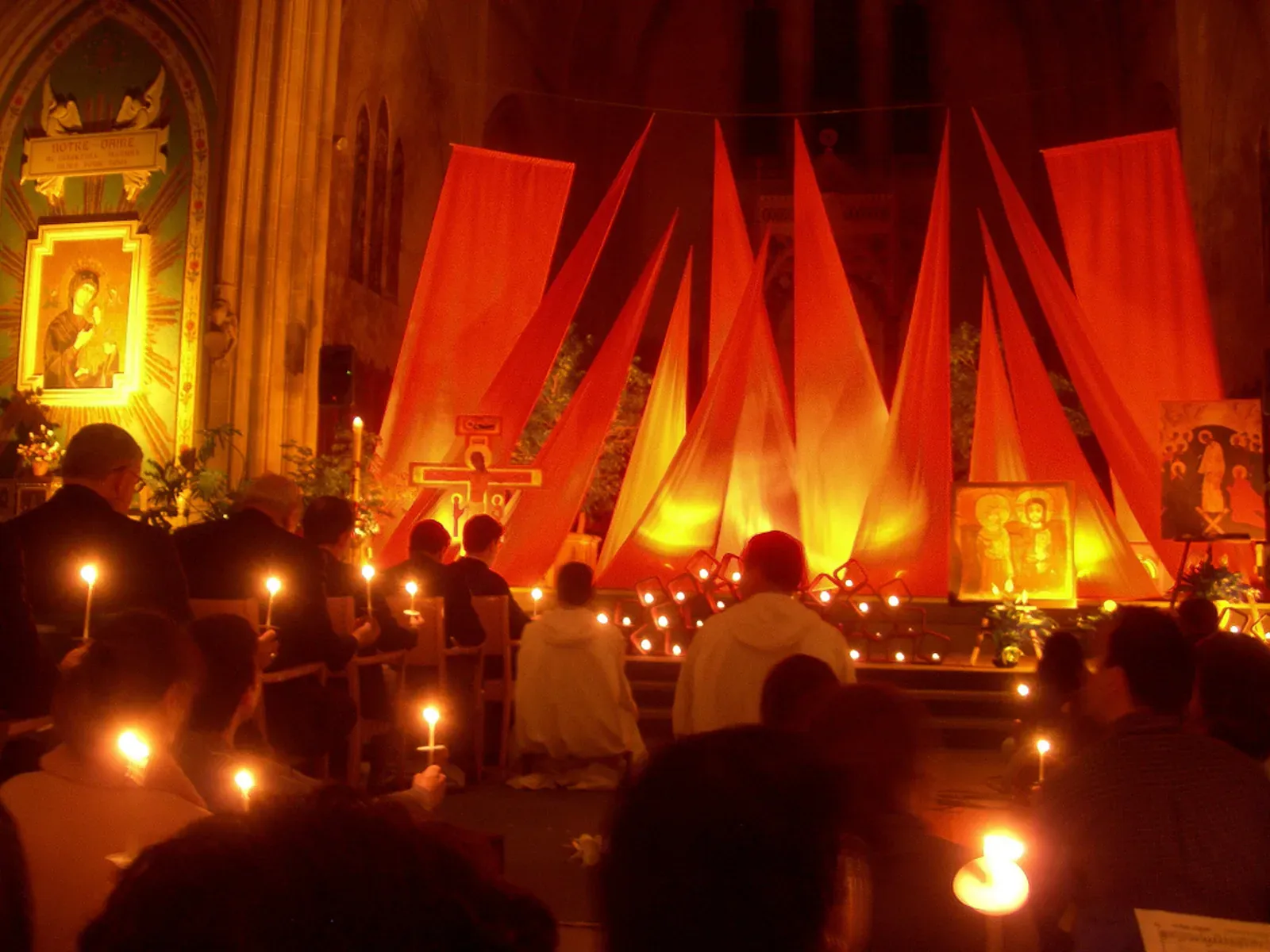
The first steps were modest. In the early 1950s the Taizé Community in France began attracting young people from many denominations with worship songs set to modern melodies. In Britain, the Salvation Army group The Joystrings appeared on television in 1964 playing Christian beat music in uniform, and in 1966 Michael Baughen and the Jubilate Group published Youth Praise, one of the first and best-known collections of simple songs for church use. The reasoning was the same on both sides of the Atlantic: church music should sound less formal and less dull to a younger generation, so it borrowed the conventions of popular music.
The decisive American step came in 1971, when Calvary Chapel founded Maranatha! Music as a nonprofit outreach. The church was home to more than 15 groups of the Jesus movement, and the label promoted a new folk-rock style of hymns and worship songs; its first release was a compilation, The Everlastin’ Living Jesus Music Concert. Maranatha later grew a children’s catalogue, which by the early 1990s made up about 40 percent of its revenue.
Praise choruses and church labels, 1980-1995
In the 1980s churches began publishing their own songs. The Vineyard church began writing its own worship songs, so John Wimber founded Mercy Records, later Vineyard Worship. Worship Songs of the Vineyard 1 and 2 appeared in 1985. The series ran to a dozen volumes by 1993, with titles such as Glory, Draw Me Closer and Refiner’s Fire. In Sydney, Hillsong’s worship team began making music in 1983 and released its first album, Spirit and Truth, in 1988. Integrity Music, founded in 1987, published the Hosanna! series that carried many of these songs to other churches.
British writers worked the same ground. Graham Kendrick wrote “Shine, Jesus, Shine” in 1987, and in 2005 viewers of the BBC’s Songs of Praise voted it tenth among the United Kingdom’s favourite hymns. By the early 1990s “Lord, I Lift Your Name on High”, “Shine, Jesus, Shine” and “Shout to the Lord” were accepted in many churches. Supporters of traditional worship hoped the new style would pass; younger members pointed to the line in Psalm 96 about singing a new song.
Global anthems, 1996-2009
“Shout to the Lord” is the song that opened the global era. Darlene Zschech wrote it while struggling with financial worries and the stress of raising a young family. Hillsong’s 1996 album of the same name, made with Integrity’s Hosanna! Music series, took it to congregations in many countries, and it later appeared in Spanish, Portuguese and other translations by other artists. On 9 April 2008 it closed the American Idol charity show Idol Gives Back, and the studio version of that performance reached number 43 on the Billboard Hot 100 on download sales alone.
A “modern worship renaissance” in the late 1990s established that any musical style was acceptable if used by believers to praise God. It was driven by the Cutting Edge recordings of the English band Delirious?, whose 1994 song “I Could Sing of Your Love Forever” became a modern worship classic, by the Passion conferences, and by albums such as Michael W. Smith’s Exodus project and the band Sonicflood. Passion began in 1997 when Louie Giglio and Chris Tomlin organised the first conference in Austin, Texas, for college students.
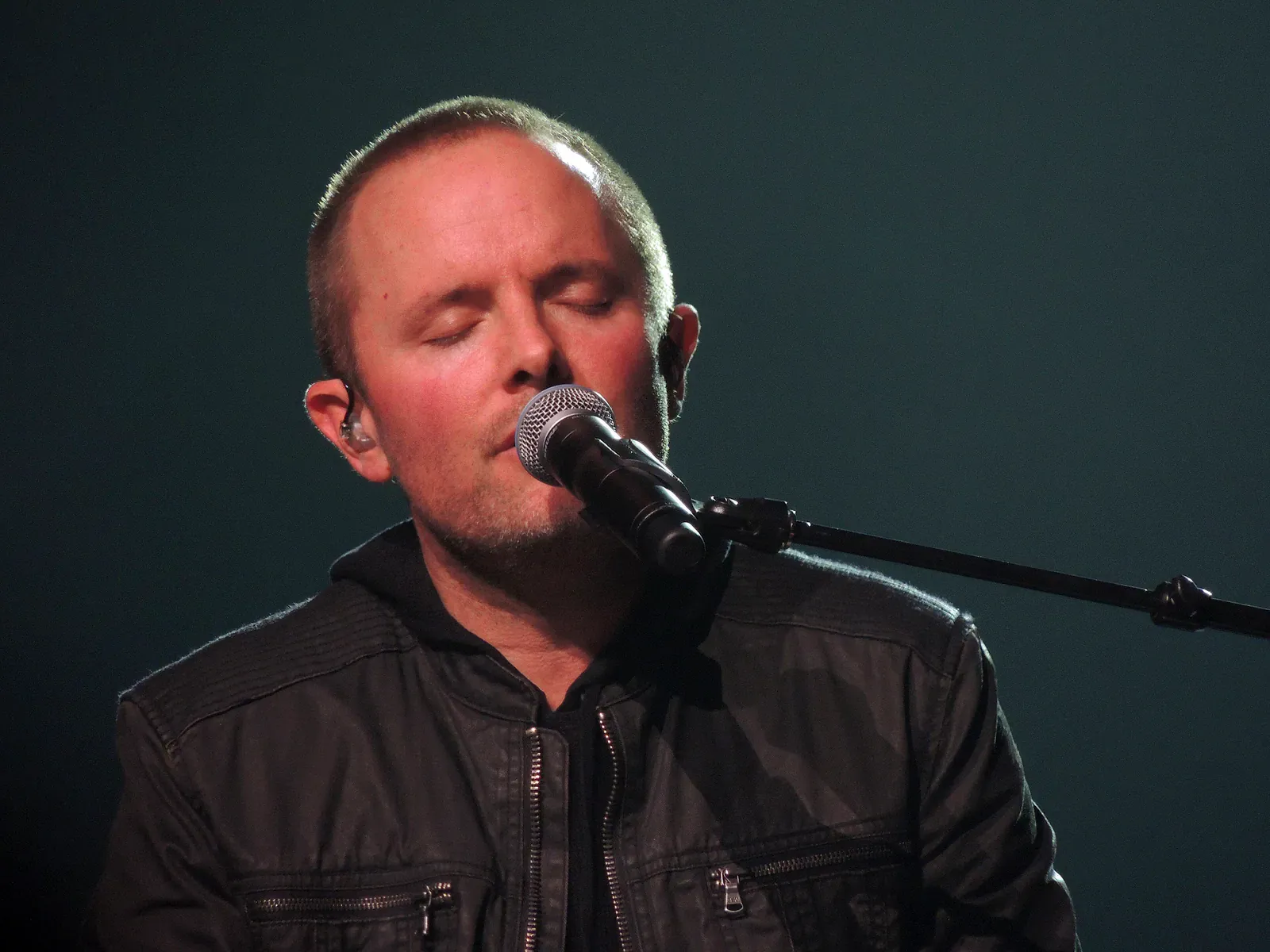
Tomlin supplied several of the decade’s staples. “How Great Is Our God”, written with Jesse Reeves and Ed Cash, appeared on his 2004 album Arriving and won Song of the Year at the 2006 Dove Awards; by 2014 it was the fifth most popular worship song on the CCLI chart. In England, Matt Redman of Watford began releasing albums in 1995 with Passion for Your Name.
Collectives and streaming, 2010 onward
From 2010 the leading sources were church-based collectives that recorded live and released through their own labels. Matt Redman and Jonas Myrin’s “10,000 Reasons (Bless the Lord)”, on the 2011 album of the same name, won two Grammy Awards in 2013 and the Dove Award for Song of the Year. Hillsong’s youth band Hillsong United released “Oceans (Where Feet May Fail)” on the 2013 album Zion, and Hillsong Worship’s “What a Beautiful Name” won the 2018 Grammy for Best Contemporary Christian Music Performance/Song after reaching platinum in the United States. Fifteen Hillsong Worship songs have charted on Billboard.
Bethel Church in Redding, California, developed a record label and publishing company between 2009 and 2013, and in 2015 its Bethel Music Artist Collective grew to include artists from other ministries and added Cory Asbury, whose “Reckless Love” came out in October 2017. Maverick City Music, formed in Atlanta in 2018, followed a similar collective model. Hillsong, Bethel and the Vineyard all run their own publishing companies, part of a Christian music industry with studios, songbooks, downloads and merchandise.
Characteristics
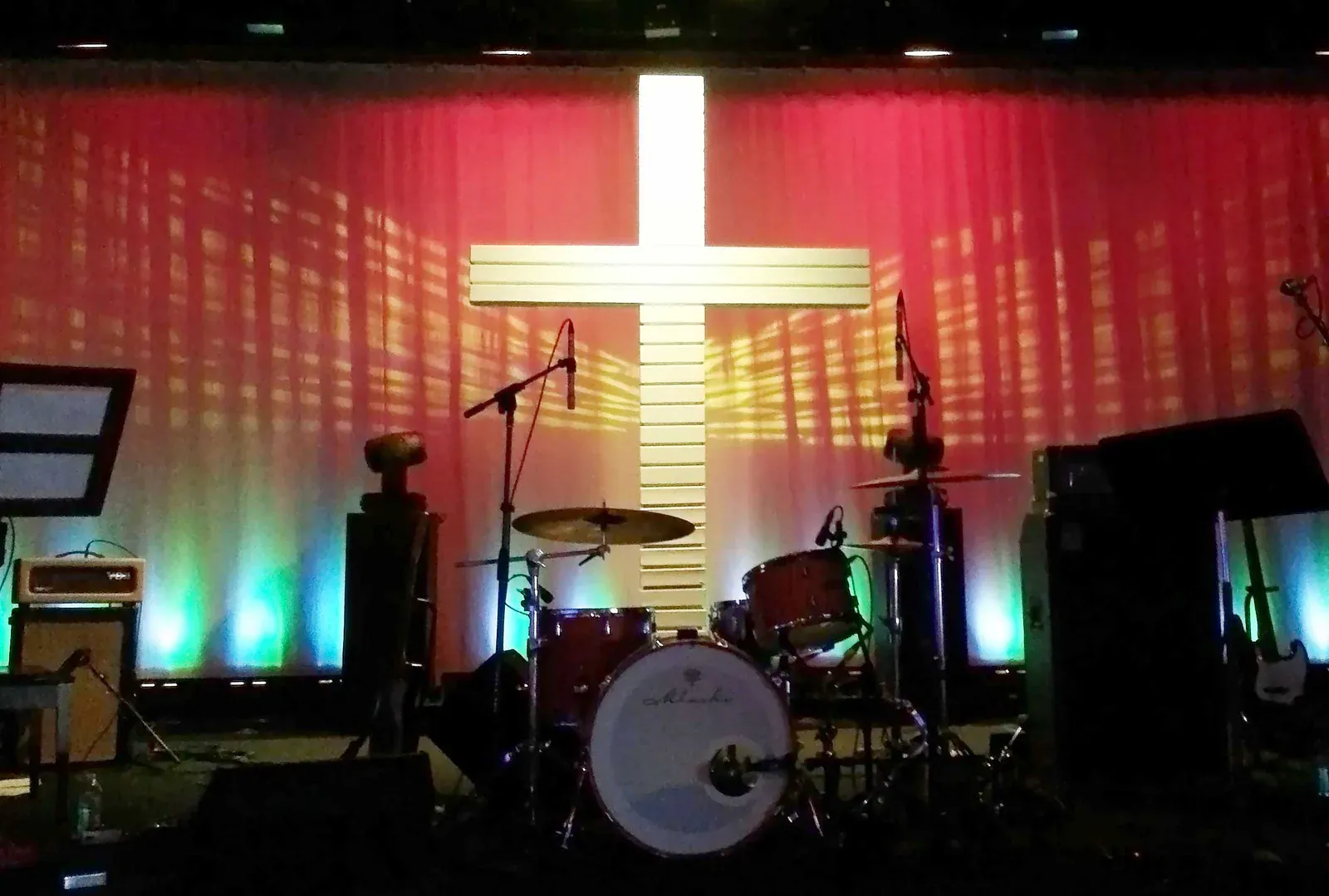
Songs follow a simple pattern: a quiet verse, a lift, a chorus that everyone sings, and a bridge that repeats and builds toward a final chorus with the full band. Melodies stay in a range untrained voices can manage, and the language is personal and devotional. Measured tempos run from about 70 to 120 beats per minute, with many of the best-known songs in the 70s. The sound sheet on this page lists keys and gear; the point here is function. The music is built to be sung by a room, not only heard.
Repetition is deliberate. Bridges are sung several times, and bands extend songs with spontaneous singing so that a congregation can stay in one moment of devotion. The genre is strongest in charismatic and non-denominational churches.
Instruments and production
The core is acoustic guitar or piano for the leader, with electric guitar, bass, drums and keyboard pads behind. Projectors changed the repertoire: a church was no longer limited to a printed songbook, and the internet made chords, lyrics and MP3 files available to any praise team. That helped globalise the repertoire.
Criticism and the modern hymn movement
Critics argue that amplified bands turn participation into performance, that the constant “I” and “You” stress an intimate relationship at the cost of the whole church, and that the emphasis on praise leaves little room for lament, since many such churches lack a lectionary with a wide range of psalms. Others note that a loud, rock-based idiom can drown out singing. Beginning in the 2010s, a modern hymn movement responded with contemporary arrangements of theologically denser lyrics, led by Keith and Kristyn Getty, Sovereign Grace Music and Citizens, mostly in Baptist, Reformed and traditional non-denominational churches.

Misconceptions
Contemporary worship music is not simply a Hillsong invention. Taizé, Youth Praise, Maranatha! Music and the Vineyard all came before Hillsong’s first album in 1988.
It is also not identical to contemporary Christian music. Worship songs are written for congregations to sing, while the wider CCM field is aimed at listeners; the two overlap, and worship later became an integral part of CCM.
Third, the repertoire is not entirely new. Critics note that many popular worship songs are updated versions of older hymns, and the modern hymn movement has deliberately brought older texts back.
Frequently asked questions
What is contemporary worship music?
Contemporary worship music is pop-styled congregational song, led by a worship band, written for use in church services. It is also known as praise and worship music.
Who are the main artists in contemporary worship music?
Hillsong Worship, Darlene Zschech, Matt Redman, Chris Tomlin and Graham Kendrick are among the best-known writers and leaders, and the Vineyard, Bethel Music and Maverick City Music are leading church-based labels or collectives.
How is contemporary worship music different from gospel?
Gospel grew from the Black church tradition of choirs and soloists, while contemporary worship music is written in a pop-rock idiom for congregations to sing. The two meet where artists such as Maverick City Music blend them.
How does it relate to Christian rock?
Christian rock is made for listening and often performed by rock bands, while worship songs are shaped for singing in services. The two overlap in bands such as Delirious?.
Sound
Sound sheet
Anatomy of a track
| # | Part |
|---|---|
| 1 | Quiet verse with guitar or piano |
| 2 | Pre-chorus lift |
| 3 | Chorus sung by all |
| 4 | Bridge repeated and built |
| 5 | Final chorus at full band |
Signature sounds
- First- and second-person address to God
- Repeated choruses and bridges
- Dynamic build from soft verse to full-band chorus
- Melodies pitched for untrained congregational voices
Drums and percussion
- Drum kit
Techniques
- Dynamic build
- Repeated bridge
- Congregational range
- Spontaneous worship
Keys and modes
A major. Shout to the Lord and Mighty to Save on database readings.
G major. 10,000 Reasons on database readings.
C-sharp major. How Great Is Our God on database readings.
Vocals
A lead singer with backing vocals, written to be sung by a whole congregation in unison.
Scenes
Where it happened
Where and when the sound lived: one bar per city on a shared timeline.
North America
Oceania
Active scenes
Peak 4, 2018-2025
Calvary Chapel's home, whose Jesus movement groups fed Maranatha! Music.
Home of Hillsong, whose worship team became the best-known exporter of congregational songs.
Site of the first Passion conference, Passion '97.
Base of Maverick City Music; Passion City Church also sits here.
Culture
Culture markers
- Praise team set
A band-led block of songs in services, common in charismatic and non-denominational churches.
Ritual - Projected lyrics
Screens replaced songbooks, so a church repertoire was no longer limited to printed books.
Artwork - Praise song
Everyday term for a song of the genre sung in church.
Slang
Media
Key media
- 1966Youth Praise
by Michael Baughen (Jubilate Group). One of the first and best-known collections of simple songs for church use.
Book
Glossary
Terms on this page
Worship in charismatic and Pentecostal churches, the main home of contemporary worship music.
Worship music from the 2010s that pairs theological lyrics with contemporary arrangements.
Another name for the genre, with praise songs for celebration and worship songs for devotion.
A short, repetitive song for congregations, common from the 1970s to 1990s.
The praise team that leads a congregation in song, with a guitarist or pianist at its head.
Religious family