Hausa music
Hausa music is the court, praise-song and folk tradition of northern Nigeria and Niger, built on the goje fiddle, kalangu talking drum and kakaki state trumpet.
Nigeria, Niger, around 1350
African family

Born
around 1350
Nigeria, Niger
Subgenres
2
Documented branches
Links
7
Genres it drew on or shaped
Tempo
90-150 BPMLineage
Family tree
Timeline
Era by era
From the first sparks to today. Select a dot to read the story behind it.
- Courts, praise singers and folk music
1350 to 1949
- Patronage stars and bandiri
1950 to 1979
- Major labels and Kannywood
1980 to 1999
- Sharia, film songs and politics
2000 to today
Eras
Moments
- 1 Courts, praise singers and folk music, 1350 to 1949
- 2 Patronage stars and bandiri, 1950 to 1979
- 3 Major labels and Kannywood, 1980 to 1999
- 4 Sharia, film songs and politics, 2000 to today
around 1350
Courts, praise singers and folk music
Islam reaches Hausa courts by the 14th century, the kakaki trumpet becomes a state symbol, and the 1805 jihad emirates keep ceremonial music, court praise song and rural folk music side by side.
- 1350Islam shapes Hausa court musicMuslim influence from the 14th century brings free-rhythm improvisation and pentatonic melody to Hausa singing.
- 1805Kano Emirate founded after the Fulani jihadThe new emirate becomes a vassal of the Sokoto Caliphate and keeps court musicians in service.
- 1890Ibrahim Narambada born in TubaliThe future court singer grows up on noma rural music before turning to Gobir praise song.
- 1923Mamman Shata born in MusawaA Fulani farmer's son, he defies his family to become a full-time praise singer.
- 1946Dan Maraya Jos born in BukuruOrphaned young, he takes up the kuntigi after hearing players on a trip to Maiduguri.
1950
Patronage stars and bandiri
Mamman Shata wins fame at a 1952 Kano princes' wedding, settles in Funtua in 1960, and Sufi gatherings in Kano start setting devotional words to popular tunes from the late 1950s.
- 1952Shata's star turn at the Kano princes' weddingA performance at a wedding of some 12 Kano princes spreads his name across the emirate.
- 1958Kano Sufi gatherings start borrowing popular stylesQadiriyya meetings add popular tunes to their devotional ritual, the seed of bandiri.
- 1960Shata settles in FuntuaHe makes the cosmopolitan town his home for about forty years.
- 1963Ibrahim Narambada diesThe Tubali singer's songs stay in circulation and in academic study.
- 1977Dan Maraya Jos performs at Festac 77 in LagosThe festival puts the one-string kuntigi on a national stage.
1980
Major labels and Kannywood
Shata signs with EMI and later Polygram, Dan Maraya Jos records for Polydor in 1986, bandiri adopts Indian film melodies, and Turmin Danya (1990) launches Hausa-language cinema.
- 1985Shata signs with EMIHe becomes the label's biggest star in the 1980s before moving to Polygram.
- 1986Dan Maraya Jos releases Kudi Masu Gida Rana on PolydorBy this year he had recorded at least 150 LPs and singles.
- 1988Bandiri adopts Indian film melodies and synthesizersPublic celebrations by the late 1980s feature Hausa praise of the Prophet over Bollywood-style tunes.
- 1990Turmin Danya opens the Kannywood eraThe first commercially successful Hausa-language film brings a new song market for singers.
- 1999Mamman Shata diesHe leaves thousands of songs, many never recorded.
2000
Sharia, film songs and politics
Hisbah crackdowns and court bans meet a booming film-song and campaign-song market led by Kano and Katsina singers such as Ali Jita, Naziru M Ahmad and Rarara.
- 2001Kano Hisbah cracks down on pop musiciansSirajo Mai Asharalle is held a week without court proceedings.
- 2007Adam Zango's Bahaushiya video provokes arrestThe hip-hop styled video leads him to relocate from Kano to Kaduna.
- 2009A Kano mobile court bans 11 Hausa songsThe songs are ruled obscene, confrontational and amoral.
- 2015Rarara rises with Buhari campaign songsThe Katsina singer becomes the best-known political praise singer of the 2015 elections.
- 2015Dan Maraya Jos diesHe had toured the United States, Europe and the Caribbean.
- 2018Naziru M Ahmad named Sarkin Wakan Sarkin KanoThe film-song singer is turbaned chief singer of the Emir of Kano in December.
Listening path
Start listening
A short path from an easy way in to the deep end. Thumbnails come from YouTube; the player loads only when you press play.
- 01
Mamman Shata, 2018
Shata's drum-led praise singing in a Topic release, the quickest way into the Katsina style.
- 02
Dan Maraya Jos, 1972
A solo kuntigi griot song, listen for the fast ostinato under the voice.
- 03
Dan Maraya Jos, 1972
Social commentary sung over a plucked kuntigi pattern.
- 04
Ali Jita, 2018
A film-era Hausa pop video from the Kano singer, showing the post-Kannywood sound.
- 05
Dauda Kahutu Rarara, 2020
A campaign-style political praise song from the Katsina singer.
Facts
| Family | African |
| Origin | Nigeria, Niger |
| Emerged | Ancient; documented courtly forms pre-colonial |
| Status | Active |
| Tempo | 90 to 150 BPM |
| Meter | free |
| Subgenres | 2 |
Hausa music is the song and instrumental tradition of the Hausa people of northern Nigeria and southern Niger.
It divides into emirate court music, praise singing for patrons and rural folk music, and it is built on the goje one-string fiddle, the kalangu talking drum and the long kakaki state trumpet. Melody is mostly pentatonic and often free in rhythm, a Muslim Sahelian style shared with the Fulani, Songhai and Kanuri. It belongs to the wider African family.
Origins
Islam has shaped Hausa music since the 14th century. Court singers took up free-rhythm improvisation and pentatonic melody. Two broad categories took shape in the 19th century: urban court music and rural folk music.
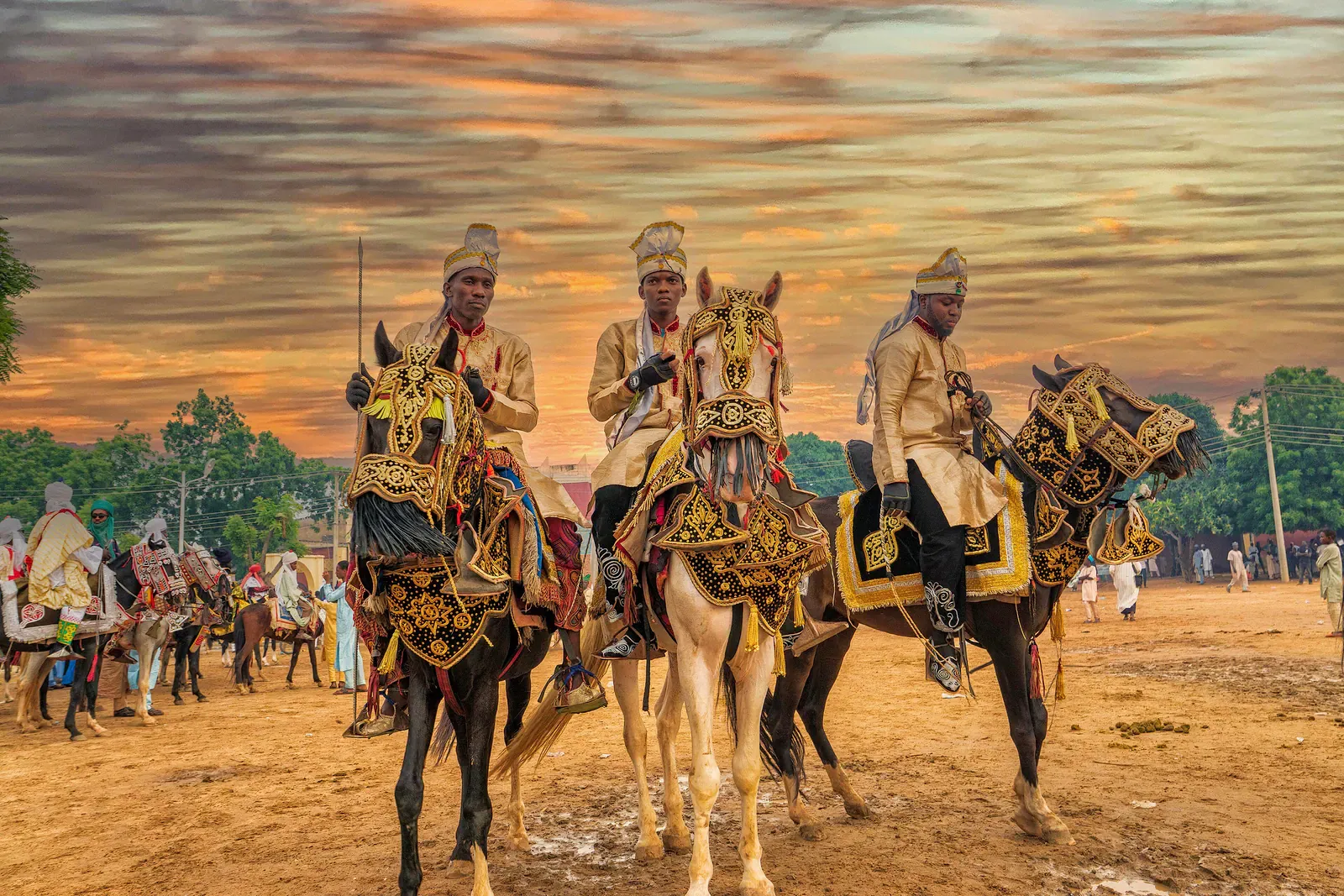
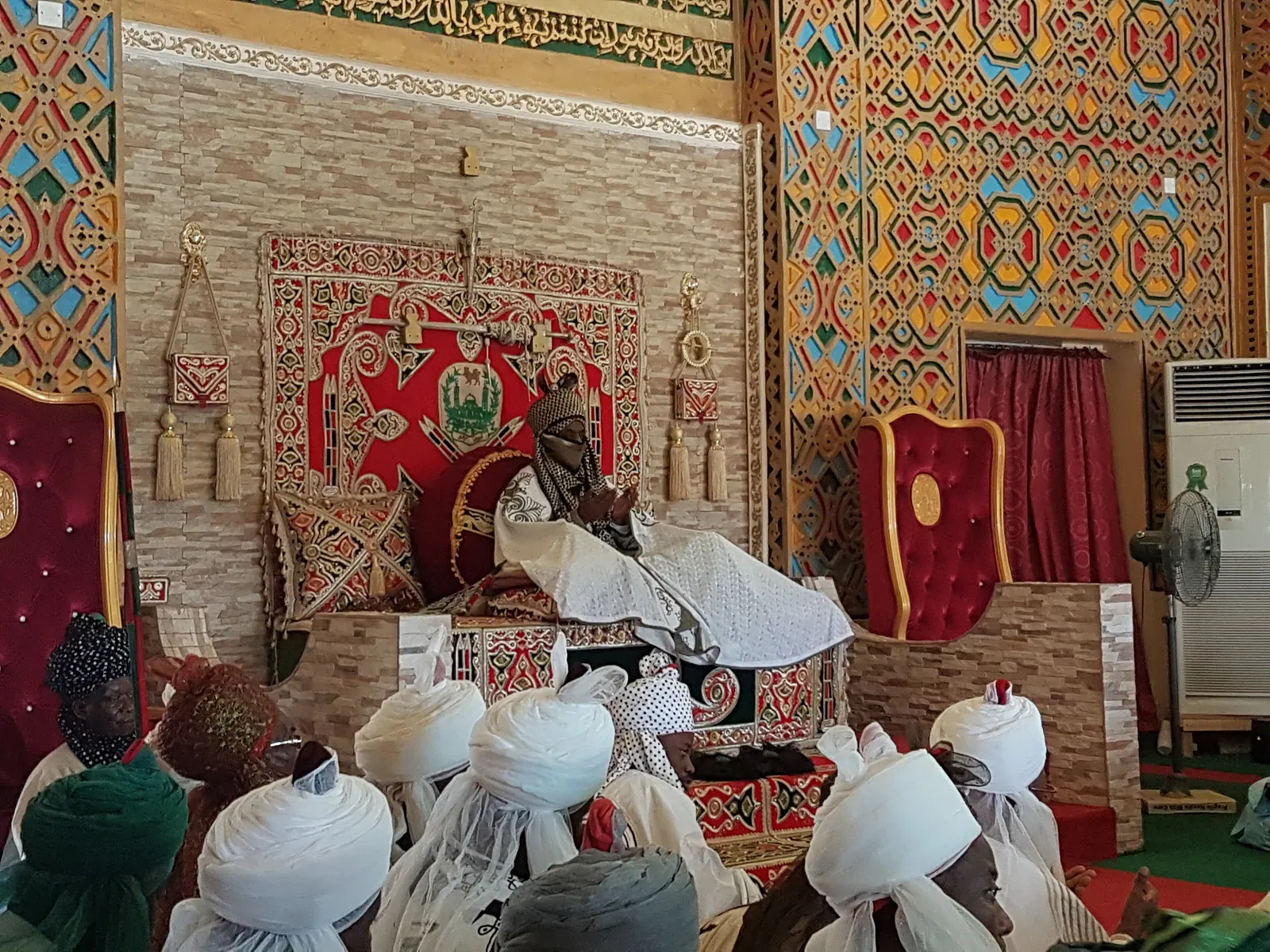
Court music itself had two branches. Rok’in fada is ceremonial music played for an emir on set occasions: installations of officials, the two major religious festivals and the weekly sara, a statement of authority outside the palace on Thursday evenings. Yabon sarakai is praise singing, in which a musician recounts the virtues of a patron such as an emir or sultan. The Kano Emirate was formed in 1805 in the Fulani jihad as a vassal of the Sokoto Caliphate.
Rural folk music served weddings, births and circumcisions and accompanied dances such as the young girls’ asauwara. Alongside it ran the bori possession tradition, a pre-Islamic spirit cult with its own trance music.
Courts, praise singers and folk music, to 1949
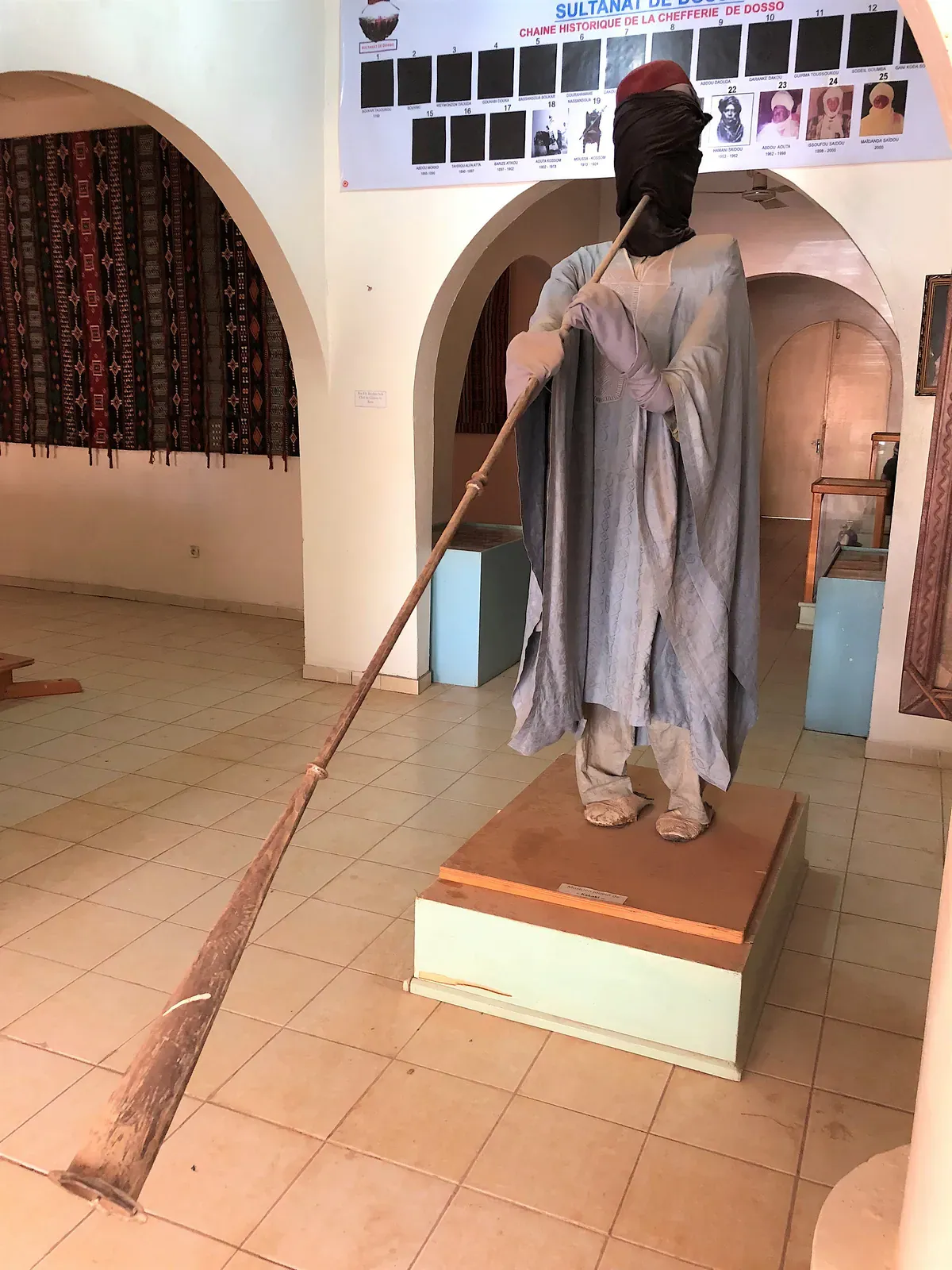
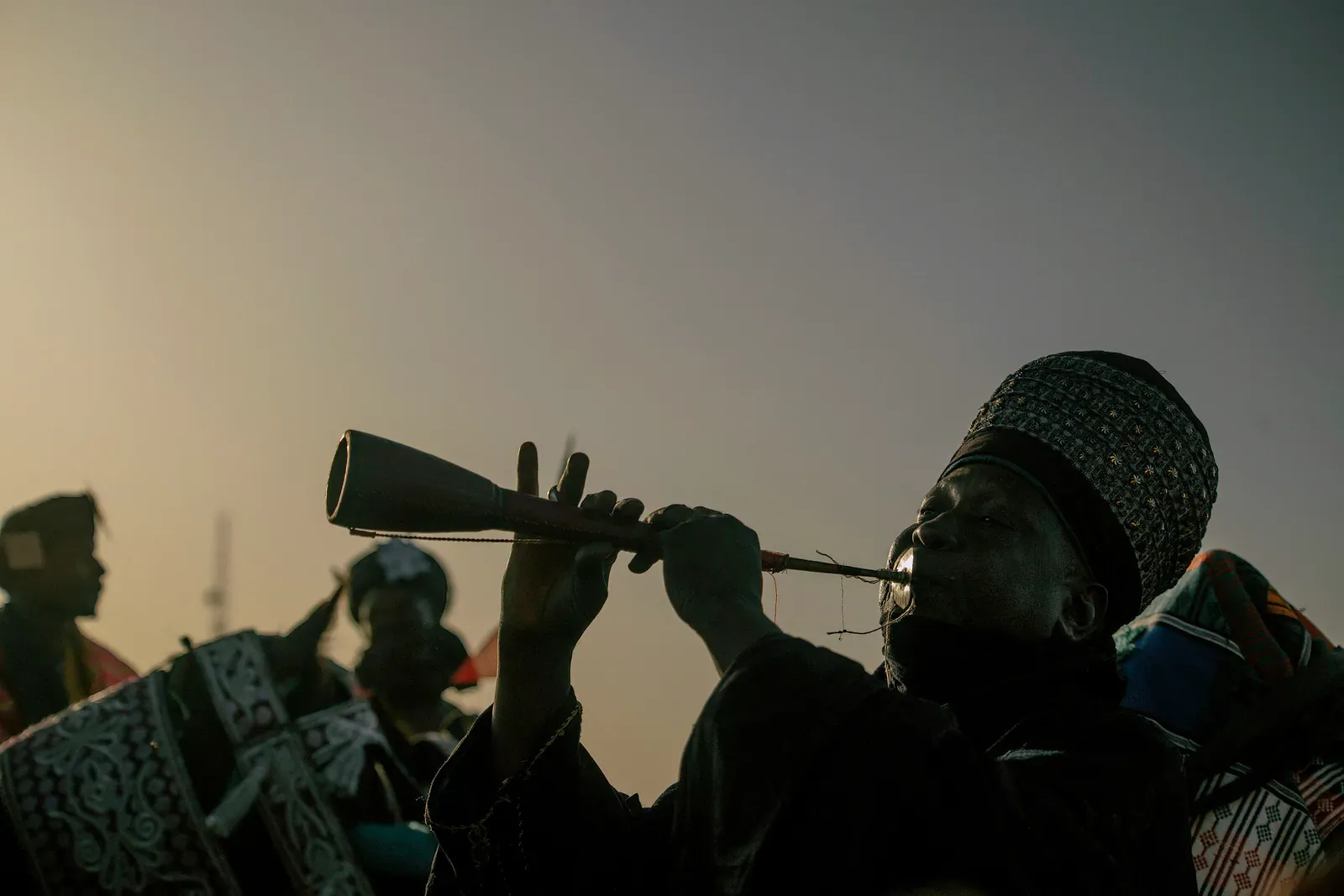
The kakaki is the best-known state instrument. Three to four metres long, made of metal and played only by men, it was carried by Songhai cavalry and adopted by rising Hausa states as a symbol of military power. Its sound is tied to royalty and is heard only at palace events, with state drums, the tambura, beside it.
Ibrahim Narambada, born around 1890 in Tubali, is the singer most often cited from this period. He grew up on the rural noma music of his village, then specialised in Gobir praise song for rulers. His songs mixed praise with social comment and religious messages. He died in 1963.
Patronage stars and bandiri, 1950-1979
Mamman Shata, born in 1923 in Musawa, Katsina, was the dominant figure. His Fulani father wanted a farmer or trader, since praise singing was seen as a form of begging, but Shata became a full-time praise singer. In 1952 he played at a wedding of some 12 Kano princes, and his reputation spread across the emirate. In 1960 he settled in Funtua, where he lived for about forty years. His band usually had twelve men, six drummers and six singers.
In Kano, the late 1950s brought a quieter change. Qadiriyya Sufi gatherings started adding popular styles to their devotional ritual, the seed of bandiri. The genre is named after the bandir drum, and Indian films, which reached Kano in the 1950s, became a source of melody.
Dan Maraya Jos, born Adamu Wayya in 1946 in Bukuru near Jos, came up in the same decades. Orphaned as an infant, he built a kuntigi from a sardine can and goatskin, and performed at Festac 77 in Lagos.
Major labels and Kannywood, 1980-1999
Shata signed with EMI in the 1980s and became its biggest star, then moved to Polygram. By 1986 Dan Maraya Jos had recorded at least 150 LPs and singles and composed 500 songs; that year his album Kudi Masu Gida Rana came out on Polydor (POLP 151).
Bandiri changed again in the late 1980s, when public celebrations featured Hausa praise of the Prophet sung to Indian film melodies and, later, synthesizers building a dense wall of sound. In 1990 the film Turmin Danya became the first commercially successful Hausa-language film, and Kannywood, centred on Kano, created a new market for film songs. Shata died in 1999, leaving thousands of songs, many never recorded.
Sharia, film songs and politics, 2000 onward
After Nigeria’s 1999 return to civilian rule, northern states adopted Sharia, and Hausa pop met official resistance. In 2001 the Kano Hisbah began a crackdown on pop musicians and Sirajo Mai Asharalle was held for a week without court proceedings. In 2007 the actor and singer Adam Zango released the video Bahaushiya, styled on Western hip-hop, was arrested and moved from Kano to the more liberal Kaduna. In 2009 a Kano mobile court banned 11 Hausa songs as obscene, confrontational and amoral.
The market kept growing. Singers such as Ali Jita, Nazifi Asnanic and Umar M Shareef worked for Kannywood films. Ali Jita’s song Love was named second best Hausa song of 2018 by BBC Hausa. Naziru M Ahmad was turbaned Sarkin Wakan Sarkin Kano, chief singer of the Emir of Kano, in December 2018. Dauda Kahutu Rarara, from Kahutu in Katsina, became the best-known political praise singer around the 2015 elections with campaign songs for Muhammadu Buhari. Dan Maraya Jos died in 2015.
Characteristics
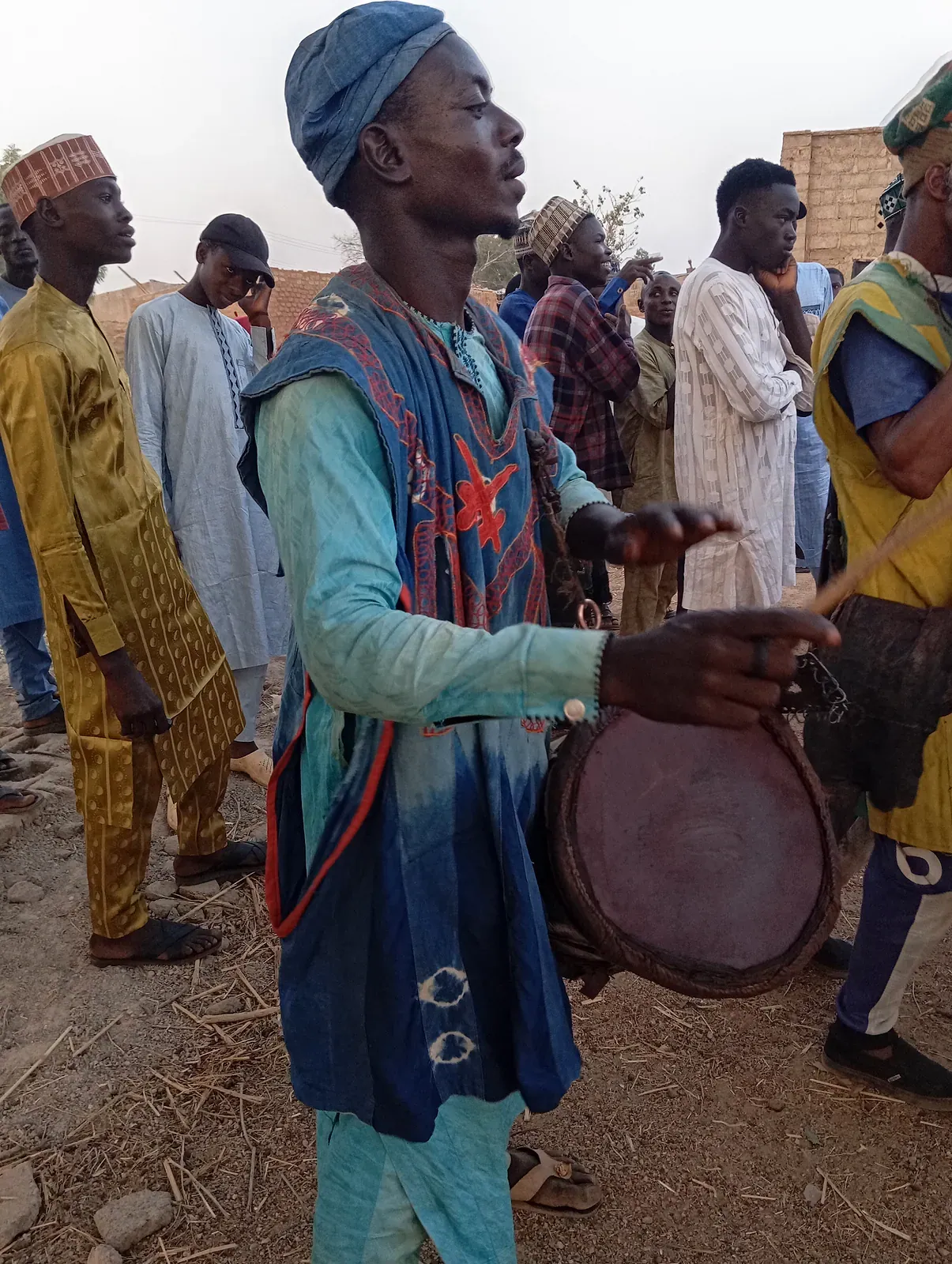
Hausa singing is a spoken-poetic art. The word waka means both song and poetry, so a praise is a poem set to music. Free-rhythm melody rises over a hand-drum pulse. In Shata’s songs the kalangu players answer the singer and stress his words, and in Kyautar Chafe the voice stops for about a measure so the drum alone can speak.
Shata sang on religion, politics and war and on national changes such as decimal currency. Dan Maraya Jos mixed praise with satire and acted out neighbourhood gossips in different voices. A Hausa song is always for someone, and the patron’s name and virtues are part of it.
Instruments and production
The goje is a bowed fiddle with a gourd body covered in skin and a single horsehair string. It accompanies song and features in bori rites, where it is held to speak to spirits. A smaller fiddle, the kukkuma, is linked to secular playing. The kuntigi is a high-pitched one-string lute whose players keep up a rapid ostinato under the voice. The kalangu is an hourglass talking drum whose pitch changes when its cords are squeezed, and the garaya lute, once tied to hunters, serves bori ceremonies.
Court and village music was acoustic, carried by voice and drums. Bandiri later brought synthesizers, and Kannywood film songs a studio-made sound.
Mainstream success
Hausa music spread mainly through patronage, labels and film rather than international charts. Shata’s rise was built on sponsors such as the Emirs of Katsina and Kano and the Sultan of Sokoto, and the major-label deals of the 1980s gave him a wider catalogue. Dan Maraya Jos toured the United States, Europe, the Caribbean and Ethiopia.
The biggest change came from film. Kannywood made songs a product, with videos and singers who rose through the cinema, and political campaigns hired praise singers in the old patronage pattern.
Notable recordings
Dan Maraya Jos’s Kudi Masu Gida Rana (1986) shows the griot in the major-label era. His first song, Wak’ar Karen Mota, praised minibus drivers’ mates, and after the civil war he lampooned figures who had sided with Biafra in Munafukan Yaki.
Adam Zango’s Bahaushiya video (2007) is remembered for its aftermath: an arrest and a move to Kaduna.
Culture
Public life gave Hausa music its stages. The sara is a weekly ritual of authority, and weddings, births and circumcisions call for praise singers, often from families that pass the profession down. Bori ceremonies divide trance music by gender: women play water-drum calabashes, men the garaya, rattles and fiddle.
Patronage shaped careers: Shata moved to Bakori when a prince of Musawa who worked there invited him. In the modern period religious police, court bans and arrests followed pop singers, while the same musicians were hired for weddings and campaigns.
Legacy
The goje gave its form to fiddles across the Sahel and appears in Yoruba sakara, and the Hausa talking drum belongs to a wider West African family that includes the Yoruba dundun. The praise-singer’s role survives in campaign songs, wedding performers and the Emir of Kano’s chief singer. Bandiri turned Bollywood tunes into Sufi devotion.
Misconceptions
The kakaki is sometimes presented as a purely Hausa creation. It was carried by Songhai cavalry and taken up by the rising Hausa states as a mark of military power, and the same trumpet appears in Yoruba, Nupe and other ceremonial music across the region.
Hausa griots are often described as singers for the rich alone. Dan Maraya Jos praised common people such as minibus drivers’ mates and also satirised governments.
Islam is sometimes said to have ended music in northern Nigeria. Muslim influence shaped Hausa music from the 14th century, and the emirate courts sustained ceremonial and praise music. Recent conflict has been over pop styles and videos.
Frequently asked questions
What is Hausa music?
Hausa music is the court, praise-song and folk tradition of the Hausa people of northern Nigeria and Niger. It centres on the goje fiddle, kalangu talking drum and kakaki trumpet, with pentatonic melody and free rhythm.
What is the kakaki in Hausa music?
The kakaki is a metal state trumpet three to four metres long, played by men at palace events and at the weekly sara. It came from Songhai cavalry and became a symbol of Hausa military power.
What is bandiri music?
Bandiri is Hausa Sufi devotional music from the Qadiriyya and Tijaniyya orders, named after the bandir drum. It sets Hausa praise of the Prophet to popular Indian film tunes, later with synthesizers.
Sound
Sound sheet
Signature sounds
- Talking-drum phrase echoing the sung line
- Fast repeating kuntigi pattern under the voice
- Patron's name and virtues in the lyrics
- Kakaki fanfare in ceremonial pieces
Drums and percussion
- Kalangu
Techniques
- Drum echo of the vocal
- Kuntigi ostinato
- Patron praise
- Borrowed film tunes
Keys and modes
Pentatonic. Free-rhythm improvised melody under Muslim Sahelian influence.
Vocals
Solo Hausa praise singing with answering voices and drums.
Scenes
Where it happened
Where and when the sound lived: one bar per city on a shared timeline.
Africa
Active scenes
Peak 5, 1960-2025
Emirate court, Shata's 1952 breakthrough, bandiri and the Kannywood film-song industry.
Mamman Shata's home base for about forty years.
Home emirate of Shata and Rarara.
Base of the kuntigi griot Dan Maraya Jos, born nearby in Bukuru.
Seat of the caliphate whose emirates kept state ceremonial music.
Culture
Culture markers
- Weekly sara
Thursday-evening ceremony outside the emir's palace with state drums and kakaki.
Ritual - Bori possession
Trance ceremonies in which spirits are called with calabash, lute and fiddle music.
Ritual - Asauwara
Young girls' dance accompanied by rural folk music.
Dance - Life-event praise
Songs for births, marriages and circumcisions, often led by families of praise singers.
Ritual
Media
Key media
- 1971Glossary of Hausa Music and Its Social Contexts
by David W. Ames. Reference guide to Hausa instruments, genres and performers.
Book - 1983Horses, Musicians and Gods: The Hausa Cult of Possession-Trance
by Fremont E. Besmer. Study of bori music and ceremony.
Book - 2004Muslim Women Sing: Hausa Popular Song
by Beverly B. Mack. Study of women's song in Hausa popular culture.
Book
Glossary
Terms on this page
Sufi devotional song named after the bandir drum, sung to borrowed popular tunes.
Pre-Islamic spirit-possession tradition with its own trance music.
State ceremonial music performed for an emir.
Weekly Thursday-evening ceremony in which the emir's musicians assert his authority.
Hausa word for both song and poetry, so a sung praise is also a poem.
Court praise singing devoted to the virtues of a patron.
African family