Highlife
Highlife is West African dance music from the Gold Coast that fuses local rhythm with brass, guitar and jazz harmony. It formed in the 1920s.
Gold Coast/Ghana, 1920
African family
Born
1920
Gold Coast/Ghana
Subgenres
7
Documented branches
Links
29
Genres it drew on or shaped
Tempo
100-125 BPMLineage
Family tree
Timeline
Era by era
From the first sparks to today. Select a dot to read the story behind it.
- Coastal roots
1870 to 1927
- Club bands and first records
1920 to 1945
- Golden age
1946 to 1966
- Fusion and exile
1967 to 1999
- Modern highlife
2000 to 2026
Eras
Moments
- 1 Coastal roots, 1870 to 1927
- 2 Club bands and first records, 1920 to 1945
- 3 Golden age, 1946 to 1966
- 4 Fusion and exile, 1967 to 1999
- 5 Modern highlife, 2000 to 2026
around 1870
Coastal roots
Palm-wine guitarists in the ports and brass-band musicians in the forts fused local rhythms with imported instruments along the Gold Coast, before the music had a name.
- 1870Palm-wine and brass-band rootsCoastal guitarists and fort brass bands create the palm-wine, adaha and konkoma styles that feed later highlife.
around 1920
Club bands and first records
Dance orchestras played for the colonial elite in exclusive coastal clubs that gave highlife its name, while guitar trios made the first recordings and the music spread to Nigeria and Sierra Leone.
- 1922The name highlife appearsOutsiders at the gates of exclusive Gold Coast clubs call the orchestrated local dance music highlife.
- 1928Yaa Amponsah recorded in LondonJacob Sam and the Kumasi Trio record the song for Zonophone, the earliest Ghanaian guitar-band highlife.
- 1935Highlife spreads along the coastGhanaian workers carry the music to Sierra Leone, Liberia, Nigeria and Gambia.
- 1945Dance-band and guitar-band streams divergeCity orchestras and rural guitar groups develop into two distinct highlife traditions.
1946
Golden age
E.T. Mensah and the Tempos led dance-band highlife, E.K. Nyame led guitar-band highlife, and independence in 1957 made the music a national sound in Ghana and a popular one in Lagos.
- 1947Decca opens a West African seriesThe label records local bands for the regional market, including highlife.
- 1947Mensah joins the TemposE.T. Mensah joins the Accra dance band and soon becomes its leader.
- 1952Akan Trio formedE.K. Nyame forms the Akan Trio and sings highlife in Akan on concert-party stages.
- 1953Tempos tour BritainE.T. Mensah and the Tempos play a successful British tour and gain international attention.
- 1956Louis Armstrong plays AccraThe American trumpeter performs with E.T. Mensah, who earns the title King of Highlife.
- 1957Ghana FreedomE.T. Mensah composes and records a highlife song for Ghanaian independence.
- 1962Ebo Taylor takes a band to LondonThe Black Star Highlife Band travels to London, where Taylor works with Fela Kuti.
- 1965Joromi wins Africa's first gold discVictor Uwaifo and the Melody Maestros release the single that earns a gold record from Philips West Africa.
1967
Fusion and exile
Highlife fed afro-rock, afrobeat and Igbo highlife, while the Ghanaian exodus of the late 1970s and 1980s produced burger highlife in Germany and a new generation of vocalists.
- 1969Osibisa formed in LondonWest African and Caribbean musicians form the afro-rock band that carries highlife rhythms to rock audiences.
- 1977E.K. Nyame diesThe guitar-band pioneer has a state funeral attended by an estimated 10,000 people.
- 1980Ghanaian exodusMany Ghanaian musicians leave the country from the late 1970s into the early 1980s, many of them for Germany.
- 1984Osondi OwendiOsita Osadebe's single makes him the leading name in Igbo highlife.
- 1989Lumba Brothers debut albumYee Ye Aka Akwantuom popularises burger highlife.
- 1998Aben Wo AhaDaddy Lumba's album becomes a modern highlife standard.
2000
Modern highlife
Reissues revived the classic recordings, a synth-driven uptempo sound arrived from the late 2010s, and UNESCO inscribed highlife on its list of intangible cultural heritage in 2025.
- 2010Love and Death reaches the worldEbo Taylor's first internationally distributed album revives interest in classic highlife and afrobeat.
- 2018Synth-driven uptempo highlifeA new generation adds electronic production and faster tempos.
- 2025UNESCO inscribes highlifeHighlife is recognised as intangible cultural heritage.
Listening path
Start listening
A short path from an easy way in to the deep end. Thumbnails come from YouTube; the player loads only when you press play.
- 01
E.T. Mensah, 1957
The independence-era dance-band standard; listen for the horn lines over a swung groove.
- 02
Victor Uwaifo, 1965
The record that won Africa's first gold disc; listen for the guitar-led dance groove.
- 03
Ebo Taylor, 1980
A 1970s highlife-afrobeat blend that reached the world in 2010; listen for the horns and bass.
- 04
Daddy Lumba, 1998
Modern vocal highlife from a leading Ghanaian singer; listen for the lead vocal and the electronic backing.
Facts
| Family | African |
| Origin | Gold Coast/Ghana, Ghana |
| Emerged | 1870s onward, matured 1920s-1950s |
| Status | Active |
| Tempo | 100 to 125 BPM |
| Meter | 4/4 |
| Grew out of | Osibisaba |
| Subgenres | 7 |
Highlife is a West African popular music that began on the Gold Coast, now Ghana, when local rhythms met brass-band instruments, guitars, calypso and jazz harmony. It is marked by jazzy horn lines, two-finger guitar picking, call-and-response singing and a swung dance pulse.
It matured between the 1920s and the 1950s, spread to Nigeria, Sierra Leone and Liberia, and remains a living form in both Ghana and Nigeria.
Origins
Highlife grew out of several coastal musics that never had one birthplace. Palm-wine guitarists played in the ports for sailors, dock workers and labourers, usually in a syncopated 4/4, and a more Africanised version with 12/8 polyrhythms became known as native blues. In the forts along the coast, local musicians drafted into military brass bands learned marching music, then mixed it with polyrhythmic local dance to make a style called adaha, and a cheaper version on local instruments called konkoma. A Fante recreational rhythm, osibisaba, fed into the first dance orchestras of the 1920s.
The name came from the clubs. Orchestras such as the Jazz Kings, the Cape Coast Sugar Babies and the Accra Orchestra played indigenous songs in orchestrated form for the colonial African elite in exclusive venues, where entry cost a fee and full evening dress. People outside, who could not go in, called the music highlife.
Club bands and first records, 1920-1945
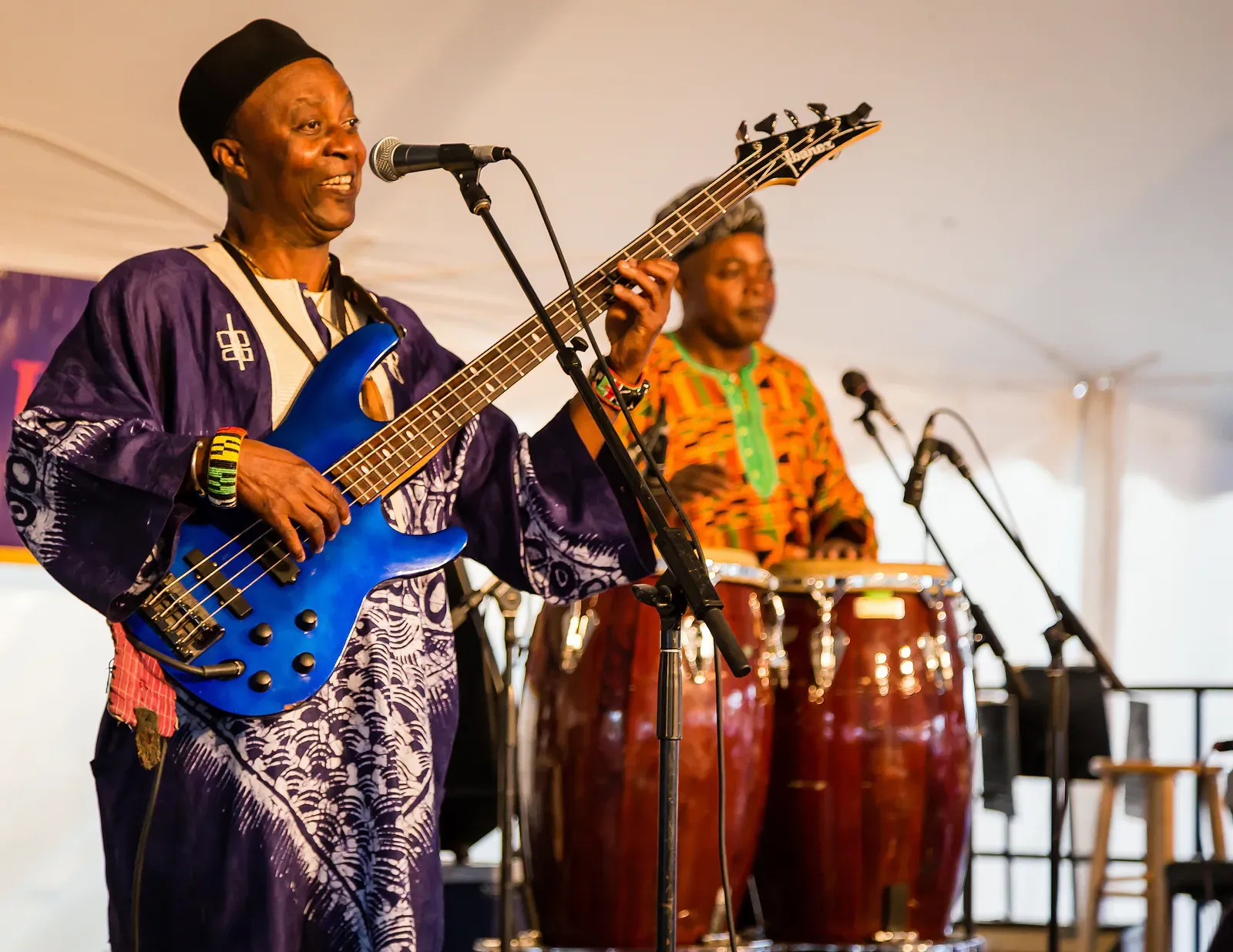
The first recordings came from guitar groups rather than orchestras. In June 1928, Jacob Asare, also known as Kwame Asare or Jacob Sam, and his Kumasi Trio recorded “Yaa Amponsah” in London for the Zonophone label, widely regarded as the earliest Ghanaian guitar-band highlife. From the 1930s Ghanaian workers carried the music to Sierra Leone, Liberia, Nigeria and Gambia, where it found local audiences.
By the 1940s highlife had split into two streams. Dance-band highlife stayed urban and orchestral. Guitar-band highlife used smaller groups, was at first more common in rural areas, and rested on the two-finger picking style that musicians adapted from the dagomba style of Kru sailors from Liberia. The Akan seprewa, a stringed instrument, made the guitar an easy addition. Guitar-band lineups added singing, drums and claves.
Golden age, 1946-1966
After the Second World War the large dance orchestras gave way to smaller professional dance bands. E.T. Mensah and the Tempos defined the shape. The Tempos began in 1946 as a jam-session group of European soldiers in Accra and became an all-African band, and Mensah joined in 1947 and then led it. A successful British tour followed in 1953, and a performance alongside Louis Armstrong in Accra in the mid-1950s helped earn Mensah the title King of Highlife. Guy Warren, later known as Kofi Ghanaba, played with the Tempos and then took highlife to the United States.
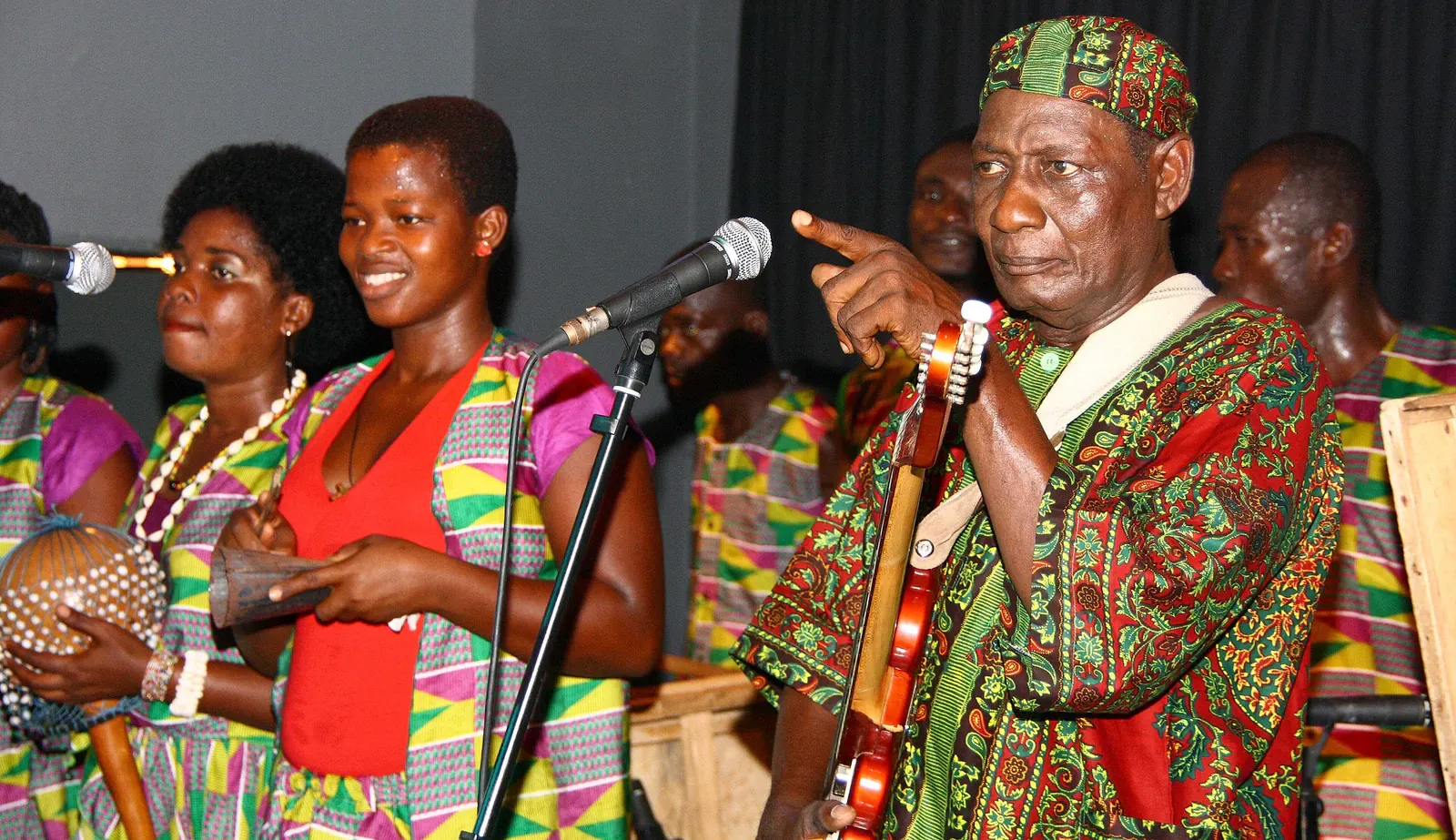
The guitar-band side was led by E.K. Nyame, who formed his band in 1949 and the Akan Trio in 1952. The Akan Trio sang highlife in Akan on concert-party stages, a practice that had not existed before, and Nyame accompanied the prime minister, Kwame Nkrumah, to Liberia in 1952. By 1975 he had recorded about 400 78 rpm discs for several record companies. When Ghana became independent in 1957, Mensah composed and recorded “Ghana Freedom”, which became a national standard.
Nigeria took highlife in its own direction. In Lagos, bandleaders such as Victor Olaiya and Bobby Benson built big-band highlife, and Rex Lawson led the Majors Band in Port Harcourt with a repertoire that included “Jolly Papa” and “So ala teme”. Lawson often featured alto saxophone solos rather than the trumpet lead typical of other highlife bands. Victor Uwaifo formed the Melody Maestros in 1965, and their “Joromi” earned the first gold record in Africa.
Fusion and exile, 1967-1999
From the late 1960s highlife became raw material for new styles. Fela Kuti and Ebo Taylor crossed paths in London in 1962, and the Ghanaian-Caribbean band Osibisa, formed in London in 1969, took highlife-based rhythm to rock audiences. Afrobeat, juju and makossa took part of their form from highlife, and the genre also fed what became afro-rock. In eastern Nigeria, the Igbo made highlife their most popular music in the 1960s, singing mostly in Igbo with some Pidgin English, and Osita Osadebe’s 1984 single “Osondi Owendi” made him the leading name in the style.
In Ghana the late 1970s and early 1980s brought a wave of emigration. Many musicians went to Germany, where they worked with German producers and mixed highlife with funk, disco and synth-pop. The result was named burger highlife, probably after Hamburg, home to the largest Ghanaian community. Its producers adopted electronic instruments heavily, and by the late 1990s some work used only electronic sound. The Lumba Brothers, with Daddy Lumba, released the debut album that helped spread the style.
Characteristics
Highlife keeps the structures of traditional African music and plays them on Western instruments. The usual metre is a swung 4/4 or a 12/8 feel, with call-and-response between the lead voice and a chorus or the horns. The melodic lead belongs to a trumpet or saxophone section in dance-band highlife and to the guitar in guitar-band highlife. Songs are sung in Akan, Ga, Igbo and other languages, and in English or Pidgin. Measured tempos of canonical recordings run from about 100 to about 125 beats per minute, a relaxed range for a dance music.
Instruments and production
A dance-band highlife record is built around a horn section and a drum kit, with the guitar playing short, interlocking figures. A guitar-band record uses a smaller group with one or two guitars, claves, hand drums and a lead singer. Burger highlife of the 1980s and 1990s relied on electronic instruments. Records of the first half of the century were cut on 78 rpm discs, and the Gold Coast catalogue was made largely by European companies for the West African market.
Mainstream success
Highlife reached national scale twice. In the 1950s it became a sound of the independence movement in Ghana, with Nyame’s songs and plays supporting Nkrumah’s campaign and Mensah’s “Ghana Freedom” marking the new state. In Nigeria it became the dominant popular music of the 1960s, producing the first gold record in Africa and a generation of bandleaders.
Its second spread was in the diaspora. Ghanaians in Germany sustained burger highlife as a secular style, and gospel highlife, drawing on Charismatic and Pentecostal Christianity, outlasted it by giving religion and popular culture a shared repertoire. In 2025, UNESCO inscribed highlife on its list of intangible cultural heritage. From 2018 a synth-driven, faster style also emerged.
Notable recordings
“Ghana Freedom” is the best-known independence-era recording, a dance-band piece whose lyrics celebrate the labour of the nation’s builders. “Joromi” shows the Nigerian side, a guitar-led dance record that won Africa’s first gold disc. Ebo Taylor’s “Love and Death”, first recorded around 1980, blends highlife with afrobeat and gave its name to his first internationally distributed album when a Berlin-based band and the London label Strut brought it out in 2010. Daddy Lumba’s “Aben Wo Aha”, from 1998, shows the modern vocal style that dominated Ghanaian highlife from the 1990s.
Culture
Highlife began as a mark of class: the dress code, the entrance price and the orchestra. By the 1950s it had become a national pastime, played at dances and concert-party theatre. Highlife also ties to ritual and religion, since gospel highlife is among the most popular genres in Ghana and the Ghanaian diaspora. The label records of the Gold Coast, such as the Decca West African series that opened in 1947, built the first mass catalogue, and later reissues by the label Strut and others re-introduced the music to listeners abroad.
Legacy
Highlife is the common ancestor of several West African styles. Afrobeat, juju, makossa, fuji and Ghanaian and Nigerian pop all took rhythm, horns or guitar technique from it, and hiplife and afrobeats are recent descendants. Its tunes are still sampled and reissued, and Taylor’s “Heaven” was sampled in a 2010 hit.
Misconceptions
Highlife is sometimes thought to be a single Ghanaian style, but it has distinct traditions: the orchestral dance bands, the guitar bands, the Nigerian big bands, the Igbo guitar-and-horn style and the German-made burger highlife. Another misconception is that the name describes the music’s tempo or lift. It comes from the exclusive clubs, where the music was heard by the well-off. A third is that highlife died in the 1960s. The style declined in popularity then, but E.T. Mensah remained active for years, Daddy Lumba made modern highlife a mass genre, and the style is still recorded.
Frequently asked questions
What is highlife music?
Highlife is a West African popular music from the Gold Coast that combines local rhythm and call-and-response singing with horns, guitar and jazz harmony. It is danced to at around 100 to 125 beats per minute.
Where did highlife come from?
Highlife began on the coast of present-day Ghana in the 19th and early 20th centuries, from palm-wine guitar music, brass-band music and osibisaba rhythm, and took the name highlife in the 1920s.
Who is the king of highlife?
E.T. Mensah of Ghana, leader of the Tempos, is called the King of Highlife. His performance with Louis Armstrong in Accra added to the title.
What is the difference between Ghanaian and Nigerian highlife?
Ghanaian highlife developed dance-band and Akan guitar-band styles. In Nigeria the music produced big-band highlife in Lagos and Igbo highlife, sung mainly in Igbo, in the east.
Is highlife the same as afrobeat?
No. Afrobeat, created by Fela Kuti, blends West African music with funk and jazz and took part of its form from highlife.
Sound
Sound sheet
Signature sounds
- Two-finger picked guitar lines
- Jazzy horn section riffs
- Swung 4/4 or 12/8 dance feel
- Call-and-response vocals
- Claves and hand-drum timeline
Drums and percussion
- Drum kit
- Claves
Techniques
- Two-finger guitar picking
- Call and response
- Horn-led arrangements
Keys and modes
Major keys with jazz and calypso harmony. Western chords and horn voicings over African metre.
Vocals
Sung in Akan, Igbo and other local languages and in English or Pidgin, often in call and response.
Scenes
Where it happened
Where and when the sound lived: one bar per city on a shared timeline.
Africa
Europe
Active scenes
Peak 4, 1980-2025
Home of the Tempos and the dance-band clubs, the centre of Ghanaian highlife.
The Ashanti capital, base of the Kumasi Trio and of later guitar-band and vocal highlife.
Nigeria's music hub, where Victor Olaiya, Bobby Benson and Victor Uwaifo built big-band highlife.
Home of the Ghanaian diaspora behind burger highlife.
Culture
Culture markers
- Evening dress at the clubs
Entry to the exclusive Gold Coast dance clubs meant a fee and full evening dress, which gave the music its name.
Fashion - Club ballroom dancing
Couples danced to orchestrated highlife in dance clubs, in a music that mixed the foxtrot and calypso with local rhythm.
Dance - Highlife as a label
People outside the clubs called the music highlife because they could not afford to go in.
Slang
Media
Key media
- 1963Highlife
by Randy Weston. American jazz pianist's album built on compositions by Bobby Benson and Guy Warren.
Compilation - 2008Highlife Time: Nigerian and Ghanaian Sound
by Various. Reissue collection of classic highlife from both countries.
Compilation
Glossary
Terms on this page
A brass-band style from fort musicians who mixed marching music with local polyrhythm.
A style made by Ghanaians in Germany that mixes highlife with funk, disco and synth-pop.
The name given by outsiders to the orchestrated local dance music played in exclusive Gold Coast clubs.
A brass-band variant played on cheaper local instruments.
A Fante recreational rhythm absorbed into 1920s dance-band highlife.
Guitar music of the ports, often in syncopated 4/4, called maringa in Sierra Leone.
African family