New Orleans brass band
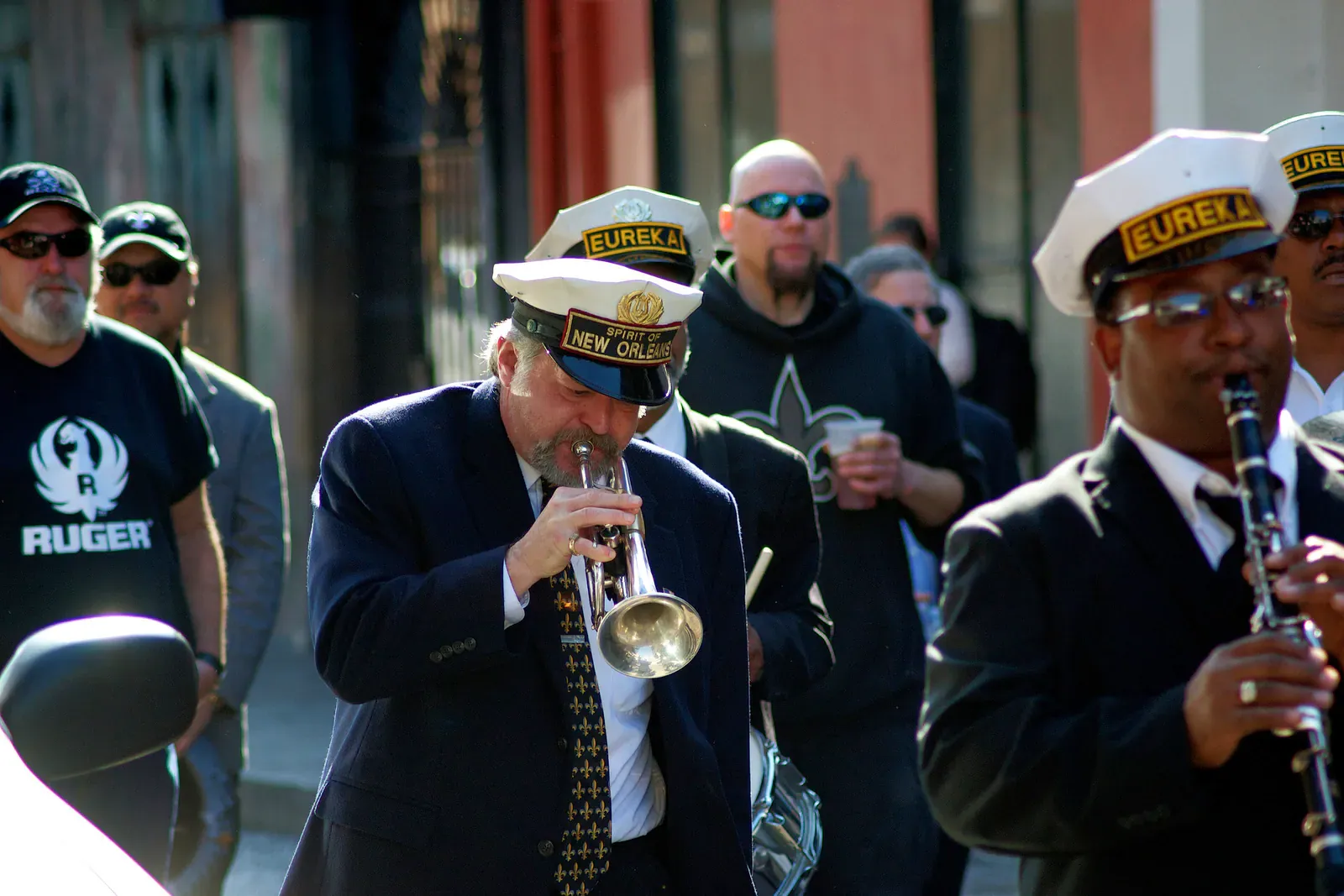
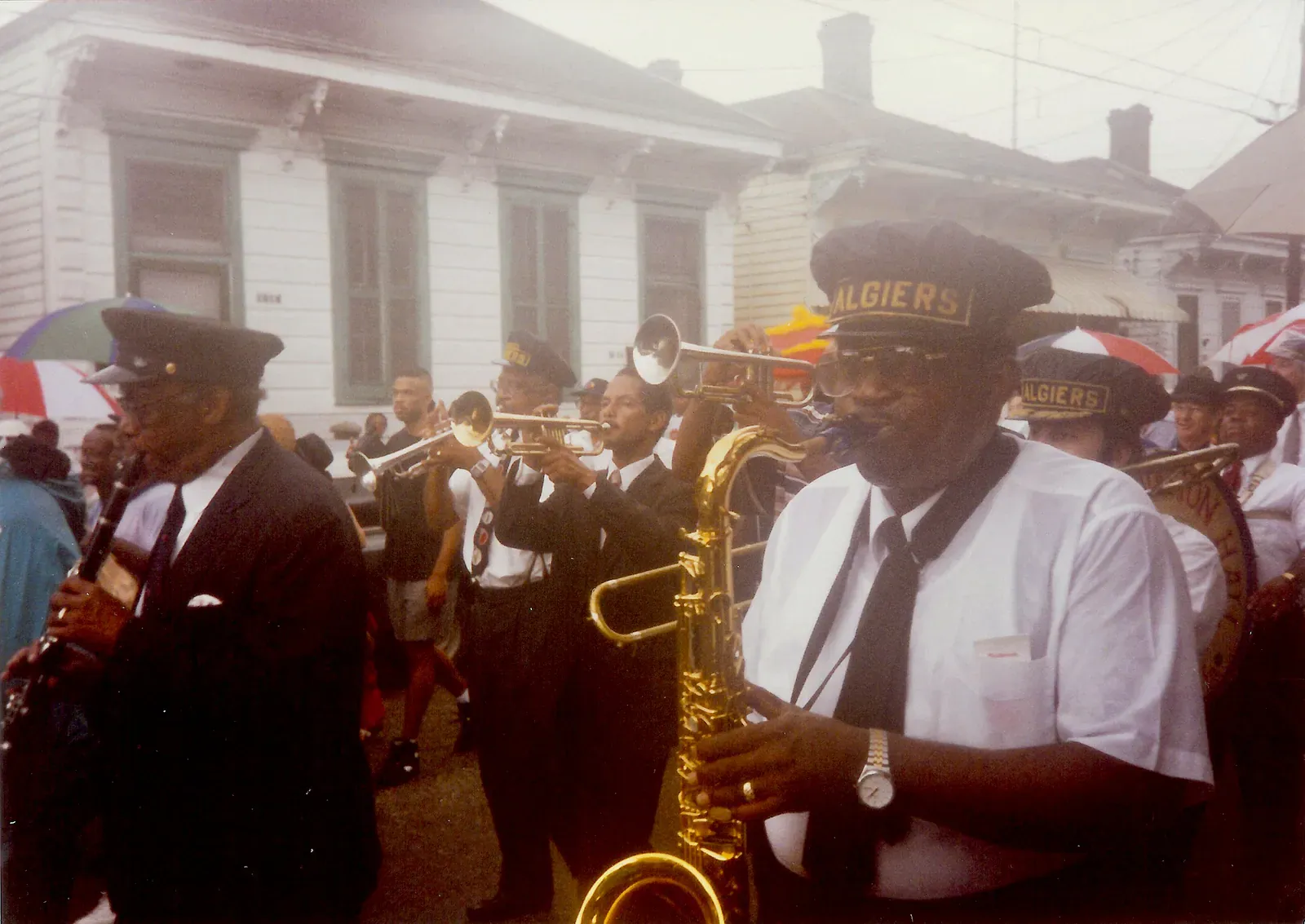
The New Orleans brass band is the marching band tradition of parades and funerals in Louisiana, built on trumpets, trombones, sousaphone and drums.
New Orleans, 1880
Jazz family
Born
1880
New Orleans
Subgenres
4
Documented branches
Links
8
Genres it drew on or shaped
Tempo
80-115 BPMLineage
Family tree
Timeline
Era by era
From the first sparks to today. Select a dot to read the story behind it.
- Parade and funeral bands
1877 to 1919
- Funerals, parades and Preservation Hall
1920 to 1976
- Funk and bebop revival
1977 to 1994
- Hip-hop brass and global spread
1995 to today
Eras
Moments
- 1 Parade and funeral bands, 1877 to 1919
- 2 Funerals, parades and Preservation Hall, 1920 to 1976
- 3 Funk and bebop revival, 1977 to 1994
- 4 Hip-hop brass and global spread, 1995 to today
around 1877
Parade and funeral bands
Bands such as the Onward and the Excelsior played marches, funerals and street parades, mixing European military band practice with African American musical habits.
- 1877Onward Brass BandThe Onward is active by the late 1870s and becomes the best-known marching band of New Orleans.
- 1895Buddy Bolden forms his bandCornetist Buddy Bolden leads a looser, improvised approach to marches, blues and hymns.
1920
Funerals, parades and Preservation Hall
The Eureka and the Olympia kept the tradition going in parades and funerals, and were recorded on parade records and at Preservation Hall.
- 1920Eureka Brass Band formedTrumpeter Willie Wilson founds the band, which later records at length and plays until 1975.
- 1951New Orleans ParadeThe Eureka records an album of parade and funeral music.
- 1958Olympia Brass Band formedSaxophonist Harold Dejan splits from the Eureka and founds the Olympia.
- 1962Jazz at Preservation Hall, Vol. 1The Eureka Brass Band records for Atlantic Records.
- 1972Fairview Baptist Church Marching BandDanny Barker starts a youth marching band, the root of the Hurricane Brass Band and then the Dirty Dozen.
- 1973Brass band on filmThe Olympia plays a funeral march in the James Bond film Live and Let Die.
1977
Funk and bebop revival
Danny Barker's youth band led to the Dirty Dozen in 1977 and the Rebirth in 1983, bands that added funk and bebop and reached festivals and labels.
- 1977Dirty Dozen formedBenny Jones and former Tornado Brass Band members start the band in Treme.
- 1983Rebirth Brass Band formedPhillip Frazier, Keith Frazier, Kermit Ruffins and classmates from Clark High School form the band.
- 1986Mardi Gras in MontreuxThe Dirty Dozen's Montreux Jazz Festival set is released on Rounder Records.
1995
Hip-hop brass and global spread
Bands such as the Hot 8 and the Soul Rebels blended hip-hop, soul and pop with the brass format, and the style spread to groups worldwide.
- 1995Hot 8 Brass Band formedTwo earlier bands, the Looney Tunes and the High Steppers, merge.
- 2012Rebirth wins a GrammyThe Rebirth wins the first Grammy for Best Regional Roots Music Album.
- 2023Dirty Dozen wins a GrammyThe Dirty Dozen wins the Grammy for Best American Roots Performance.
Listening path
Start listening
A short path from an easy way in to the deep end. Thumbnails come from YouTube; the player loads only when you press play.
- 01
Dejan's Olympia Brass Band, 1984
A hymn played at funerals, slow on the way to the cemetery.
- 02
Dirty Dozen Brass Band, 1984
The title track of the band's first album, a signature of the funk revival.
- 03
Rebirth Brass Band, 1991
A second-line funk groove from the Treme band.
- 04
Hot 8 Brass Band, 2005
A Marvin Gaye cover that shows the pop side of the modern brass band.
- 05
The Soul Rebels, 1995
A soul and hip-hop leaning brass band track.
Facts
| Family | Jazz |
| Origin | New Orleans, United States |
| Emerged | Late 19th century |
| Status | Active |
| Tempo | 80 to 115 BPM |
| Subgenres | 4 |
The New Orleans brass band is a street ensemble of trumpets, trombones, clarinets or saxophones, sousaphone and marching drums that plays for parades, funerals and neighbourhood celebrations in New Orleans, Louisiana.
The tradition dates to the late nineteenth century and joins European military band practice to African American musical habits. It supplied early jazz with its parade repertoire and its instruments, and it is still the music of the city’s street processions.
Origins
The tradition of brass bands in New Orleans goes back to the late nineteenth and early twentieth centuries. Louisiana’s colonial past had left it with military-style brass bands, which were called on for many occasions, including funeral processions. Black New Orleanians took that format and combined it with African musical and spiritual practice. The result was a fusion of European military band music and African folk music that played a significant part in the development of traditional jazz.
Early bands included the Onward, the Excelsior, the Eureka and the Tuxedo. The Onward was founded some time before 1877 and by the time of the Spanish-American War was regarded as the leading marching band in the city. Under cornetist Manuel Perez its members included Peter Bocage, Lorenzo Tio Jr., Isidore Barbarin and King Oliver. Around 1895 cornetist Buddy Bolden formed a group that played marches, blues and hymns in a looser, improvised way.
The social setting mattered as much as the instruments. After emancipation, African Americans formed social aid and pleasure clubs that paid for sickness and burial, held annual neighbourhood parades and hired a brass band for each. That arrangement kept the bands working.
Parades and funerals, 1920-1976
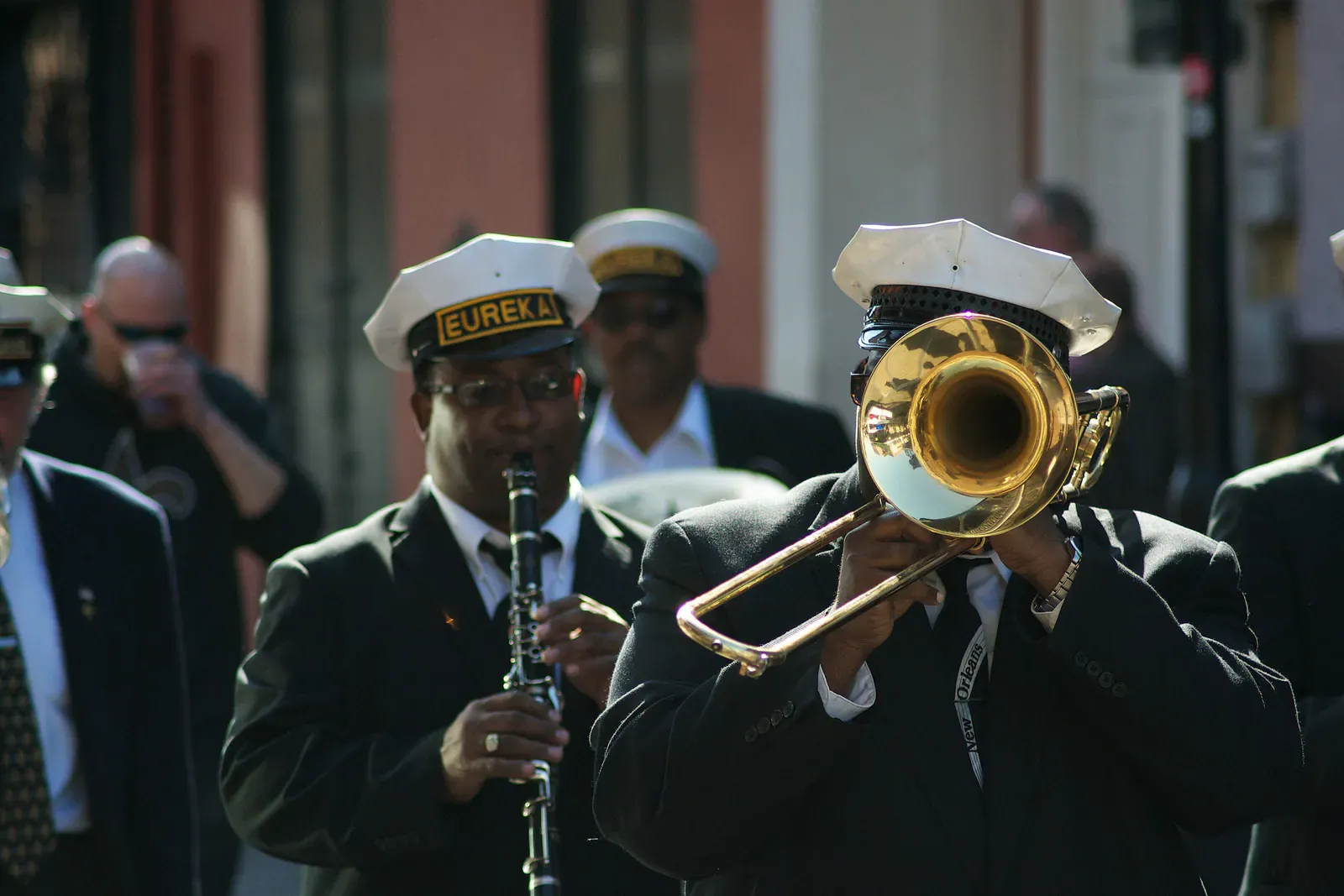
The Eureka Brass Band was founded in 1920 by trumpeter Willie Wilson and played until 1975. It usually had nine to eleven members and a typical line-up of three trumpets, two trombones, two reeds, a tuba, a snare drum and a bass drum. Percy Humphrey led it for its last decades. It recorded a parade and funeral album in 1951 and, in 1962, the first volume of a Preservation Hall series for Atlantic Records.
In 1958 saxophonist Harold Dejan, who led a second unit of the Eureka, split off to form the Olympia Brass Band. The Olympia held a weekly Sunday night spot at Preservation Hall, toured Europe and Africa, and appeared as a funeral band in the 1973 James Bond film Live and Let Die. The Olympia is regarded as having ended with the death of grand marshal Richard “King” Matthews in 2010.
The funk revival, 1977-1994
By the mid 1970s opportunities for brass bands were drying up. The revival began with Danny Barker, who in 1972 started the Fairview Baptist Church Marching Band to give young people a positive outlet. It turned professional as the Hurricane Brass Band, then briefly the Tornado Brass Band, before breaking up.
A few of its musicians kept rehearsing into 1977: trumpeter Gregory Davis, sousaphonist Kirk Joseph, trombonist Charles Joseph and saxophonist Kevin Harris, joined by Benny Jones, who was active in the social club scene. They named themselves the Original Sixth Ward Dirty Dozen, after the Dirty Dozen Social and Pleasure Club. WWOZ co-founder Jerry Brock made the first professional recording of the band in 1980.
The Dirty Dozen Brass Band put funk and bebop into the New Orleans jazz format. A European tour booked by promoter George Wein in 1984 led to their first album, My Feet Can’t Fail Me Now, on Concord Jazz. Their set at the Montreux Jazz Festival in 1986 was released on Rounder Records, and in 1987 they signed to Columbia, which issued Voodoo in 1989 with guests Dr. John, Dizzy Gillespie and Branford Marsalis.
The Rebirth Brass Band followed in 1983. It was founded by tuba player Phillip “Tuba Phil” Frazier, his brother Keith Frazier, Kermit Ruffins and classmates from Joseph S. Clark Senior High School in Tremé. Arhoolie released its first album in 1984, and records such as Do Whatcha Wanna in 1991 and Feel Like Funkin’ It Up in 1992 established a funk brass sound that younger bands still follow.
Hip-hop brass and global spread, 1995 to the present
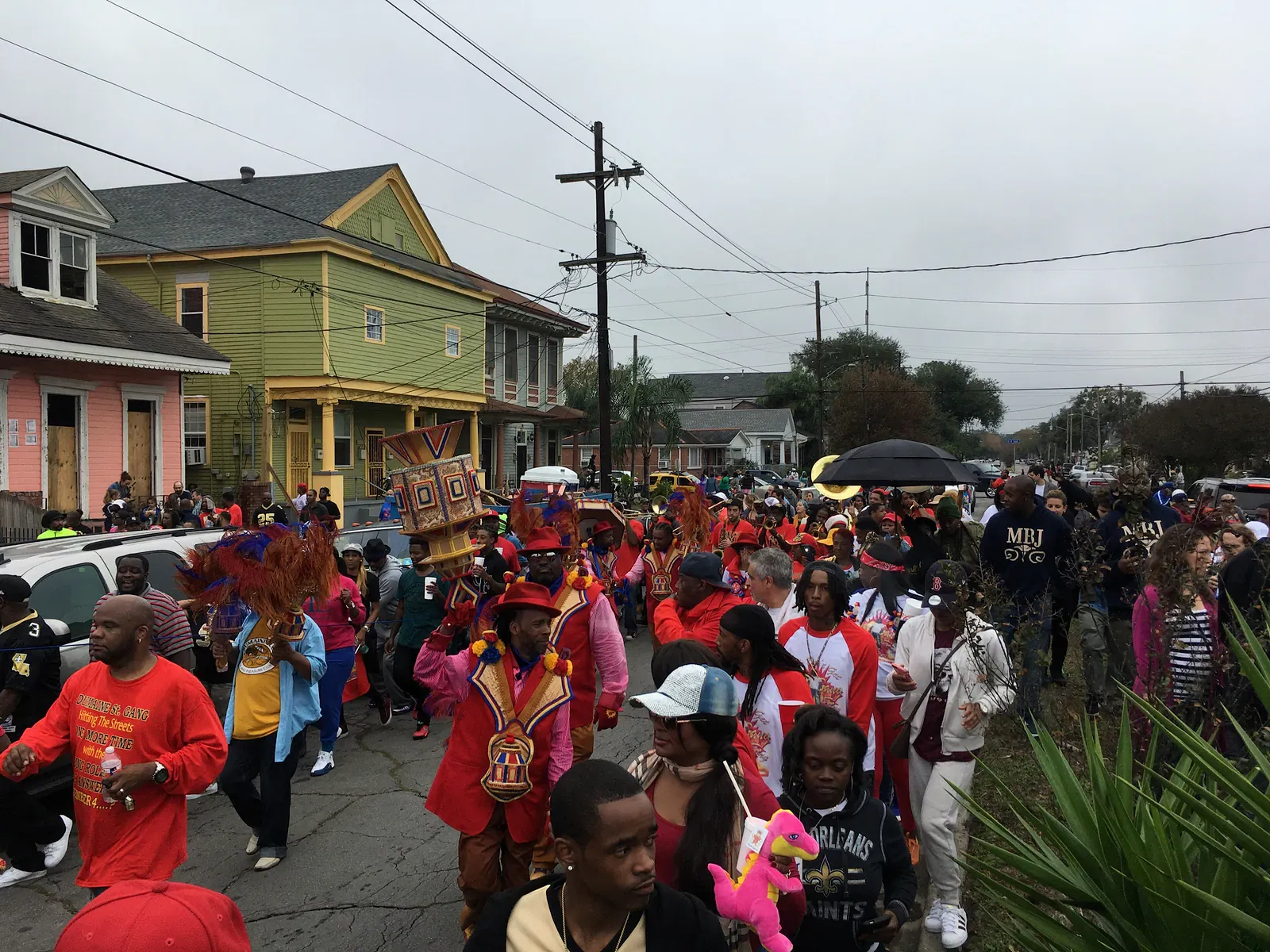
The next generation added hip-hop, soul and pop. The Hot 8 Brass Band formed in 1995 when two earlier bands, the Looney Tunes and the High Steppers, merged, and it signed to the British label Tru Thoughts in 2007. The Soul Rebels, formed in 1991, fold soul, jazz, funk, hip-hop and rock into the brass format, a style also called brasspop or urban brass. The style has since spread to bands in Japan, Germany, Finland, Australia and other countries.
Characteristics
The sousaphone usually plays the bass line that a double bass would carry, either as a walking line in the jazz manner or as a repeated riff. Trumpets, trombones, saxophones and other horns play melodies and harmonies loosely over it, and the lines are often heavily embellished by improvisation. A typical set-up has two percussionists: one on a marching bass drum with a cymbal mounted on it, and one on a snare drum. The snare drummer often switches to a drum kit when not marching.
The snare drum follows the second line, the crowd that walks behind the band, with improvised polyrhythmic figures against the marching beat. Second line drumming became a feature of early jazz drumming and of 1950s New Orleans rhythm and blues. Many older tunes are in B-flat, the natural key of the discarded military band instruments the first jazz players used.
Culture
The best-known occasion for the music is the jazz funeral, a funeral procession with a brass band. The procession marches from the home, funeral home or church to the cemetery while the band plays dirges and hymns such as “Nearer My God to Thee” and “Just a Closer Walk with Thee”. After the burial, or once the hearse leaves, the mourners “cut the body loose” and the music turns upbeat, often starting with a hymn played in swing and moving into hot tunes such as “When the Saints Go Marching In” and “Oh, Didn’t He Ramble”. Onlookers who follow the band just to enjoy the music are the second line, and their dancing, walking and twirling a parasol or handkerchief, is called second lining.
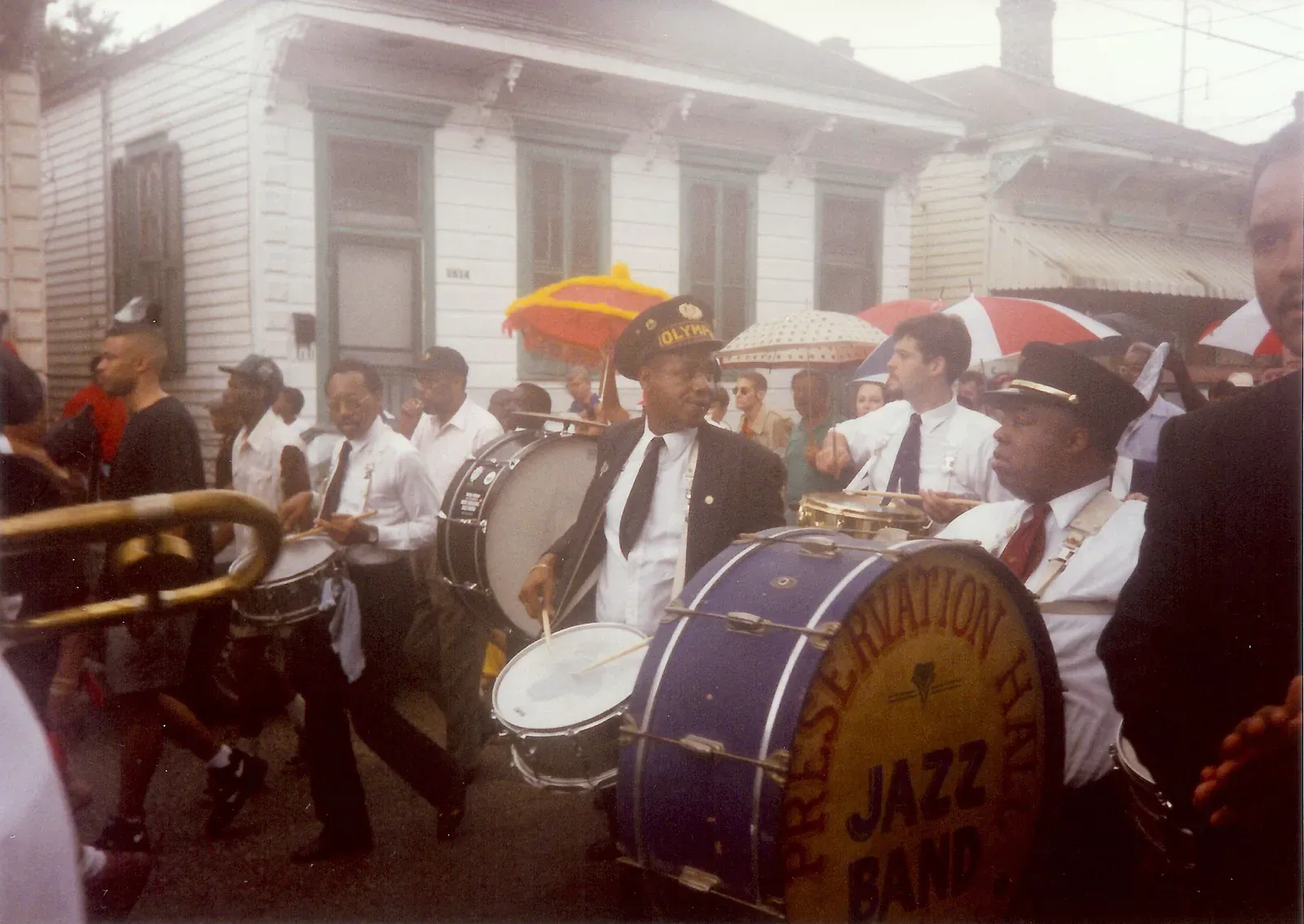
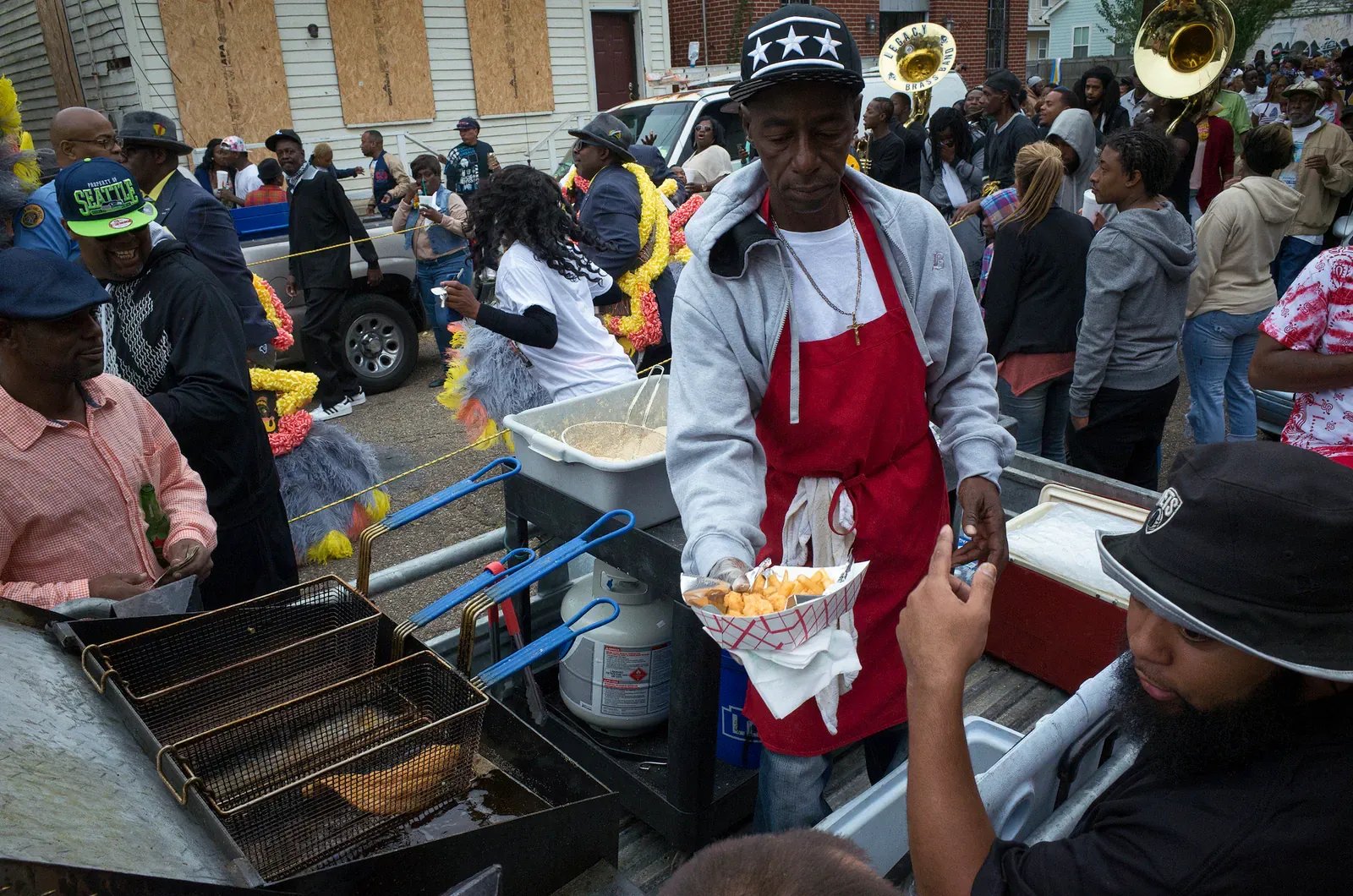
The same format serves the annual parades of social aid and pleasure clubs. In these, a first line of club members with the parade permit and the band is followed by the second line of neighbours, who dance and eat along the route. Mardi Gras Indians are often part of the processions.
Mainstream success
For decades the music reached outsiders mostly through records and the Preservation Hall bands. The Dirty Dozen changed that. After the 1984 European tour they toured widely, signed to Columbia in 1987 and later opened for the Black Crowes for most of 1995. In 1990 they played “When the Saints Go Marching In” at the memorial service for Jim Henson in New York. They won a Grammy for Best American Roots Performance in 2023. The Rebirth won the inaugural Grammy for Best Regional Roots Music Album in 2012.
Notable recordings
“My Feet Can’t Fail Me Now” gave the Dirty Dozen their first album title in 1984 and is the title track of the band’s first album. “Do Whatcha Wanna” by the Rebirth, first released in 1991, is the title track of the Rebirth’s best-known early album and a funk brass staple. The Hot 8’s version of Marvin Gaye’s “Sexual Healing”, from the 2005 album Rock With the Hot 8, shows the format taking on pop songs.
Legacy
Brass bands remain the music of New Orleans parades, funerals and festivals, and their sound passed into jazz, rhythm and blues and funk. The format has spread beyond the city, with bands in Japan, Finland, Germany, Belgium, the Netherlands, Scotland, England and Australia.
Misconceptions
The brass band is not only a funeral band. Funerals are the best-known setting, but the same bands play the annual club parades. The name “jazz funeral” was long used by outsiders and was often disliked by local musicians, who preferred “funeral with music” because jazz was only part of the music played. It is also not a museum piece: brass band work was scarce by the mid 1970s, and the Dirty Dozen in 1977 and the Rebirth in 1983 revived it with funk and bebop.
Frequently asked questions
What instruments are in a New Orleans brass band?
A typical line-up has trumpets, trombones, saxophones or clarinets, a sousaphone for the bass line, a snare drum and a bass drum. Early bands such as the Eureka used three trumpets, two trombones, two reeds, a tuba and two drums.
What is a second line in New Orleans?
The second line is the crowd that follows a parade band to enjoy the music and dance. The first line is the club members and the band itself. Second liners walk and dance freely, sometimes carrying parasols or handkerchiefs.
Sound
Sound sheet
Signature sounds
- Sousaphone bass line in place of a double bass
- Marching snare and bass drum with a mounted cymbal
- Horns improvising loosely over the bass line
- Hymn played in swing after the body is cut loose
Drums and percussion
- Snare drum
- Marching bass drum
Techniques
- Second line snare drumming
- Sousaphone bass line
- Collective improvisation
- Dirge to uptempo shift
Keys and modes
B-flat major. A common key because it suited the military band instruments the early bands used.
Vocals
Mostly instrumental; funk-era bands add a lead singer and call-and-response chants.
Scenes
Where it happened
Where and when the sound lived: one bar per city on a shared timeline.
North America
Active scenes
Peak 2, 1977-2025
Home of the parade and funeral band tradition.
Neighbourhood of the Dirty Dozen and the Rebirth.
Culture
Culture markers
- Second lining
Followers walk and dance behind the band, sometimes twirling a parasol or handkerchief.
Dance - Jazz funeral
A dirge on the way to the cemetery, then upbeat music after the body is cut loose.
Ritual - Social aid and pleasure club parades
Annual neighbourhood parades led by a brass band.
Ritual
Media
Key media
- 1973Live and Let Die
by Guy Hamilton. James Bond film with the Olympia Brass Band in a funeral march scene.
Film - 2005Make It Funky!
by Michael Murphy. Documentary on New Orleans music featuring the Dirty Dozen.
Film
Glossary
Terms on this page
A name for the funk and hip-hop style of brass band, also called urban brass.
The moment after the burial when the music turns upbeat.
A slow hymn or march played on the way to the cemetery.
A funeral procession with a brass band; locals often prefer the name funeral with music.
The dancers and followers who walk behind a parade band.
A neighbourhood organisation that gives mutual aid and holds annual parades with a brass band.
Jazz family