Polish national dances
The five Polish national dances, polonaise, mazur, kujawiak, oberek and krakowiak, are folk forms that shaped Chopin's mazurkas and polonaises.
Poland, around 1400
European folk family
Born
around 1400
Poland
Subgenres
4
Documented branches
Links
5
Genres it drew on or shaped
Tempo
50-150 BPMLineage
Family tree
Timeline
Era by era
From the first sparks to today. Select a dot to read the story behind it.
- Chodzony and court forms
1400 to 1794
- Romantic stylisation
1795 to 1900
- Concert and state ensembles
1901 to 1989
- Standardisation and heritage
1990 to today
Eras
Moments
- 1 Chodzony and court forms, 1400 to 1794
- 2 Romantic stylisation, 1795 to 1900
- 3 Concert and state ensembles, 1901 to 1989
- 4 Standardisation and heritage, 1990 to today
around 1400
Chodzony and court forms
A walking dance recorded from the 15th century spreads from villages to the gentry and the courts of Europe, where it is called the polonaise.
- 1450Chodzony walking dance recordedThe peasant dance later called polonaise is documented as a walking dance known as chodzony, among other names.
- 1650Polonaise reaches French courtsThe 3/4 dance is introduced to French courts in the 17th century and takes the name polonaise.
1795
Romantic stylisation
Under foreign rule the dances become signs of national identity. Printed krakowiaks, salon mazurkas and Chopin's piano forms carry them across Europe, and the kujawiak joins the canon late in the century.
- 1797Dąbrowski's Mazurka is writtenJózef Wybicki writes the song in Italy for the Polish Legions in July; it becomes the national anthem, officially adopted in 1927.
- 1816First printed krakowiakFranciszek Mirecki's piano album Krakowiaks Offered to the Women of Poland is published in Warsaw.
- 1824Chopin begins composing mazurkasHe keeps writing them until 1849 and reaches full maturity in the form by 1830.
- 1825Szymanowska's mazurka collectionMaria Szymanowska publishes the largest set of piano mazurkas issued before Chopin.
- 1827The word kujawiak appearsT. F. Jaskólski's Sielanki Kujawskie is the first work to use the name.
- 1828Chopin's Rondo a la KrakowiakOp. 14 for piano and orchestra is a concert krakowiak; the finale of his first piano concerto also draws on the dance.
1901
Concert and state ensembles
Szymanowski revisits the mazurka in the 1920s. After 1948 state song and dance ensembles such as Mazowsze and Śląsk stage the dances for audiences at home and abroad.
- 1925Szymanowski's mazurkasIn the 1920s Szymanowski writes a set of twenty piano mazurkas, adding a final pair in 1934.
- 1948Mazowsze is foundedA ministry decree of 8 November orders Tadeusz Sygietynski to form a state ensemble; it premieres at the Polish Theatre in Warsaw on 6 November 1950.
- 1953Śląsk ensemble is foundedStanisław Hadyna founds the ensemble on 1 July; it is based at Koszęcin palace.
1990
Standardisation and heritage
A 1990 typology fixes the components of the dances, the polonaise opens school and civic balls, and in 2023 it joins the UNESCO intangible heritage list.
- 1990National dances typology publishedCzesław Sroka's Polskie tańce narodowe - systematyka sets standard components, such as ten pair positions and fifteen step types for the kujawiak.
- 2023Polonaise joins UNESCO listThe dance is inscribed on the intangible heritage lists as a form of joint celebration.
Listening path
Start listening
A short path from an easy way in to the deep end. Thumbnails come from YouTube; the player loads only when you press play.
- 01
Maurizio Pollini, 1976
Chopin's stately 3/4 polonaise at concert scale; listen for the dotted rhythm of the walking dance.
Facts
| Family | European folk |
| Origin | Poland |
| Status | Active |
| Tempo | 50 to 150 BPM |
| Meter | 3/4 |
| Subgenres | 4 |
The Polish national dances are five forms, the polonaise, mazur, kujawiak, oberek and krakowiak, that grew out of regional village dancing and were recognised as the country’s representative repertoire. Four are in triple meter and the krakowiak is a fast syncopated dance in duple time.
Their rhythms entered European ballrooms and, through Chopin, Szymanowska and Szymanowski, the concert hall as the polonaise and the mazurka.
Origins
The oldest of the five is the polonaise, called chodzony, the walking dance, in Polish. It is documented as a peasant dance from the 15th century under several names, among them chmielowy, pieszy and wielki. By the late 16th century the sung folk versions were danced by the lower nobility, and the dance acquired an instrumental form among the aristocracy. It reached French courts in the 17th century, where the name polonaise replaced the Polish one, and the same origin links it to the Swedish polska.
The other dances come from the regions that named them. The krakowiak belongs to Kraków and Lesser Poland, the kujawiak to Kuyavia in the centre of the country, and the mazur and oberek to Mazovia. The mazur takes its name from the region, and the words mazurka and mazurek share that root. French nobility imitating Polish peasant style after Napoleon’s expansion brought many of them to the ballroom floor with ballet elements added.
Romantic stylisation, 1795-1900
Under foreign rule from the partitions onward, the dances became signs of national identity. The song later adopted as the national anthem, Dąbrowski’s Mazurka, was written in Italy in July 1797 for the Polish Legions and takes its name from the dance. The first printed krakowiak appeared in Franciszek Mirecki’s piano album of 1816, and in the 1820s the krakowiak, polonaise and mazurka signalled a Romantic sympathy for a picturesque and oppressed nation in Vienna and Paris.
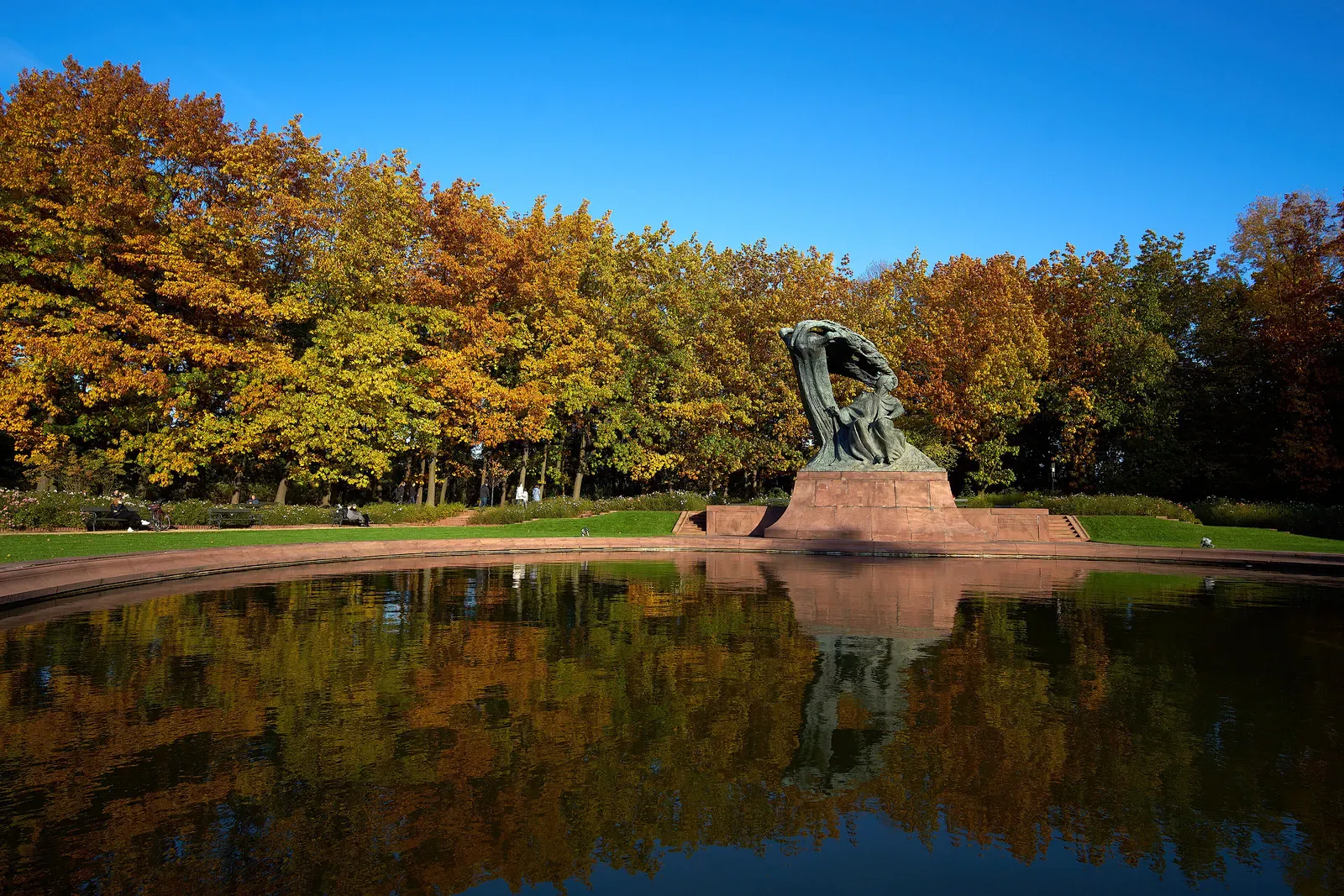
Piano composers carried the forms further. In 1825 Maria Szymanowska published the largest collection of piano mazurkas issued before Chopin. Chopin began writing mazurkas in 1824, reached full maturity in the form by 1830, the year of the November Uprising, and kept composing them until 1849. His mazurkas are more complex than the dance, using counterpoint, chromaticism and harmony, and he appears to have written them so that they could not be danced. Yet they keep the repetition of the folk form and borrow rhythms from the kujawiak and oberek alongside the mazur. In 1828 he wrote a concert krakowiak, the Rondo à la Krakowiak, Op. 14, for piano and orchestra.
The kujawiak entered the canon later. The name first appears in print in 1827, in T. F. Jaskólski’s Sielanki Kujawskie, and the dance is argued to have developed from the mazur between 1750 and 1830. Nobles collected and published its melodies and invited village musicians to teach it at their manors, so it reached ballrooms in the 1860s and was adopted as a national dance at the end of the century.
Concert and state ensembles, 1901-1989
In the 1920s Karol Szymanowski wrote a set of twenty piano mazurkas and added a final pair in 1934, extending the form into a modernist idiom. Michał Kleofas Ogiński, a statesman who wrote about twenty polonaises, had set the polonaise tradition earlier; the Farewell to the Homeland polonaise is traditionally credited to him, though recent research says he did not write it.
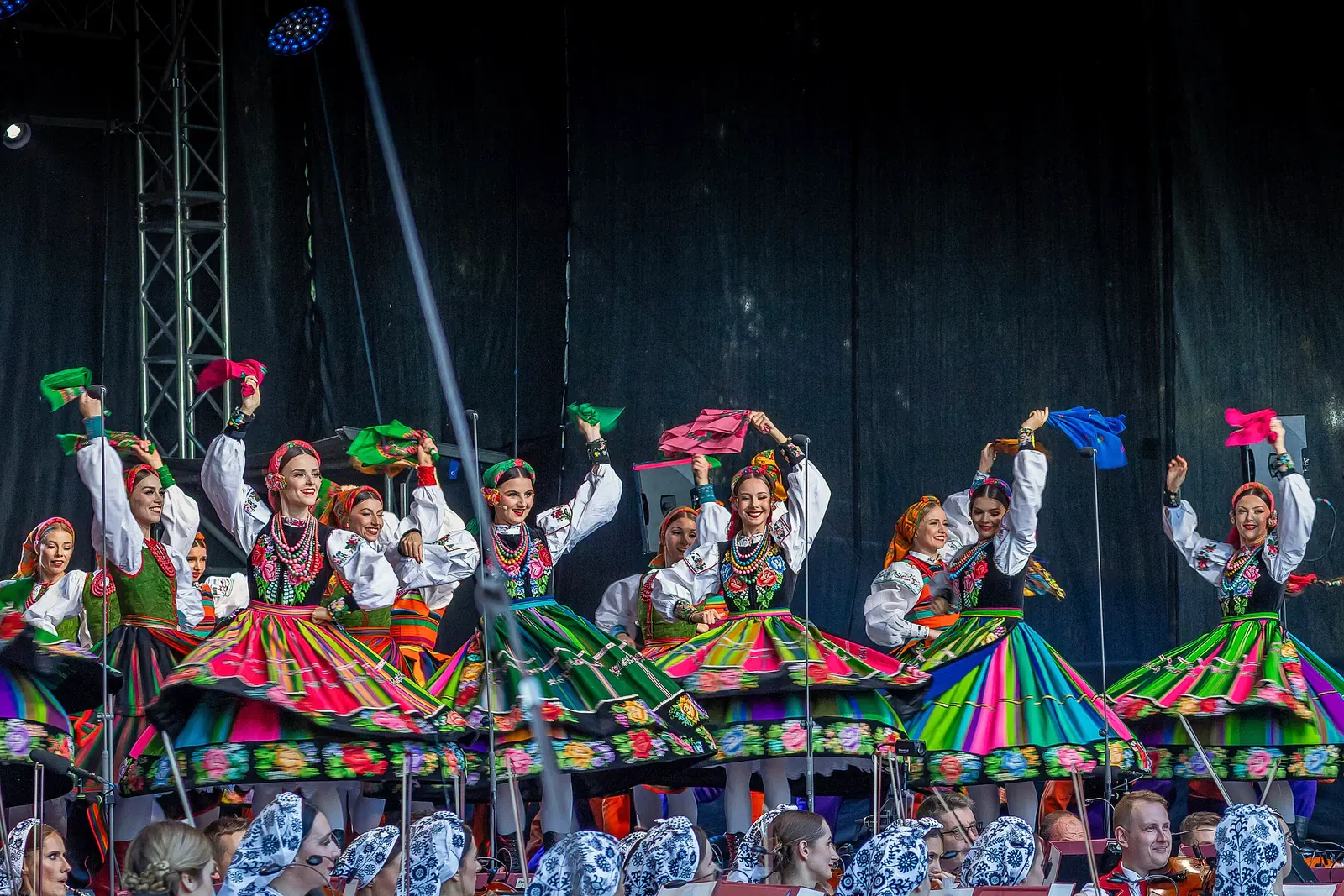
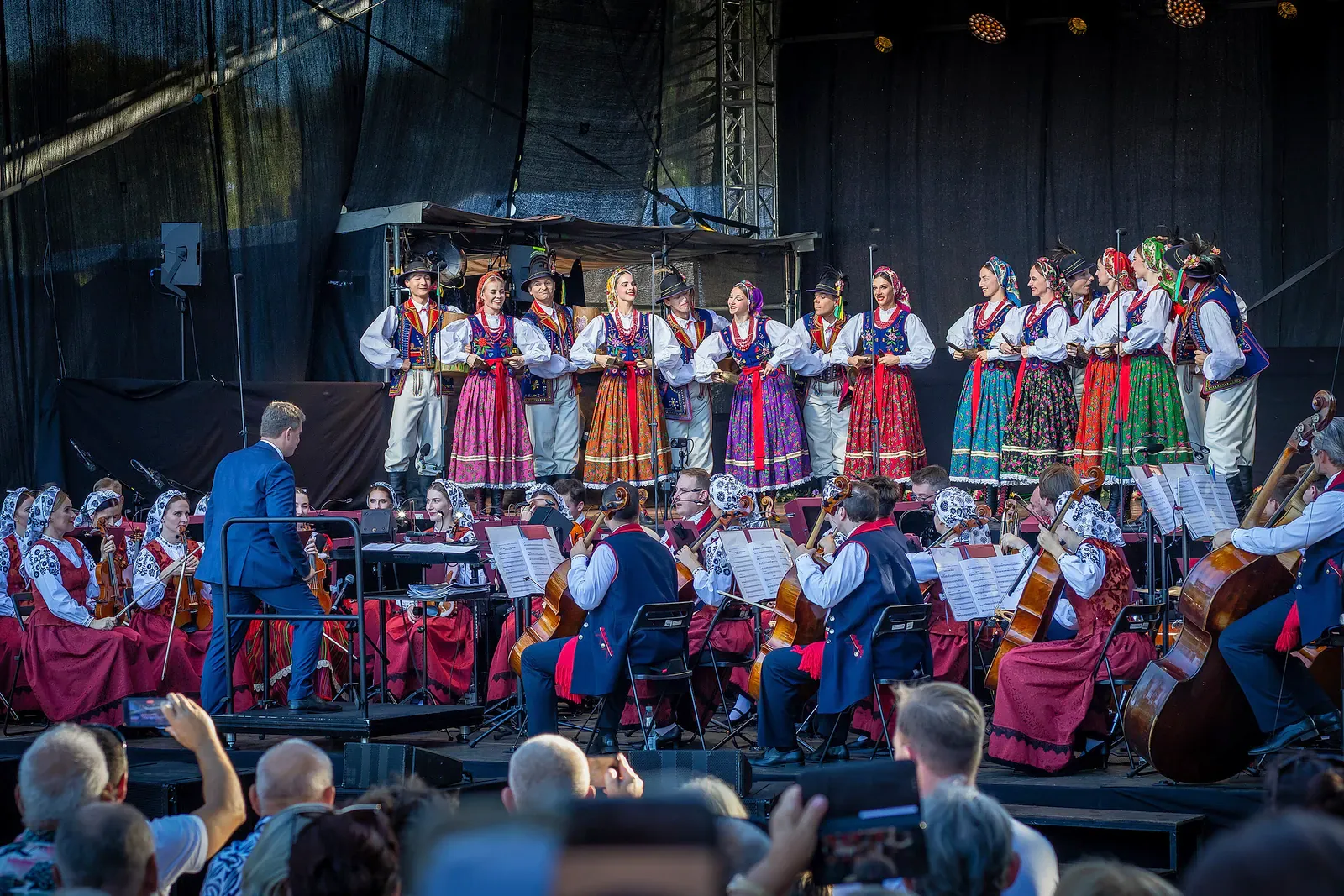
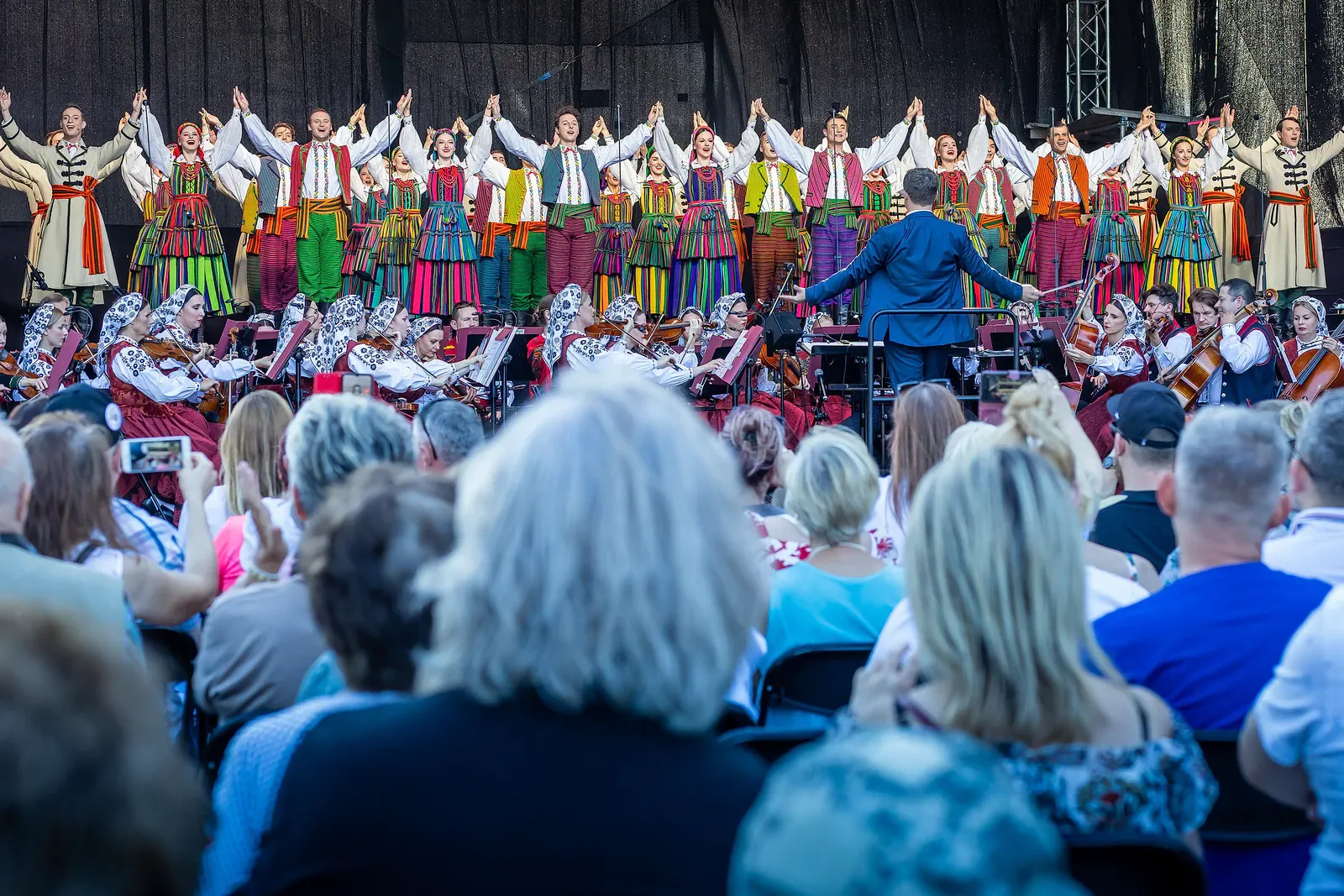
After the Second World War the state took over staging the dances. A ministry decree of 8 November 1948 ordered Tadeusz Sygietyński to form Mazowsze, which gave its premiere at the Polish Theatre in Warsaw on 6 November 1950 with songs and dances from Opoczno, Kurpie and Mazovia. It began touring in 1951, reached Paris in 1954 and the United States six years later. Stanisław Hadyna founded the Śląsk ensemble on 1 July 1953 at Koszęcin palace, and it later widened its repertoire from Upper Silesia to every Polish region.
Characteristics
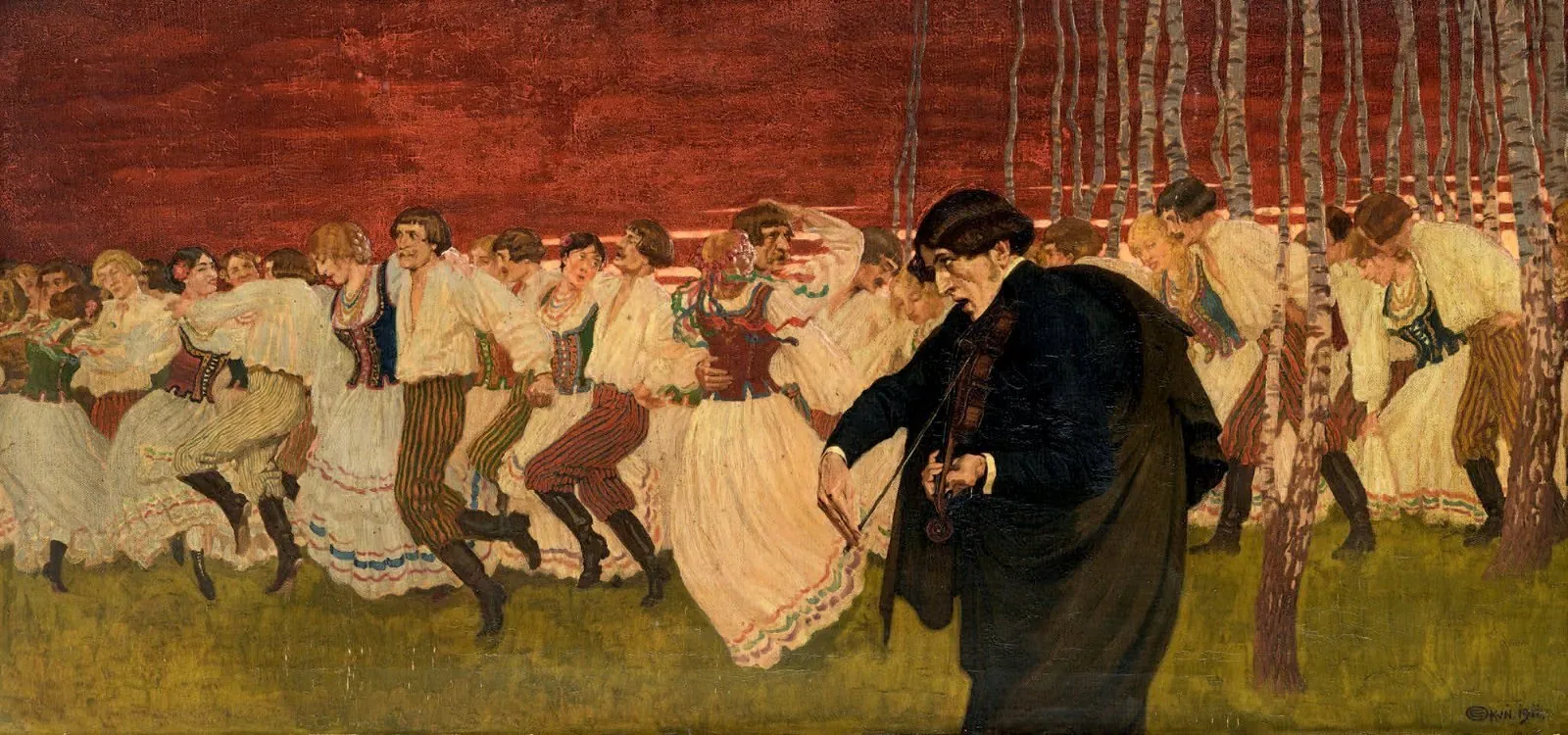
The mazur is the most irregular. Its strong accents fall unpredictably on the second or third beat, and the figure usually opens with a triplet, a trill or a dotted pair before two quarter notes. The kujawiak is slow, lyrical and rubato, in a minor key with plaintive minor thirds, built on two symmetrical four-measure phrases that often end on the dominant and so seem unfinished. The oberek is the fastest, a whirling dance whose name comes from the verb obracać się, to spin, with lifts and jumps for the men. The polonaise is the most stately, a procession in 3/4. The krakowiak differs from all of them: a fast dance in duple time, led by the first man, who sings a melody with new words to his partner while the couples follow in a file.
In village practice the dances were chained. The kujawiak was often one of a suite called okrągły, three dances at rising tempo, preceded by a slow walking dance such as the chodzony and ended by a quick mazurek or oberek. In some regions the order was reversed, from mazur through kujawiak to oberek, with a falling tempo.
Instruments and production
The core village ensemble, the kapela, was led by a violin in central Poland. A Kuyavian band added a basy, a two-string bowed bass played as a percussion instrument, sometimes a clarinet, a small drum called a bębenek and bagpipes known as dudy. Modern Kuyavian ensembles use clarinet, accordion and flutes. A dancer would request a tune by singing it to the band, often to the syllables dana, dana, and the first fiddler had to read the dancer’s movements to follow changes in melody and tempo.
Mainstream success
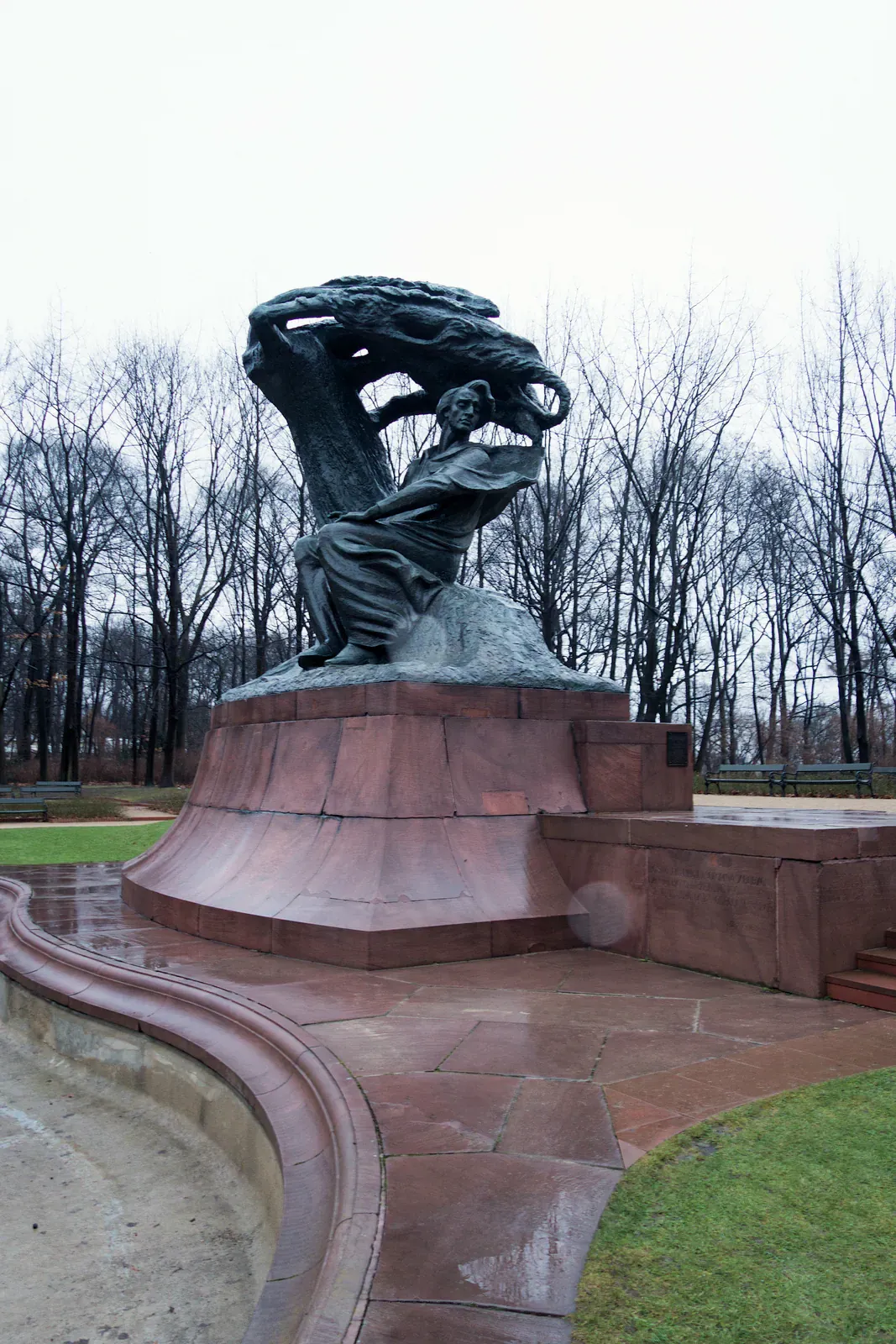
The dances spread through sheet music and the stage rather than a record industry. Ballroom versions reached Vienna, where the krakowiak was the Krakauer, and Paris, where it was the cracovienne. Concert pianists made the polonaise and mazurka standard recital repertoire, and recordings of Chopin’s work became the international face of the dances: Arthur Rubinstein’s mazurkas from 1967 and Maurizio Pollini’s polonaises on Deutsche Grammophon from the 1970s are among the long-standing references.
Notable recordings
Chopin’s Polonaise in A-flat major, Op. 53, known as the Heroic, is the most recognised polonaise in the concert repertoire and shows how far the stately walking dance had been stretched into a virtuoso piece. Rubinstein’s The Mazurkas, issued in 1967, gave listeners a wide view of the form Chopin built from the mazur, kujawiak and oberek. The Polish Song and Dance Ensemble LPs by Śląsk (1963) and Mazowsze (1965) documented stage arrangements of the dances.
Culture
The polonaise still opens large events, New Year’s balls and national days. It is always the first dance at a studniówka, the school ball held about 100 days before the final exams, which gave the event its name. In 2023 the dance was inscribed on the UNESCO intangible heritage lists as a form of joint celebration that marks important moments in family and community life. In 1990 Czesław Sroka’s typology of the national dances fixed standard components for each, giving the kujawiak ten pair positions, fifteen step types, eleven ornaments and eleven figures.
Legacy
The Polish dances gave European music the mazurka and polonaise as piano forms, and with them the idea that a regional dance could carry national feeling in art music. Szymanowska, Chopin, Szymanowski and Scriabin all wrote sets of mazurkas, and the rhythm spread through ballrooms to places as far as Ireland, Brazil and Cape Verde. In Poland the dances survive in school balls, folk ensembles and festivals.
Misconceptions
The mazurka and the mazurek are often treated as one thing, but the mazurek is a rural dance based on the mazur and sometimes identified with the oberek. Chopin’s mazurkas are also not dance music: he composed them to be listened to, and he deliberately distanced them from the folk form. A third misunderstanding is that the five dances are one family of one meter, when the krakowiak is in duple time and the kujawiak, oberek and mazur differ sharply in tempo and accent, which is why a typology was needed in 1990.
Frequently asked questions
What are the five Polish national dances?
The polonaise, mazur (mazurka), kujawiak, oberek and krakowiak. They are called national because almost every region of Poland has its own variety of them. The polonaise is the stately opening dance, the kujawiak is slow and lyrical, the mazur has unpredictable accents, the oberek is the fastest and the krakowiak is a syncopated dance in duple time.
What is the difference between a mazur and an oberek?
Both are triple-meter dances from central Poland. The mazur is slower, with strong accents placed unpredictably on the second or third beat, while the oberek is much quicker and built on constant spinning, lifts and jumps.
Did Chopin write Polish national dances?
He wrote piano pieces in their forms: 58 or more mazurkas, polonaises and a concert krakowiak. These are stylised art-music versions, not dance music, though they borrow rhythms from the mazur, kujawiak and oberek.
Why is the polonaise the first dance at a Polish ball?
It is the most stately of the five dances and works as a procession for large groups. Tradition makes it the opening dance at major events and always at the studniówka school ball.
Are Polish national dances still performed?
Yes, mostly at holidays, major events and in staged shows. State ensembles such as Mazowsze and Śląsk perform them, and the polonaise remains part of school and civic balls.
Sound
Sound sheet
Anatomy of a track
| # | Part | Bars |
|---|---|---|
| 1 | Four-measure phrase A | 4 |
| 2 | Four-measure phrase B | 4 |
| 3 | Sixteen-measure dance phrase | 16 |
Signature sounds
- Accents unsystematically placed on the second or third beat
- Eighth-note pair or trill before two quarter notes
- Plaintive minor thirds in the kujawiak
- Syncopation in the duple-time krakowiak
Drums and percussion
- Bębenek
Techniques
- Displaced accents
- Rubato
- Syncopation
- Sung improvised verses
Keys and modes
Minor mode. The kujawiak is built on a minor key with plaintive minor thirds.
Vocals
Mostly danced to instruments; the krakowiak leader sings improvised verses and kujawiak dancers hum a requested tune.
Scenes
Where it happened
Where and when the sound lived: one bar per city on a shared timeline.
Europe
Active scenes
Peak 4, 1953-2025
Printed krakowiaks, Chopin's early training and the Mazowsze premiere all belong to the capital.
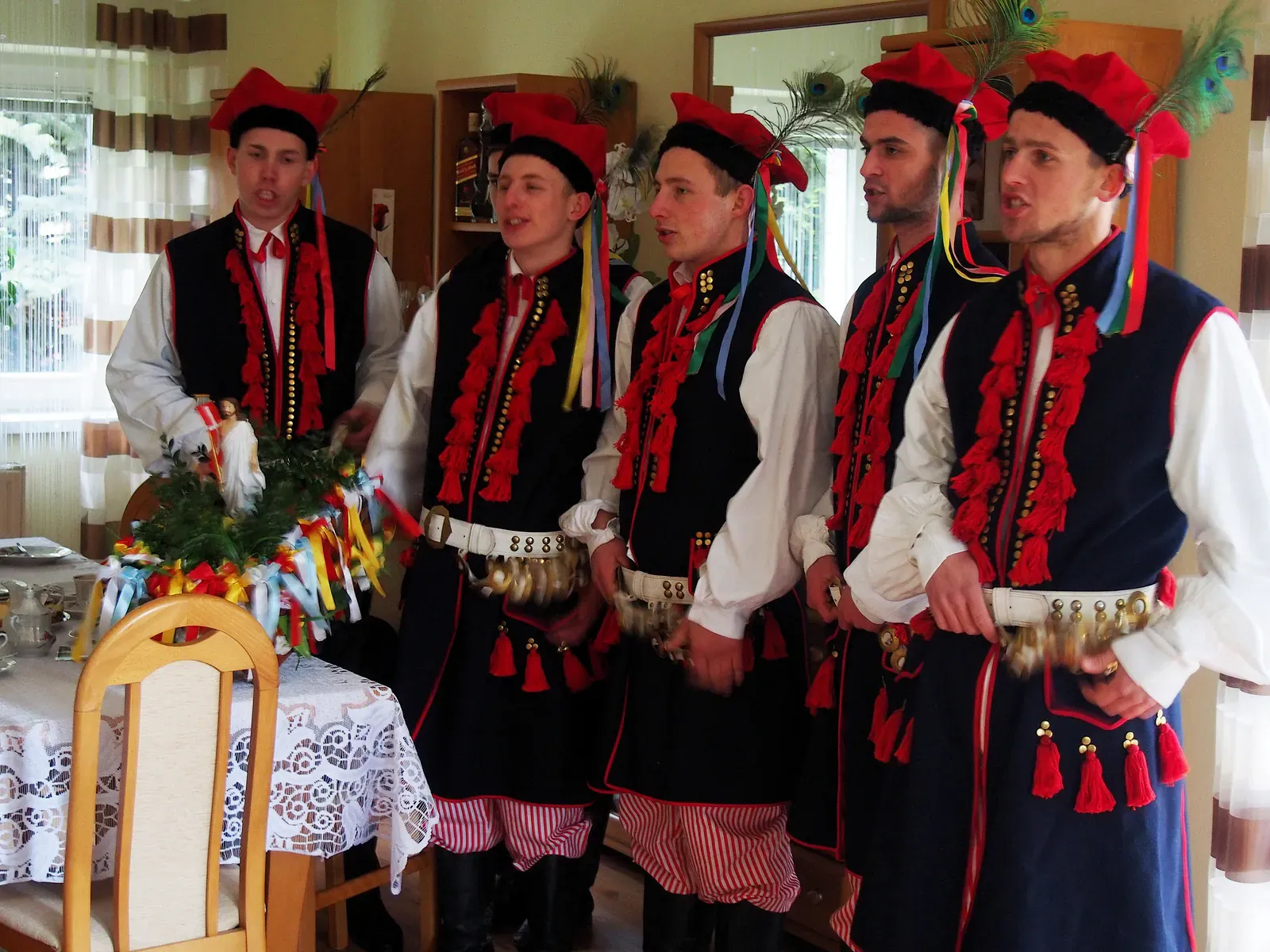
Home region of the krakowiak, whose folk costume with a peacock-feather cap became the national costume.
Principal city of Kuyavia, the region that gave the kujawiak its name.
Palace base of the Śląsk ensemble in Upper Silesia.
Venues and places
Warsaw, 1950 to today. Where Mazowsze staged its premiere on 6 November 1950.
Koszęcin, 1953 to today. Home base of the Śląsk ensemble since its founding.
Culture
Culture markers
- Polonaise opening balls
The polonaise opens large events and is always the first dance at a studniówka.
Dance - Krakowiak costume
The folk outfit with the rogatywka peaked hat and peacock feathers became the national costume.
Fashion - Requesting the tune
In the kujawiak a dancer sang the wanted melody to the band with the syllables dana, dana and paid the fiddler.
Ritual - Okrągły suite
A slow walking dance precedes the kujawiak, then a quick turning mazurek or oberek ends the set.
Dance
Media
Key media
- 1990Polskie tańce narodowe - systematyka
by Czesław Sroka. Standardised typology of the national dances, with components for each.
Book
Glossary
Terms on this page
Score marking for a piece in polonaise rhythm and character.
The older Polish name of the polonaise, meaning walking dance.
A small village band, led by violin, that plays for dances.
A kujawiak suite of three dances at rising tempo, ending in a mazurek or oberek.
School ball held about 100 days before exams, always opened with a polonaise.
Zespół Pieśni i Tańca, a song and dance ensemble such as Mazowsze or Śląsk.
European folk family