Volksmusik
Volksmusik is the traditional folk music of the German- and Slovene-speaking Alps: major-key song and dance for accordion, zither and Hackbrett.
Alps, around 1545
European folk family

Born
around 1545
Alps
Subgenres
7
Documented branches
Links
7
Genres it drew on or shaped
Tempo
85-145 BPMLineage
Family tree
Grew out of
Alps
Volksmusik
Led to (7)
Timeline
Era by era
From the first sparks to today. Select a dot to read the story behind it.
- Oral tradition
1545 to 1926
- Collectors and revival
1927 to 1952
- Stubenmusik and the media boom
1953 to 1972
- Neue Volksmusik
1973 to 2009
- Youth wave
2010 to today
Eras
Moments
- 1 Oral tradition, 1545 to 1926
- 2 Collectors and revival, 1927 to 1952
- 3 Stubenmusik and the media boom, 1953 to 1972
- 4 Neue Volksmusik, 1973 to 2009
- 5 Youth wave, 2010 to today
around 1545
Oral tradition
Herders' calls, yodels, dance tunes and couplets passed by ear in farming communities. The oldest notated Alpine piece, an Appenzell Kuhreihen, dates from 1545.
- 1545Oldest Appenzell Kuhreihen notatedThe earliest surviving Alpine herders' melody was written down in the Appenzell region.
1927
Collectors and revival
Kiem Pauli in Bavaria and Tobi Reiser in Salzburg collected songs, staged singing contests and built institutions that turned village repertoire into an organised movement.
- 1927Kiem Pauli begins collectingKiem Pauli travels farm to farm in Upper Bavaria by bicycle, noting songs that had only been sung by ear.
- 1930Tegernsee singing contestA contest at Rottach-Egern drew nearly 1,000 submitted songs and was broadcast on radio.
- 1934Chromatic Hackbrett builtHeinrich Bandzauner built the chromatic Hackbrett to Tobi Reiser's design, turning a mostly accompanying instrument into a melody voice.
- 1946Salzburger Adventsingen foundedTobi Reiser and Karl Heinrich Waggerl started the Advent singing in Salzburg.
1953
Stubenmusik and the media boom
Reiser's all-string quintet of 1953 set the model for quiet parlour ensembles, while a commercial Volkstümliche Musik grew from the early 1960s as a counterweight to rock and pop.
- 1953Tobi Reiser Quintett foundedZither, guitar, harp, double bass and chromatic Hackbrett played quietly: the template for Stubenmusik groups.
- 1962Volkstümliche Musik emergesA commercial light-folk style is conceived in the early 1960s as a counterweight to youth-oriented rock and pop.
1973
Neue Volksmusik
Werner Pirchner, Biermösl Blosn, Hubert von Goisern and Attwenger mixed dialect folk with satire, jazz, rock and hip-hop, and drew new audiences to the tradition.
- 1973Pirchner starts Alpenrock experimentsTyrolean composer Werner Pirchner begins work cited as an early path to Neue Volksmusik.
- 1976Biermösl Blosn foundedThe Well brothers form a Bavarian band that pairs folk playing with political satire.
- 1979BayWa anthem parody broadcastBavarian television airs Biermösl Blosn's parody of the Bavarian anthem; the backlash keeps the group off the broadcaster for years.
- 1986Original Alpinkatzen formedHubert Achleitner and Wolfgang Staribacher found the band and take the stage names von Goisern and von Wien.
- 1990Attwenger formed in LinzA drummer and a button accordion player combine Upper Austrian dialect folk with hip-hop.
- 1992Koa Hiatamadl reaches No. 2 in AustriaThe Alpinkatzen album Aufgeig'n statt niederschiass'n brings Alpine rock to national charts.
2010
Youth wave
In Switzerland a wave of Volksmusik has reached urban young people since 2010, partly blended with rap and pop, while local ensembles and broadcasts keep the traditional repertoire alive.
- 2012Biermösl Blosn play a last concertThe Well brothers end their band after 36 years with a final show in Fürth on 18 January.
Listening path
Start listening
A short path from an easy way in to the deep end. Thumbnails come from YouTube; the player loads only when you press play.
- 01
Hubert von Goisern und die Alpinkatzen, 1992
The Alpine rock single that reached No. 2 in Austria and brought dialect folk to the pop mainstream.
- 02
Hubert von Goisern und die Alpinkatzen, 1992
Companion single from the breakthrough album, blending accordion and yodel colours with rock.
- 03
Biermösl Blosn, 1982
Satirical folk song that parodies the Bavarian anthem and triggered a broadcast ban.
- 04
Attwenger, 2026
A recent track of the Upper Austrian dialect duo that carries the tradition into club-style beats.
Facts
| Family | European folk |
| Origin | Alps, Austria |
| Emerged | Documented from 16th century |
| Status | Active |
| Tempo | 85 to 145 BPM |
| Meter | 3/4 |
| Subgenres | 7 |
Volksmusik, in the Alpine sense, is the common name for the traditional folk music of the German- and Slovene-speaking Alpine regions of Austria, Bavaria, Switzerland, South Tyrol and Slovenia.
It is sung and played in dialect for dances, inns and family gatherings, built on simple major-key melodies, and passed on largely by ear. Its oldest written traces date from the 16th century. It belongs to the European folk family and differs from Volkstümliche Musik, the commercial light folk of television and record charts.
Origins
The tradition grew out of farming and herding communities, where music was a matter of amateurs rather than professionals. Pieces were handed down without notation over generations, which favoured short forms, repetition and endless variants of the same tune. The oldest surviving Alpine piece is an Appenzell Kuhreihen, a herders’ melody written down in 1545.
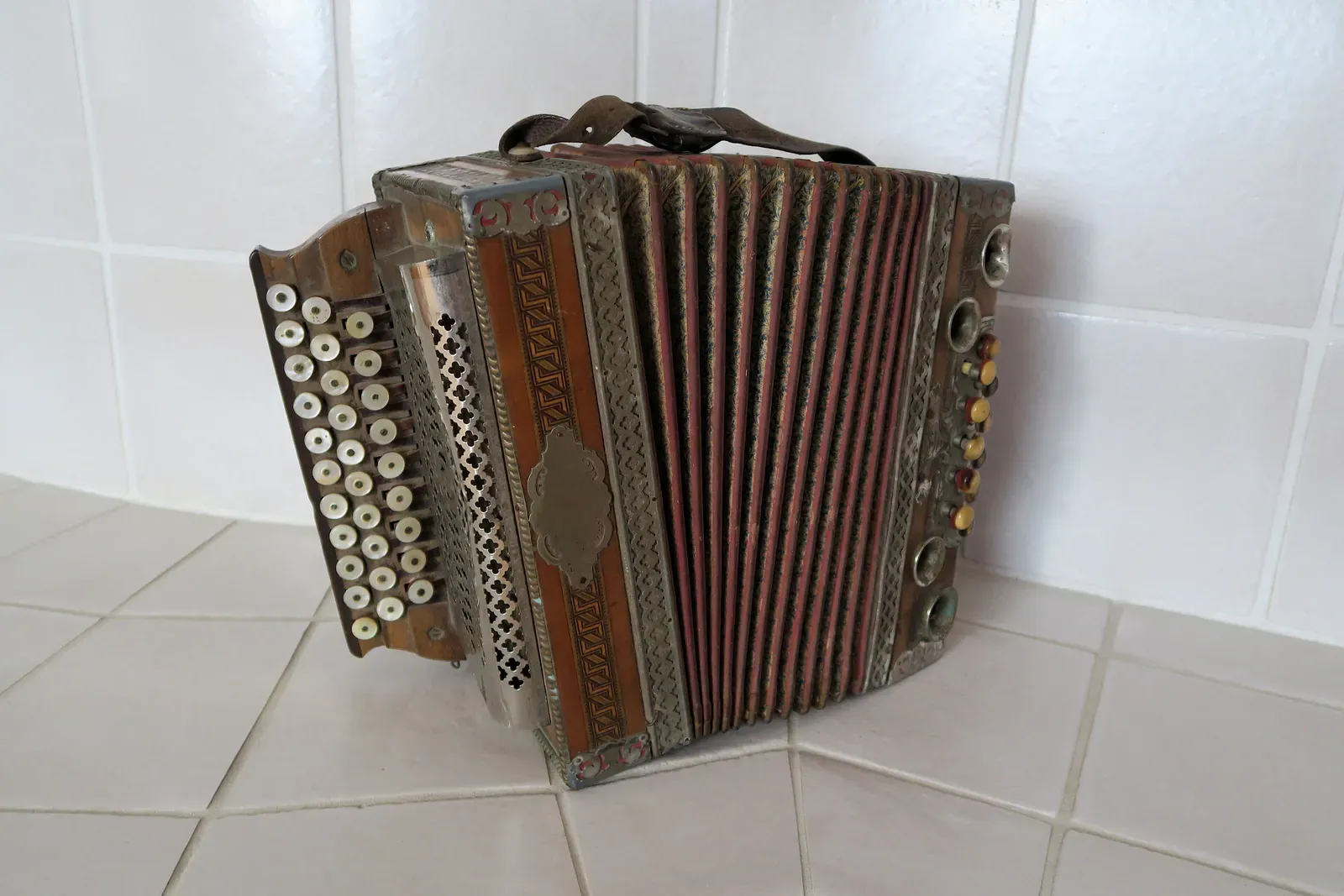
Most of what is now called traditional repertoire belongs to dance music: waltz, polka, march, Ländler, Boarischer, mazurka and the Zwiefacher, which alternates between three-four and two-four. Couplets known as Gstanzl and yodels sit beside them. The Ländler, a partner dance with hopping and stamping, is thought to have influenced the Viennese waltz, and composers from Schubert to Mahler borrowed its manner. In Vienna, the Steirische Harmonika was built as a diatonic button accordion for rural music, and the city’s trade even gave it the name “steirisch” as a byword for country sounds.
Collectors and revival, 1927-1952
By the 1920s, much of the oral repertoire was fading. The Bavarian musician Kiem Pauli began cycling from farm to farm in Upper Bavaria in 1927, asking people to sing and noting down what he heard. A singing contest at the Gasthaus Überfahrt in Rottach-Egern in March 1930 drew nearly 1,000 submitted songs and was broadcast on radio. His collection of Upper Bavarian songs appeared in 1934.
Reiser and Otto Eberhard staged the first public Volksliedsingen in St. Johann im Pongau in 1932. In 1934 the Salzburg instrument maker Heinrich Bandzauner built a chromatic Hackbrett to Reiser’s design, which made a hammered box zither that had mostly accompanied other instruments into a melody voice.
This movement had a dark side. Historians have shown that Reiser was a convinced National Socialist who hosted a monthly programme on a Vienna radio station during the war; he was stripped of all offices in 1945. A prize named after him is no longer awarded. Volksmusik had been claimed by nationalist movements, which is part of why the word still carries political weight in German-speaking countries.
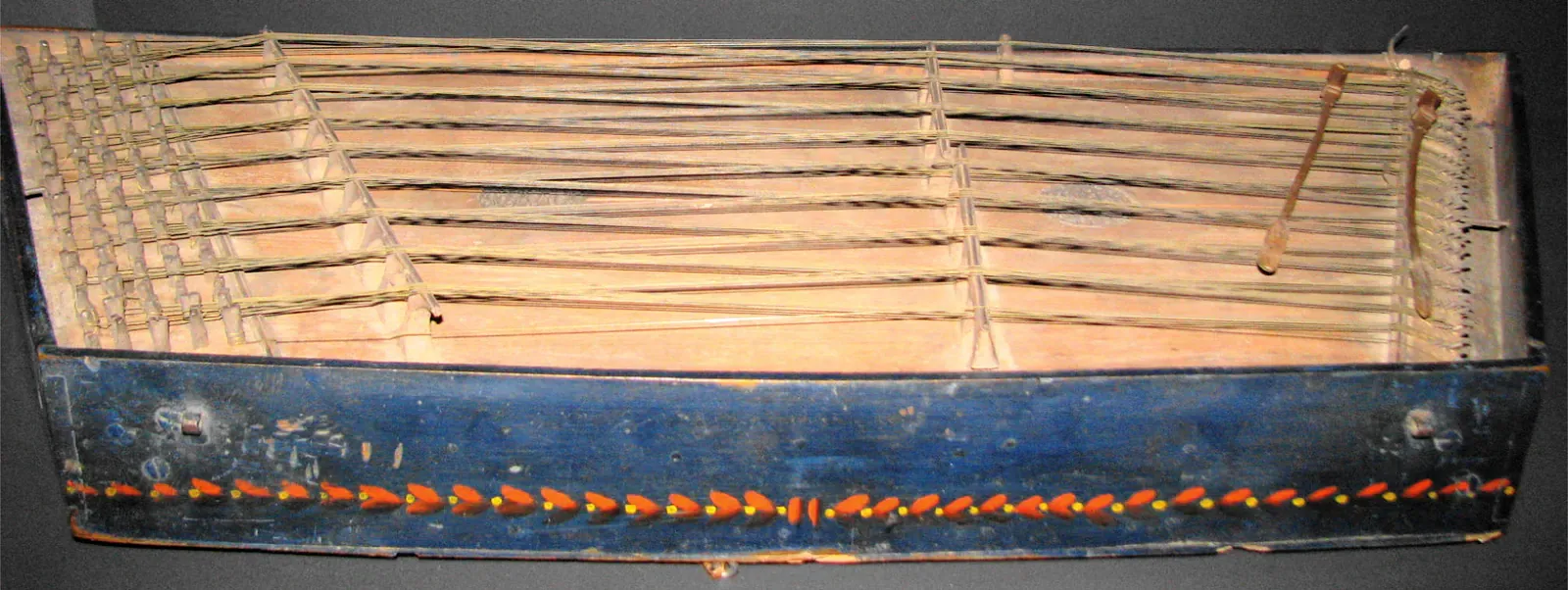
Stubenmusik and the media boom, 1953-1972
After the war Reiser founded the Salzburger Adventsingen with Karl Heinrich Waggerl in 1946, and in 1953 his quintet of zither, guitar, harp, double bass and chromatic Hackbrett set a new model. All the instruments were plucked or struck and played quietly, for small rooms rather than loud dance halls. This Stubenmusik became the pattern for ensembles in Austria and Bavaria, and within about sixty years it was widely taken for the oldest form of the tradition, although it dates from the 1950s.
From the early 1960s a different strand grew in the media. Volkstümliche Musik was conceived as a commercial counterweight to rock and pop, borrowing folk imagery and linking it to light dance music from waltz to swing.
Neue Volksmusik, 1973-2009
In the 1970s musicians began to bend the tradition. The Tyrolean composer Werner Pirchner, from 1973, and the Bavarian band Biermösl Blosn, founded in 1976 by the brothers Hans, Christoph and Michael Well, combined folk playing with jazz, satire and politics. The label Neue Volksmusik covers this crossover with jazz, folk, rock, electronic music and hip-hop.
Hubert von Goisern founded the Original Alpinkatzen in 1986, and his 1992 album Aufgeig’n statt niederschiass’n made Alpine rock a national phenomenon. Attwenger, a duo formed in Linz in 1990, took Upper Austrian dialect and button accordion into hip-hop territory. Festivals followed, among them Schräg Dahoam in Munich in 1993 and Gratwanderung in Piesendorf in 1995.
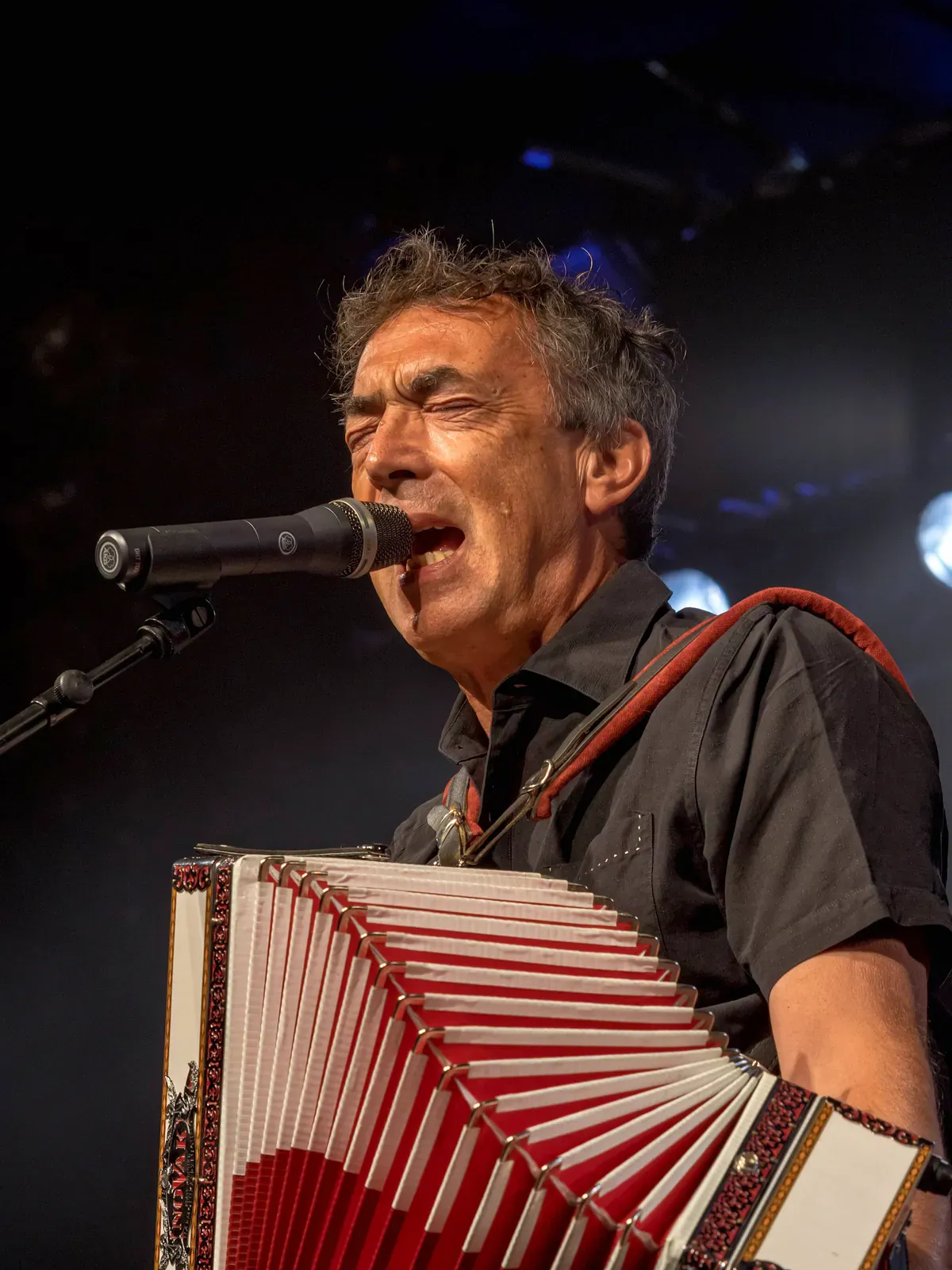
Youth wave, 2010 onwards
Since 2010 a wave of Volksmusik has reached urban young people in Switzerland, in some cases blended with rap and pop. Elsewhere, local ensembles and regional broadcasts keep the repertoire alive across the Austrian-Bavarian border.
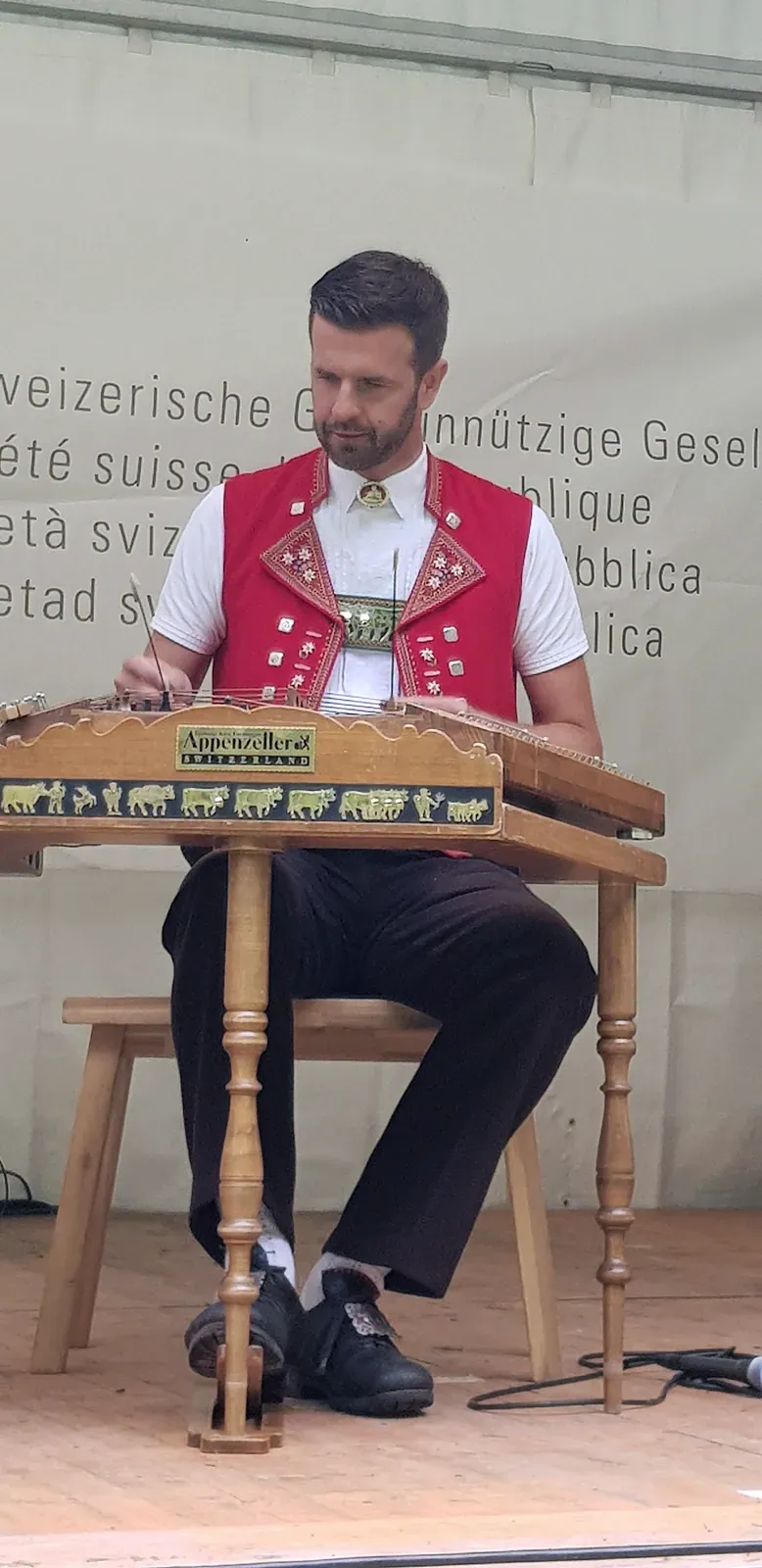
Characteristics
Melodies tend to hop through broken triads, which a German source describes as bouncing up and down like the Alps. Keys are mostly major, harmony is built on tonic and dominant with occasional visits to the subdominant, and bass lines keep to roots. A main voice is usually joined by a second voice a third above, or a sixth below, with an optional third. Each piece exists in countless variants, and the habit of playing “aus’n Huat”, freely and without notation, works only because the harmonic rules are shared by everyone in the room.
Dance pieces are metrical, with the Ländler in three-four time.
Instruments and production
The core instruments are the Steirische Harmonika, zither, Hackbrett, guitar, harp, violin and double bass, with brass for marches and the long alphorn for herders’ calls. The harmonika is loud and carries a dance; Stubenmusik uses strings to sound quiet and concert-like. Commercial Volkstümliche Musik, by contrast, mostly uses drum machines and synthesizers.
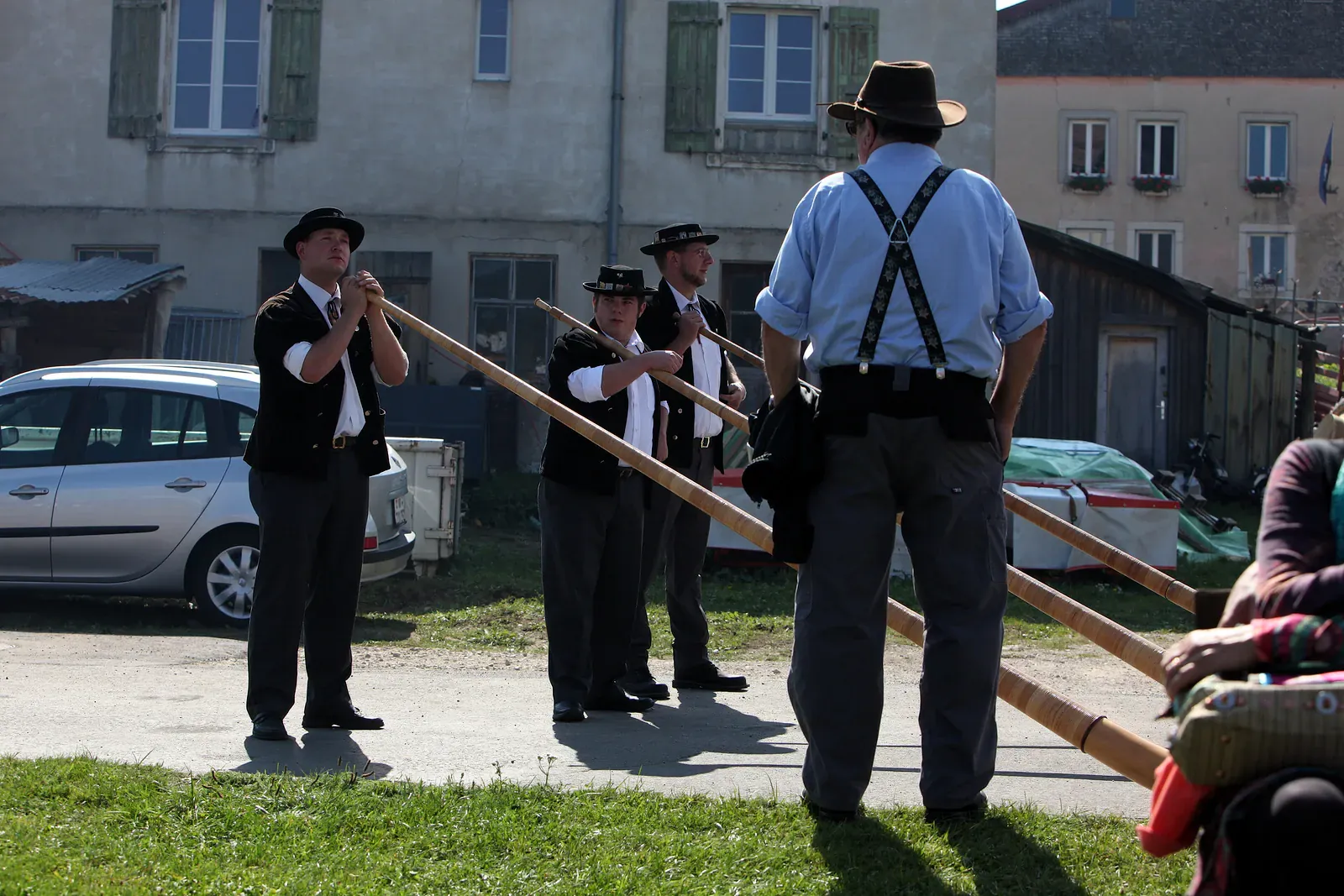
Mainstream success
Traditional Volksmusik lives largely on regional radio and television in Bavaria, Austria and Switzerland, with programmes such as the ORF series Klingendes Österreich, presented by Sepp Forcher from 1986 to 2020. The mass-market version went further: Musikantenstadl ran from 1981, and the Grand Prix der Volksmusik from 1986 to 2010, promoting acts such as Heino, Die Flippers and Andy Borg. Its acts merged increasingly with schlager.
The biggest crossover from the traditional side came with the Alpinkatzen. “Koa Hiatamadl” received extended airplay in 1992 and peaked at No. 2 in the Austrian singles chart. Hubert von Goisern’s second album, Omunduntn, followed in 1994, after which the band gave a farewell tour.
Notable recordings
“Koa Hiatamadl” (“no herder girl”) comes from Aufgeig’n statt niederschiass’n, the 1992 album that also held “Weit, weit weg” and “Heast as nit”. It combined the Alpine accordion and yodel colours with a rock band, and the Alpinkatzen then toured German-speaking countries.
“Gott mit dir, du Land der BayWa” by Biermösl Blosn parodies the Bavarian anthem to attack heavy fertilizer use in farming, naming the BayWa company that sold much of it. Bavarian television broadcast it in 1979. The reaction was so hostile that the broadcaster did not air the group’s music for years, and in 2001 the Bavarian education ministry kept the song out of a school songbook for lampooning the anthem.
Attwenger’s work shows how far the crossover reaches. The accordionist Hans-Peter Falkner sends his instrument through effects pedals to get a distorted, guitar-like timbre, while the drummer Markus Binder sometimes adds drum machines. The duo toured Zimbabwe in 1993 and Siberia, Pakistan, Vietnam and Malaysia in 1995, and Binder’s soundtrack for the film Club Zero won an award at the European Film Awards in 2023.
Culture
The Ländler remains the emblem of the dance side, and the Schuhplattler, a slapping dance, belongs to the same group of Austrian folk dances. Public singing contests and the Advent singing in Salzburg turned house repertoire into community events. Dialect and local identity stay central to the songs.
Legacy
Volksmusik gave the Alpine regions a repertoire shared across borders. Its dialect songs and instruments feed Alpine rock and crossover acts that mix the tradition with hip-hop.
Misconceptions
The first myth is that Volksmusik is the music of Musikantenstadl. That programme belongs to Volkstümliche Musik, a commercial form of the 1960s onward, and the two are kept apart in Bavaria, Austria and Switzerland.
The second is that Stubenmusik is the oldest layer. It was shaped by Tobi Reiser in the 1950s, and older dance music had to be played loudly over the noise of dancers.
The third is that Volksmusik is the music of a nation. Many tunes cross language and state borders, as the Zwiefacher shows, and texts are translated while melodies are passed on. The idea of a national folk music grew mostly through nationalist appropriation.
Frequently asked questions
What is Volksmusik?
Volksmusik is the traditional folk music of the Alpine regions of Austria, Bavaria, Switzerland, South Tyrol and Slovenia. It features dialect singing, yodeling, dances and instruments such as the Steirische Harmonika and zither.
What is the difference between Volksmusik and Volkstümliche Musik?
Volksmusik is handmade regional music passed down locally. Volkstümliche Musik is commercial entertainment performed by celebrity singers, with newly written cheerful songs.
Which instruments are typical for Alpine Volksmusik?
The Steirische Harmonika, zither, Hackbrett, guitar, harp and double bass are typical, together with violin, brass and the alphorn.
What is Neue Volksmusik?
Neue Volksmusik is a crossover that combines Volksmusik elements with jazz, rock, electronic music or hip-hop. Biermösl Blosn, Hubert von Goisern and Attwenger are well-known examples.
Who is Hubert von Goisern?
Hubert von Goisern is an Austrian singer-songwriter who founded the Original Alpinkatzen in 1986 and became a leading Alpine rock artist after 1992.
Sound
Sound sheet
Signature sounds
- Broken-chord melodies in major keys
- Parallel two-part singing a third apart
- Tonic and dominant harmony with root-note bass
- Yodel refrains and dialect lyrics
Techniques
- Parallel thirds
- Yodeling
- Free variation
- Functional bass
Keys and modes
Major keys. Melodies mostly major, built from broken triads with simple harmony.
Vocals
Dialect singing in harmony, with yodel refrains and satirical couplets.
Scenes
Where it happened
Where and when the sound lived: one bar per city on a shared timeline.
Europe
Active scenes
Peak 5, 1990-2025
Site of the 1930 Tegernsee singing contest that anchored the Bavarian revival.
Tobi Reiser's base: Adventsingen, a Heimatwerk and the Stubenmusik quintet.
Place where the Well brothers founded Biermösl Blosn.
Home town behind Hubert von Goisern's stage name.
Where Attwenger formed.
Venues and places
Rottach-Egern, 1930 to today. Inn that hosted the 1930 Tegernsee singing contest.
Munich, 1994 to today. Where the Alpinkatzen's farewell concert of 1994 was filmed.
Culture
Culture markers
- Ländler
A partner dance in three-four time with hopping and stamping, sometimes with yodeling.
Dance - Singing contests and Advent singing
Public Preissingen and Adventsingen turned house repertoire into staged community events.
Ritual - Musizieren aus'n Huat
Free ensemble playing without notation, made possible by shared simple harmonic habits.
Slang - Schuhplattler
Slapping dance named with the Ländler as a main Austrian folk dance.
Dance
Media
Key media
- 1934Sammlung oberbayrischer Volkslieder
by Kiem Pauli. The Upper Bavarian song collection that grew out of his bicycle field trips.
Book - 1995Wia die Zeit vergeht
by Joseph Vilsmaier. Concert documentary of the Alpinkatzen's farewell at Circus Krone, shown at the Munich festival.
Film - 2016Tobi Reiser und der Nationalsozialismus
by Oliver Rathkolb. Historian's study of Reiser's Nazi-era role and the politics of Volksmusik work.
Book
Glossary
Terms on this page
Short couplet sung to a fixed tune, often improvised and teasing.
Wordless yodel refrain; the Naturjodler of Swiss and Allgäu valleys avoids instrumental accompaniment.
Herders' song or call of the Alpine pastures; the oldest notated example comes from Appenzell.
Crossover that joins Volksmusik elements with jazz, rock, electronic music or hip-hop.
Small, quiet ensemble music for the parlour rather than the dance floor, modelled on Tobi Reiser's string quintet.
Commercial light folk of broadcasting and merchandise, often confused with traditional Volksmusik.
European folk family