Children's music
Children's music is music written and performed for young listeners, mixing entertainment with teaching, from nursery rhymes to television and film songs.
United Kingdom, United States, 1870
Pop family
Born
1870
United Kingdom, United States
Subgenres
5
Documented branches
Links
8
Genres it drew on or shaped
Tempo
75-140 BPMLineage
Family tree
Grew out of
United Kingdom, United States, 1870
Children's music
Led to (5)
Timeline
Era by era
From the first sparks to today. Select a dot to read the story behind it.
- School and parlour songs
1870 to 1920
- Records and animated films
1888 to 1955
- Folk revival and television
1956 to 1975
- A distinct industry
1976 to 2005
- Streaming and video
2006 to today
Eras
Moments
- 1 School and parlour songs, 1870 to 1920
- 2 Records and animated films, 1888 to 1955
- 3 Folk revival and television, 1956 to 1975
- 4 A distinct industry, 1976 to 2005
- 5 Streaming and video, 2006 to today
1870
School and parlour songs
Compulsory class singing in England and the Tin Pan Alley publishers created school operettas, choral works and songs aimed at children.
- 1870Education Act makes class singing compulsorySchool singing in England created demand for choral works and school operettas.
1888
Records and animated films
Nursery rhymes appeared on the first discs sold in 1888, and record companies and Disney films made children's songs a regular product.
- 1888First discs on sale include Mother Goose rhymesChildren's titles sat in the earliest catalogues of the recording industry.
- 1937Snow White and the Seven DwarfsThe first feature-length animation set the pattern of fairy tale, animation and signature songs.
around 1956
Folk revival and television
Folk singers aimed albums at baby boomer families, and Sesame Street and Schoolhouse Rock! made teaching songs a television staple.
- 1957Ella Jenkins records for FolkwaysHer call-and-response albums brought world songs and participation to children's records.
- 1958The Chipmunk Song reaches No. 1A novelty single with sped-up voices topped the US chart.
- 1969Sesame Street launchesSongs by Joe Raposo and Jeff Moss became the model for educational television music.
1976
A distinct industry
Raffi, The Wiggles and the Disney animated musicals turned children's music into its own market with touring acts and soundtrack sales.
- 1976Raffi releases Singable Songs for the Very YoungThe album began a career that helped children's music become a market of its own.
- 1989The Little Mermaid revives the Disney musicalUnder the Sea won the Oscar for best song, and later Disney features repeated the feat.
- 1991The Wiggles form in SydneyThe group grew into one of the biggest touring acts for young children.
2006
Streaming and video
Soundtracks and compilations topped adult charts, and video platforms made children's songs among the most viewed videos online.
- 2006Children's albums hold the top three Billboard spotsHigh School Musical, Kidz Bop and the Curious George soundtrack led the chart.
- 2016Baby Shark and the streaming eraSmithsonian Folkways acquired the Bobby Susser series in 2016, and Pinkfong's Baby Shark Dance became a global video hit.
Listening path
Start listening
A short path from an easy way in to the deep end. Thumbnails come from YouTube; the player loads only when you press play.
- 01
Ella Jenkins, 1966
Call-and-response singing at its plainest, with the leader and the group trading phrases.
- 02
Ernie, 1970
A television song with a gentle swing, a simple hook and a toy as the subject.
- 03
Raffi, 1980
A story song with a repeated refrain, sung slowly and clearly.
- 04
The Wiggles, 1994
An action song built on a quick call to dance and shout.
- 05
Pinkfong, 2016
A modern video hit that pairs a repeated hook with choreography.
Facts
| Family | Pop |
| Origin | United Kingdom, United States |
| Emerged | 19th century; industry from the 1870s |
| Status | Active |
| Tempo | 75 to 140 BPM |
| Meter | 4/4 |
| Subgenres | 5 |
Children’s music, also called kids’ music, is music composed and performed for a young audience, usually by adults. It began as school and nursery repertoire in the nineteenth century and became a recording and television industry in the twentieth.
Its songs use simple melodies, repetition, call-and-response and lyrics that teach or entertain, and it sits within the pop family while borrowing heavily from folk traditions.
Origins
Class singing became compulsory in England with the Education Act of 1870. Within a few decades, demand for choral works for schools had produced more than 50 school operettas in the catalogue of one leading publisher, most modelled on the tuneful, humorous and morally safe operettas of Gilbert and Sullivan. Composers with serious reputations, among them Gustav Holst, wrote for the genre.
The popular song industry followed. Tin Pan Alley publishers in New York turned out songs aimed at children, such as School Days in 1907, and the tune of Teddy Bears’ Picnic, composed by John William Bratton in 1907, gained its lyrics in 1932. Many songs of the period were older folk material, nursery rhymes and play songs, adapted for printing and for the piano at home.
Records and animated films, 1888-1955
Children’s titles sat in recorded sound from the beginning. The first words ever recorded, in 1860, were a verse of the French song Au clair de la lune, and the first discs offered for sale in 1888 included Mother Goose rhymes. The early catalogues of the major recording companies all carried separate children’s sections.
From the 1930s through the 1950s, record companies issued albums based on cartoons and nursery rhymes, often as read-along sets with booklets that told the child when to turn the page. Film shaped the repertoire as much as records did. The first popular Disney song, Minnie’s Yoo Hoo, dates from 1930, and Snow White and the Seven Dwarfs in 1937 fixed a pattern of fairy tale, animation and signature songs that Disney followed into the 1970s. The company’s music arm, Walt Disney Records, grew out of this tradition.
Folk revival and television, 1956-1975
The arrival of the baby boomers created a market for children’s music as a separate category. Woody Guthrie, Pete Seeger and Ella Jenkins were among a group of socially minded performers who made albums for this audience. Jenkins, who began recording for children in the 1950s, built her work on call-and-response, inviting children to repeat a phrase back to the leader, and drew on songs from many countries; her catalogue later sat with Smithsonian Folkways. In the 1960s Peter, Paul and Mary, the Limeliters and Tom Paxton also wrote albums for children.
Novelty records reached the top of the pop charts in the same years. The Chipmunk Song, sung by sped-up voices, reached No. 1 in 1958, and Rudolph the Red-Nosed Reindeer, which began as a department store promotion, became a book and a television special.
Television set the next template. Sesame Street launched in 1969 in the United States, with songs by Joe Raposo and Jeff Moss, and its music has won many Grammy Awards. Rubber Duckie, from 1970, became one of its best known songs. Schoolhouse Rock! on network television and the music of Mister Rogers’ Neighborhood on public television pursued the same aim of teaching a subject through a tune.

A distinct industry, 1976-2005
In the late 1970s the Canadian singer Raffi arrived with Singable Songs for the Very Young, and children’s music took shape as a market in its own right, with its own touring circuit, retailers and radio. Raffi’s Baby Beluga, from 1980, became his best known song. Other performers worked in the same space, among them Fred Penner and Sharon, Lois and Bram in Canada and Red Grammer in the United States.
The Wiggles formed in Sydney in 1991 and grew into a major touring act for preschoolers, built on action songs, bright costumes and the repeated format of the live show. Disney returned to the animated musical with The Little Mermaid in 1989, whose song Under the Sea won the Oscar for best song, and Beauty and the Beast, Aladdin, The Lion King and Pocahontas each took the same award in the following years.

Characteristics
Children’s music is defined by its listener more than by one musical style. Melodies are simple and usually stay within about an octave so that children can sing them. Songs lean on repetition, with a refrain that returns often and verses that change one word at a time, as in counting and animal songs. Call-and-response gives the child a part, and action songs attach movements such as clapping, stamping or pointing to the lyrics.
Lyrics have a dual role. Many songs aim to teach about culture, behaviour, facts or skills, while others simply entertain. Tempos tend to sit in a moderate range, from slow story songs and lullabies to brisk dance numbers, and accompaniment is kept clear so that the words can be heard.
Instruments and production
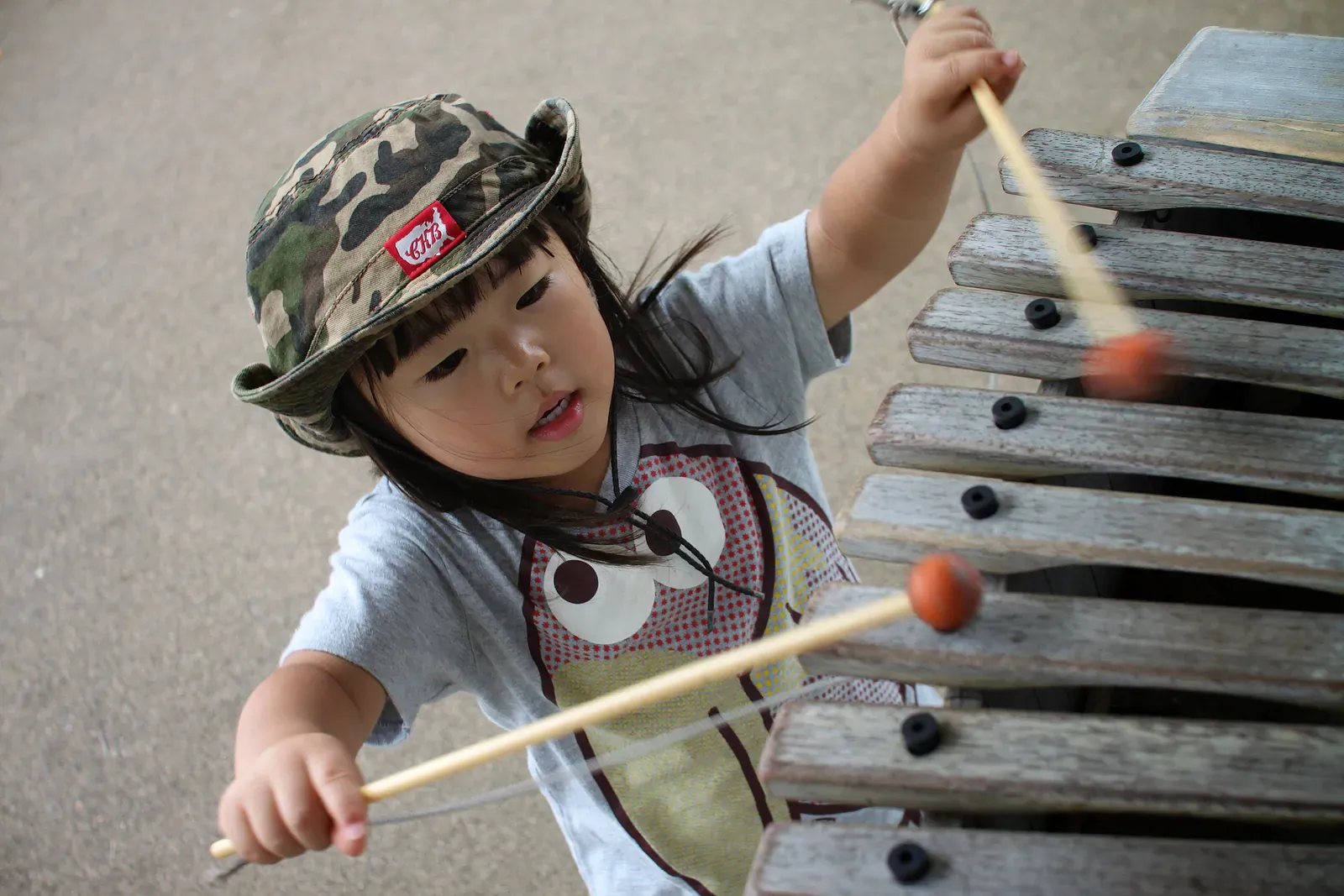
Early children’s records relied on piano, voice and a small ensemble; folk-based artists used acoustic guitar. Percussion such as shakers and tambourines and bright tuned instruments such as the xylophone and glockenspiel are favoured because children can hear and imitate them. Producers choose clean, close-miked vocals, simple arrangements and sound effects such as animal noises. Television and film songs add orchestral or theatre-style arrangements, and recent video-led hits are produced for the screen first, with animation and choreography built around the song.
Mainstream success
Children’s music has repeatedly reached the general charts. In early 2006 the top three albums on the Billboard chart were the High School Musical soundtrack, a volume of the Kidz Bop series and the Curious George film soundtrack. Most albums aimed at a national children’s audience in this period were film soundtracks or tie-ins with mass-marketed acts such as The Wiggles.
The twenty-first century also brought many independent performers, including Dan Zanes, Laurie Berkner and the Imagination Movers, who gained exposure on cable channels for children. Rock acts such as They Might Be Giants released albums for children, and some children’s acts crossed the other way and toured with adult rock and punk bands. In 2016 Smithsonian Folkways acquired the Bobby Susser series, which had passed five million CD sales by 2009.
Streaming era
As children moved to smartphones, tablets and smart televisions, kids’ songs entered the on-demand era. On video platforms, some children’s songs have passed one billion views and rank among the most viewed videos of all time. Baby Shark Dance, a production from the Seoul studio Pinkfong that reached an international audience in 2016, is the best known example. The format favours a short, repeated hook, bright animation and a dance that children can copy, and it has reshaped how new songs are produced and released.
Culture
Children’s songs are tied to rituals of care and play. Lullabies belong to bedtime, action songs to circle time and playgrounds, and counting rhymes to games. Costumed characters, puppets and mascots, from Sesame Street’s Big Bird to the coloured outfits of touring groups, give acts a recognisable face for very young viewers. Parents and teachers are the gatekeepers of the market, so albums are often judged by adults on educational value as well as by children on appeal.
Legacy
Children’s music supplied the first musical memories of generations and carried folk songs across borders, from nursery rhymes in England to the world songs in Ella Jenkins’s catalogue. Its methods, especially call-and-response, repetition and singable melodies, were adopted by classroom music teaching. Television and film songs established the model for musical storytelling in animation, and the online video hits of recent years show the same principles adapted to a new medium.
Misconceptions
One common belief is that children’s music is a single style. It draws on folk, pop, jazz, rock and hip-hop, and the artists differ widely in sound; what unites them is the audience and the aim. Another is that it is only for babies and toddlers. School operettas, pop cantatas and film musicals were written for older children, and some acts such as Kidz Bop target older children with adapted pop songs. A third is that it is a recent commercial invention. Songs for children appear in the earliest recording catalogues of 1888 and in printed school music long before.
Frequently asked questions
What is children’s music?
Children’s music is music written and performed for young listeners, usually by adults, which combines entertainment with teaching. It includes nursery rhymes, school songs, action songs, lullabies and songs from television and film.
When did children’s music begin?
Songs for children are very old, but a dedicated children’s music industry dates from about the 1870s with school singing and printed song publishing. Recorded children’s titles appeared in the first catalogues of 1888, and the market grew sharply from the 1950s.
Who are the best known children’s music artists?
Ella Jenkins, Pete Seeger, Woody Guthrie, Raffi and The Wiggles are among the most influential, together with the songwriters of Sesame Street and the composers of Disney’s animated films. In recent years the video-led Pinkfong has reached a very large audience.
How fast is children’s music?
Most children’s songs fall between about 75 and 140 beats per minute, from the gentle swing of a television song like Rubber Duckie to brisk action songs. The meter is almost always 4/4.
Sound
Sound sheet
Anatomy of a track
| # | Part | Bars |
|---|---|---|
| 1 | Short intro | 4 |
| 2 | Verse | 8 |
| 3 | Refrain | 8 |
| 4 | Repeated verses with a changed word | 16 |
| 5 | Final refrain | 8 |
Signature sounds
- Repeated hook phrase
- Animal sounds and sound effects
- Spoken action cues
- Melody within about an octave
Techniques
- Call-and-response
- Cumulative repetition
- Narrow vocal range
- Action cues
Keys and modes
Major keys. Simple diatonic tunes built mostly on the tonic, subdominant and dominant chords.
Tuning
12-TET, A=440
Vocals
Clear, mid-range singing with careful diction, led by an adult and often joined by a group of children.
Scenes
Where it happened
Where and when the sound lived: one bar per city on a shared timeline.
North America
Oceania
Asia
Active scenes
Peak 4, 2010-2025
Sesame Street and its Children's Television Workshop made the city a center of children's songwriting.
Ella Jenkins worked from the city and became known as the first lady of children's music.
The Wiggles formed here and built an international touring act.
Pinkfong's Baby Shark Dance came from the city's educational content studios.
Culture
Culture markers
- Action songs
Songs with clapping, stamping and finger motions teach rhythm and coordination.
Ritual - Circle singing
A leader sings a line and children repeat it, as in Ella Jenkins's call-and-response method.
Ritual - Costumed characters
Puppets, mascots and coloured stage outfits identify acts for young viewers.
Fashion
Media
Key media
- 1937Snow White and the Seven Dwarfs
by Walt Disney. Its songs set the template for the animated musical.
Film - 1989The Little Mermaid
by Walt Disney. Under the Sea won the Oscar for best song and began a run of Disney winners.
Film
Glossary
Terms on this page
A song with set movements such as clapping or pointing that go with the words.
A leader sings a phrase and listeners answer, which invites children to join in.
A short rhyme acted out with the hands and fingers.
A record with a book, where a signal tells the child to turn the page.
A performance meant to be sung by the audience.
Pop family