Gugak
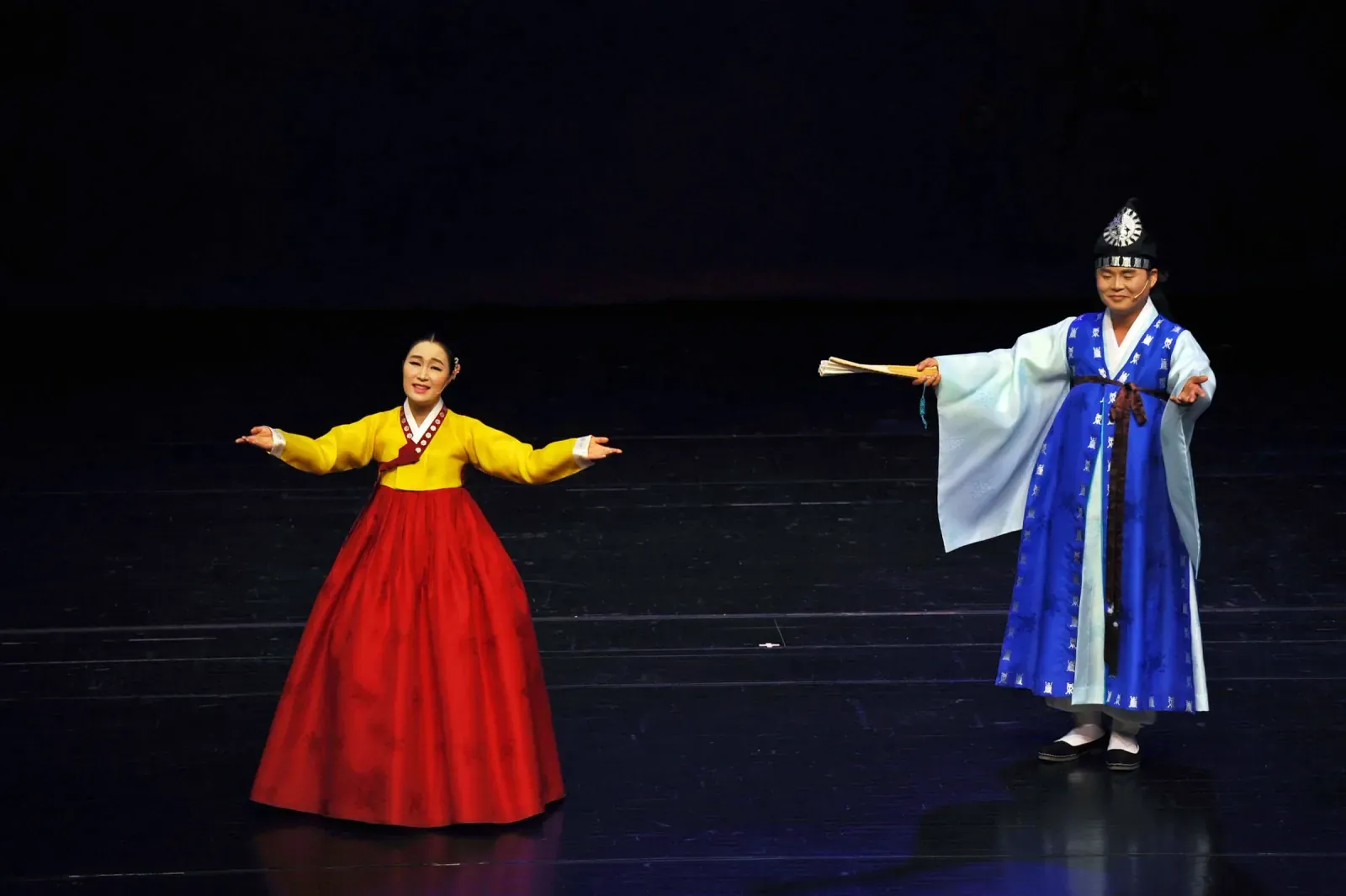
Gugak, or national music, is the umbrella term for traditional Korean music: court ritual, chamber suites, folk song, sanjo and shamanic and Buddhist music.
South Korea, around 500
East Asian family
Born
around 500
South Korea
Links
3
Genres it drew on or shaped
Tempo
90-150 BPMLineage
Family tree
Timeline
Era by era
From the first sparks to today. Select a dot to read the story behind it.
- Three Kingdoms to Goryeo roots
500 to 1392
- Joseon court and village
1392 to 1910
- Colonial rupture
1910 to 1951
- State institutions
1951 to 1990
- Heritage and world stage
1990 to today
Eras
Moments
- 1 Three Kingdoms to Goryeo roots, 500 to 1392
- 2 Joseon court and village, 1392 to 1910
- 3 Colonial rupture, 1910 to 1951
- 4 State institutions, 1951 to 1990
- 5 Heritage and world stage, 1990 to today
around 500
Three Kingdoms to Goryeo roots
Zithers, flutes and ritual music take shape under Gaya, Silla and Goryeo, with Chinese court styles arriving as gifts and imports alongside native hyangak.
- 550Gayageum developed in GayaCourt tradition credits King Gasil of Daegaya and the musician Wu Ruk with the 12-string zither.
- 1114Song gifts of instruments reach the Goryeo courtGifts from the Song emperor in 1114 and 1116 enlarge the court orchestra.
1392
Joseon court and village
Confucian rites shape court repertoire and notation while pansori, sanjo and farm-band music grow among commoners.
- 1392Joseon dynasty foundedThe new Confucian state builds court music around ritual and ceremony.
- 1493Akhak gwebeom compiledThe first independent Korean music treatise records court instruments, scores and rites.
1910
Colonial rupture
Court music loses its ceremonial role under Japanese rule, and traditional music survives mainly through a reduced court office and a few singers.
- 1913Yiwangjik Aakbu establishedA reduced court music office keeps court repertoire alive under colonial rule.
1951
State institutions
A national center, heritage designations and new composers move gugak onto concert stages.
- 1951National Gugak Center foundedA merger of musical organizations creates the main institution for teaching and performing gugak.
- 1962Hwang Byungki begins composing for traditional instruments
- 1971Daegeum sanjo designated an Important Intangible Cultural Property
- 1978First samulnori performanceKim Duk-soo and three players present farm-band percussion on a Seoul stage on 22 February.
1990
Heritage and world stage
UNESCO listings, overseas tours and a steady concert circuit make gugak a recognised national heritage.
- 2001UNESCO lists Jongmyo jeryeak
- 2003UNESCO proclaims pansori
- 2007Hwang Byungki completes his fifth gayageum album
- 2010UNESCO lists gagok
- 2012Arirang listed by UNESCO
Listening path
Start listening
A short path from an easy way in to the deep end. Thumbnails come from YouTube; the player loads only when you press play.
- 01
Hwang Byungki, 2007
The fast closing movement, a quick way into the gayageum's rhythmic drive.
- 02
Hwang Byungki, 2007
The slow opening of the same suite, where the silk strings and long ornaments are most exposed.
- 03
National Gugak Center, 2023
The royal shrine ritual orchestra and dancers, the stately court end of gugak.
Facts
| Family | East Asian |
| Origin | South Korea |
| Status | Active |
| Tempo | 90 to 150 BPM |
| Meter | Jangdan cycles of 4 to 16 beats |
Gugak, “national music”, is the umbrella term for traditional Korean music. It covers court and ritual music, refined chamber and literati music, folk song and instrumental solos, and the music of shamanistic and Buddhist ceremonies.
Its roots reach back to the Three Kingdoms period, and the repertoire most heard today was settled under the Joseon dynasty (1392-1910). It sits in the East Asian family beside Chinese and Japanese court traditions, and it divides into refined jeongak and folk minsogak.
Origins
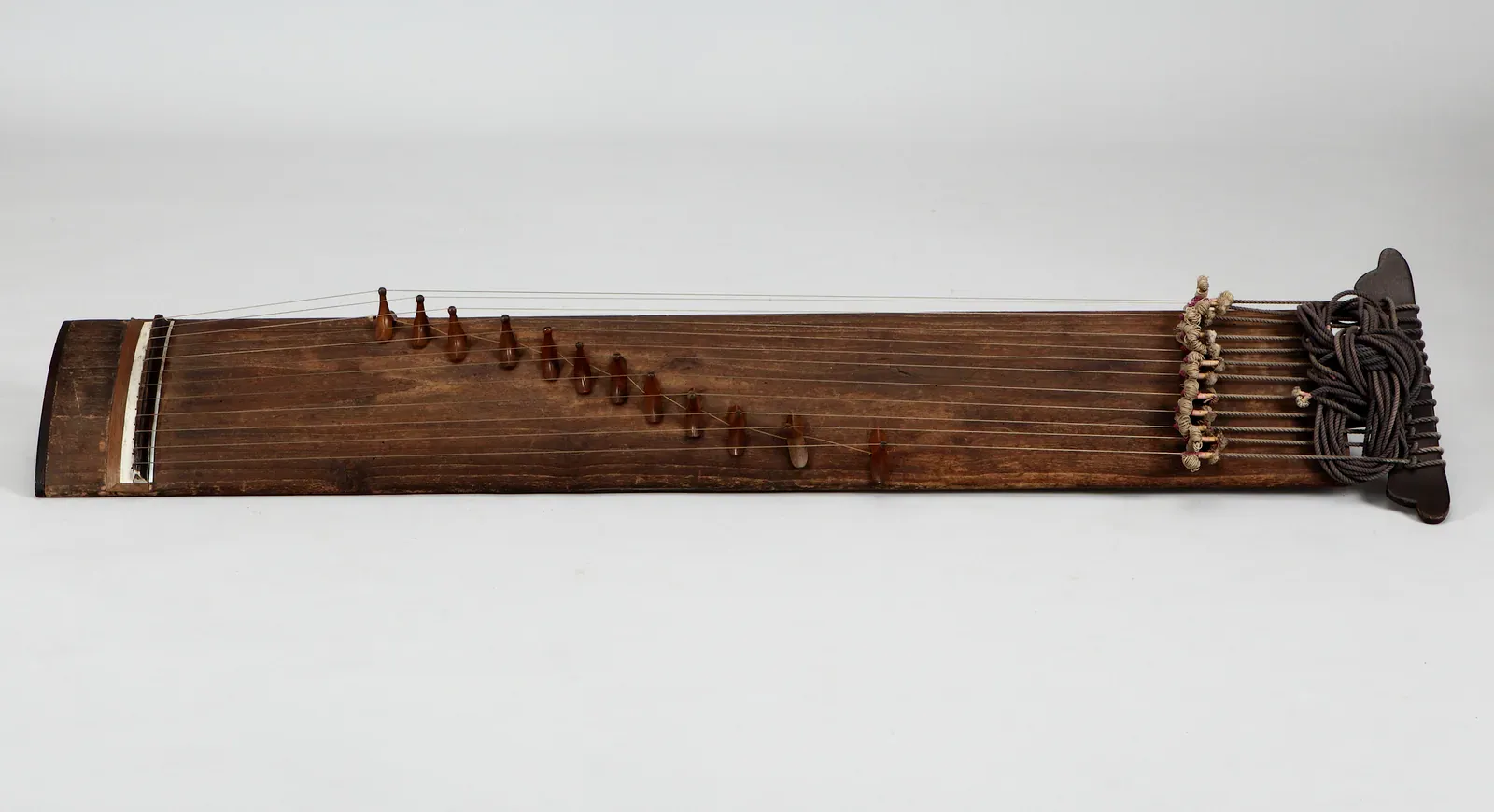
Korean writers trace several instruments to the ancient kingdoms. The geomungo, a fretted zither, is tied to Goguryeo and was made before the 5th century. The gayageum, a plucked silk zither, is credited to the Gaya confederacy around the sixth century, where a king is said to have commissioned a musician to write pieces for it after seeing a Chinese zither. Early tomb murals show string instruments already highly developed, and farming festivals and shamanic rites carried music long before any court wrote it down.
The word gugak itself is a modern category. It sets Korean music against imported Western music and gathers repertoire that earlier centuries kept apart: court music, the elite chamber tradition, village song and ritual.
Gaya to Goryeo, to 1392
Court music came in three strands. Hyangak is native music, with the piece Sujecheon, about 1,300 years old, as its best-known example. Dangak came from Tang China, with instruments imported and later reinforced by gifts from the Song emperor in 1114 and 1116. Aak is ritual music of Chinese origin, chosen for its association with Confucian propriety. Korea kept aak melodies that were later lost in China, and the piece is now performed only at rare ceremonies such as the sacrifice to Confucius in Seoul.
Joseon, 1392-1910
The Joseon dynasty adopted Confucianism, and the idea of yeak, ritual and music working together, shaped its court. Music flourished under King Sejong, helped by the musician Park Yeon, who founded an independent music office and created jeongganbo, a grid notation that records pitch and length. The court music treatise Akhak gwebeom, compiled in 1493, set down instruments, scores and ceremonies. Ancestor rites at Jongmyo shrine and the Confucian shrine were revived and held each year, though two wars badly damaged the court repertoire.
Outside the palace a different music grew. Pansori, a storytelling form for a singer and a drummer, emerged as a common culture in the middle of the dynasty and spread from commoners to the elite. Sanjo, a solo instrumental form with drum, took shape in the 19th century, and the sanjo gayageum evolved with closer strings and a shorter body to manage faster passages. Middle-class players mixed lyric poems and long cyclical songs. These folk traditions are covered in detail on the minsogak page.
Colonial period, 1910-1951
Japanese rule from 1910 brought Western music and cut court music off from its ceremonies. A reduced court office, the Yiwangjik Aakbu, was established in 1913 and kept the repertoire alive in small form, while marching music replaced court celebration. Cultural suppression in the 1920s left traditional music barely surviving, and folk music was constrained in the 1930s even as some singers found support. Radio carried a few of them: in January 1934 the singer Wang Su-bok appeared in the first live Korean-language broadcast to Japan. The term nongak for farmers’ music also arose in this period, and later performers and scholars objected that it limited the tradition to farm labor.
State institutions, 1951-1990
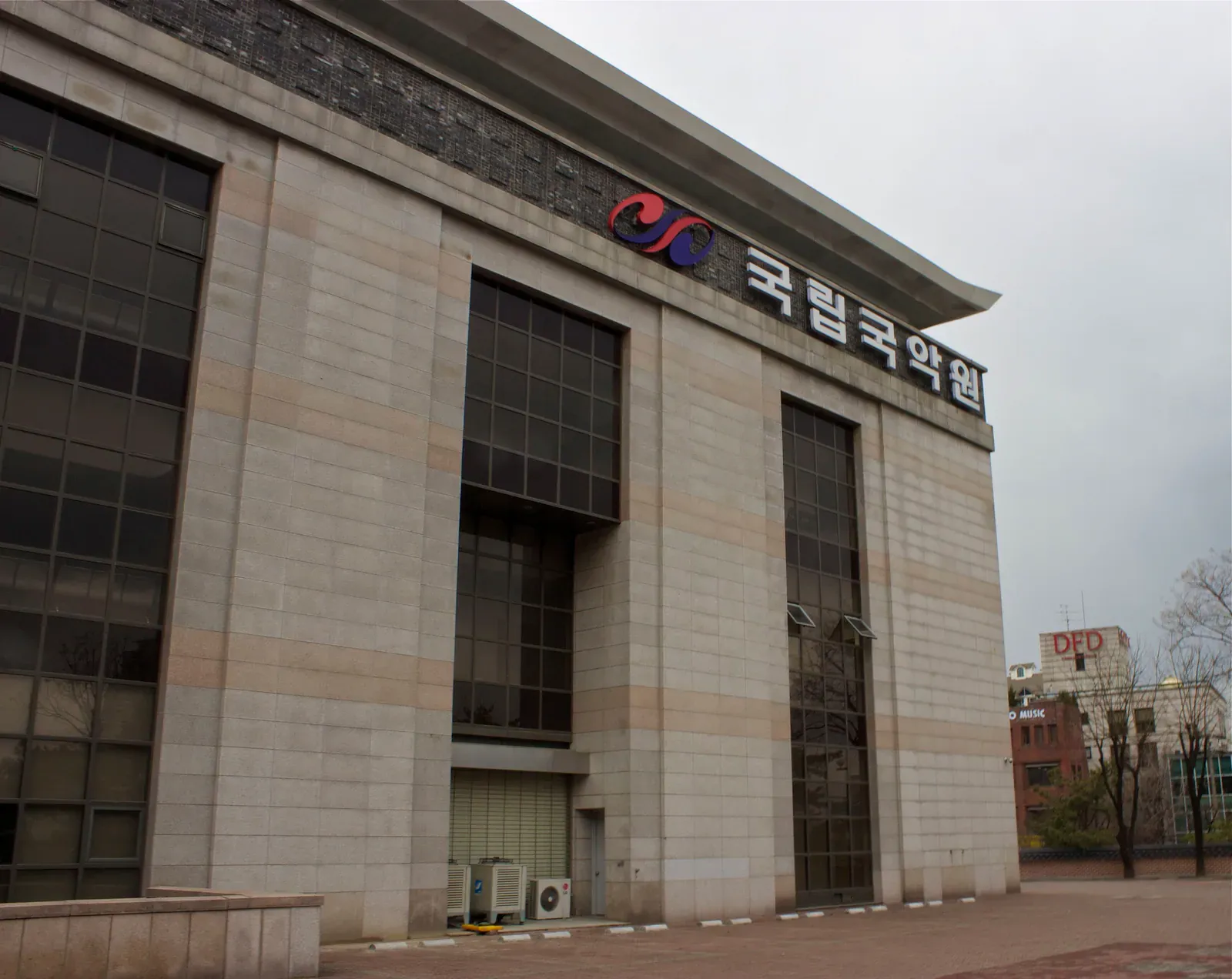
The National Gugak Center was founded in 1951 through a merger of musical organizations, and it became the primary place for teaching, research and performance. Under state protection, masters were designated as holders of traditions: the gagok singer Kim Wol-ha was named in 1973, and daegeum sanjo received its heritage designation in 1971. The center moved to Seocho in Seoul in 1987.
A new generation also began composing for traditional instruments. The gayageum player Hwang Byungki began writing concert and film music for them in 1962 and toured abroad in 1964. In 1978 Kim Duk-soo and three players staged the first samulnori performance, moving rural percussion onto an indoor stage, and its worldwide success is told in the minsogak article. Hwang’s recordings, from the 1978 album Chimhyangmu onward, brought gayageum composition to listeners who had never heard a village sanjo.
Heritage and the world stage, 1990 onward
In 1990 Hwang led South Korean musicians to the Pan-Korean Unification Concert in Pyongyang, showing how gugak became a symbol of shared culture across the divide. Heritage recognition followed: Jongmyo shrine entered the World Heritage list in 1995, Jongmyo jeryeak was listed by UNESCO in 2001, pansori in 2003, gagok in 2010 and the folk song Arirang in 2012. The center’s court orchestra now records and streams its repertoire.
Characteristics
Gugak is mostly modal and ornamented. Melodies sit in pentatonic modes, notably the peaceful pyeongjo and the plaintive gyemyeonjo, and players bend and vibrate notes around a fixed frame. Rhythm follows jangdan cycles, which a drum marks. Tempo is the clearest divide: court suites crawl, and sanjo and percussion pieces speed up through a sequence of movements. Songs hold vowels at length or move through a rough, wide-ranging voice. Individual pieces stay with a few players instead of building harmony, so the timbre of each instrument matters more than chord progression.
Instruments and production
String, wind and percussion groups divide the ensemble. The geomungo is the old scholars’ instrument, played with a bamboo stick. The haegeum is a two-string fiddle held upright, used in court music and in village ensembles. Court and folk percussion differ: ritual orchestras use bronze bells, stone chimes and a tiger-shaped scraper, while folk players use the janggu, buk, kkwaenggwari and jing.
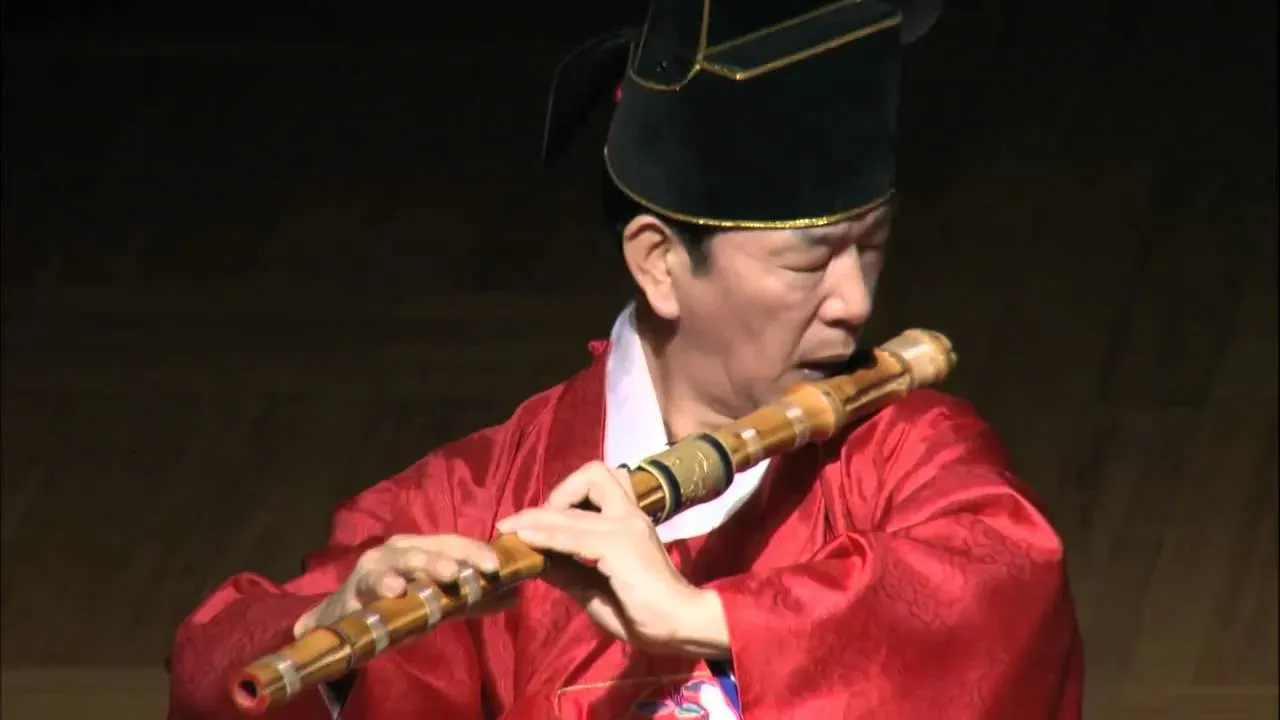
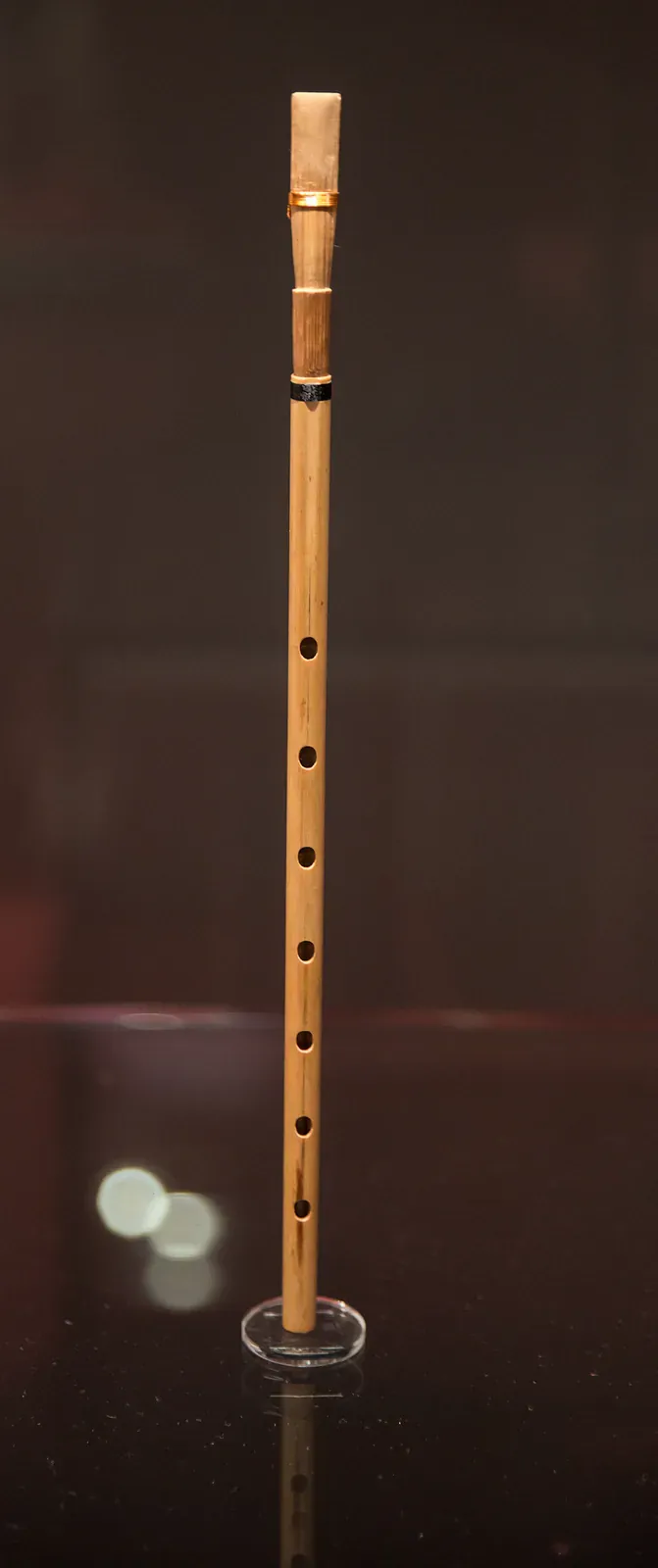
The daegeum, a large transverse bamboo flute with a membrane that buzzes, is used in court, aristocratic and folk music alike and has a wide range. Its fixed pitch is what other instruments tune to. Smaller flutes in the family, the junggeum and sogeum, complete the three bamboo flutes of the Silla period. The piri, a double-reed pipe, carries the main melody in many ensembles.
The gayageum shows how much variety hides inside one instrument. The old court version has wider string spacing for slow music such as Yeongsan hoesang. Modern versions use 13 to 25 strings, often with nylon-wrapped steel, built for new compositions.
Mainstream success
Gugak never competed on pop charts, and its audience reached through institutions, festivals and heritage listings. Samulnori became widely described as Korea’s most successful traditional music, with dozens of professional and amateur groups, and Hwang’s concert pieces made the gayageum a solo instrument abroad.
Notable recordings
Hwang Byungki’s Darha Nopigom, on the fifth volume of his gayageum series, is a five-movement suite. It opens in a slow reverent manner and ends in the quick eonmori rhythm, a short course in what the instrument does with a rising tempo. His earlier album Chimhyangmu helped establish a new concert style for the instrument. The percussion album Record of Changes, taken to New York, offered a different sound: four players layering gongs and drums. For the sung repertoire, the gagok album by Kim Wol-ha released through Ocora preserved the long-vowel court poems for international listeners.
Culture
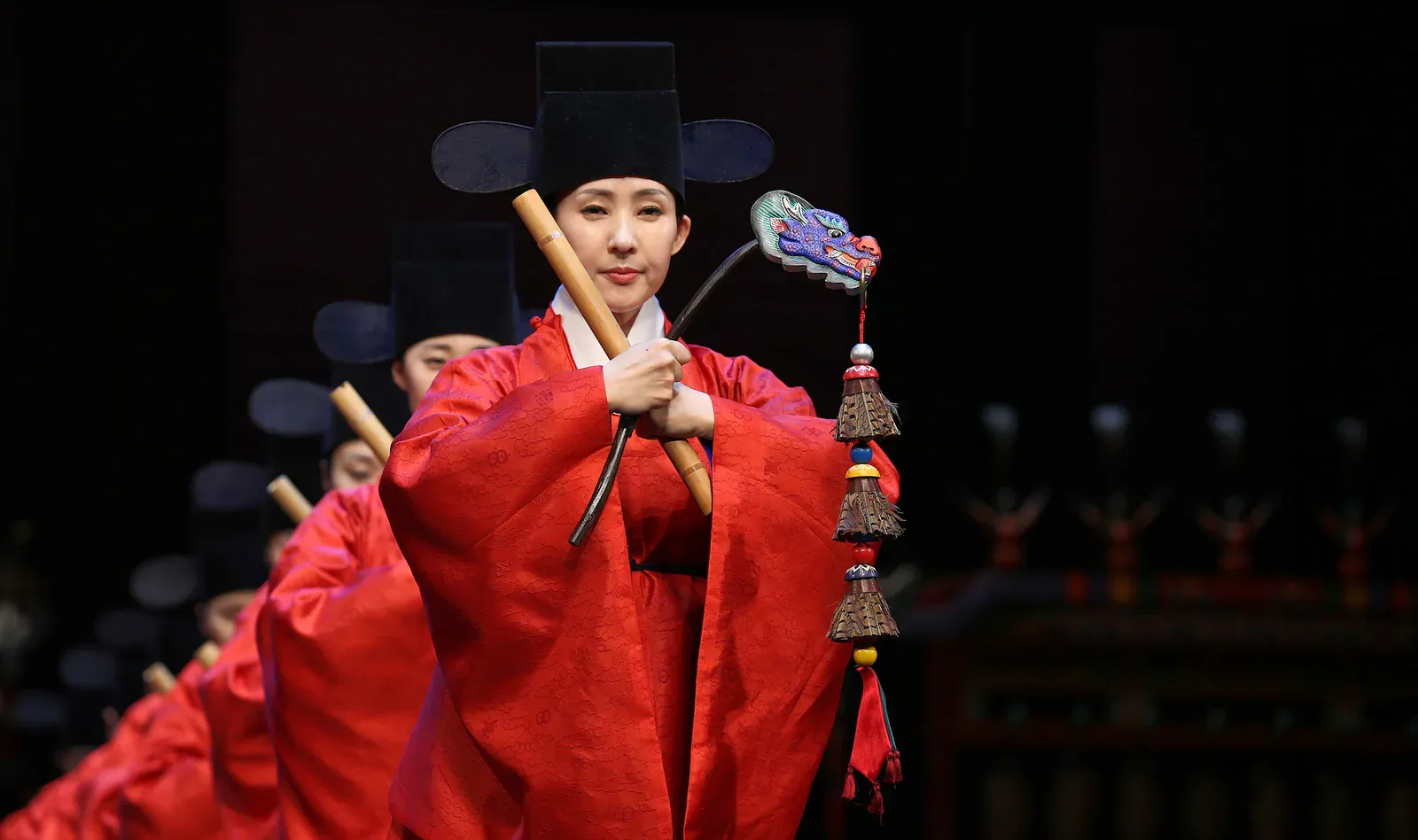
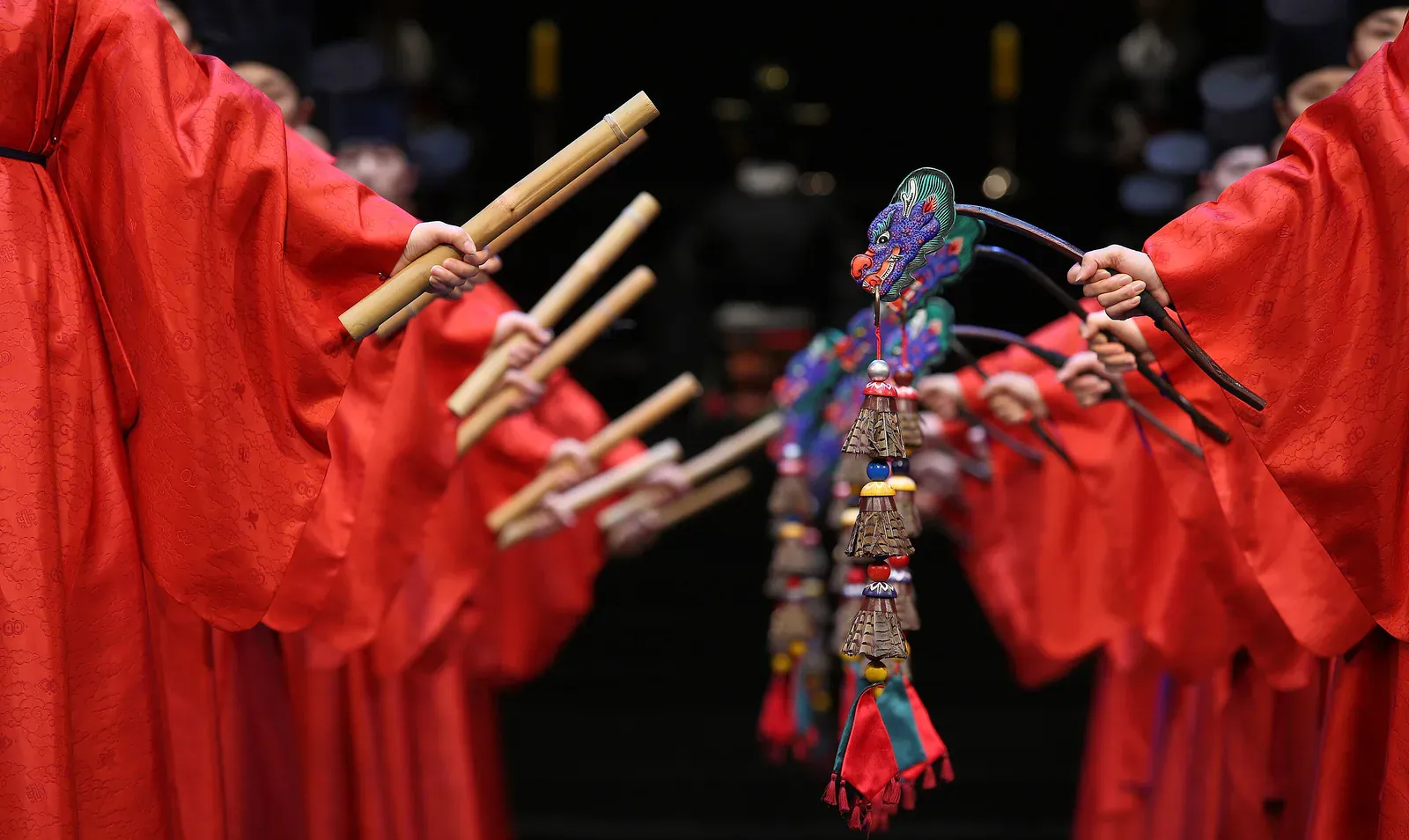
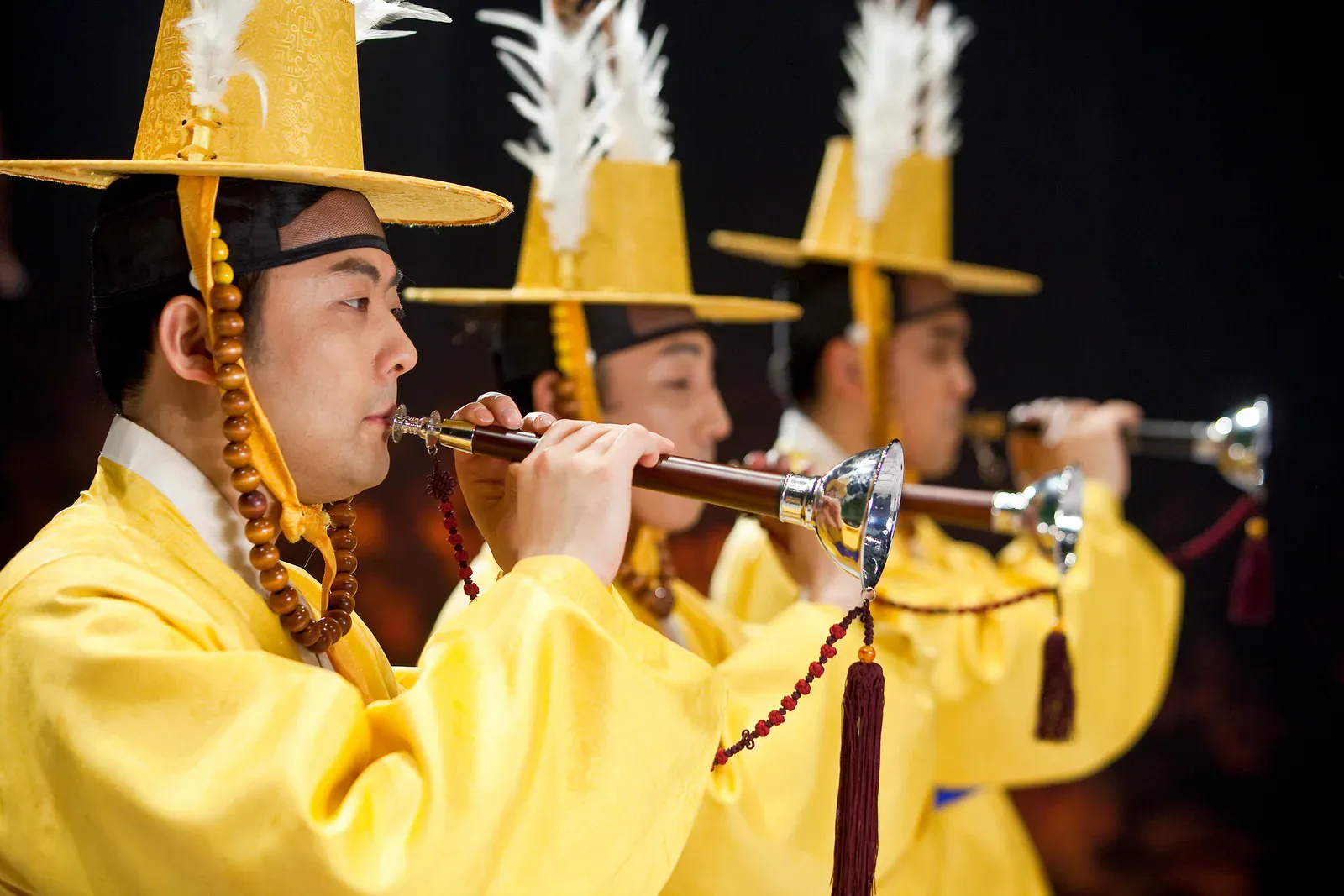
The best-known occasion is the Jongmyo ceremony each May, where court orchestra, dancers in red robes and black hats and ritual props are staged at the royal ancestral shrine. The ceremonial dress, the dragon-headed props and the long slow procession are part of its appeal for visitors. Notation also holds a place in the culture, since jeongganbo grids on paper show how old court pieces were kept.
Legacy
Gugak survives because of institutions: the National Gugak Center, heritage designations and university departments such as the one where Hwang taught. It remains the reference point for modern Korean music, and later generations have mixed its instruments and rhythms into new forms, with fusion covered on its own page.
Misconceptions
Gugak is not just court music. Folk song, pansori, sanjo and the rites of shamans and Buddhists fall inside the term.
It is not frozen in antiquity either. Court music lost pieces in wars, the 19th century produced sanjo, and composers such as Hwang Byungki have written new works for old instruments since the 1960s.
It is not uniformly slow. Court suites move at a stately pace, but sanjo accelerates through its movements, and percussion pieces can run quickly.
Frequently asked questions
What does gugak mean?
Gugak means national music. It is the umbrella term for traditional Korean music, including court music, chamber music, folk song, instrumental solos and ritual music.
What is the difference between gugak, jeongak and minsogak?
Gugak is the whole field. Jeongak is the refined court and literati branch, and minsogak is the folk branch that includes pansori, sanjo and farm-band percussion.
What instruments are used in gugak?
The main instruments are the gayageum and geomungo zithers, the haegeum fiddle, the daegeum flute, the piri pipe and the janggu hourglass drum, with gongs and barrel drums in folk ensembles.
Where can gugak be heard today?
The National Gugak Center in Seoul holds regular concerts, and Jongmyo jeryeak is performed each year at the royal shrine.
Sound
Sound sheet
Anatomy of a track
| # | Part |
|---|---|
| 1 | Slow opening movement |
| 2 | Medium movements |
| 3 | Fast closing movement |
Signature sounds
- Slow-to-fast progression across a piece
- Bent and vibrated notes around a fixed melody
- Hourglass drum marking a rhythm cycle
- Silk-string zither and bamboo wind timbre
Drums and percussion
- Janggu
- Buk
- Kkwaenggwari
- Jing
Techniques
- Sigimsae ornamentation
- Slow-to-fast progression
- Jangdan cycles
- Improvised variation
Keys and modes
Pyeongjo. Peaceful pentatonic mode of court and chamber music.
Gyemyeonjo. Plaintive pentatonic mode of sorrowful scenes and songs.
Tuning
Pentatonic modes; the gayageum has no single standard tuning pitch
Vocals
Solo singing ranges from long-held gagok vowels to the strong raw voice of pansori.
Scenes
Where it happened
Where and when the sound lived: one bar per city on a shared timeline.
Asia
Active scenes
Peak 3, 1987-2025
The Gaya state tied to the origin of the gayageum.
Jongmyo shrine and the former court music office stood here, the old centre of ritual and court performance.
Home of the National Gugak Center, the main teaching and performing institution.
Venues and places
Seoul, 1395 to today. Royal ancestral shrine where Jongmyo jeryeak is performed each May.
Seoul, 1987 to today. Concert halls, studios and classrooms of the national traditional music institution.
Culture
Culture markers
- Jongmyo jerye
Ancestral rite at the royal shrine each May, performed with court music and dance.
Ritual - Red court robes and black hats
Performers of court repertoire wear ceremonial robes and horsehair hats.
Fashion - Jeongganbo notation
A grid score system created in the Sejong era to write pitch and duration.
Artwork
Media
Key media
- 2015Corée: chants lyriques Gagok
by Kim Wol-ha. Ocora's selection of gagok sung by Kim Wol-ha.
Compilation
Glossary
Terms on this page
Ritual court music of Chinese origin, now performed at rare ceremonies such as the Confucian shrine rite in Seoul.
Literally national music, the umbrella term for traditional Korean music.
Native Korean court music, as opposed to imported Chinese styles.
Korean rhythmic cycle that underlies a piece.
Solo instrumental form with a drum, played in rising tempo through successive rhythm cycles.
East Asian family