Gypsy jazz
Gypsy jazz is acoustic string jazz from 1930s Paris, built on Django Reinhardt's guitar, Stéphane Grappelli's violin and the rhythm guitar la pompe.
Paris, 1934
Jazz family
Born
1934
Paris
Subgenres
2
Documented branches
Links
17
Genres it drew on or shaped
Tempo
100-205 BPMLineage
Family tree
Timeline
Era by era
From the first sparks to today. Select a dot to read the story behind it.
- Paris and the Hot Club
1934 to 1939
- War and a changing sound
1940 to 1953
- Small circles, amplified guitars
1954 to 1967
- Festivals and revival
1968 to today
Eras
Moments
- 1 Paris and the Hot Club, 1934 to 1939
- 2 War and a changing sound, 1940 to 1953
- 3 Small circles, amplified guitars, 1954 to 1967
- 4 Festivals and revival, 1968 to today
1934
Paris and the Hot Club
Reinhardt and Grappelli meet at the Hotel Claridge in 1934, found the all-string Quintette du Hot Club de France and record extensively and tour Europe until war breaks out in 1939.
- 1910Django Reinhardt is bornJean Reinhardt is born on 23 January 1910 in Pont-a-Celles, Belgium, into a Romani family.
- 1931Reinhardt hears American jazz in ToulonAt painter Emile Savitry's home he listens to Armstrong, Ellington, Venuti and Lang records.
- 1934Claridge jam sessionsReinhardt and Stephane Grappelli play together in Louis Vola's band at the Hotel Claridge in Paris during the summer.
- 1934First recordings on OdeonThe group records its first two titles in November under the name Delaunay's Jazz.
- 1935Dinah and DjangologyEarly Quintette singles such as Dinah / Lady Be Good and Some of These Days / Djangology appear.
- 1937Hot Club founds the Swing labelThe Hot Club de France starts the Swing record label, later the home of Quintette releases.
- 1937Minor SwingThe Quintette records Minor Swing, the best-known piece in the style.
- 1939War splits the QuintetteOn tour in England when war breaks out, Reinhardt returns to Paris while Grappelli stays in London.
1940
War and a changing sound
Reinhardt keeps the Quintette name with clarinet and drums, records Nuages, reunites with Grappelli in 1946, then turns toward bebop and an electric guitar until his death in 1953.
- 1940NuagesReinhardt first records Nuages with a clarinet melody, released on the Swing label.
- 1953Reinhardt diesDjango Reinhardt dies on 16 May 1953, ending the first era of the style.
1954
Small circles, amplified guitars
Romani players favour amplified, modern playing, while Baro and Matelo Ferret and a few others keep the acoustic Quintette sound alive with little press attention.
1968
Festivals and revival
The Samois-sur-Seine festival starts in 1968, a new generation of Manouche and Sinti players takes up the hot club repertoire from the 1970s, and the style spreads to Europe, North America and beyond.
- 1968Samois-sur-Seine festival beginsThe first Festival Django Reinhardt is a single evening at Samois-sur-Seine, where he lived last.
- 1983Festival becomes a week-long eventFrom 1983 the Samois festival runs annually for a week, commemorating Reinhardt and his music.
- 2004Django in June camp opensThe weeklong Django in June camp starts at Smith College in Massachusetts, a hub for American players.
Listening path
Start listening
A short path from an easy way in to the deep end. Thumbnails come from YouTube; the player loads only when you press play.
- 01
Quintette du Hot Club de France, 1935
An early Quintette take on a swing standard: listen for the pompe and the violin lead.
- 02
Django Reinhardt, 1937
The style's signature minor-key piece.
- 03
Django Reinhardt, 1940
Reinhardt's best-known composition, a ballad with an unhurried melody.
- 04
Django Reinhardt, 1941
A Reinhardt original from the wartime years.
- 05
The Rosenberg Trio, 2017
A modern Sinti trio plays the standard for the 2017 film Django.
Facts
| Family | Jazz |
| Origin | Paris, France |
| Emerged | 1930s |
| Status | Active |
| Tempo | 100 to 205 BPM |
| Meter | 4/4 |
| Grew out of | Hot jazz |
| Subgenres | 2 |
Gypsy jazz, also called jazz manouche, is an acoustic jazz style inspired by the Romani guitarist Django Reinhardt and the violinist Stéphane Grappelli.
It took shape in Paris in the mid-1930s around their Quintette du Hot Club de France and is defined by lead guitar and violin, a double bass and a percussive rhythm guitar technique, la pompe, that replaces the drums. The style has stayed popular among the Manouche clan of Romani people, and the name now describes a way of playing rather than the ethnicity of the players.
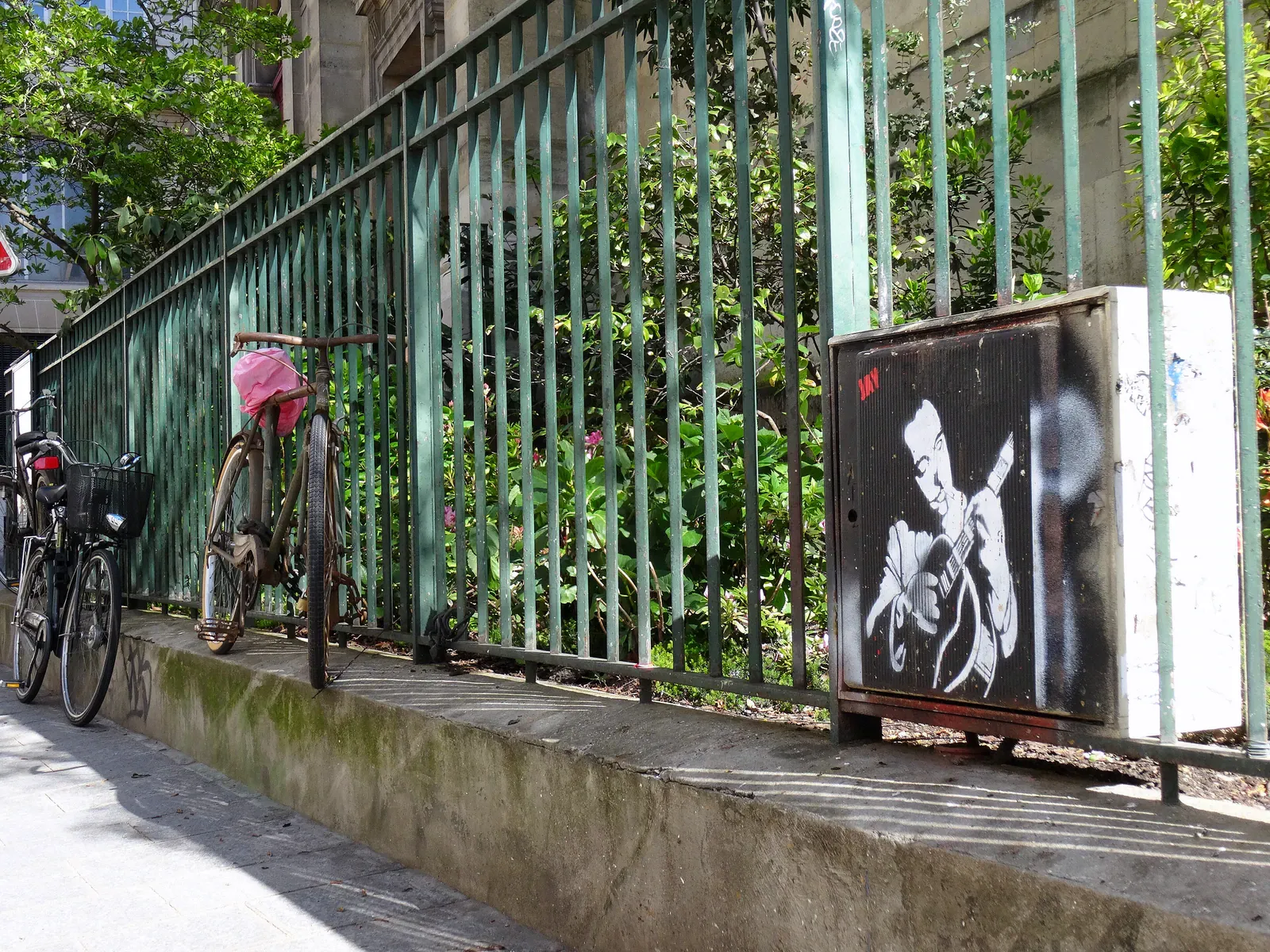
Origins
Reinhardt came to jazz through the musette bands of Paris, where he played with accordionists and accompanied popular singers. In 1931, at the Toulon home of the painter Émile Savitry, he heard ragtime and Dixieland records, Duke Ellington, the Joe Venuti and Eddie Lang duo and above all Louis Armstrong.
In the summer of 1934 he and Grappelli were hired in a band led by the bassist Louis Vola at the Hôtel Claridge on the Champs-Élysées. Backstage jam sessions there, with Roger Chaput on rhythm guitar, formed the core of a new group. The promoters Pierre Nourry and Charles Delaunay of the Hot Club de France, a Paris society devoted to jazz, urged them to make it permanent. With Reinhardt’s brother Joseph on a second rhythm guitar it became the Quintette du Hot Club de France.
The first recordings were made in November 1934 for Odeon under the name Delaunay’s Jazz. A December session produced the first discs credited to Django Reinhardt and the Quintette, with his first name misspelled as “Djungo”. The lineup was unusual for jazz: lead parts on acoustic guitar and violin, a double bass in place of the tuba or sousaphone of New Orleans bands, and no drummer.
Paris, 1934-1939
The Quintette recorded extensively and toured Europe, with particular success in Britain. Bassists and rhythm guitarists came and went, while Reinhardt and Grappelli stayed constant. In 1937 the American singer Adelaide Hall opened the Montmartre club La Grosse Pomme and hired the Quintette as one of its house bands. The same year the Hot Club de France started its own record label, Swing.
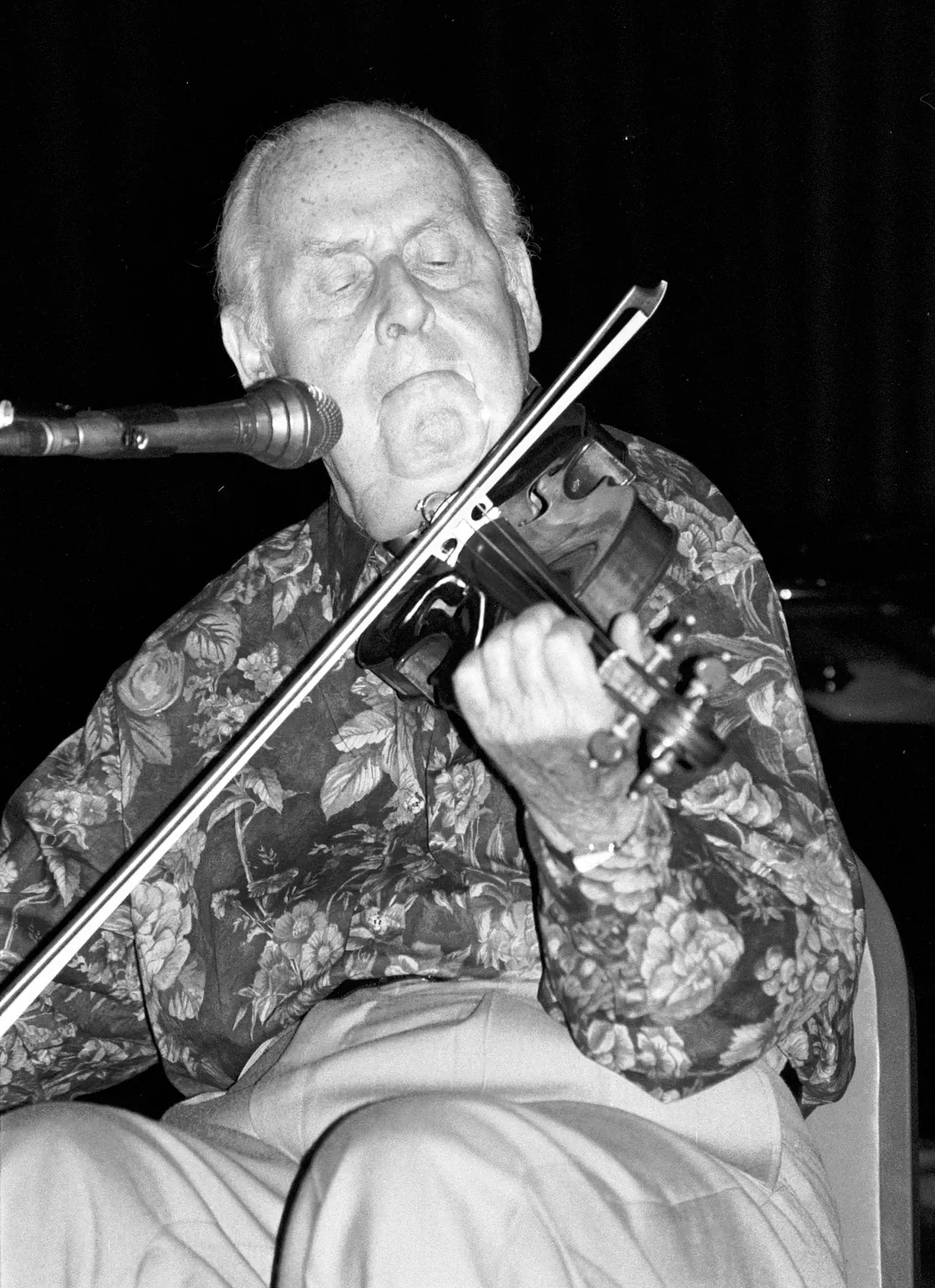
War ended this period. In September 1939 the group was on tour in England. Reinhardt, who spoke almost no English, returned to Paris, and Grappelli stayed in London for the duration.
War and a changing sound, 1940-1953
Reinhardt kept the Quintette name for a different group, with clarinettist Hubert Rostaing and a more conventional rhythm section of drums, bass and rhythm guitar, played by his son Lousson or his brother Joseph. Wartime shortages limited output, though roughly 70 titles were recorded between 1940 and 1948, including the first recording of his composition Nuages. After the war Reinhardt and Grappelli reunited intermittently in London and in an all-string format, and made their last recordings together in Rome in 1949.
By then Grappelli’s violin swing was out of fashion in France, and Reinhardt had moved to an electric guitar and an interest in bebop and players such as Dizzy Gillespie. He died on 16 May 1953.
Small circles and revival, 1954 onward
In the 1950s and 1960s a handful of European guitarists kept the acoustic sound going, among them the brothers Baro and Matelo Ferret, Étienne “Patotte” Bousquet and Tchan Tchou Vidal, often mixing it with musette waltzes and with little attention from the jazz press. Many Romani players of the period used amplified instruments in a modern style.
A turn came in the late 1960s. The Festival Django Reinhardt began in 1968 as a single evening at Samois-sur-Seine, the village of his last residence, and from 1983 became a week-long annual event. From the 1970s a younger generation of Romani musicians took up the hot club repertoire, among them the German violinist Schnuckenack Reinhardt, who had played it earlier, and then Fapy Lafertin, Häns’che Weiss, Boulou Ferré, Raphaël Faÿs, Biréli Lagrène, Wawau Adler and Stochelo Rosenberg. Grappelli returned to the hot club sound with acoustic guitars and double bass at the instigation of the guitarist Diz Disley, and his audiences drew younger listeners to the style.
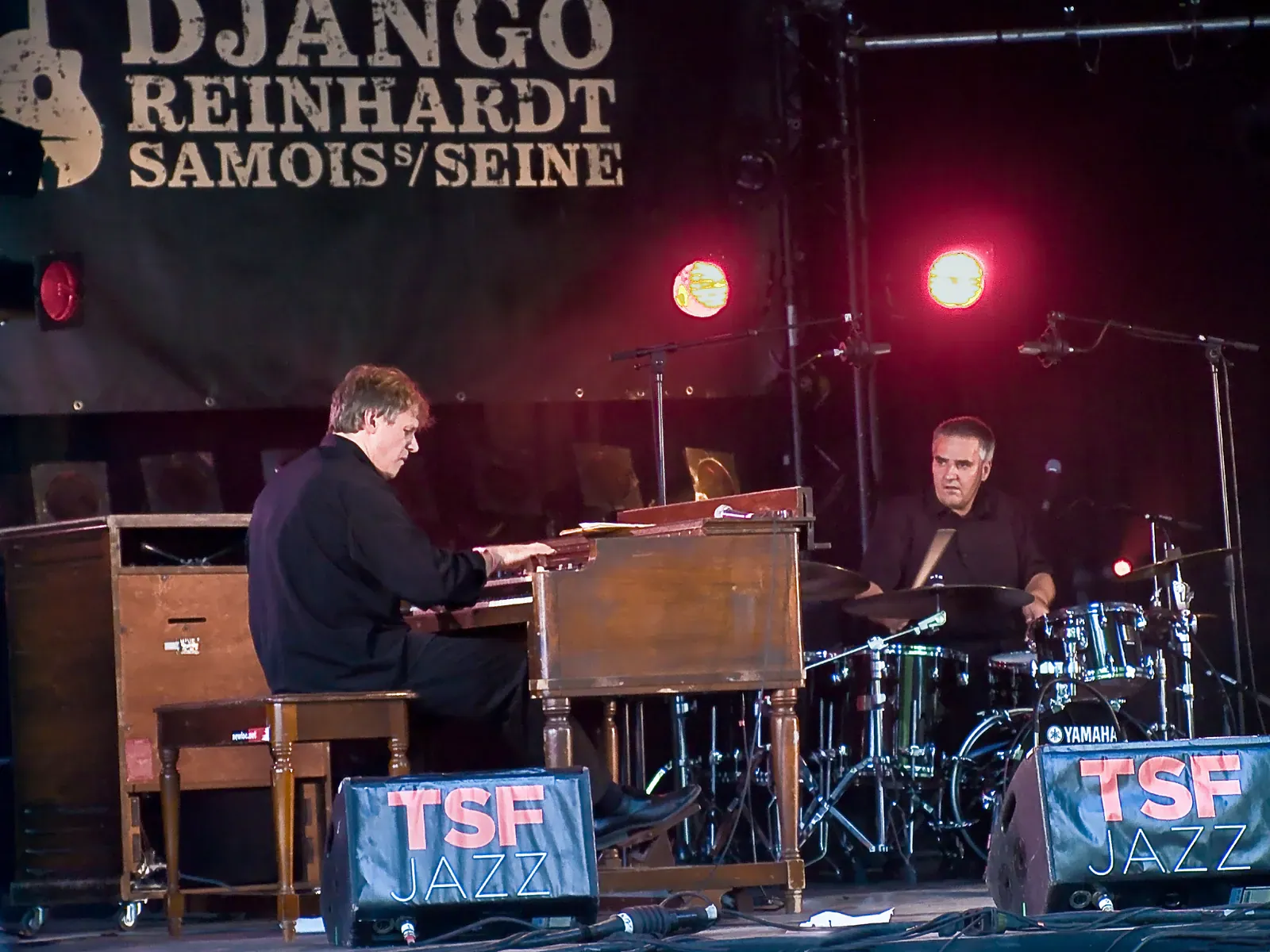
The Rosenberg Trio, founded in 1989 by Stochelo Rosenberg with his cousins Nonnie and Nous’che, played at Samois and in the 1990s toured and recorded with Grappelli. Dorado Schmitt formed his own trio in 1978 and wrote Bossa Dorado, now a standard. Camps and courses later spread the style, among them Django in June at Smith College in Massachusetts from 2004 and a gypsy jazz ensemble at the Berklee College of Music.
Characteristics
The rhythm guitar is the engine. La pompe is a quick up-down strum followed by a down strum that accents beats two and four, played by two or more guitarists in unison; the strumming hand never touches the top of the guitar. It gives fast tempos their swing and stands in for a drum kit.
Harmony favours major seventh, major sixth and 6/9 chords over plain triads, partly because of the chord shapes Reinhardt could use after his injury left him able to use only two fingers of his fretting hand for lead lines. Reharmonisation often leans toward a minor feel, with a minor sixth substituted for a dominant seventh, and half-diminished chords lead into dominants in minor keys.
Lead lines are summarised as ornamented arpeggio. Patterns run diagonally across the neck with no more than two fretted notes per string, joined by chromatic runs, glissandi, diminished runs and flamenco-like bursts of chords. The repertoire mixes 1920s and 1930s swing numbers such as Limehouse Blues and Dinah, bal musette waltzes, Reinhardt originals and jazzed Romani songs such as Dark Eyes. Much of it is in minor keys, with Dorian and harmonic minor modes giving a dark, modal colour against spirited playing.
Instruments and production
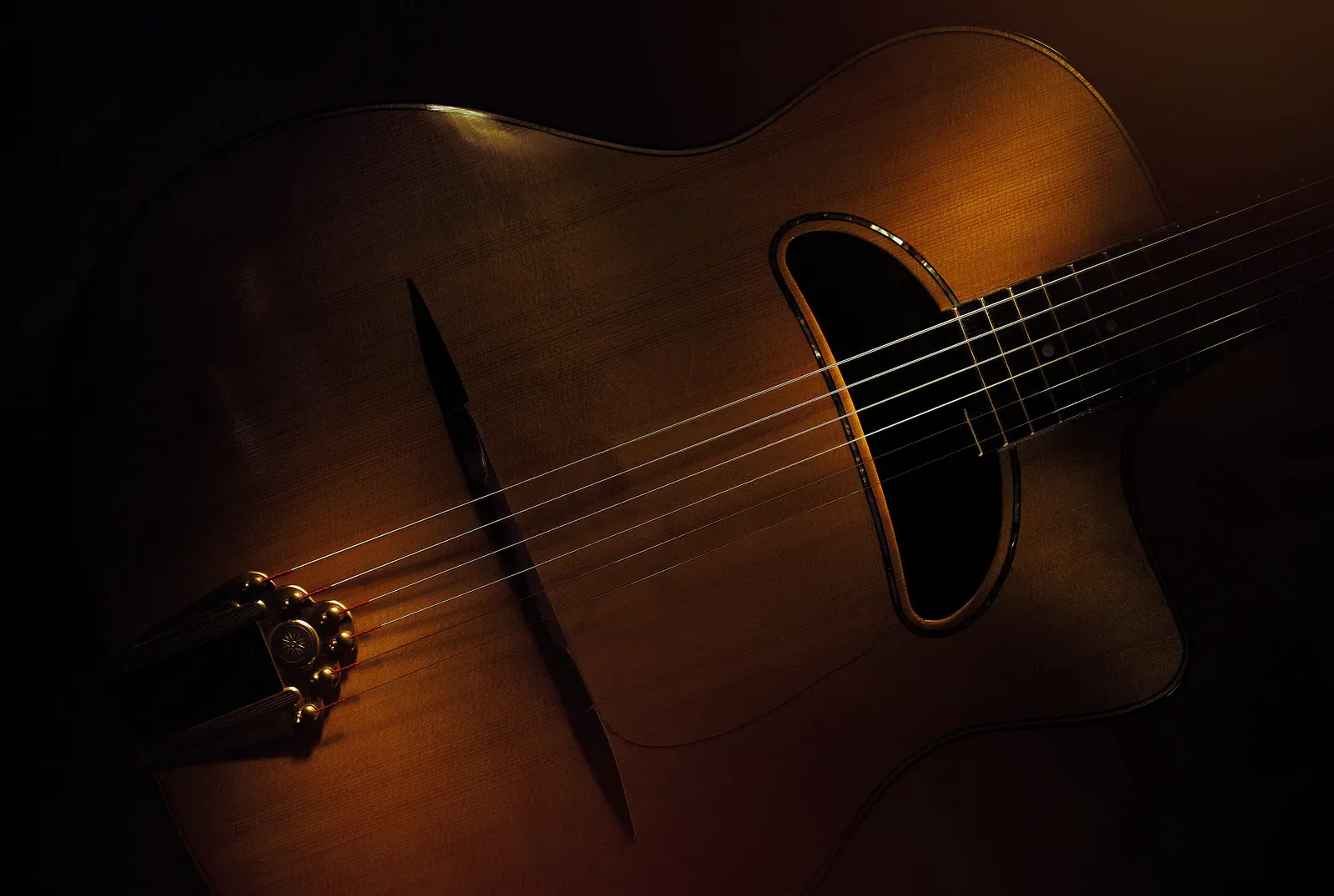
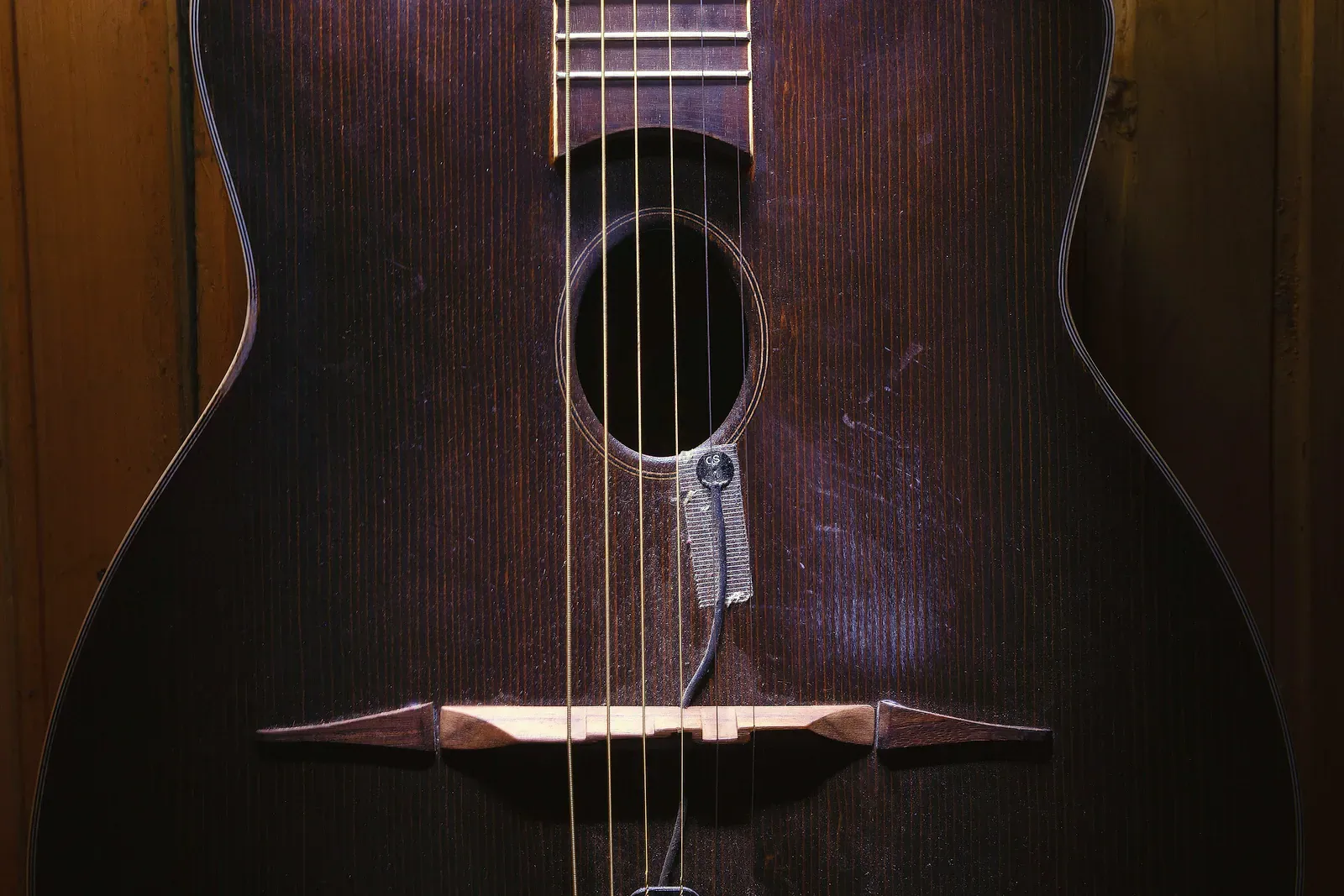
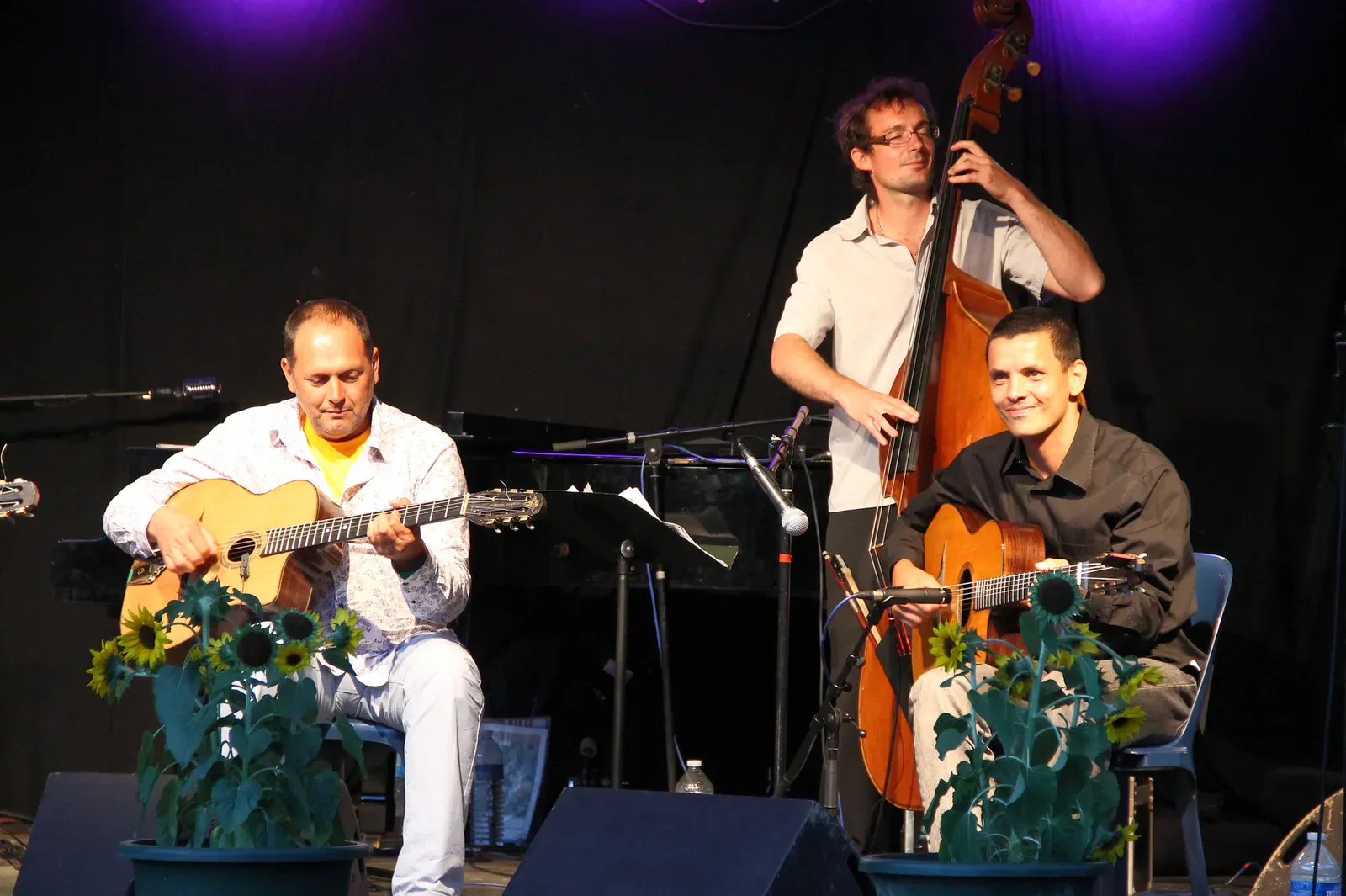
Most players use a version of the Selmer-Maccaferri guitar. Selmer of France made it from 1932 to about 1952, and the designer Mario Maccaferri left the firm in 1933. The earliest models had a large D-shaped hole; later ones had a smaller oval hole, now favoured for lead work. Designs based on them are sold as gypsy jazz guitars. The double bass plays walking lines, two-feel roots and fifths, bowed notes on ballads and sometimes a slapped, percussive style. Clarinet, saxophone, mandolin and accordion appear as additional solo voices.
Notable recordings
Minor Swing, recorded in 1937, is a 16 bar minor progression and perhaps the best-known gypsy jazz composition. Djangology and Dinah, both issued in 1935, belong to the early Quintette years, and Swing 42 first appeared on a 1941 single. Nuages, first recorded in 1940 with a clarinet melody in F major, exists in at least thirteen Reinhardt versions; the 1946 recording is in G major, and the tune has English and French lyrics. These pieces remain the common ground of the repertoire.
Culture
The scene is organised around jam sessions and festivals, with informal playing in small venues at Samois-sur-Seine. In Manouche and Sinti communities children learn the style from relatives, often before they can handle a full-size guitar. Local scenes exist in Canada, Germany, Malta, the Nordic countries, Romania, Spain and the United States.
Legacy
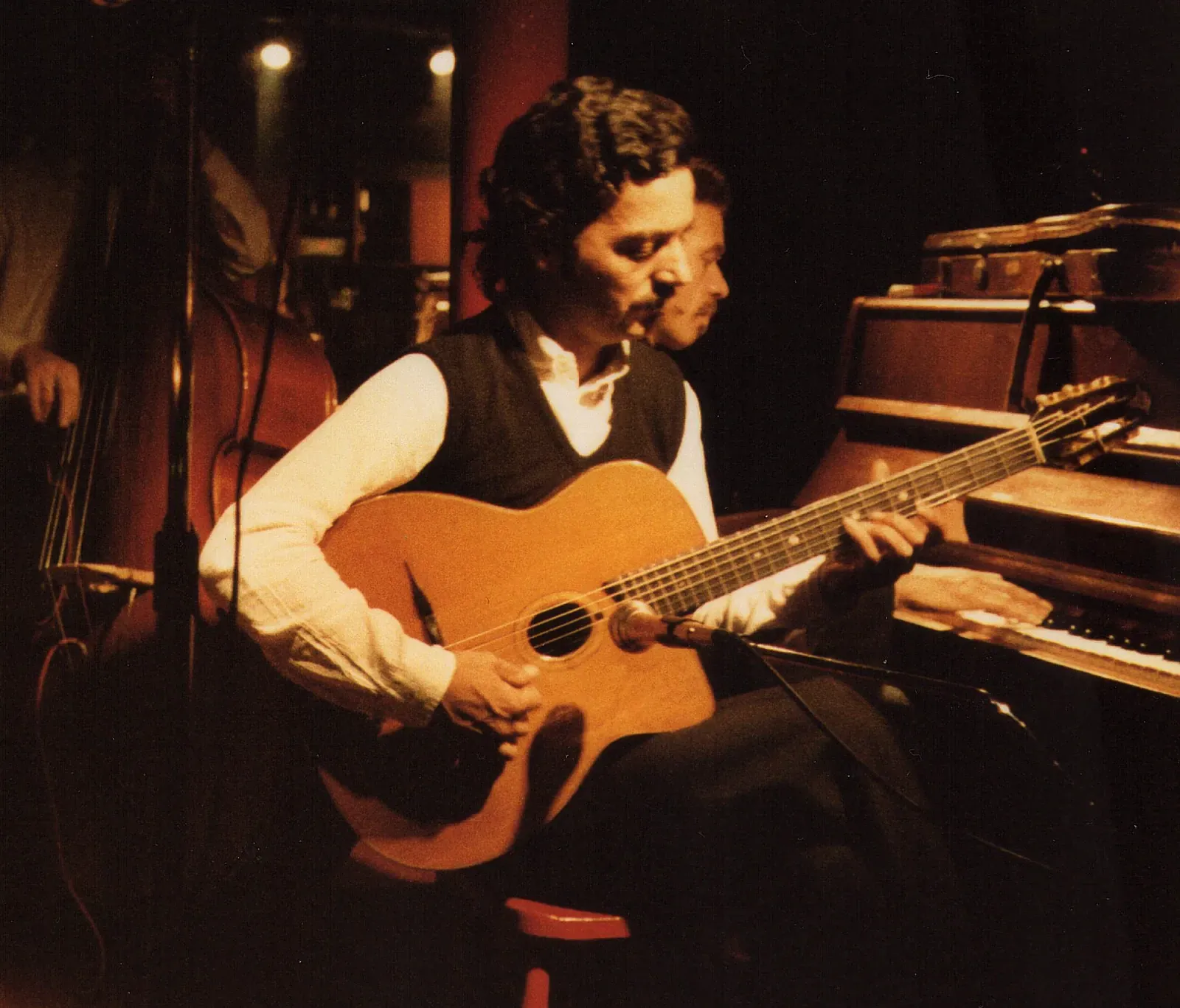
The style kept a repertoire of French and Romani material alive alongside American standards. Its revival ties to festivals, to Grappelli’s late career and to Manouche and Sinti guitarists who learned it within families.
Misconceptions
The first is that only Roma play it. Of the original Quintette, only Reinhardt and his brother Joseph were Roma, and Reinhardt often played in non-Roma jazz settings; many of today’s players are not Romani, which is why the term refers to a style.
The second is that Reinhardt knew the style as jazz manouche. He would not have known the term: the Quintette was simply a popular jazz group of its day, and the label came later.
The third is that the sound never changed. After 1940 the group often recorded with a drummer, Reinhardt turned to an electric guitar influenced by bebop, and his sons Lousson and Babik played in a style influenced by American jazz.
Frequently asked questions
What is gypsy jazz?
Gypsy jazz is an acoustic jazz style from 1930s France, led by guitar and violin with a double bass and a rhythm guitar playing la pompe. It is also called jazz manouche.
Who created gypsy jazz?
Django Reinhardt and Stéphane Grappelli created it in Paris in 1934 through the Quintette du Hot Club de France.
What is la pompe?
La pompe, French for “the pump”, is the percussive rhythm guitar strum of the style, a quick up-down strum followed by a down strum that accents the second and fourth beats.
Does gypsy jazz use drums?
The original Quintette had none, and the rhythm guitar took the drums’ role. After 1940 Reinhardt’s groups often added a drummer, while la pompe remains the standard way to do without them.
Sound
Sound sheet
Signature sounds
- La pompe rhythm guitar standing in for drums
- Acoustic lead guitar and violin over double bass
- Ornamented arpeggio lines with chromatic and diminished runs
- Minor-key repertoire in Dorian and harmonic minor modes
Techniques
- La pompe
- Ornamented arpeggios
- Chromatic and glissando runs
- Diminished runs
- Economy picking with down strokes
Keys and modes
Minor keys. Much of the repertoire sits in minor keys, giving a dark sound over lively playing.
Dorian mode. Frequently heard in lead lines and tune melodies.
Harmonic minor. Frequently heard alongside Dorian.
Vocals
Mostly instrumental, with occasional vocal numbers.
Scenes
Where it happened
Where and when the sound lived: one bar per city on a shared timeline.
Europe
North America
Active scenes
Peak 3, 2004-2025
Where the Quintette formed and recorded, and the base of the Hot Club de France.
Reinhardt's last residence and the site of the annual Festival Django Reinhardt.
Home of the Django in June camp, held on the Smith College campus.
Venues and places
Paris, 1934 to today. On the Champs-Elysees, where backstage jams between Reinhardt and Grappelli led to the Quintette.
Paris, 1937 to today. Montmartre nightclub opened by Adelaide Hall and Bert Hicks, with the Quintette as a house band.
Samois-sur-Seine, 1968 to today. Annual late June or early July festival, since 2017 also in the grounds of Fontainebleau chateau.
Culture
Culture markers
- Festival jam sessions
Informal jam sessions in small venues are part of the annual Samois festival scene.
Ritual - Learning within families
In Manouche and Sinti communities children learn from relatives at a very early age.
Ritual
Glossary
Terms on this page
Paris jazz society founded in 1931-32 that promoted jazz and gave the Quintette its name.
French name for gypsy jazz, after the Manouche clan of Romani people.
Percussive rhythm guitar stroke, an up-down then down strum stressing beats two and four.
Romani clan in France and Belgium among whom the style has stayed popular.
Name for Reinhardt's wartime and later groups with clarinet, drums and rhythm guitar.
Jazz family