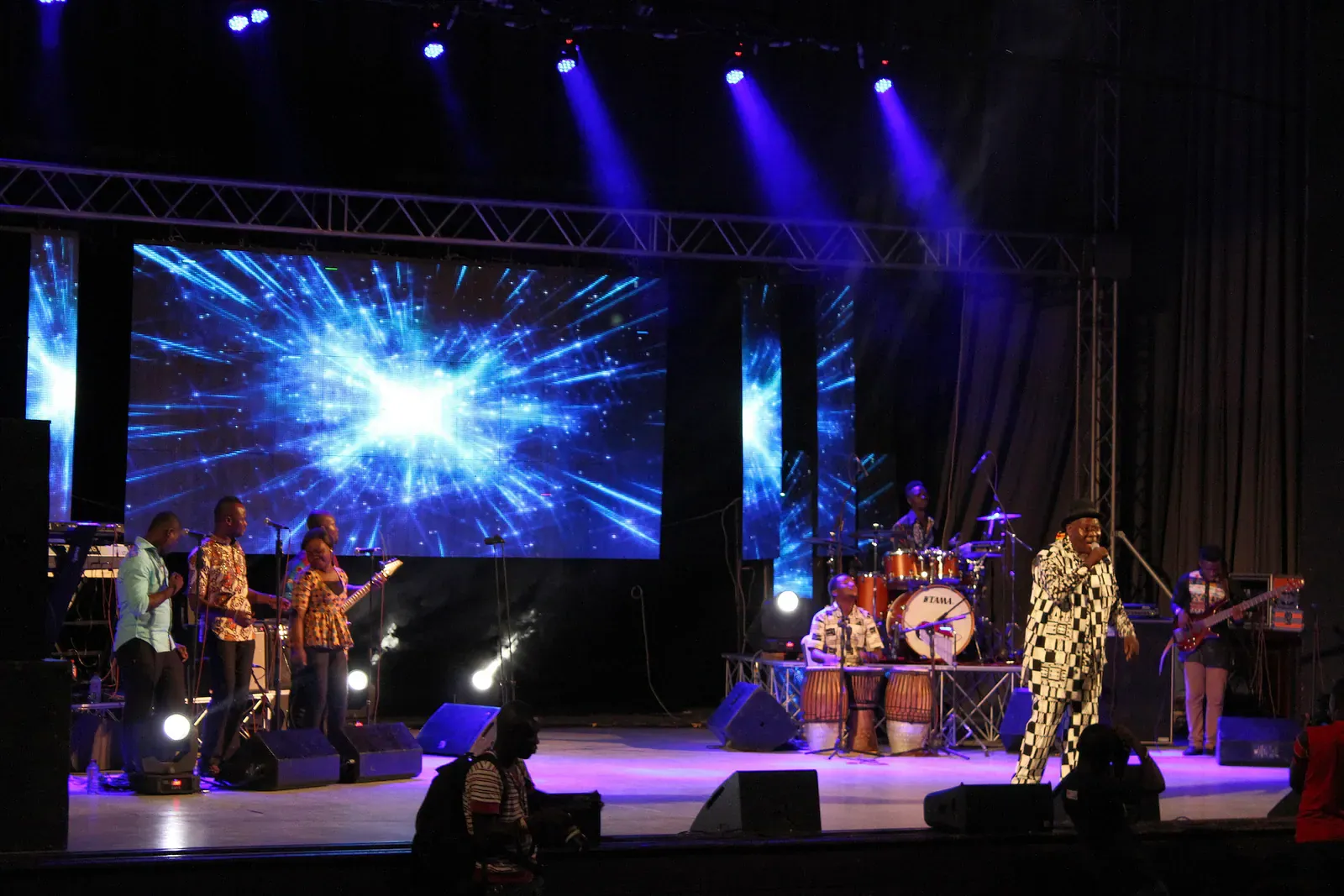
Mande music
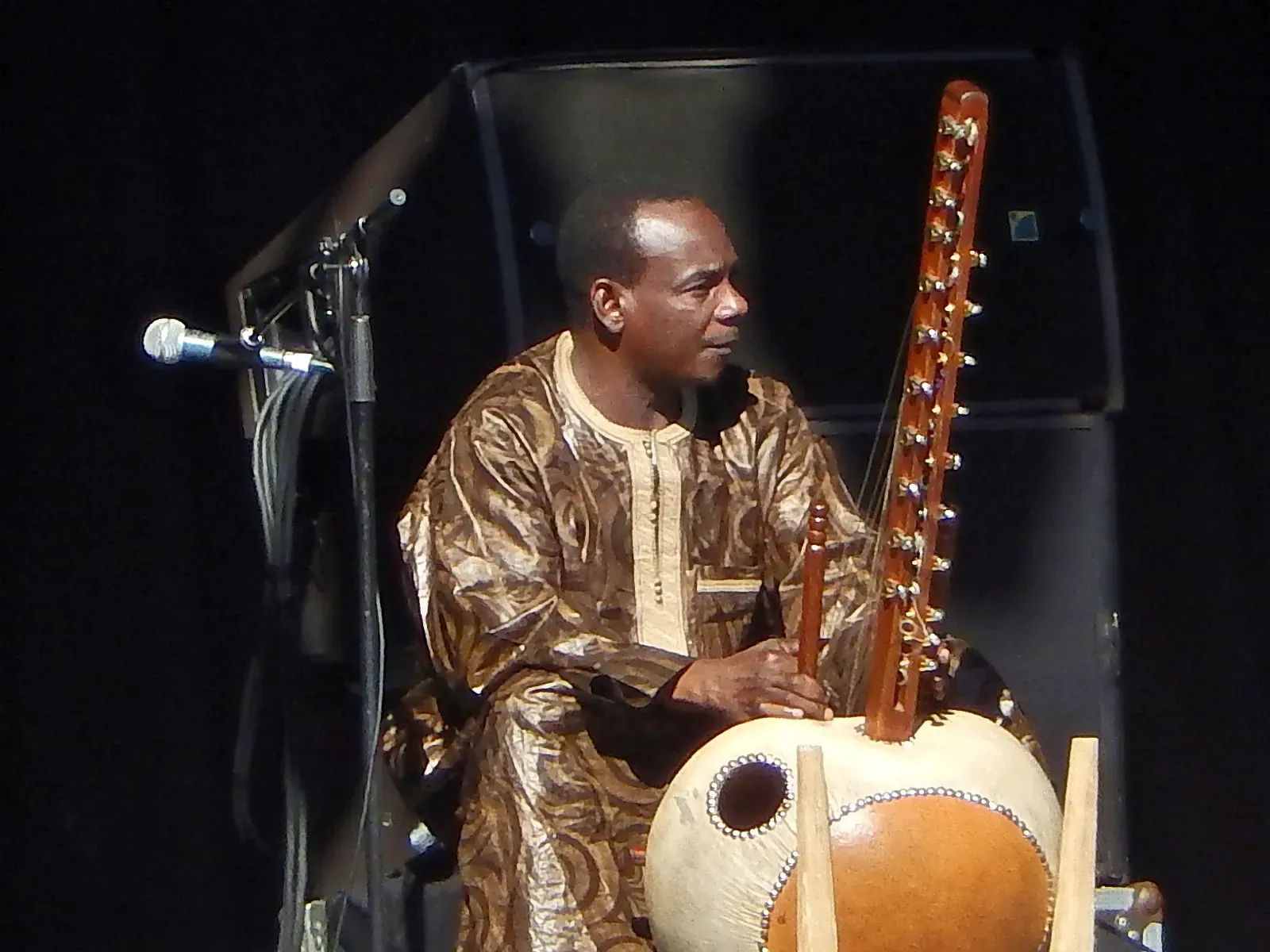
Mande music is the song and instrumental tradition of Mandinka, Maninka and Bamana peoples, led by hereditary jeli musicians on kora, ngoni and balafon.
Mali, Guinea, Senegal, Gambia, Guinea-Bissau, Côte d’Ivoire, Burkina Faso, around 1230
African family
Born
around 1230
Mali, Guinea, Senegal, Gambia, Guinea-Bissau, Côte d’Ivoire, Burkina Faso
Subgenres
4
Documented branches
Links
6
Genres it drew on or shaped
Tempo
90-160 BPMLineage
Family tree
Grew out of
Mali, Guinea, Senegal, Gambia, Guinea-Bissau, Côte d’Ivoire, Burkina Faso
Mande music
Led to (5)
Timeline
Era by era
From the first sparks to today. Select a dot to read the story behind it.
- Court and patron tradition
1230 to 1957
- Independence and state orchestras
1958 to 1979
- Paris and the roots revival
1980 to 1989
- Kora and ngoni abroad
1990 to 2009
- Conflict, loss and a new generation
2010 to today
Eras
Moments
- 1 Court and patron tradition, 1230 to 1957
- 2 Independence and state orchestras, 1958 to 1979
- 3 Paris and the roots revival, 1980 to 1989
- 4 Kora and ngoni abroad, 1990 to 2009
- 5 Conflict, loss and a new generation, 2010 to today
around 1230
Court and patron tradition
Jeli families serve noble patrons of the Mali Empire and its successors as historians, praise singers and advisers, carrying epics such as Sundiata on kora, ngoni and balafon.
- 1235Manden Charter at Kouroukan FougaAfter the Battle of Krina, nobles of the new Mali Empire proclaim the charter that jeli oral tradition still preserves; UNESCO lists it in 2009.
1958
Independence and state orchestras
Guinea's cultural policy and Mali's sponsored bands, among them Bembeya Jazz National and the Rail Band, set Mande songs to electric guitars, horns and Cuban rhythms.
- 1961Orchestre de Beyla, later Bembeya Jazz, formsThe regional orchestra of Beyla in Guinea begins, and goes on to become the national orchestra in 1966.
- 1967Syliphone label foundedThe Guinean state establishes Syliphone in Conakry, the first African label funded by a post-colonial state.
- 1970Rail Band formed in BamakoA state-sponsored house band at the Buffet Hôtel de la Gare blends Latin dance music with Mande praise song, kora and balafon.
- 1972Salif Keita joins Les AmbassadeursThe Rail Band singer defects to rivals Les Ambassadeurs, whose clash with the Rail Band defines 1970s Malian music.
1980
Paris and the roots revival
Exiled stars made Paris the capital of Mande dance music, with Salif Keita's Soro and Mory Kanté's Yé ké yé ké, while acoustic revival records such as Yasimika returned to jeli sources.
- 1983Yasimika starts an acoustic revivalJali Musa Jawara's album is credited with launching a mid-1980s return to acoustic, jeli-based records.
- 1987SoroSalif Keita's Paris-made album, with keyboardist Jean-Philippe Rykiel, drops the Cuban influence for pop and rock.
- 1987Yé ké yé ké singleMory Kanté's single tops charts in several European countries in 1988 and is called the first African single to sell a million.
- 1988KairaToumani Diabaté's solo kora album, recorded in one afternoon in London, is his first release for Western audiences.
1990
Kora and ngoni abroad
Toumani Diabaté's Kaira, the Kulanjan sessions with Taj Mahal and Bassekou Kouyaté's Segu Blue took acoustic Mande instruments to festival and world-music audiences.
- 1999KulanjanToumani Diabaté and bluesman Taj Mahal record with six Malian players in Athens, Georgia, linking Mande music to the blues.
- 2006Segu BlueBassekou Kouyaté and Ngoni ba release a first album built around several sizes of ngoni.
2010
Conflict, loss and a new generation
The 2012 ban on music in northern Mali, the death of Toumani Diabaté in 2024 and younger players such as Sidiki Diabaté mark the present period.
- 2012Music banned in northern MaliArmed groups holding the north outlaw music in August; many musicians flee the region.
Listening path
Start listening
A short path from an easy way in to the deep end. Thumbnails come from YouTube; the player loads only when you press play.
- 01
Toumani Diabaté, 1988
A solo kora piece: listen for the bass ostinato and the improvised runs played at once.
- 02
Salif Keita, 1987
The Paris pop sound of the 1980s over a Mande vocal line.
- 03
Mory Kanté, 1987
The dance-floor hit that took a Mande song to number one in Europe.
- 04
Salif Keita, 2002
An acoustic return to Mande roots on the album Moffou.
- 05
Bassekou Kouyaté & Ngoni ba, 2006
The ngoni ensemble leading a full band with a blues feel.
Facts
| Family | African |
| Origin | Mali, Guinea, Senegal, Gambia, Guinea-Bissau, Côte d’Ivoire, Burkina Faso |
| Emerged | Medieval Mali Empire onward |
| Status | Active |
| Tempo | 90 to 160 BPM |
| Meter | 4/4 |
| Subgenres | 4 |
Mande music is the body of song and instrumental music made by the Mandinka, Maninka (Malinké), Bamana (Bambara), Dyula, Soninke and related Mande-speaking peoples of Mali, Guinea, Senegal, the Gambia, Guinea-Bissau, Ivory Coast and Burkina Faso.
Its core is the repertoire of the hereditary jeli (griot) musicians, who sing genealogies and praise over the kora, the ngoni and the balafon, a tradition tied to the Mali Empire of the 13th century. Around that core grew twentieth-century dance orchestras, Paris-made pop and the international kora circuit. It sits within African music.
Origins
Mande music is tied to the political history of the Mande heartland, the upper Niger and Sankarani region. The Mali Empire of the Mandinka, which ran from about 1230 to about 1600, gave the tradition its founding story. In the Epic of Sundiata, the king Sundiata Keita was given a griot, Balla Fasséké, as an adviser, and Balla Fasséké is regarded as the founder of the Kouyaté line of jeli that survives. Jeli oral tradition also preserves the charter said to have been proclaimed at Kouroukan Fouga after the Battle of Krina in 1235, which UNESCO inscribed on its intangible heritage list in 2009.
The word jeli means “blood” in Maninka. Jeli were historians, advisers, mediators and storytellers, and in a system of patronage no jeli was without a noble patron (jatigi) and no patron without a jeli. Families such as Kouyaté, Diabaté, Sissoko, Kamissoko, Soumano and Koné are jeli surnames, and the profession passed from parent to child, with marriage largely kept within the group. The French word griot is the colonial name for the same people, and many West African musicians prefer jeli.
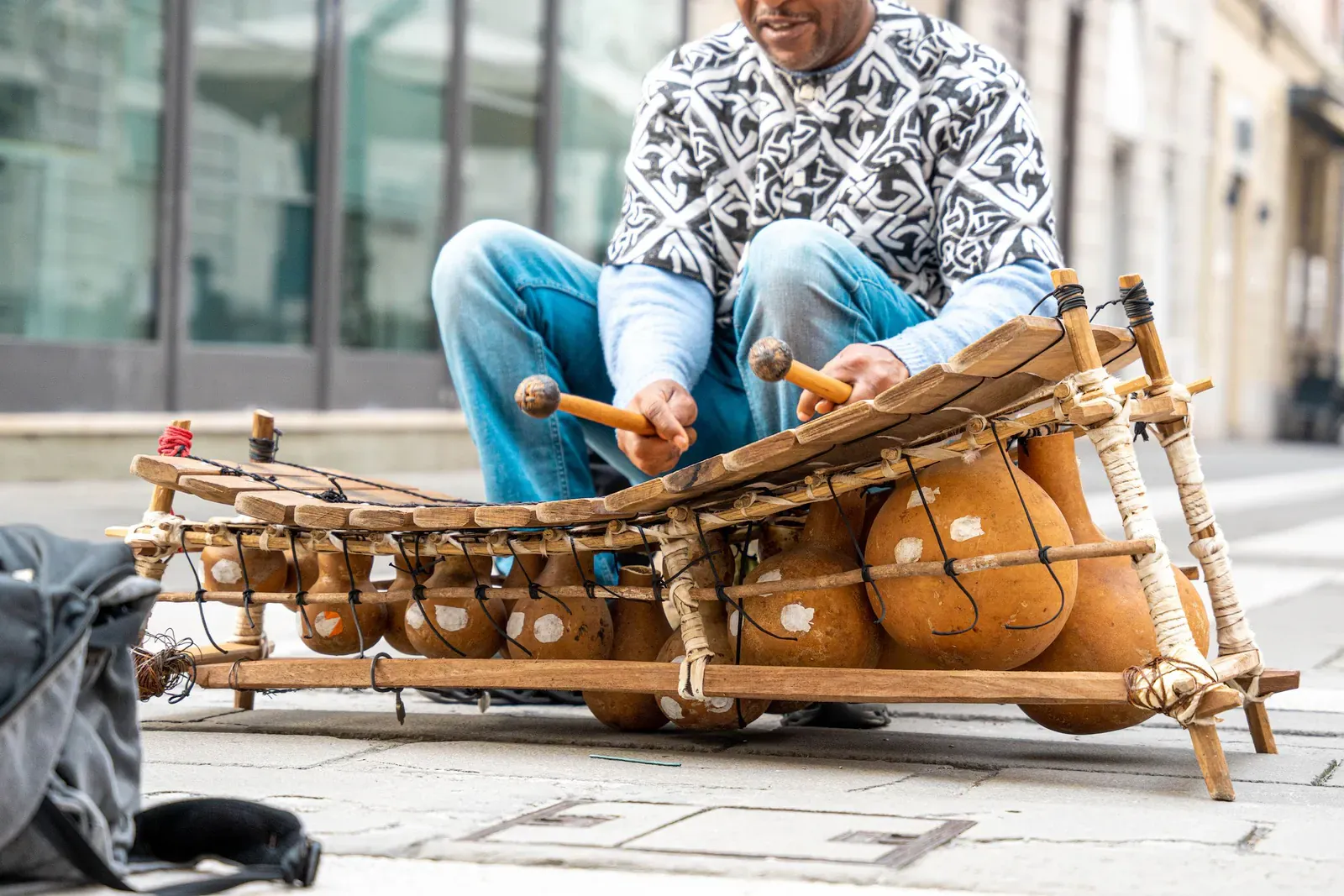
The instruments are older than the records: an ngoni and a balafon were reported at the court of Mansa Musa in 1352, and the Sosso Bala, a balafon kept in Niagassola in Guinea, is said in the epic to have passed from the Susu king Sumanguru to the Kouyaté family.
Colonial rule and the loss of patrons
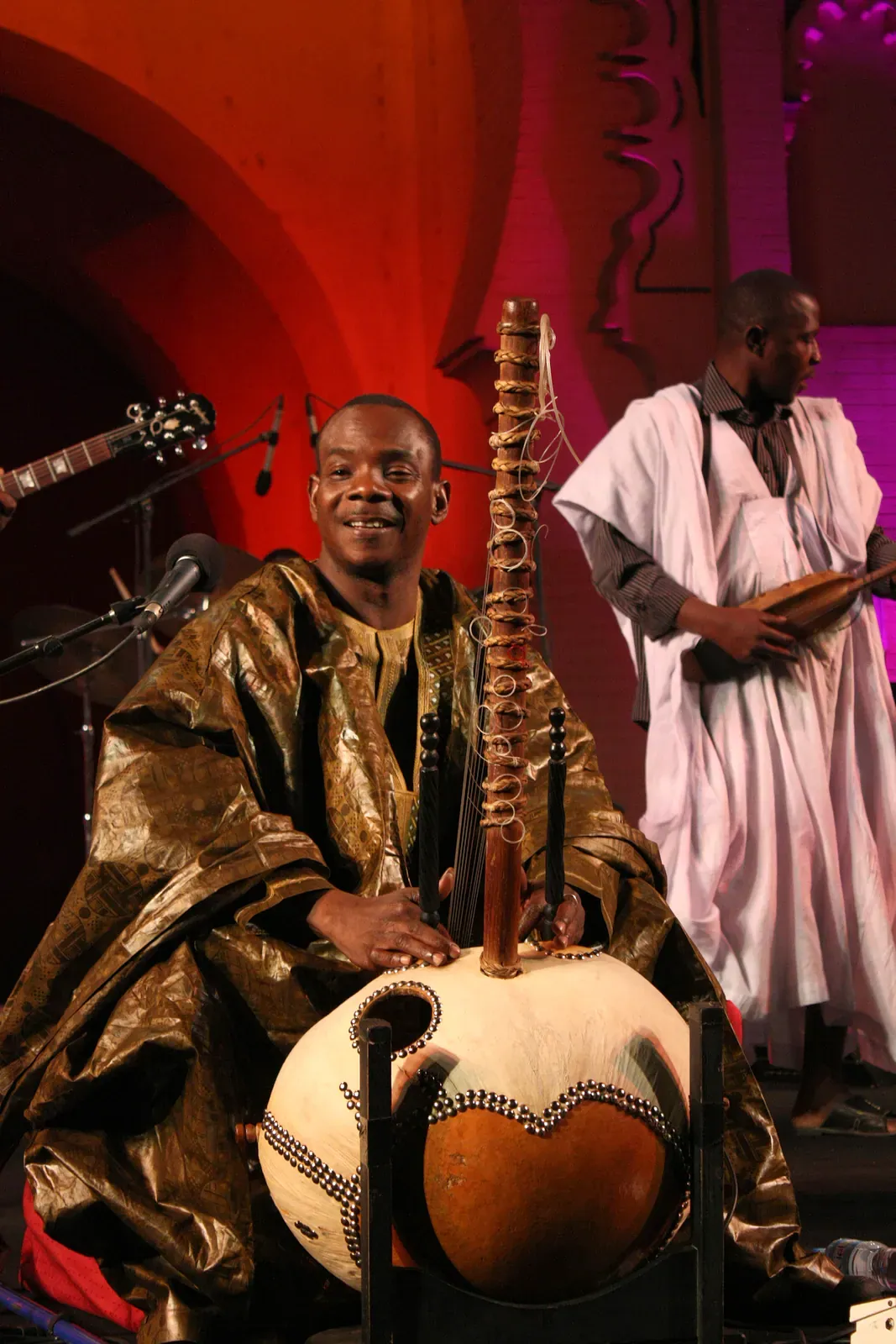
Colonial rule weakened the system that supported the jeli. French authorities regulated and in places restricted wandering musicians, and the kings and warrior families who had been the patrons faded from public life. After independence many jeli played for politicians, in concert halls and in recording studios instead of before individual patrons, and microphones and pickups fitted to the kora widened the audience.
State orchestras and Cuban dance bands, 1958 to 1979
Independence brought state backing. After 1958 the Guinean government replaced private dance bands with state-supported orchestras under a policy of cultural pride. The best known, Bembeya Jazz National, formed in 1961 in Beyla and became the national orchestra in 1966. Its 1968 album Regard sur le passé honoured Samory Touré, who founded a Mande state in northern Guinea. The state label Syliphone, founded in Conakry in 1967, documented this era.
In Mali the picture was similar. The Rail Band, founded in 1970 with sponsorship from the information ministry and the railway, played as the house band of the Buffet Hôtel de la Gare in Bamako. It began as a Latin dance group in the manner of Congolese music and soon added Bambara vocals, kora, balafon, ngoni and griot praise singing to electric guitar, organ and horns. Its rival Les Ambassadeurs du Motel formed in 1971. Singer Salif Keita, who had come up in the Rail Band, joined Les Ambassadeurs in 1972, and a joint concert of the two groups is still remembered as a defining night of 1970s Malian music. The Cuban dance rhythms of son cubano were everywhere.
In 1975 Fanta Damba became the first jelimuso to tour Europe, which set up the later popularity of female singers in Mali.
Paris and the roots revival, 1980 to 1989
At the end of the 1970s the Rail Band and Les Ambassadeurs moved to Abidjan because Mali’s economy was poor, and “Mandjou”, recorded there by Les Ambassadeurs, helped make Keita a solo star. Many leading musicians then left for Dakar, Paris, London or New York, and by the mid-1980s Paris was the centre of Mande dance music. Keita’s 1987 album Soro, made with producer Ibrahima Sylla and French keyboardist Jean-Philippe Rykiel, removed the Cuban traces and brought in rock and pop. Mory Kanté, who had also come through the Rail Band, released “Yé ké yé ké” as a single in 1987. It topped charts in Belgium, Finland, the Netherlands and Spain, is described as the first African single to sell a million copies, and carried the album Akwaba Beach.

A counter-movement began in the mid-1980s. Jali Musa Jawara’s 1983 album Yasimika is credited with starting a return to acoustic jeli recordings.
Kora and ngoni abroad, 1990 to 2009
The acoustic line reached world stages in this period. Toumani Diabaté’s Kaira (1988), a solo kora album recorded in London in an afternoon, introduced the instrument’s repertoire to a Western audience. In 1999 he gathered six Malian players to record Kulanjan in Athens, Georgia, with the blues musician Taj Mahal, a project that explored the link between Mande music and the blues. Diabaté worked widely with partners from flamenco to jazz and recorded with the London label World Circuit.
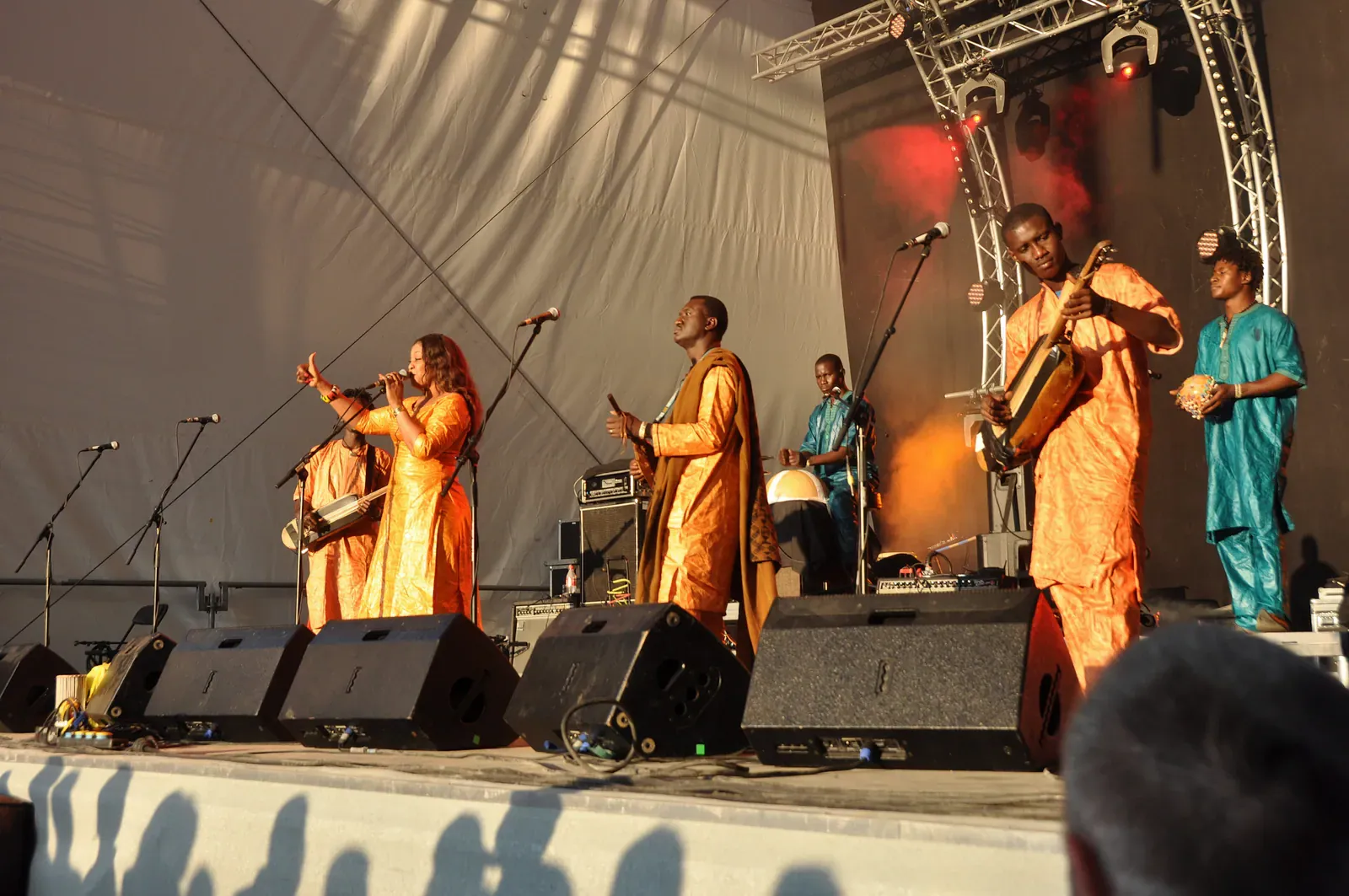
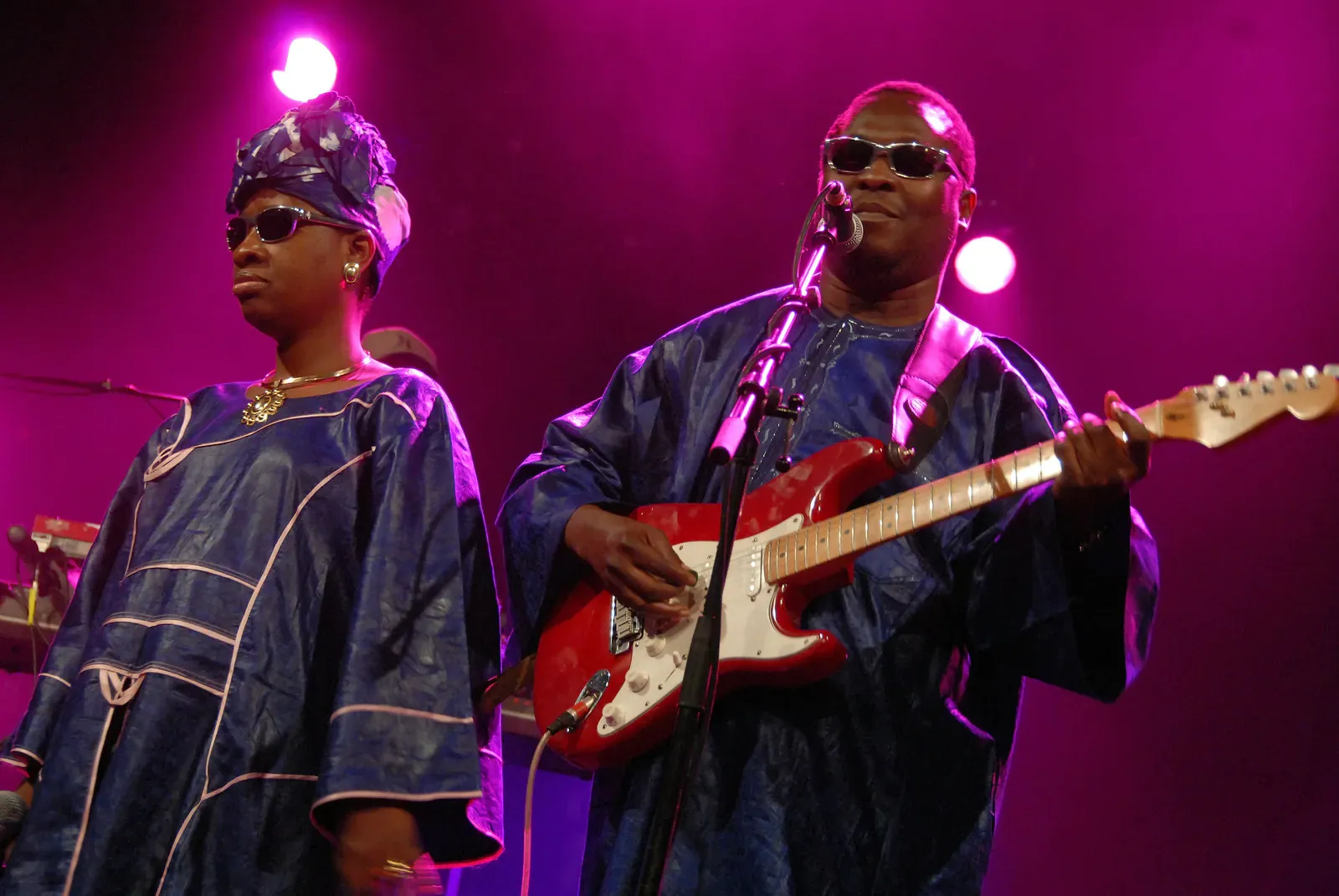
The ngoni moved from accompanist to lead. Bassekou Kouyaté assembled the ensemble Ngoni ba, built on several sizes of ngoni, and released Segu Blue in 2006. Amadou and Mariam, a blind couple from Bamako, joined Mande songs to electric guitar and a rock beat and reached international audiences through the 2000s.
Characteristics
Most pieces are built from a repeating, interlocking figure and a voice that decorates it. The kora tradition separates a bass and riff pattern (kumbengo) from improvised solo runs (birimintingo), played together by both hands. Songs balance a scripted refrain (donkili) against improvised praise that is usually organised around a family surname, with proverbs as a major component. Regional styles differ. Bamana music is described as simple and pentatonic, Maninka music as highly ornamented, heptatonic and led by female vocalists, and the kora tradition of Senegal and the Gambia as more rhythmically complex than the vocally led style of Mali and Guinea.
Instruments and production
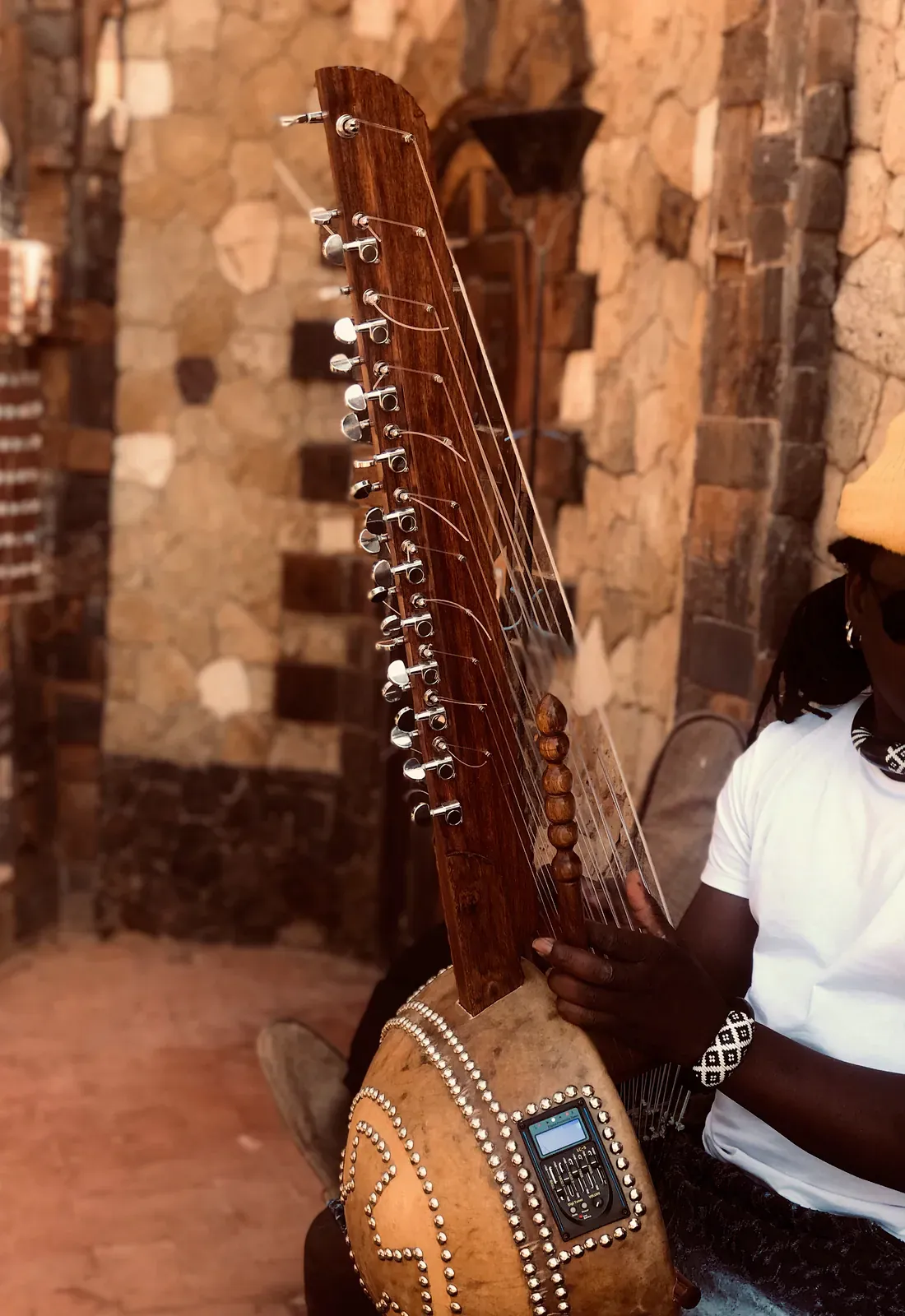
The jeli ensemble is a melody core of kora, ngoni and balafon over drums and bells, and the electric era added guitar, organ, horns and kits without removing it. Maninka guitarists in eastern Guinea adapted balafon patterns to the electric guitar, and many kora players now use guitar machine heads instead of leather tuning rings.
Mainstream success
Mande music reached the mass market twice: through Paris-made dance records by Keita and Kanté in the late 1980s, and through world-music festivals that made Diabaté, Kouyaté and Amadou and Mariam known abroad in the 2000s. At home female jeli such as Kandia Kouyaté from Kita, called la grande vedette malienne, are a constant on radio, television and market stalls. Wassoulou, a related style from south of Bamako, produced its own star in Oumou Sangaré.
Notable recordings
Soro (1987) shows the Paris method most clearly: a Mande voice over keyboards and pop arrangements, made abroad by an exiled star. Kaira (1988) is the opposite, one instrument recorded in an afternoon, and tracks such as “Jarabi” remain an entry point to the kora.
Culture
Jeli sing at weddings, baptisms and other life-cycle ceremonies, reciting genealogies and praising the host family, and in much of Mande society most singers are women because these events are attended mostly by women. Female singers are also followed as style setters. The profession carries mixed status: respected and trusted with privileged information, yet set apart by caste-like rules about marriage and, historically, burial. The year 2012 brought a rupture in northern Mali, when armed groups banned music and many musicians fled.
Legacy
The Mande model of a professional voice that carries history through music shaped West African popular music, and its instruments are now standard on world stages. Toumani Diabaté, who died on 19 July 2024, came from a long line of kora-playing jeli, and his son Sidiki Diabaté, born in 1992, performs and produces in Bamako.
Misconceptions
One common claim is that griot and jeli are different traditions. Griot is the French word and jeli the Manding one, and they name the same hereditary profession. A second is that Mande music is only acoustic and ancient. The record shows electric bands from the 1970s, a Paris pop style in the 1980s and a modern rock-tinged strand through Amadou and Mariam. A third is that all Malian music is Mande. Mande peoples are about half of Mali’s population; Fula, Songhai and Tuareg musicians have their own traditions.
Frequently asked questions
What instruments define Mande music?
The kora, ngoni and balafon carry the melody, with dununba and talking drums for rhythm and electric guitar added in the dance-band era.
What is a jeli?
A jeli is a hereditary Mande musician, historian and praise singer, called a griot in French. Families such as Kouyaté and Diabaté hold the profession.
Who are the best-known Mande musicians?
Toumani Diabaté and Ballaké Sissoko on the kora, Salif Keita and Mory Kanté in popular song, Kandia Kouyaté in the female jeli tradition and Bassekou Kouyaté on the ngoni are among the best known.
Where did Mande music begin?
It grew out of the court culture of the Mali Empire in the upper Niger region from the 13th century, and Mali and Guinea remain its main centres.
Sound
Sound sheet
Signature sounds
- Kora ostinato (kumbengo) under improvised runs
- Scripted refrain against improvised praise vocals
- Kora, ngoni and balafon as melody voices
Drums and percussion
- Dununba
- N'taman
- Tabale
Techniques
- Kumbengo and birimintingo
- Improvised praise over a refrain
- Balafon style on guitar
- Two-handed ranks
Keys and modes
Kora heptatonic tunings. Moving the konso rings sets one of four seven-note scales close to Western major, minor and Lydian.
Bamana pentatonic. Bamana melodic instruments are built on a pentatonic structure.
Tuning
Kora retuned by sliding leather rings along the neck into one of four seven-note scales
Vocals
Hereditary jeli singers, often women, recite genealogies and praise patrons in call and refrain over the melody instruments.
Scenes
Where it happened
Where and when the sound lived: one bar per city on a shared timeline.
Africa
Europe
Active scenes
Peak 4, 1984-2025
Capital of independent Guinea, home of Syliphone and the state orchestras such as Bembeya Jazz National.
Base of the Rail Band, Les Ambassadeurs and most Malian jeli stars.
Where the Rail Band and Les Ambassadeurs moved at the end of the 1970s and recorded Mandjou.
Exile home of Salif Keita and Mory Kanté, and by the mid-1980s the capital of Mande dance music.
Venues and places
Bamako, 1970 to today. Station hotel bar where the Rail Band played as house band.
Culture
Culture markers
- Praise singing at weddings and baptisms
Jeli singers recite genealogies and praise the host family at life-cycle ceremonies, often with female vocalists.
Ritual - Surname praise songs
Improvised lyrics over a fixed refrain praise ancestors through the epithet attached to each family name.
Ritual - Jelimusow as style setters
Female singers such as Kandia Kouyaté are followed in Mali for their moral lyrics and as fashion trend-setters.
Fashion
Media
Key media
- 1960Soundjata ou l'épopée mandingue
by Djibril Tamsir Niane. Written version of the Sundiata epic as told by a Guinean jeli, the best-known entry to Mande oral history.
Book
Glossary
Terms on this page
Improvised solo run of the kora over the kumbengo.
Scripted refrain of a jeli song, set against improvised praise lyrics.
Noble patron of a jeli family; in the tradition no jeli is without a jatigi.
Hereditary Mande musician, historian and praise singer, called griot in French; the feminine form is jelimuso.
Leather tuning rings slid along the kora neck to change its scale.
Ostinato riff of the kora, played together with improvised solo runs.
African family