Rajasthani folk music
Rajasthani folk music is the desert song of the Manganiyar, Langa, Kalbelia and Bhopa communities, from court maand to Coke Studio and film playback.
Rajasthan, 1947
South Asian family
Born
1947
Rajasthan
Subgenres
6
Documented branches
Links
8
Genres it drew on or shaped
Tempo
100-170 BPMLineage
Family tree
Grew out of
Rajasthan
Rajasthani folk music
Led to (6)
Timeline
Era by era
From the first sparks to today. Select a dot to read the story behind it.
- Independence and documentation
1947 to 1989
- Awards and the first screen hits
1990 to 2005
- Stage shows and festivals
2006 to 2013
- Streaming and film playback
2014 to today
Eras
Moments
- 1 Independence and documentation, 1947 to 1989
- 2 Awards and the first screen hits, 1990 to 2005
- 3 Stage shows and festivals, 2006 to 2013
- 4 Streaming and film playback, 2014 to today
1947
Independence and documentation
The Criminal Tribes Act was repealed in 1952, Komal Kothari's Rupayan Sansthan began archiving desert oral traditions in 1960, and the 1972 Wildlife Act pushed Kalbelia families from snake handling toward performance.
- 1952Criminal Tribes Act repealedThe law that had branded the Kalbelia as habitual criminals ended after independence, though social stigma continued.
- 1960Rupayan Sansthan founded at BorundaKomal Kothari helped found the Rajasthan Institute of Folklore, which archives the oral traditions of western Rajasthan, including Langa and Manganiyar song.
- 1972Wildlife Act ends snake handlingThe Kalbelia lost their traditional trade, and performing arts became a main source of income for the community.
- 1982Allah Jilai Bai receives the Padma ShriThe Bikaner singer, a leading voice of maand, was honoured again with the Sangeet Natak Akademi Award in 1988.
1990
Awards and the first screen hits
Kamaicha master Sakar Khan won the Sangeet Natak Akademi Award in 1991, Nimbooda reached Hindi cinema in 1999, and French-based Dhoad formed in 2002 to take Rajasthani musicians on world tours.
- 1991Kesariya Baalma in the film LekinLata Mangeshkar sings a film version of the maand song, with music by Hridaynath Mangeshkar.
- 1999Nimbooda in Hum Dil De Chuke SanamThe Manganiyar tune popularised by Gazi Khan Barna is adapted by Ismail Darbar and sung by Kavita Krishnamurthy and Karsan Sagathia.
- 2002Dhoad formed in FranceRahis Bharti brings dancers, singers and instrumentalists from Rajasthan together as the Dhoad Gypsies of Rajasthan.
2006
Stage shows and festivals
The Manganiyar Seduction opened in 2006, the Jodhpur RIFF began in 2007, UNESCO listed Kalbelia songs and dances in 2010, and Coke Studio put Manganiyar singers before a television audience.
- 2006The Manganiyar Seduction opensRoysten Abel stages over 40 Manganiyar musicians in New Delhi, then tours the UK, US, Germany, Austria and Australia.
- 2007Jodhpur RIFF beginsMehrangarh Museum Trust and Jaipur Virasat Foundation launch the Rajasthan International Folk Festival at Mehrangarh Fort, timed to Sharad Purnima.
- 2010UNESCO lists Kalbelia songs and dancesThe oral tradition, learned without texts or training manuals, joins the Intangible Cultural Heritage list.
- 2011Barmer Boys formedThe Manganiyar trio forms at the Amarrass Desert Music Festival and mixes Sufi kalam with beatboxing and DJ sets.
- 2012Chaudhary on Coke StudioMame Khan and Amit Trivedi perform the folk song in the second season of Coke Studio @ MTV, which brings Khan wide attention.
- 2012At Home: Sakar KhanAmarrass Records issues analogue field recordings of the kamaicha master made at his home in Hamira, his only album.
2014
Streaming and film playback
Singers from the Manganiyar community, such as Mame Khan and Swaroop Khan, moved between independent albums, Hindi film playback and fusion releases, while the Barmer Boys mixed folk with beatboxing and electronics.
- 2018Ghoomar in PadmaavatSwaroop Khan and Shreya Ghoshal sing the film version of the women's circle dance song.
Listening path
Start listening
A short path from an easy way in to the deep end. Thumbnails come from YouTube; the player loads only when you press play.
- 01
Mame Khan, 2021
The best-known Rajasthani folk song, sung in the maand style here by a Manganiyar singer.
- 02
Mame Khan and Amit Trivedi, 2012
Coke Studio setting of a Marwari folk song with the dholak and a full vocal line.
- 03
Barmer Boys, 2017
Live Manganiyar trio with harmonium, khartal and dholak, built on a bhakti and Sufi song.
- 04
Barmer Boys, 2019
Devotional song from the group's second album, performed live in Portugal.
Facts
| Family | South Asian |
| Origin | Rajasthan, India |
| Emerged | Traditional |
| Status | Active |
| Tempo | 100 to 170 BPM |
| Subgenres | 6 |
Rajasthani folk music is the group of oral song traditions of Rajasthan, India, kept by hereditary musician castes of the Thar Desert, chiefly the Manganiyar and Langa, alongside the Kalbelia, the Bhopa priest-singers and court-trained maand singers.
It is built on epic ballads, seasonal and water-carrying songs and wedding repertoire, carried by bowed lutes and hand percussion. It belongs to the South Asian family and shares much of its lineage with the music of Sindh across the border.
Origins
The Manganiyar are a Muslim community of Barmer and Jaisalmer districts, with relatives in Tharparkar and Sanghar in Sindh. Their songs pass from one generation to the next as an oral history of the desert, and their patrons, the jajman, have traditionally been the locally dominant Rajput and Charan families. The name comes from mangan, to beg, and har, a garland; a community legend says that Bibi Fatema gave a necklace to a musician called Mangan. The Langa belong to the same hereditary system and have long performed mainly for Muslim patrons.
Other strands run beside them. The Kalbelia are a snake-charming community of the Nath Shaiva tradition who follow the sage Kanifnath, and their women sing and dance. The Bhopa are priest-singers who recite the epics of folk deities, above all Pabuji, in front of a painted cloth scroll. Maand grew up in the royal courts: Allah Jilai Bai of Bikaner was singing in the durbar of Maharaja Ganga Singh by the age of 10, trained in maand, thumri, khayal and dadra, and her recording of Kesariya Balam is the earliest available of that song.
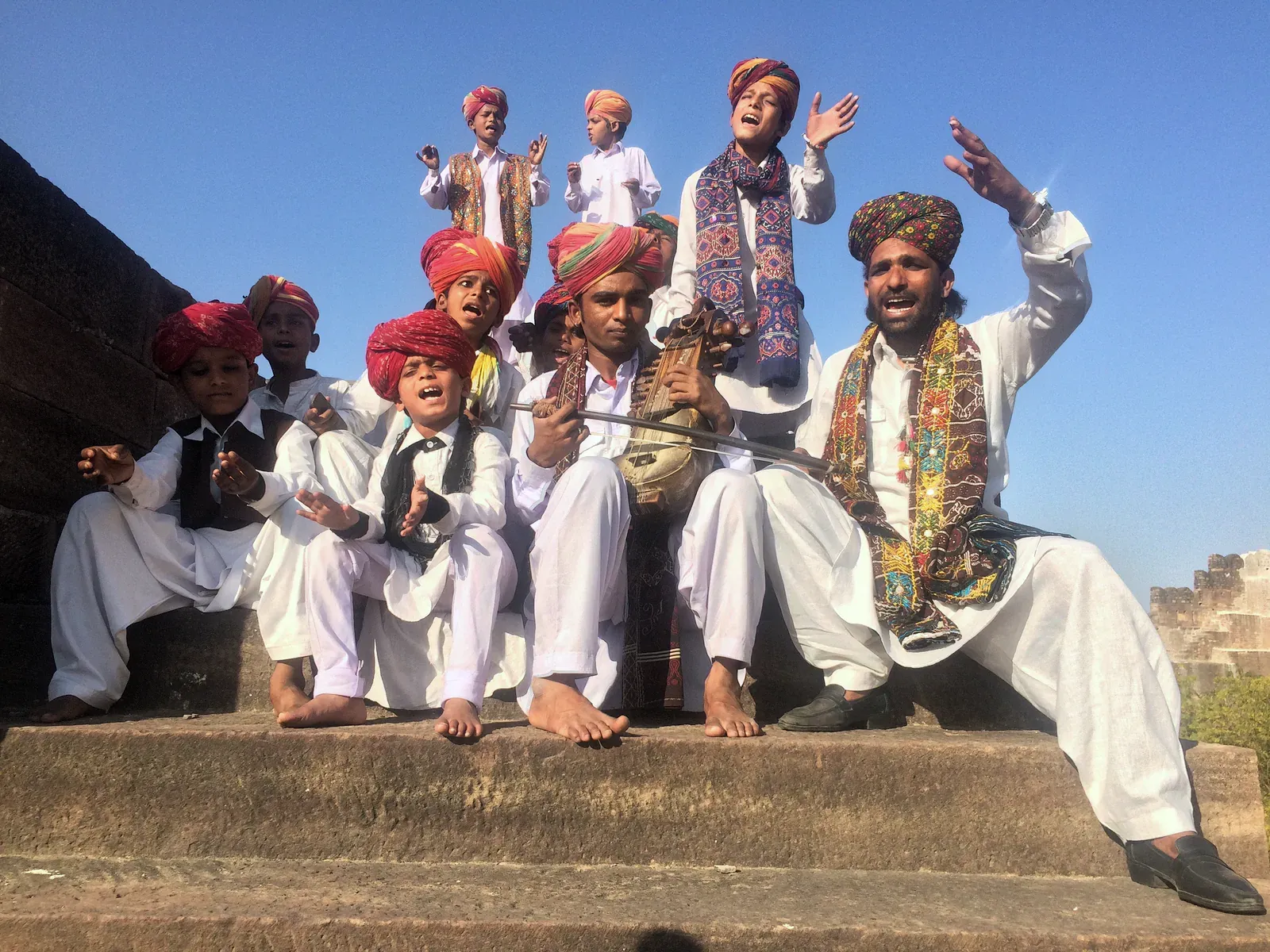
Independence and documentation, 1947-1989
After independence the Criminal Tribes Act, which had branded the nomadic Kalbelia as habitual criminals, was repealed in 1952, although stigma remained. The folklorist Komal Kothari began recording the Langa and Manganiyar, the first to do so, and helped bring them out of their home districts. In 1960 he helped found Rupayan Sansthan at Borunda, an institute that archives the oral traditions of western Rajasthan. The Wildlife Act of 1972 ended snake handling as a trade and pushed Kalbelia families toward the stage. Allah Jilai Bai received the Padma Shri in 1982 and the Sangeet Natak Akademi Award in 1988.
Recognition, 1990-2005
Sakar Khan, born in 1938 at Hamira in Jaisalmer district and taught by his father, became the best-known kamaicha player. He won the Sangeet Natak Akademi Award in 1991 and the Padma Shri in 2012, played with Yehudi Menuhin and Ravi Shankar in Brussels, toured the United States, France, Japan and the USSR, and performed in London with George Harrison. He added sympathetic strings to the instrument, and his Bhairavi and Kalyani renditions are held in the Smithsonian ethnomusicology archives.
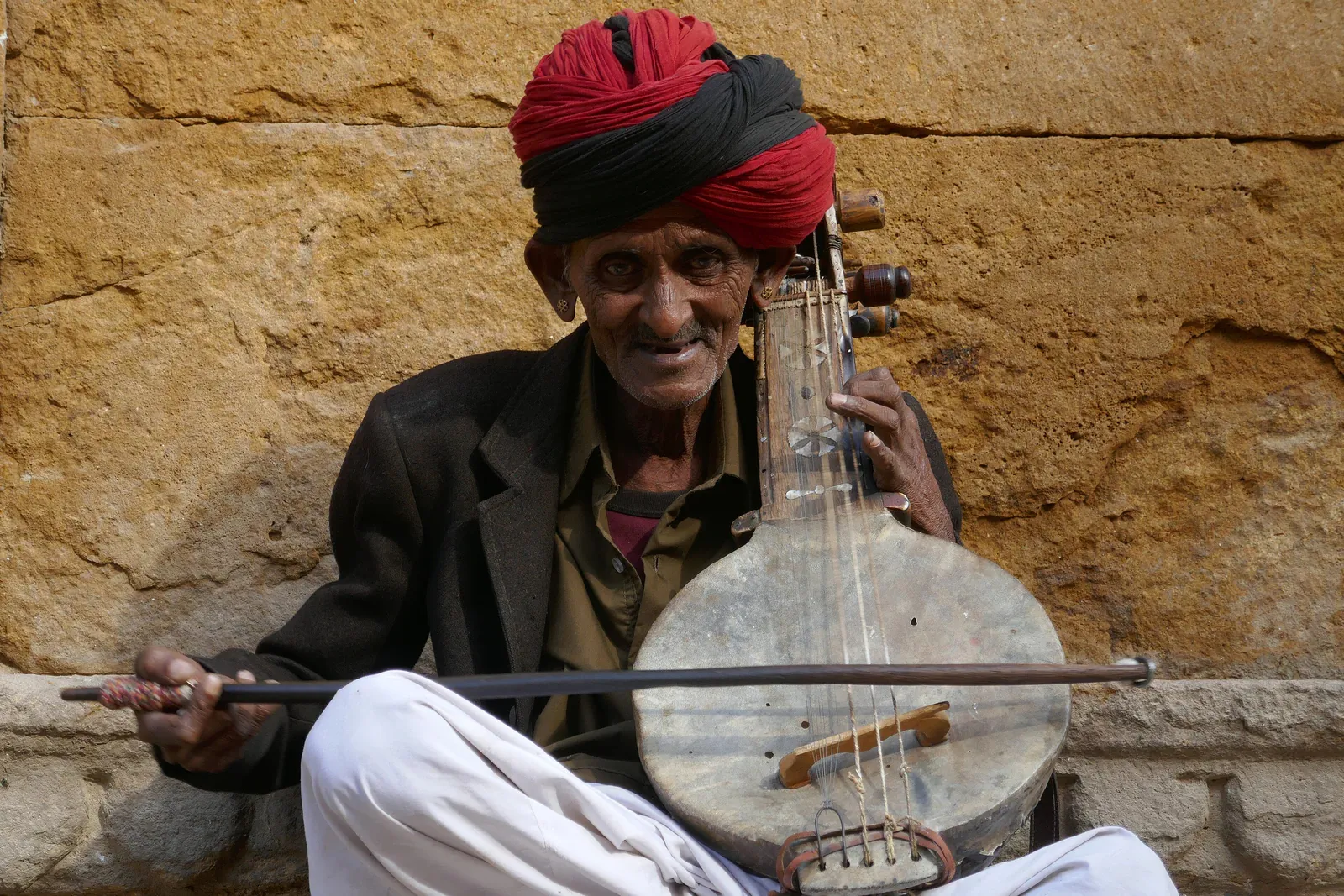
The screen opened a second route. Lata Mangeshkar sang Kesariya Baalma in the film Lekin in 1991, and Nimbooda, a Manganiyar tune made popular by Gazi Khan Barna, was adapted for Hum Dil De Chuke Sanam in 1999. In 2002 Rahis Bharti, a tabla player from a line of Rajasthani court musicians, formed the Dhoad Gypsies of Rajasthan in France; he has since given over 2,500 concerts in more than 110 countries.
Stage shows and festivals, 2006-2013
The Manganiyar Seduction, staged by the theatre director Roysten Abel, opened in New Delhi in 2006 with more than 40 Manganiyar musicians and toured the United Kingdom, the United States, Germany, Austria and Australia. The Rajasthan International Folk Festival began at Mehrangarh Fort in Jodhpur in 2007, timed to the brightest full moon of the year. UNESCO listed Kalbelia songs and dances as intangible heritage in 2010.
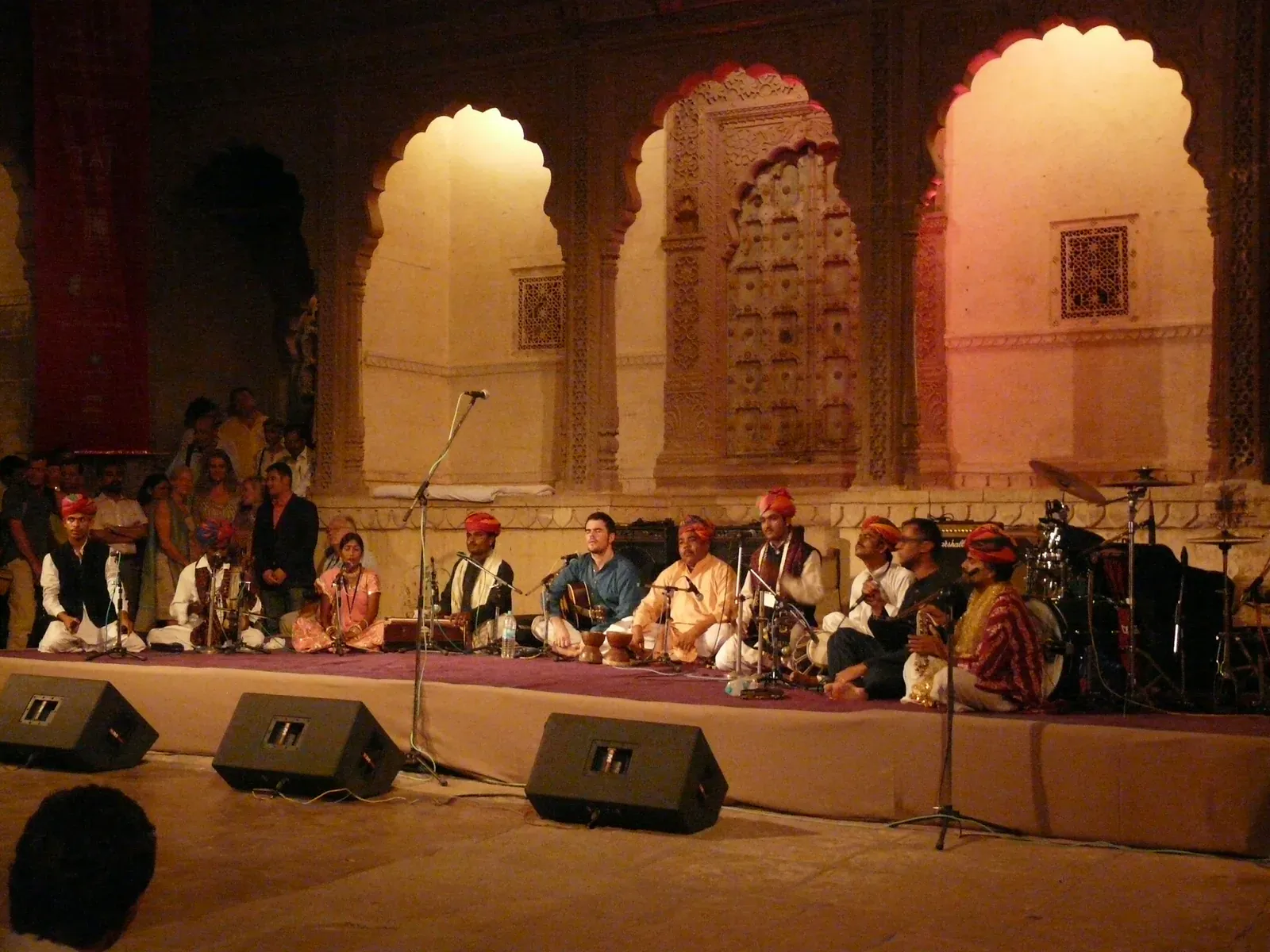
Amarrass Records recorded Sakar Khan at home in Hamira, released as At Home: Sakar Khan in 2012, his only album. The Barmer Boys formed in 2011 at the Amarrass Desert Music Festival, and Coke Studio @ MTV carried Mame Khan’s Chaudhary in 2012 and the Barmer Boys’ Pir Jalani with the composer Clinton Cerejo in 2013.
Streaming and film playback, 2014 onward
Singers from Manganiyar families now move between folk albums, film playback and fusion. Mame Khan, who made his Bollywood debut in 2009, released the crowd-funded Desert Sessions in 2015 and in 2022 became the first folk artist to walk the red carpet at Cannes. Swaroop Khan, who entered Indian Idol in 2010, sang Ghoomar for Padmaavat in 2018. The Barmer Boys mix beatboxing, electronics and DJ sets with Sufi kalam, and have shared stages with Bombino, Fatoumata Diawara and Khaled. Ila Arun, from Jaipur, built a folk-pop career in film and albums; related currents are Sufi music and filmi.
Characteristics
Craft is inherited. A Manganiyar or Langa child learns from the family, and a household’s repertoire follows its patrons: the Manganiyar sing for both Hindu and Muslim patrons and are noted for a liberal repertoire, while Langa repertoire leans toward Muslim patrons. Songs describe people, nature and salvation, and some ragas of the repertoire are said to have begun in the Thar. Epics such as the story of Pabuji carry the heroes of Rajput and herder life, and women’s panihari songs describe the daily work of carrying water in the desert. Maand sits near the classical thumri and ghazal; the link to Hindustani classical music is closest here. Kalbelia songs are made up and reshaped in performance, with no texts or training manuals.
Instruments and production
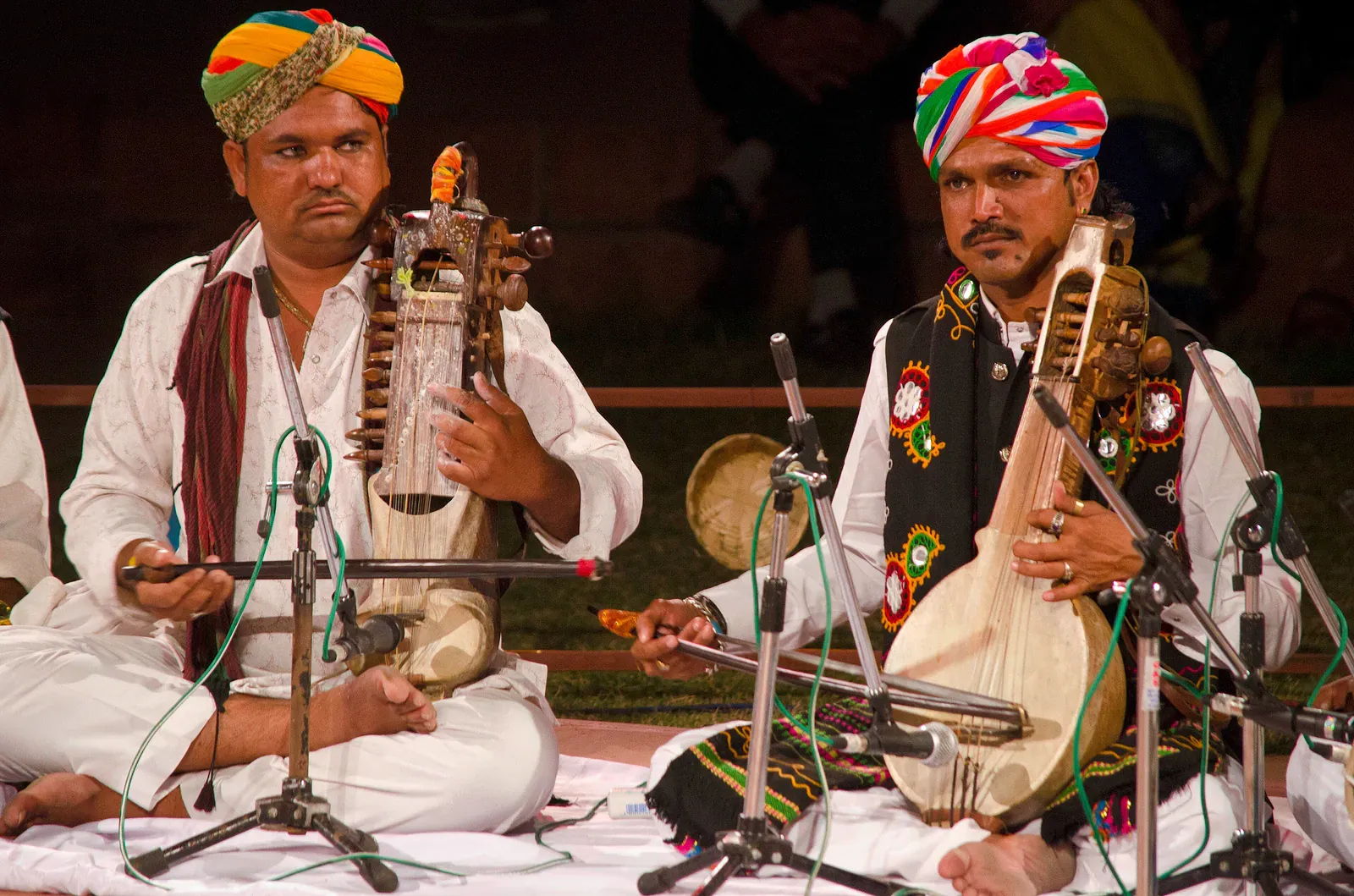
The kamaicha has a mango-wood body with a goatskin face, three gut strings and 14 steel resonating strings, and is related to the sarangi and the Persian kamancheh. The Sindhi sarangi is the other lead lute, and Kartals of teak and the dholak, whose bass head is weighted with a paste of tar, clay and sand, keep the pulse. Pungi and algoza players use unbroken breath, and the ravanahatha, a bowed instrument tied by legend to the demon king Ravana, is popular with street musicians and was once the first instrument many Rajasthani princes learned.
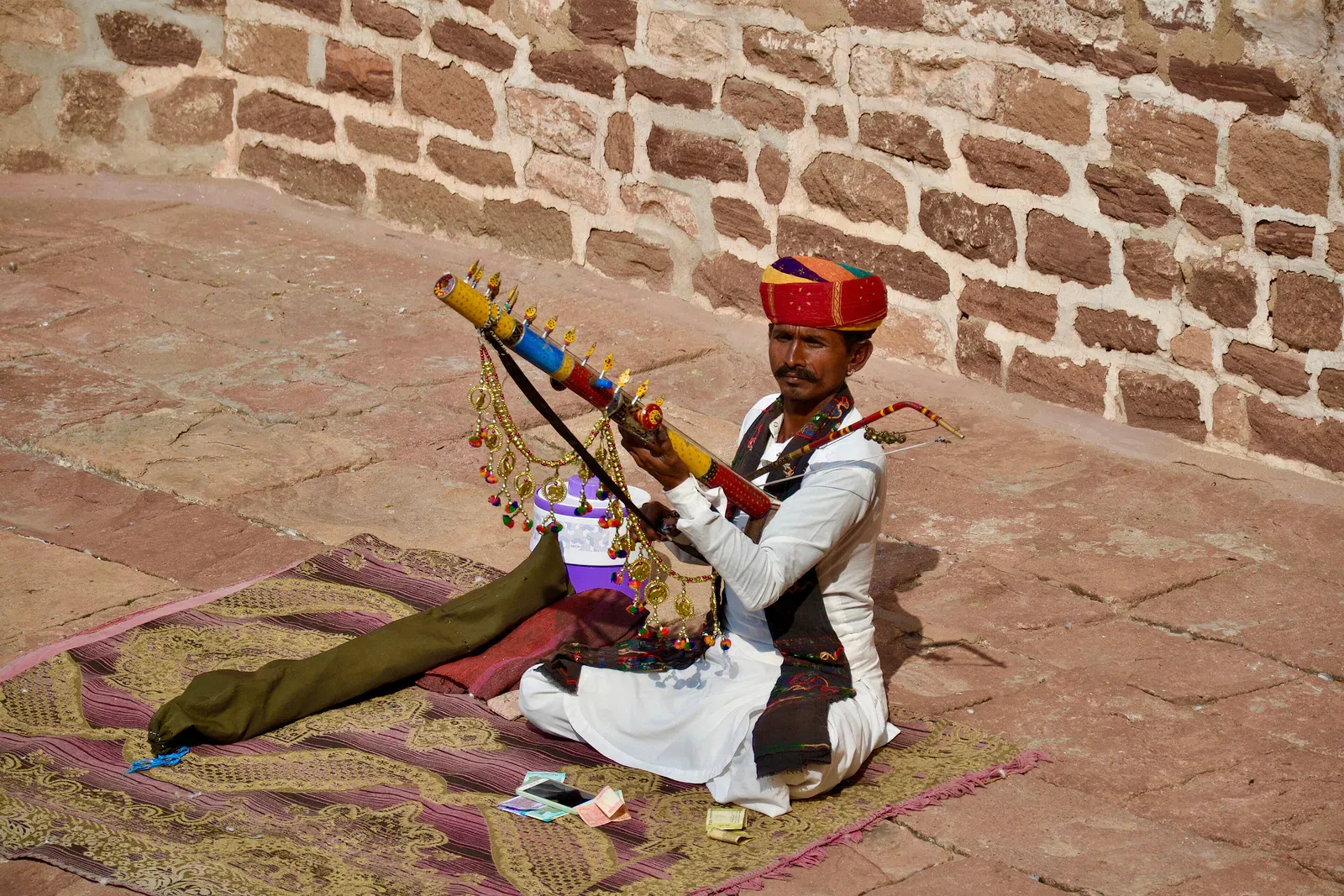
Much of the catalogue is acoustic. The Barmer Boys add beatboxing and electronics and play with DJs, Dhoad has worked with flamenco and African musicians, and Amarrass made analogue field recordings of players in their own villages.
Notable recordings
At Home: Sakar Khan documents a master at home in Hamira rather than in a studio. Chaudhary, composed by Amit Trivedi with lyrics by Shellee and sung in Hindi and Marwari, ran about seven minutes on Coke Studio and made Mame Khan widely known. Pir Jalani, arranged by Clinton Cerejo with Manga Khan on vocals, drew praise from reviewers. Kesariya Balam is the most widely covered folk song of the region: first sung, by one account, by Mangibai of Udaipur, recorded early by Allah Jilai Bai, used in Lekin in 1991, and issued as an album title by the Barmer Boys in 2017.
Culture
Ghoomar, a women’s circle dance linked to the Bhil people and later adopted by the Rajput courts, is danced by veiled women in wide skirts, and a bride is expected to dance it when she enters her new home. Kalbelia women dance in black skirts with mirrorwork and silver thread, spinning faster as the rhythm climbs; the community honours the cobra at Naga Panchami and buries its dead under an idol of Shiva’s bull Nandi. Bhopa performances run all night before a phad scroll hung between two poles, and villagers invite them in times of sickness or misfortune.
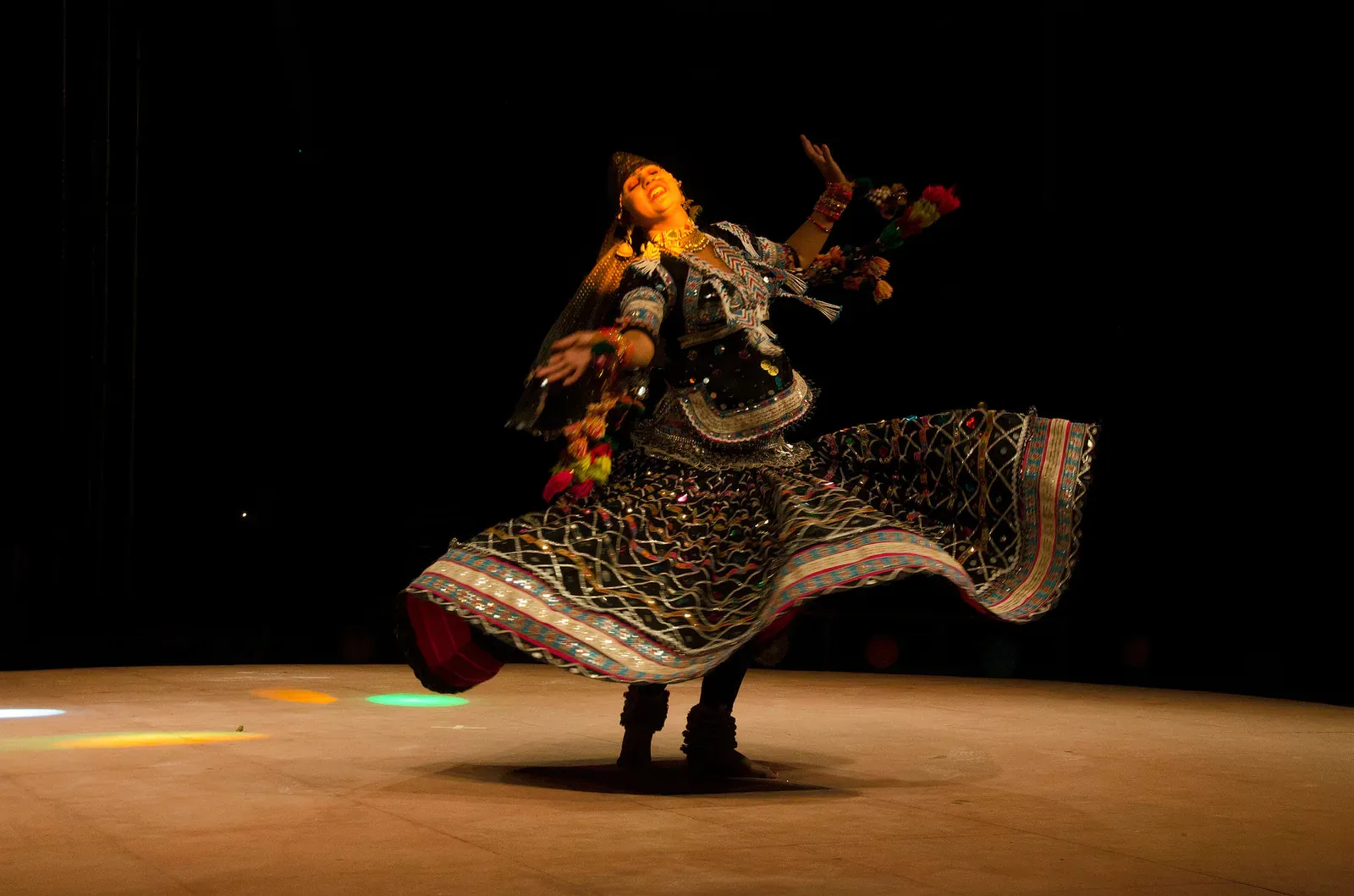
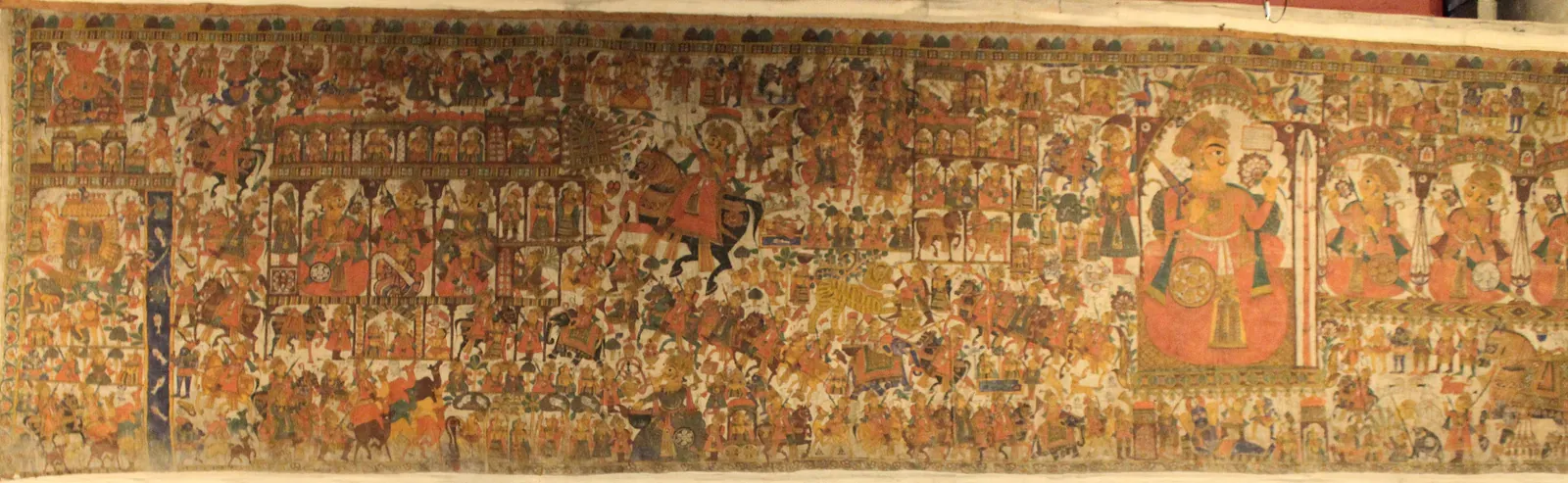
Performance work for the Kalbelia depends on the tourist season, so many also farm or graze cattle, and social and economic marginalisation continues despite the recognition.
Misconceptions
The first myth is that Manganiyar simply means beggar. The word does derive from mangan, to beg, but the community are professional musicians with long-standing patron families, and the term is now used as a debasing label for the Merasi. The second is that the music is a single Hindu or Rajput tradition: the Manganiyar and Langa are Muslim, perform for Hindu and Muslim patrons alike, and sing Sufi kalam and bhakti songs, while the Kalbelia are Hindu followers of the Nath Shaiva path. The third is that Kalbelia dance is a snake-charming act. The women imitate a serpent’s movement, handling snakes was banned by the 1972 Wildlife Act, and the dance now survives as a performing art with its own songs and no written manuals.
Frequently asked questions
What is Rajasthani folk music?
Rajasthani folk music is the oral song tradition of Rajasthan, kept mainly by hereditary Manganiyar and Langa musician castes, and also by Kalbelia, Bhopa and maand singers, with bowed lutes and hand percussion.
Who are the Manganiyar?
The Manganiyar are a Muslim hereditary musician community of the Thar Desert, mainly in Barmer and Jaisalmer districts and in Sindh, who traditionally sing for Rajput and Charan patrons.
What is the kamaicha?
The kamaicha is a bowed lute with a goatskin body, three gut strings and 14 steel resonating strings, played mainly by the Manganiyar and made famous abroad by Sakar Khan.
What is Kalbelia music?
Kalbelia music is the song and dance tradition of the Kalbelia snake-charming community of Rajasthan, played on pungi and khanjari, and listed by UNESCO as intangible heritage in 2010.
Sound
Sound sheet
Anatomy of a track
| # | Part |
|---|---|
| 1 | Slow vocal opening, often unmetered |
| 2 | Verse with kamaicha or sarangi answering the voice |
| 3 | Dholak and khartal enter, tempo rises |
| 4 | Fast closing section for dance numbers |
Signature sounds
- Bowed kamaicha or Sindhi sarangi over dholak and khartal
- Open-throated vocals with long melodic runs
- Drone from algoza or harmonium
- Rhythm that speeds up through a dance piece
Drums and percussion
- Dholak
- Khanjari
Techniques
- Maand singing
- Sympathetic strings
- Circular breathing
- Improvised lyrics
- All-night recitation
Keys and modes
Raga Bhairavi. Sakar Khan's kamaicha renditions of this raga were archived by a folkways collection.
Raga Kalyani. Also recorded by Sakar Khan on the kamaicha, which shows how folk players borrow classical ragas.
Vocals
Male voices of hereditary Manganiyar and Langa families, strong and open, plus maand sung by court-trained women and improvised Kalbelia women's songs.
Scenes
Where it happened
Where and when the sound lived: one bar per city on a shared timeline.
Asia
Active scenes
Peak 2, 2007-2025
Hosts the Rajasthan International Folk Festival at Mehrangarh Fort and the Rupayan Sansthan archive nearby.
Staged Manganiyar shows opened here in 2006 and the Amarrass Desert Music Festival followed, taking desert musicians to urban audiences.
Venues and places
Jodhpur, 2007 to today. Fort that stages the Rajasthan International Folk Festival, with about 250 musicians and artists each year.
Culture
Culture markers
- Ghoomar
Veiled women twirl in a wide circle, and a new bride is expected to dance it on arrival at her marital home.
Dance - Kalbelia dance
Women in black skirts sway and spin like serpents while men play pungi, khanjari and dholak.
Dance - Phad scroll
Bhopa priest-singers unroll a painted cloth and sing its episodes overnight, using the scroll as a portable temple.
Artwork - Naga Panchami
The Kalbelia honour the cobra as divine and keep the Nath Shaiva tradition.
Ritual
Media
Key media
- 1991Lekin
Set in Rajasthan, it used Kesariya Baalma sung by Lata Mangeshkar.
Film - 1999Hum Dil De Chuke Sanam
Staged Nimbooda as a wedding dance and carried the folk tune to a national audience.
Film
Glossary
Terms on this page
Priest-singer who recites the epic of a folk deity such as Pabuji before a phad.
Makeshift camp where Kalbelia families live and move along a repeated route.
Traditional patron of a musician family, usually from the Rajput or Charan communities.
Semi-classical Rajasthani vocal style tied to royal courts and close to thumri and ghazal.
Hereditary Muslim musician community of the Thar Desert, also spelled Manganhar and Manganiar.
Painted cloth scroll showing the episodes of a folk deity, sung in front of by Bhopa priest-singers.
South Asian family