Spirituals
Spirituals are Christian folk songs made by enslaved African Americans, joining West African rhythm to hymn texts, and taken to the concert stage from 1871.
the American South, 1700
Religious family
Born
1700
the American South
Subgenres
7
Documented branches
Links
33
Genres it drew on or shaped
Tempo
60-105 BPMLineage
Family tree
Timeline
Era by era
From the first sparks to today. Select a dot to read the story behind it.
- Hush harbors and plantation song
1700 to 1865
- Collection and the jubilee tours
1866 to 1899
- Concert spirituals and the first records
1900 to 1949
- Freedom songs and modern concert practice
1950 to today
Eras
Moments
- 1 Hush harbors and plantation song, 1700 to 1865
- 2 Collection and the jubilee tours, 1866 to 1899
- 3 Concert spirituals and the first records, 1900 to 1949
- 4 Freedom songs and modern concert practice, 1950 to today
around 1700
Hush harbors and plantation song
Enslaved Africans in the American South blended West African rhythm and call and response with Protestant hymn texts, singing in secret worship meetings and in the ring shout. The songs stayed oral.
- 1700Spirituals begin in hush harborsEnslaved Africans in the American South sing in secret worship meetings away from overseers, merging African practice with Christian hymns.
- 1819Ring shout observed in PhiladelphiaThe earliest dated account of the ring shout, a counterclockwise circle dance with call and response singing, follows a camp meeting.
- 1861Port Royal ExperimentFreed workers take over plantations on Port Royal Island, South Carolina, and northern teachers arrive and begin hearing the songs.
1866
Collection and the jubilee tours
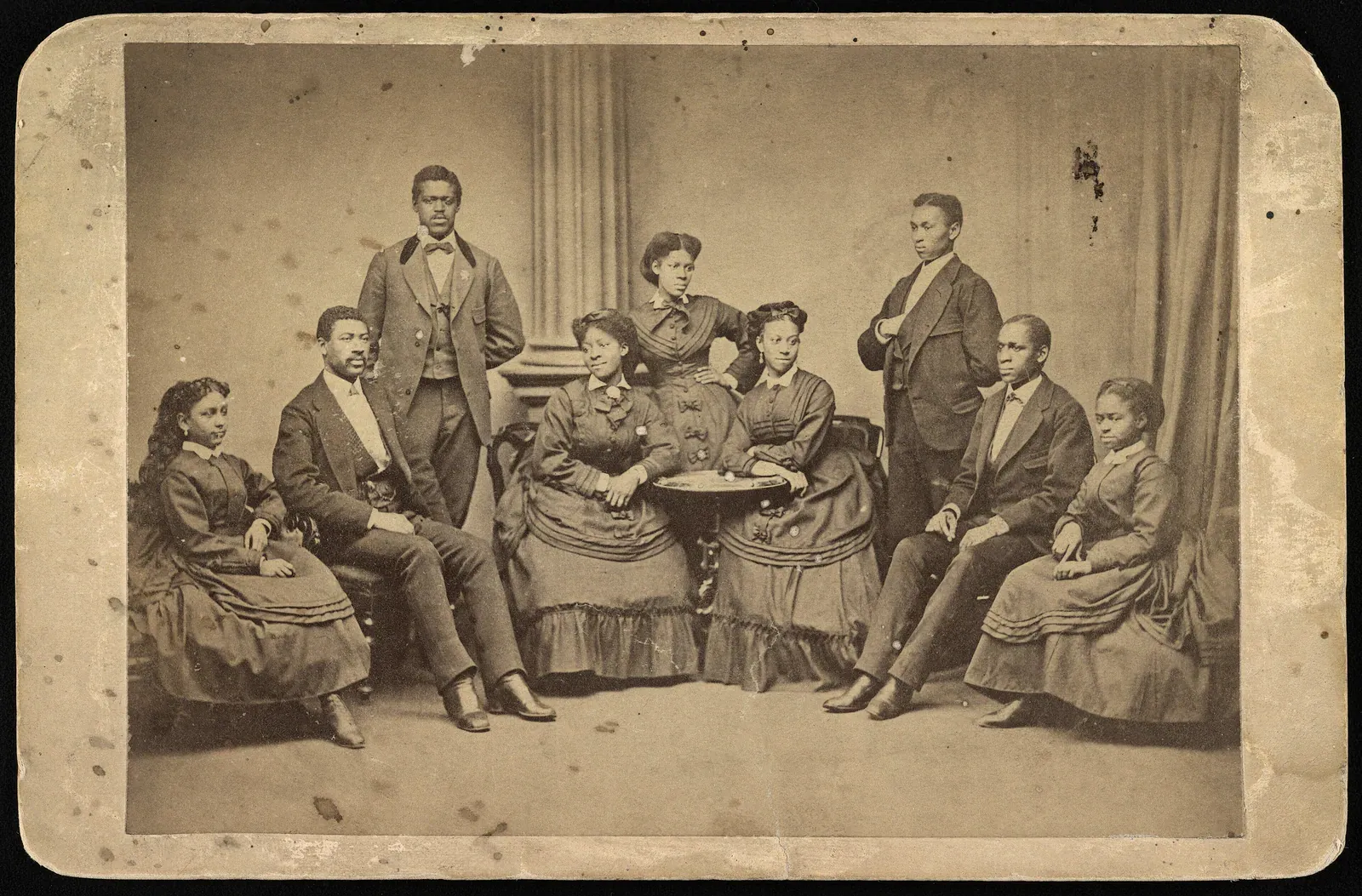
Northern abolitionists printed the first collection in 1867, and the Fisk Jubilee Singers took the songs on tour from 1871 to the White House and across Europe, turning folk worship into concert repertory.
- 1867Slave Songs of the United StatesAllen, Ware and Garrison publish 136 songs, the first and most influential printed collection, gathered largely among Gullah singers on St. Helena Island.
- 1871Fisk Jubilee Singers begin touringOn 6 October nine Fisk University students leave Nashville on a fundraising tour that makes spirituals a concert repertory.
- 1873Jubilee Singers tour Europe; Hampton Singers formThe Fisk group crosses to Europe, and Hampton Institute in Virginia starts its own choir, the first to rival them.
1900
Concert spirituals and the first records
Fisk quartets recorded for Victor in 1909. Harry Burleigh, R. Nathaniel Dett and William Dawson arranged the songs for solo voice, choir and orchestra, and Marian Anderson and Paul Robeson carried them to concert halls.
- 1903Du Bois names the sorrow songsW. E. B. Du Bois, in The Souls of Black Folk, calls the slave songs the sorrow songs, a term still used for the slow, melancholic spirituals.
- 1909Fisk quartet records Swing Low, Sweet ChariotThe Fisk Jubilee Singers cut their first commercial records for Victor in December 1909.
- 1916Burleigh publishes Deep River arrangementsHarry Burleigh's solo-voice settings, printed from 1916, make spirituals standard recital art songs.
- 1923Marian Anderson records Deep RiverThe contralto records the spiritual for Victor in November, years before her concert fame.
- 1927Paul Robeson records Deep RiverThe bass-baritone records it on 10 May for the Montgomery Ward label.
- 1934Dawson's Negro Folk SymphonyThe Philadelphia Orchestra premieres William Dawson's symphony built on spiritual themes.
1950
Freedom songs and modern concert practice
Civil rights marches adapted spirituals into freedom songs, while choral composers kept arranging them. Jessye Norman and Kathleen Battle filled Carnegie Hall with them in 1990.
- 1990Spirituals in Concert at Carnegie HallJessye Norman and Kathleen Battle perform a spirituals program on 18 March with James Levine conducting.
Listening path
Start listening
A short path from an easy way in to the deep end. Thumbnails come from YouTube; the player loads only when you press play.
- 01
Marian Anderson, 1938
A slow, sustained reading of the spiritual by the contralto who carried it to the concert stage; listen for the long vocal line.
Spirituals are Christian folk songs created by enslaved African Americans in the American South, beginning in the early 1700s. They joined West African performance practice, with its call and response, complex rhythm and bent notes, to the texts and tunes of Protestant hymnody.
Defining traits are group singing without instruments, pentatonic melody, handclapped counter-rhythm and lyrics that often carry a second meaning. The tradition belongs to the religious music family and is the root of both gospel and, with work songs and field hollers, the blues.
Origins
The songs grew in secret worship meetings known as hush harbors, where enslaved people gathered out of sight of overseers. Communal singing was a means of survival and a quiet form of resistance, and the repertoire absorbed Old Testament stories of deliverance, above all the Exodus. Nothing was written down: spirituals stayed oral until the end of the Civil War, passed between generations and sung as lullabies, play songs and, at times, adapted as work songs.
The African contribution is audible in the layered rhythms, the shouted exclamations and the habit of answering a soloist in chorus. Enslaved people also brought bones, body percussion and a fretless banjo ancestor called the banjar. The ring shout, a counterclockwise circle dance with clapping, stick beating and responsorial song, is the clearest ritual survival. Its earliest dated account describes a gathering in a Philadelphia neighbourhood in 1819, after a Christian camp meeting, and it was recorded at revival services in the 1840s. White clergy often condemned it as an African relic.
Collection and the jubilee tours, 1865-1899
The first printed collection appeared in 1867. Slave Songs of the United States, compiled by the abolitionists William Francis Allen, Charles Pickard Ware and Lucy McKim Garrison, held 136 songs, many taken down from Gullah singers on St. Helena Island, South Carolina, near the Port Royal plantations that freed workers had taken over in 1861. In 1869 Thomas Wentworth Higginson, who commanded the first Black regiment of the Civil War, printed lyrics heard in camp in his memoir.
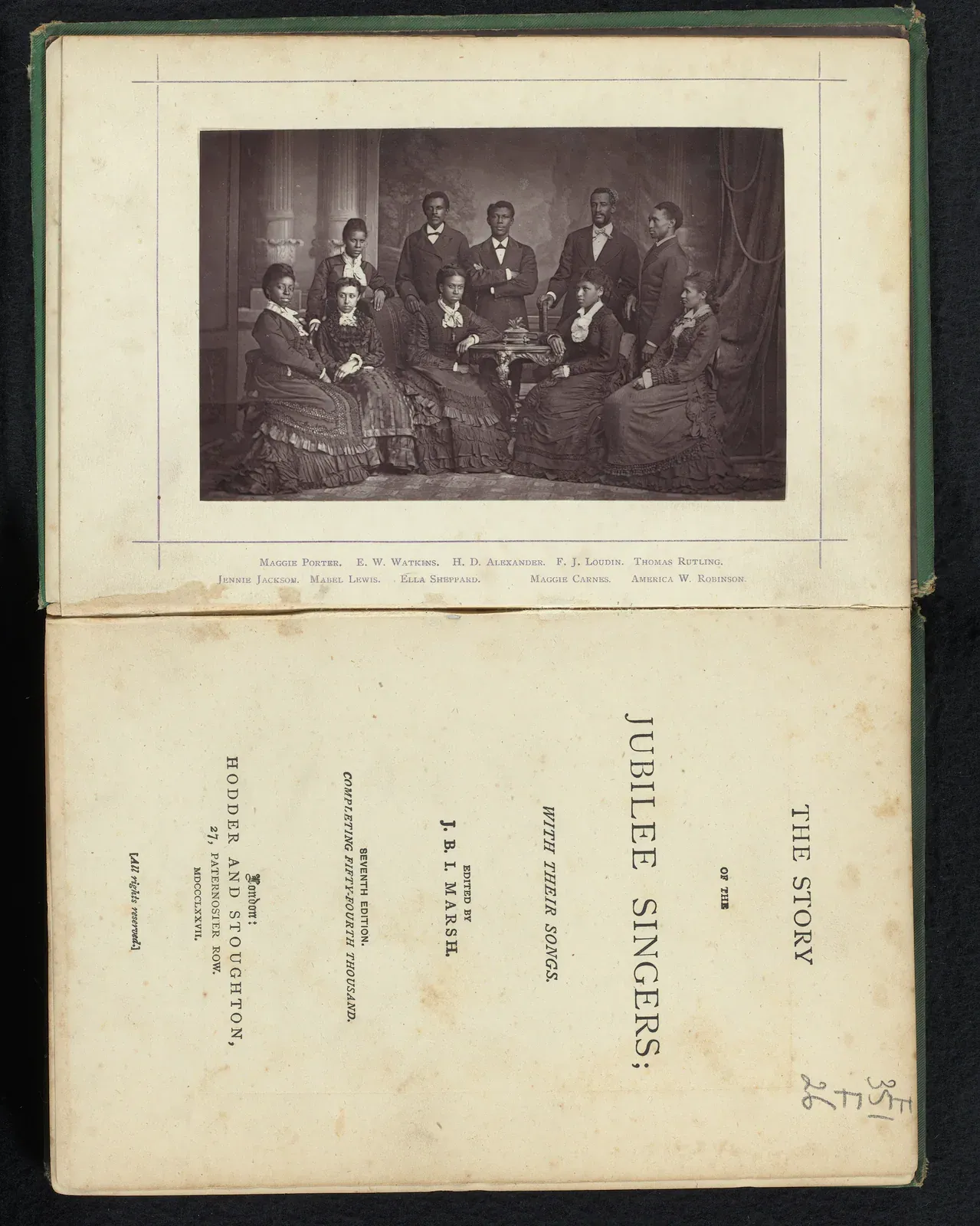
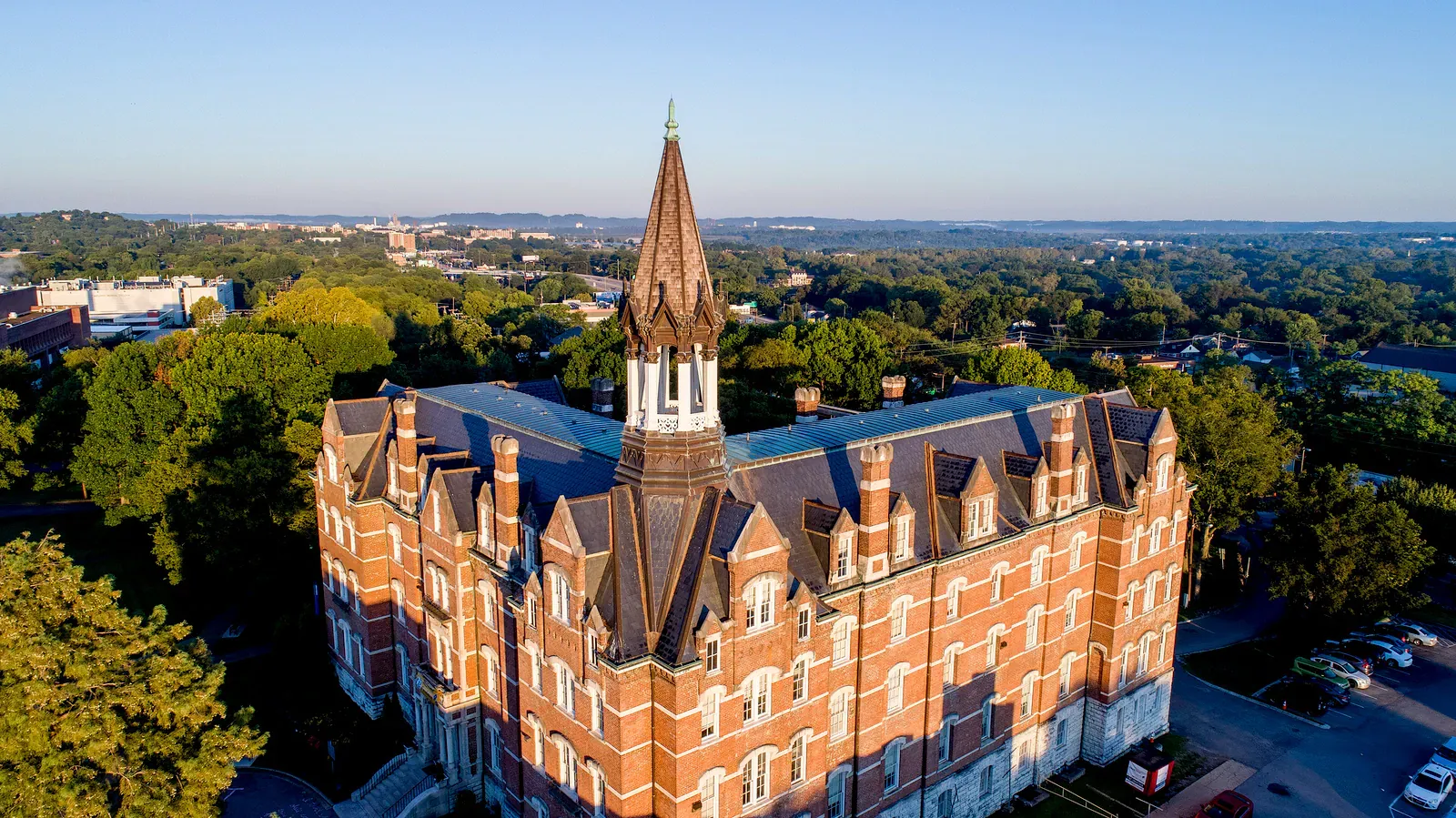
What carried spirituals beyond the South was a fundraising tour. Fisk University opened in Nashville in 1866, and on 6 October 1871 nine of its students set out as the Fisk Jubilee Singers. At first they left the slave songs out of their programs, because those songs were sacred to their parents, and they came to them only gradually. By 1872 they had sung at Boston’s World Peace Festival and at the White House, and in 1873 they toured Europe. The ensemble disbanded in 1878, but its arranged, harmonised style set the template for concert spirituals. Hampton Institute in Virginia formed its own singers in 1873, and Booker T. Washington had organised a Tuskegee quartet in 1884.
Concert spirituals and the first records, 1900-1949
Fisk’s later quartets, led by John Wesley Work Jr., made the first commercial recordings. They cut sides for Victor in December 1909 and February 1911, for Edison in December 1911, for Columbia in October 1915 and February 1916, and for Starr in 1916. The 1909 “Swing Low, Sweet Chariot” was among the first recordings inducted into the Library of Congress National Recording Registry in 2002.
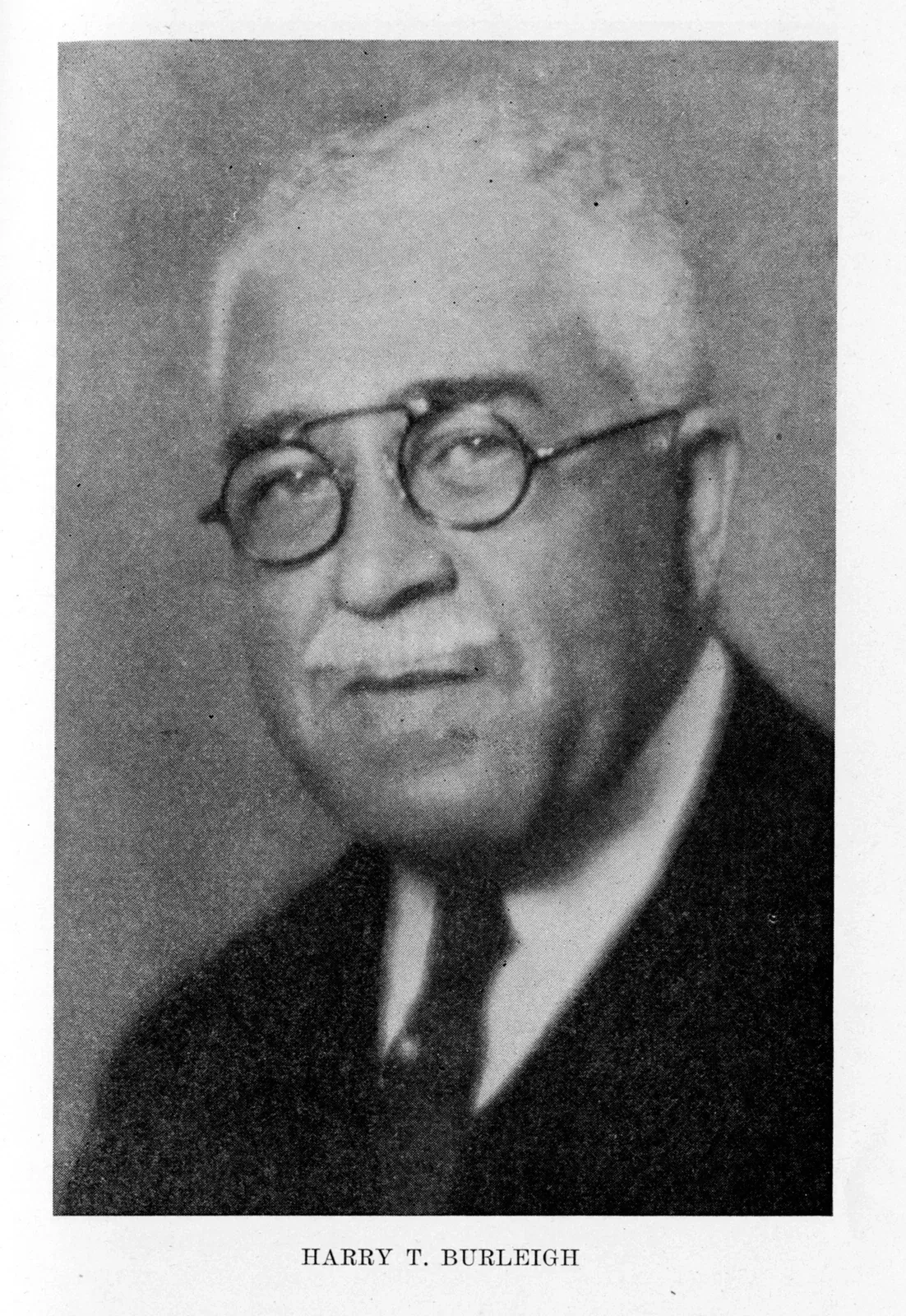
At the same time Black composers trained in Western conservatories turned the folk songs into art music. Harry Burleigh, a baritone who studied at New York’s National Conservatory from 1892, is said to have sung spirituals for Antonin Dvorak there, and some listeners hear their trace in the Symphony From the New World. From 1916 his solo settings of “Deep River” and other songs made spirituals standard recital repertoire. R. Nathaniel Dett, who led the Hampton choir until 1933, argued that the songs should be treated in choral form and in operatic and orchestral works. William Dawson’s Negro Folk Symphony was premiered by the Philadelphia Orchestra in 1934.
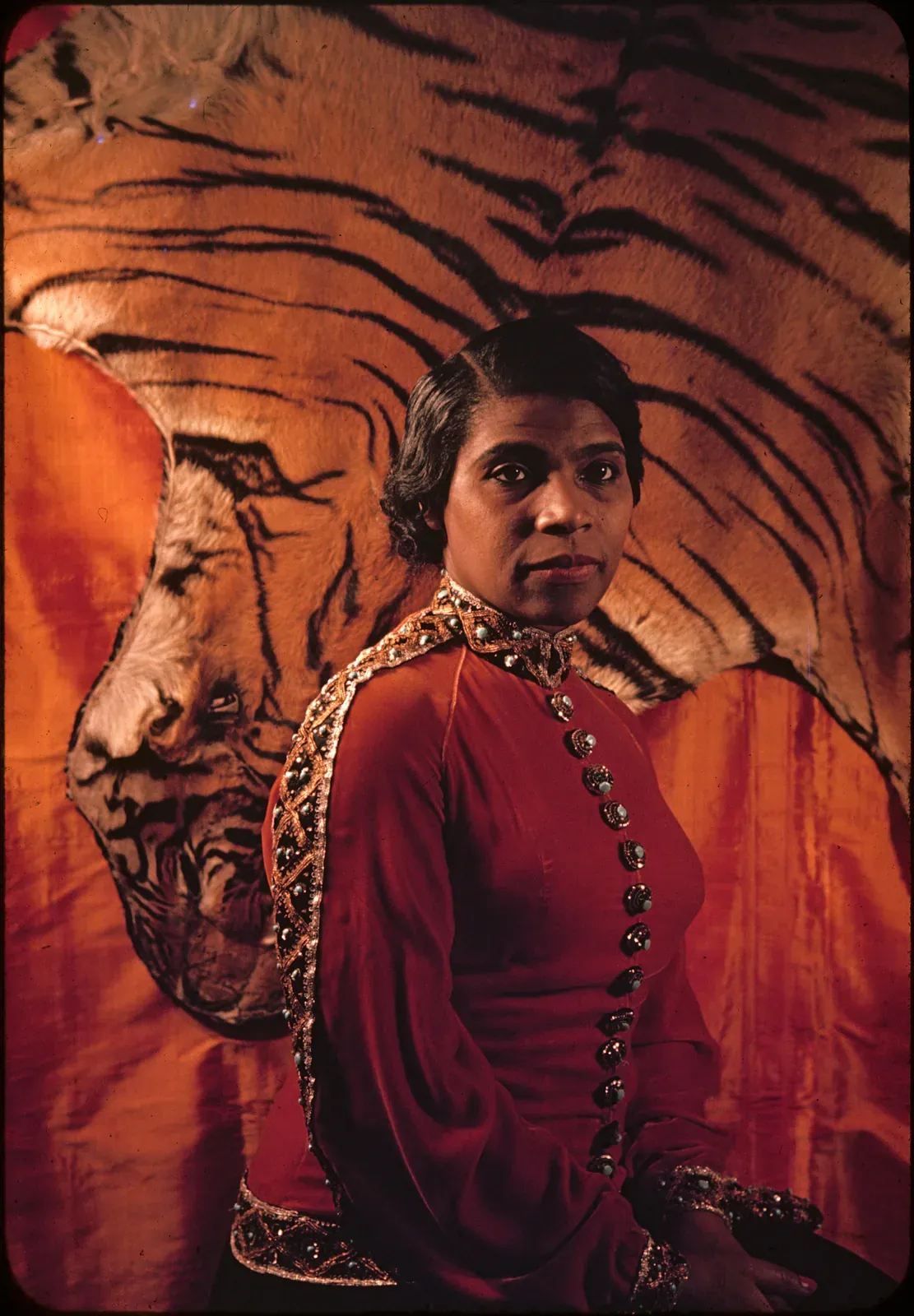
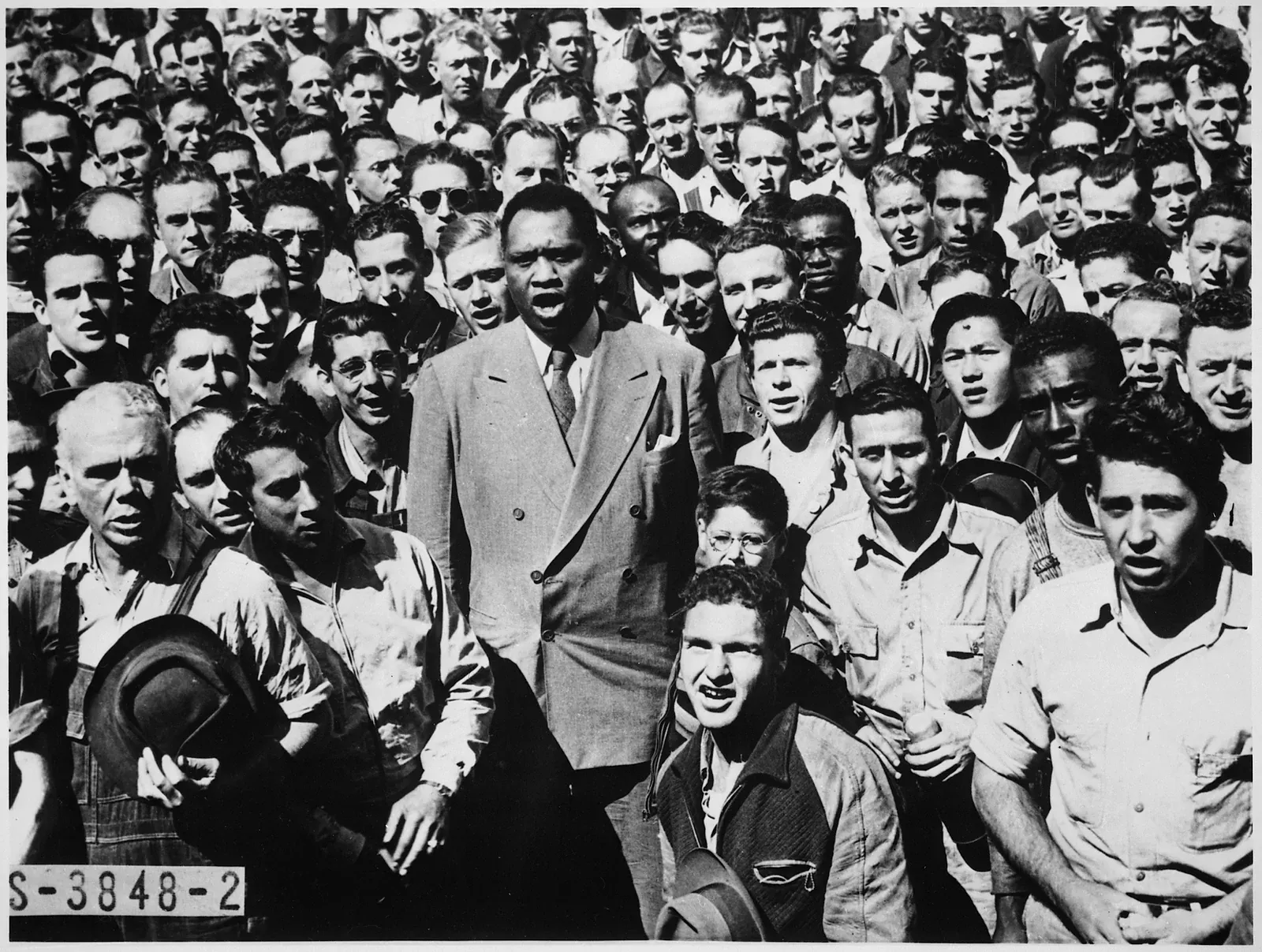
Singers followed the arrangers. Burleigh coached Marian Anderson, and Roland Hayes and Paul Robeson also carried his legacy into the recital hall. In the same decades jubilee quartets such as the Golden Gate Quartet, formed in 1934, added syncopation and tight harmony to the repertoire and performed at Carnegie Hall in the late 1930s. Not everyone approved: in 1938 the writer Zora Neale Hurston dismissed the polished concert style as full of musicians’ tricks and said real spirituals survived only in the unfashionable church.
Characteristics
Spirituals were first monophonic songs for a leader and a group, and the quality prized in performance is the blending of voices, exact timing and intonation. Melodies lean on the pentatonic scale and on microtonally flatted notes. Rhythm comes from handclapping and stamping, and the timbre can include shouting, cries of “Glory” and raspy falsetto. Sorrow songs, a name W. E. B. Du Bois gave the slow, melancholic pieces in 1903, such as “Nobody Knows the Trouble I’ve Seen”, are sung at a slower pace. Jubilee songs, also called camp meeting songs, are fast, rhythmic and syncopated and look toward deliverance.
Instruments and production
The folk form needs no equipment beyond the body. Concert settings add a piano for solo voice, a choir or an orchestra. The 20th-century choral composers Moses Hogan, Roland Carter, Jester Hairston, Brazeal Dennard and Wendell Whalum carried the arrangements well beyond their folk-song roots for unaccompanied choruses.
Notable recordings
Anderson recorded “Deep River” for Victor in November 1923, at the start of a concert career that ran from 1925 to 1965, and returned to it in a recording of 1938. Paul Robeson recorded the same song on 10 May 1927 for Montgomery Ward and issued a Spirituals album in 1946. The Golden Gate Quartet recorded “Rock My Soul” in 1938 as a model of the jubilee quartet sound.
Mainstream success and culture
Spirituals never depended on charts. Fisk records of the 1900s and 1910s sold well, concert tours put the songs on formal stages, and on 18 March 1990 Jessye Norman and Kathleen Battle filled Carnegie Hall with a spirituals program conducted by James Levine, released the next year as Spirituals in Concert.
The songs also served as a language of freedom. Frederick Douglass wrote that they gave him his first glimpse of slavery’s dehumanising character, and Harriet Tubman said that “Go Down, Moses” was taboo in the slave states yet sung anyway. In the civil rights movement of 1954 to 1968 songs such as “Oh, Freedom!” were adapted from early spirituals, and “We Shall Overcome” combined a gospel hymn with the spiritual “I’ll Be All Right”.
Legacy
Spirituals fed nearly every later strand of American music. The blues grew from the same song culture and shares its call and response and blue notes, and Black gospel developed from about 1906 in the Pentecostal churches, with the genre’s golden age running from 1945 to 1955. The songs remain in choral repertoire and in churches, while jubilee-style groups such as the Golden Gate Quartet are still active. The wider hymnody tradition that gave them their texts and tunes continues alongside.
Misconceptions
Spirituals are often said to be encoded escape maps. Some songs, including “Swing Low, Sweet Chariot” and “The Gospel Train”, are believed to have carried coded messages, and scholars note that coded words could be hidden in the call and response overlap, but the belief that “Wade in the Water” warned fugitives to take to the water is unproven, and no corroborating evidence supports a hidden route in “Follow the Drinking Gourd”.
Another assumption is that spirituals are simply gospel. They are older: spirituals were oral songs of enslaved communities, while gospel arrived as a distinct style in the early 20th century, in churches and later in professional quartets and choirs. A third is that all spirituals are sad. Sorrow songs are slow, but jubilee songs are fast and exuberant, and many pieces look forward to a day of deliverance.
Frequently asked questions
What are spirituals?
Spirituals are Christian folk songs created by enslaved African Americans, mixing West African rhythm and call and response with hymn texts. They were passed on orally, performed in secret worship meetings and in the ring shout, and later arranged for choirs and soloists.
Who were the Fisk Jubilee Singers?
The Fisk Jubilee Singers were a student ensemble from Fisk University in Nashville that began touring on 6 October 1871 to raise funds for the school. Their performances in the United States and Europe made spirituals a concert repertoire, and later Fisk quartets made some of the first recordings.
What is the difference between spirituals and gospel?
Spirituals are older oral folk songs from slavery, usually sung unaccompanied. Gospel is a later church-based style, shaped in the early 20th century, that adds piano, organ and professional songwriting.
Are spirituals still sung?
Yes. Choirs, soloists and congregations perform them today, and composers continue to write new arrangements for unaccompanied chorus and concert stage.
Sound
Sound sheet
Anatomy of a track
| # | Part |
|---|---|
| 1 | Solo call |
| 2 | Group response |
| 3 | Repeated refrain |
Signature sounds
- Call and response
- Pentatonic melody with flatted notes
- Handclapping counter-rhythm
- Coded or double-meaning lyrics
Techniques
- Call and response
- Bent and flatted notes
- Handclapped counter-rhythm
- Falsetto and shouted exclamations
- Ritardando in sorrow songs
Keys and modes
Pentatonic. Melodies lean on the five-note scale, with microtonally flatted notes.
Vocals
Unaccompanied group singing with a solo caller; concert settings add trained solo voices.
Scenes
Where it happened
Where and when the sound lived: one bar per city on a shared timeline.
North America
Active scenes
Peak 4, 1892-2025
Home of Fisk University, where the Jubilee Singers formed in 1871 and the concert tradition began.
Gullah community of the Sea Islands whose singers supplied much of the first printed collection.
Hampton Institute's choir, led by R. Nathaniel Dett until 1933, earned an international following.
Harry Burleigh studied here from 1892 and later arranged the spirituals that recitalists took to the stage.
Culture
Culture markers
- Ring shout
Worshippers move counterclockwise in a circle, clapping and shuffling to call and response song.
Dance - Hush harbor meetings
Secret worship away from overseers, where the songs first flourished.
Ritual - Coded lyrics
Biblical images such as Canaan and the Gospel Train could carry hidden meanings of escape.
Slang
Media
Key media
- 1867Slave Songs of the United States
by Allen, Ware and Garrison. The first and most influential printed collection of spirituals, with 136 songs.
Book - 1903The Souls of Black Folk
by W. E. B. Du Bois. Names the sorrow songs and argues they are the nation's most beautiful folk music.
Book - 1999Negro Spirituals: The Concert Tradition: 1909-1948
by Various. Historical recordings tracing the Fisk quartets through the solo concert singers.
Compilation
Glossary
Terms on this page
A leader sings a line and the group answers, often in overlapping layers.
A spiritual arranged for trained voices, choir or orchestra rather than sung as folk worship.
A secret outdoor meeting place where enslaved people worshipped away from overseers.
A fast, syncopated spiritual looking forward to deliverance, also called a camp meeting song.
A counterclockwise circle dance with clapping, stick beating and call and response singing.
W. E. B. Du Bois's name for the slow, melancholic spirituals such as Nobody Knows the Trouble I've Seen.
Religious family