Vedic chant
Vedic chant is the Sanskrit recitation of the four Vedas on fixed pitch accents, kept by memory since about 1500 BCE and the root of Samaveda singing.
India, -1500
South Asian family
Born
-1500
India
Links
2
Genres it drew on or shaped
Tempo
80-125 BPMLineage
Family tree
Timeline
Era by era
From the first sparks to today. Select a dot to read the story behind it.
- Composition and fixing of the texts
-1500 to -500
- Recitation modes and teacher-to-pupil schools
-500 to 1975
- Fieldwork and recording
1975 to 2007
- Heritage recognition
2008 to today
Eras
Moments
- 1 Composition and fixing of the texts, -1500 to -500
- 2 Recitation modes and teacher-to-pupil schools, -500 to 1975
- 3 Fieldwork and recording, 1975 to 2007
- 4 Heritage recognition, 2008 to today
around -1500
Composition and fixing of the texts
The Rigveda is composed from about 1500 BCE and the Samaveda gathers its melodies on Rigvedic verses between about 1200 and 1000 BCE, all kept by memory alone.
- -1500Rigveda composedThe oldest of the four Vedas, kept in oral form since about 1500 BCE, becomes the text base of Vedic chant.
- -1200Samaveda collectedThe song Veda of 1,875 verses, nearly all taken from the Rigveda, is set into melody collections between about 1200 and 1000 BCE.
around -500
Recitation modes and teacher-to-pupil schools
Complex recitation modes such as jata, dhvaja and ghana grow after the 5th century BCE, and schools (shakhas) pass the texts, accents and melodies from teacher to pupil by ear.
- -500Complex recitation modes developJata, dhvaja and ghana patha appear after the 5th century BCE as cross-checks for exact transmission of the Vedic text.
- 1963Challakere Brothers formedThe Karnataka duo M. S. Venugopal and M. S. Srinivasan, later known for Purusha Suktam and Rudram, begins its chanting career.
1975
Fieldwork and recording
Scholars record a twelve-day Kerala fire ritual in 1975, the Kalady project documents the last Samaveda practitioners of Kerala from 1995, and Ravi Shankar's Chants of India reaches a pop audience in 1997.
- 1975Kerala fire ritual recordedFrits Staal's team films and records the twelve-day Nambudiri Agnicayana in April, capturing about eighty hours of recitation and chant.
- 1992First women's batch for Vedic chantSrinivasan of the Challakere Brothers opens his first women's class on 4 November with three students.
- 1995Kalady Samaveda documentation startsAudio and video recording begins at Kalady in Kerala, aiming to preserve the Nambudiri Samaveda practitioners, then only five elderly men.
- 1996Chants of India sessions beginRavi Shankar and George Harrison start recording Vedic prayers and mantras in Madras in January.
- 1997Chants of India releasedAngel Records issues the album on 6 May in the United States, and it reaches number 3 on Billboard's Top World Music Albums chart.
- 1998The Essence and the Gayatri MantraDeva Premal's album carries a long, slow setting of the Rigvedic Gayatri verse that spreads Sanskrit chant to meditation audiences.
2008
Heritage recognition
UNESCO proclaims Vedic chant a Masterpiece of the Oral and Intangible Heritage of Humanity in 2008, and chanting duos teach hundreds of students and publish their recitations online.
- 2008UNESCO proclaims Vedic chantOn 7 November the tradition is named a Masterpiece of the Oral and Intangible Heritage of Humanity.
Listening path
Start listening
A short path from an easy way in to the deep end. Thumbnails come from YouTube; the player loads only when you press play.
- 01
Ravi Shankar, 1997
A short Chants of India piece closest to unaccompanied chant; listen for the held accents of the reciters.
- 02
Ravi Shankar, 1997
The opening track of Chants of India, with chorus and instruments over a Vedic invocation.
- 03
Deva Premal, 1998
The Rigvedic Gayatri verse in a slow meditative setting that reached audiences far beyond India.
Facts
| Family | South Asian |
| Origin | India |
| Emerged | Ancient, c. 1500 BCE |
| Status | Active |
| Tempo | 80 to 125 BPM |
Vedic chant is the oral recitation of the four Vedas in Sanskrit, delivered on fixed pitch accents and passed from teacher to pupil by ear. It goes back to the Rigveda, dated to about 1500 BCE, and is often counted the oldest unbroken oral tradition in existence.
Its most melodic branch is the sung chanting of the Samaveda, known as sama-gana, which Indian musicology treats as an ancestor of later raga music. UNESCO proclaimed the tradition a Masterpiece of the Oral and Intangible Heritage of Humanity on 7 November 2008. It belongs to the South Asian family of music traditions.
Origins
The oldest layer of the tradition is the Rigveda, whose 1,028 hymns and about 10,600 verses were composed around 1500 BCE and preserved without writing. The Samaveda, a collection of 1,875 verses, came later: its text is dated to roughly 1200 to 1000 BCE, and all but 75 of its verses are taken from the Rigveda. What the Samaveda adds is melody. Its words are Rigvedic, but each verse is set to notes, and the collection was the repertoire of the udgatr, the singer priests of the sacrifice.
The care taken over sound has a religious basis. The potency of a mantra is held to lie in how it is pronounced, so exact vowels, consonants and accent matter as much as meaning. Later philosophical texts describe the whole creation as beginning in sound, which turns correct recitation into a spiritual discipline and explains why preservation was treated as a duty.

Recitation modes, 5th century BCE onward
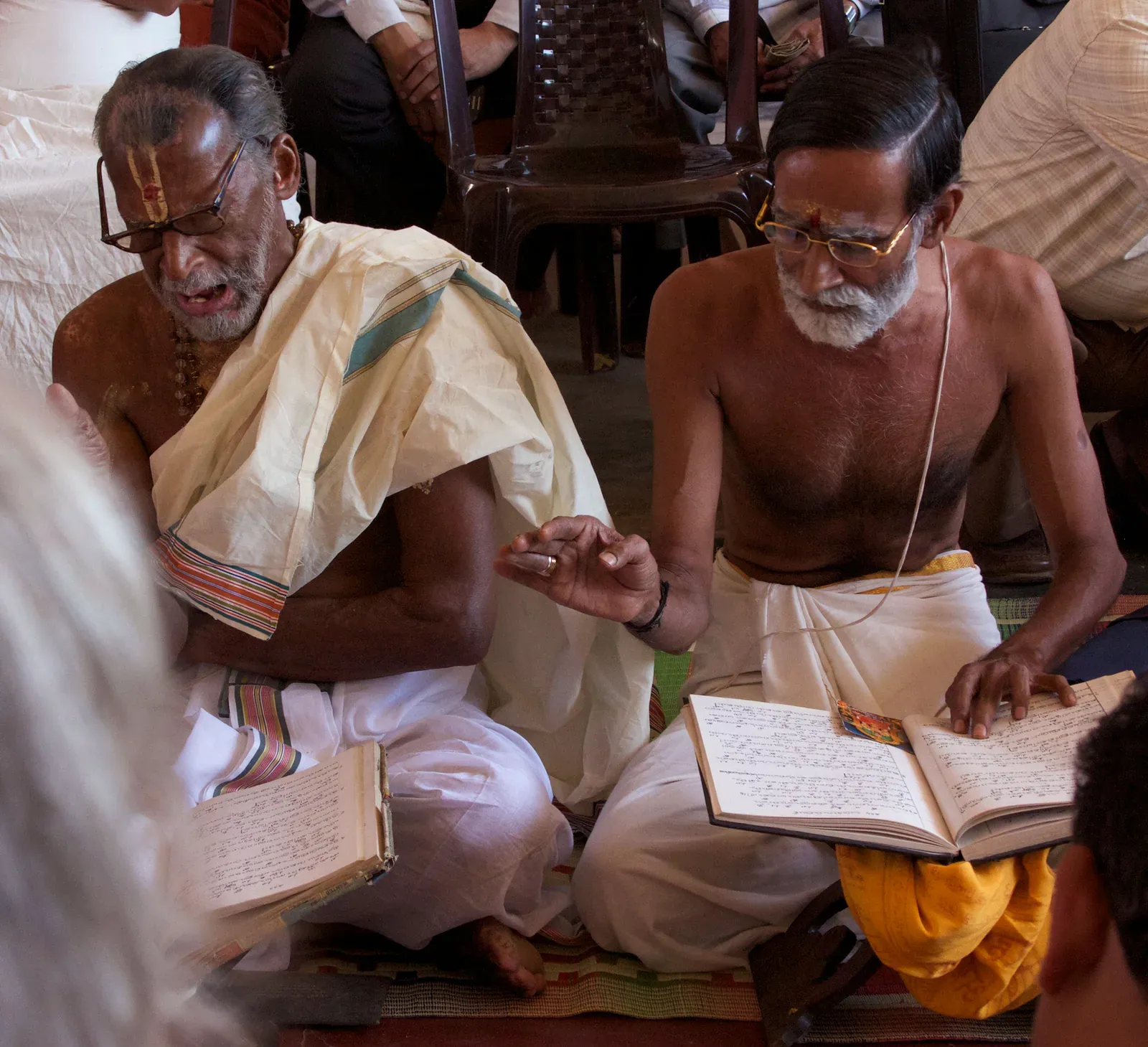
Chant was the technology for keeping the texts intact. Eleven recitation modes, called pathas, were devised: samhita, pada, krama, jata, maala, shikha, rekha, dhwaja, danda, ratha and ghana. In samhita patha the words run continuously. In pada patha each word is separated by a pause and restored to its own form. In krama patha the words are linked in overlapping pairs, so that a line of words one to four is chanted as one-two, two-three, three-four. These three are called natural modes, and a student learns them first.
The remaining eight are complex modes that reverse the word order, and ghana is usually considered the hardest. In ghana the words are repeated back and forth in a bell shape, which also strengthens the natural resonance of the chant. In jata the words are braided together and run forward and backward. Jata, dhwaja and ghana are described as developing after the 5th century BCE. Reciting words backward does not change the meaning in Sanskrit, and the modes act as cross-checks on each other: a chanter who knows the text in several arrangements cannot slip unnoticed. A scholar who has mastered the modes is a pathin, and one who has reached ghana is a ghanapathin.
The method worked well: the Rigveda, composed around 1500 BCE, survives with its words and sounds intact, held in human memory for most of that time.
Characteristics
Vedic chant is built on pitch accent rather than a melody in the usual sense. Four tones are used: udatta, the middle tone; anudatta, the lower tone; svarita, the higher tone; and dirgha svarita, a high tone that is lengthened. In writing they appear as simple marks, an underline for anudatta, a small vertical stroke above the letter for svarita and two strokes for dirgha svarita. Most Vedic recitation moves within this narrow accent system, close to speech and tightly controlled.
The Samaveda goes further. Musicologists describe sama as the placing of notes on the words of Rigvedic hymns, so that the verse supplies the words and the sama supplies the notes. The scale is conceived downward from the upper register of the voice. Of the surviving melody collections, the gramageya songs were for public recitation and the aranyageya songs for personal meditation in solitude. Three branches of Samaveda chanting remain of the many once taught, known as Ranaiya, Kauthuma and Jaiminiya.
The vocals are solo or in unison, with no instruments in the traditional form. Group recitation depends on great synchronisation, since each chanter must keep to the same accents and timing.
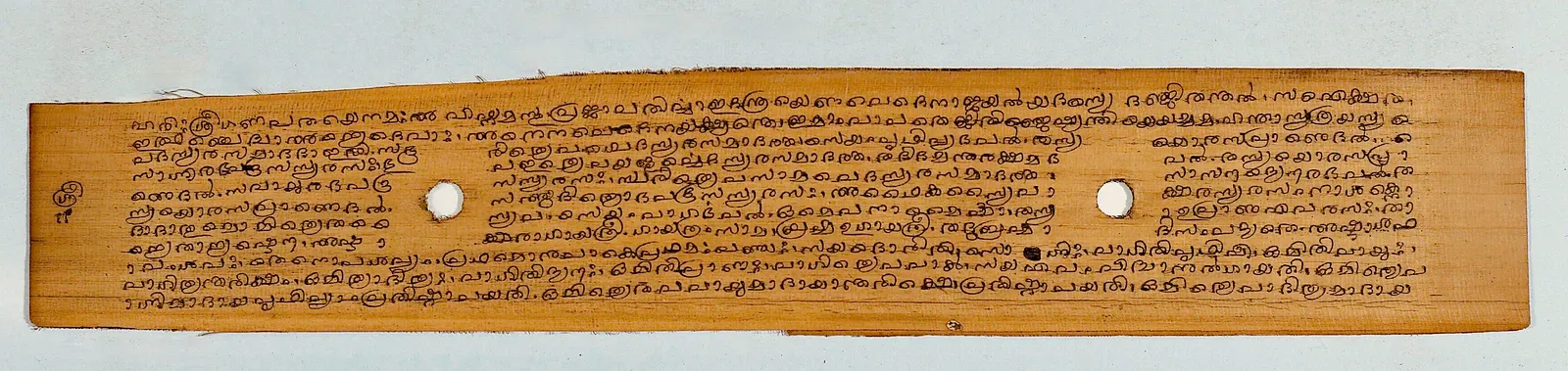
Recording and documentation, 1975 to 2007
Fieldwork gave the first large records of the sound. In April 1975 Frits Staal and his team filmed and recorded the Nambudiri Agnicayana, a twelve-day fire-altar ritual in Kerala, taking in about eighty hours of recitation and chant. The material shows how the Vedas sound inside their own ritual.
Preservation proved urgent for the Samaveda in particular. From 1995 a project at Kalady in Kerala made audio and video recordings of the last Nambudiri Samaveda practitioners, then five men in their eighties and nineties, and gathered about 95 hours of material. The Jaiminiya branch is now close to extinct.
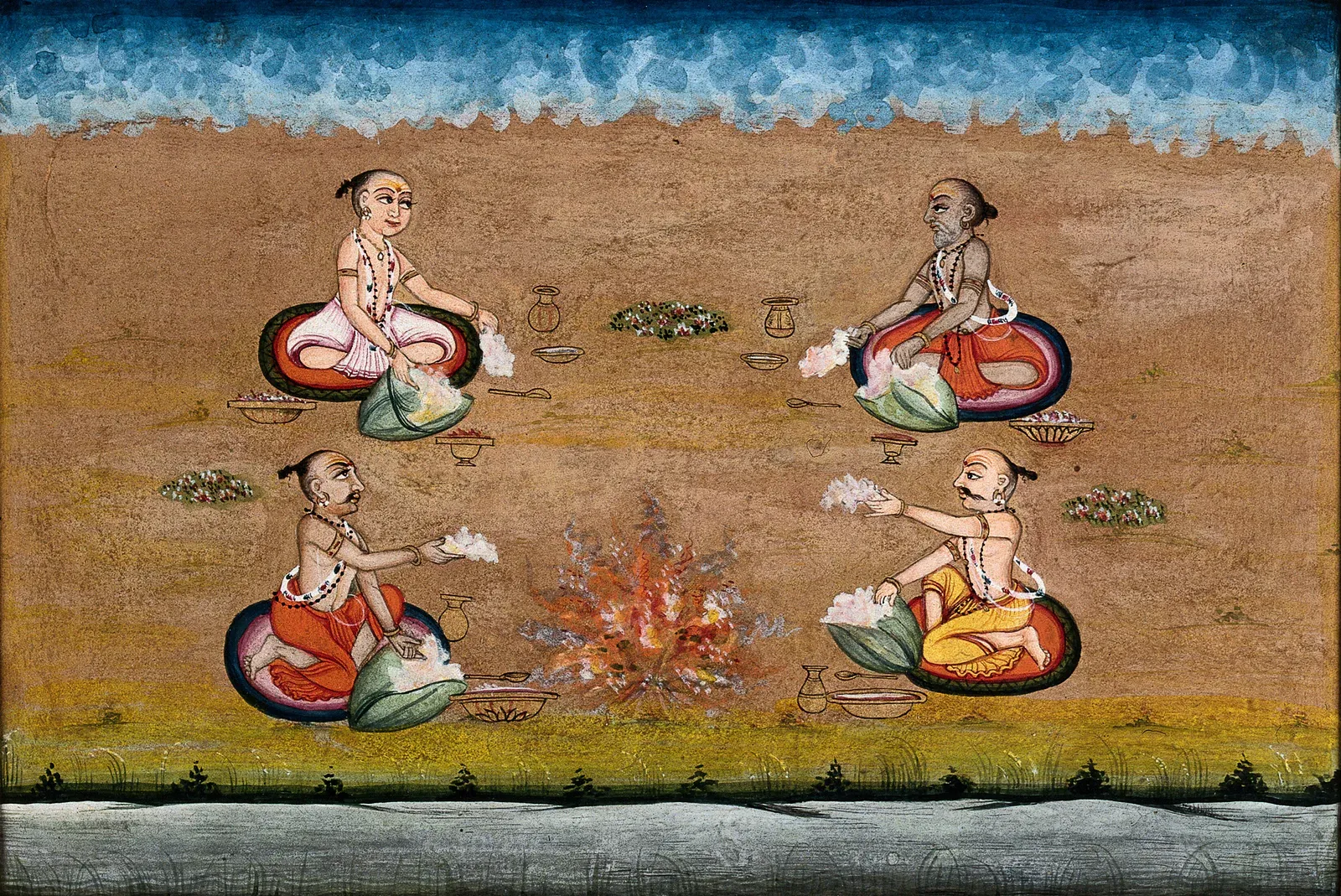
Chants of India and crossover
Vedic chant reached a global audience mostly through arrangement. Ravi Shankar and George Harrison began recording Chants of India in Madras in January 1996 and finished it at Harrison’s home studio in Henley-on-Thames. Angel Records released it on 6 May 1997 in the United States. The label hoped to repeat the success of an album of Gregorian chants set against a contemporary rhythm section.
Shankar set Vedic and other Hindu sacred texts to music, adding four new pieces, “Prabhujee”, “Mangalam”, “Svara Mantra” and “Hari Om”. He used a chorus of 21 singers with veena, violin, flute, cello, tanpura and mridangam. The album peaked at number 3 on Billboard’s Top World Music Albums chart, and it was reissued in 2010 in the Dark Horse Records box set Collaborations. It is an arrangement rather than the traditional form: the texts are sung by a chorus with instruments, where traditional recitation uses voices alone.
A year later, Deva Premal’s album The Essence included a long, slow Gayatri Mantra, a Rigvedic verse, which carried Sanskrit chant to meditation audiences far from India.
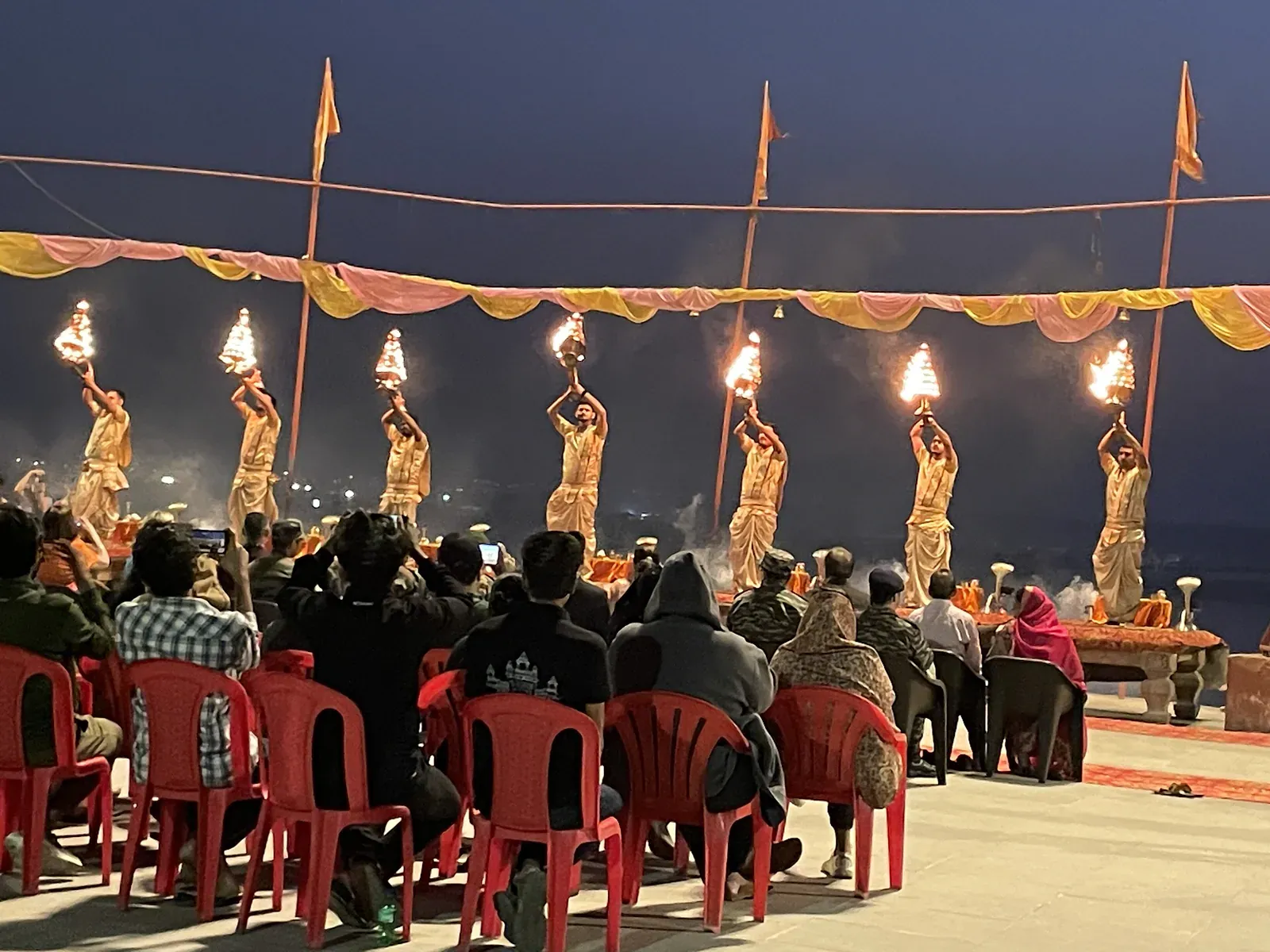
Culture
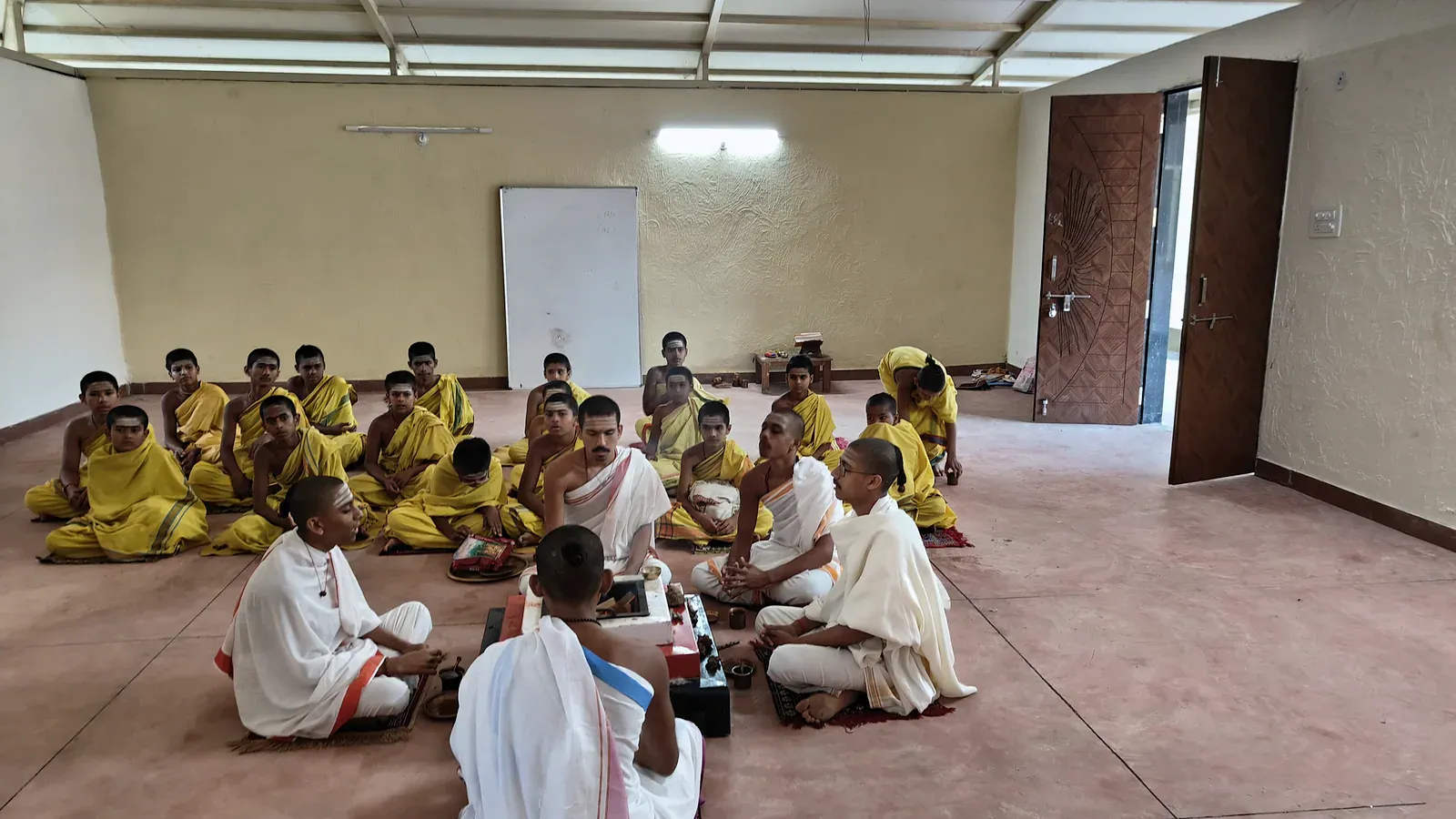
Vedic chant lives in ritual. Temples and ceremonies use Purusha Suktam, Rudram, the Shanti mantras and other texts, and priests chant at the daily rites on the river ghats of Varanasi at sunrise and sunset. A chant is learned from a teacher in a Veda school. Teachers such as the Challakere Brothers of Bengaluru, M. S. Venugopal and M. S. Srinivasan, also reach a wide public: Srinivasan has taught Vedic chant since 1992, and the brothers now have more than 500 students who chant in close unison. Their recitations of Purusha Suktam and Rudram are widely held to be among the most authentic.
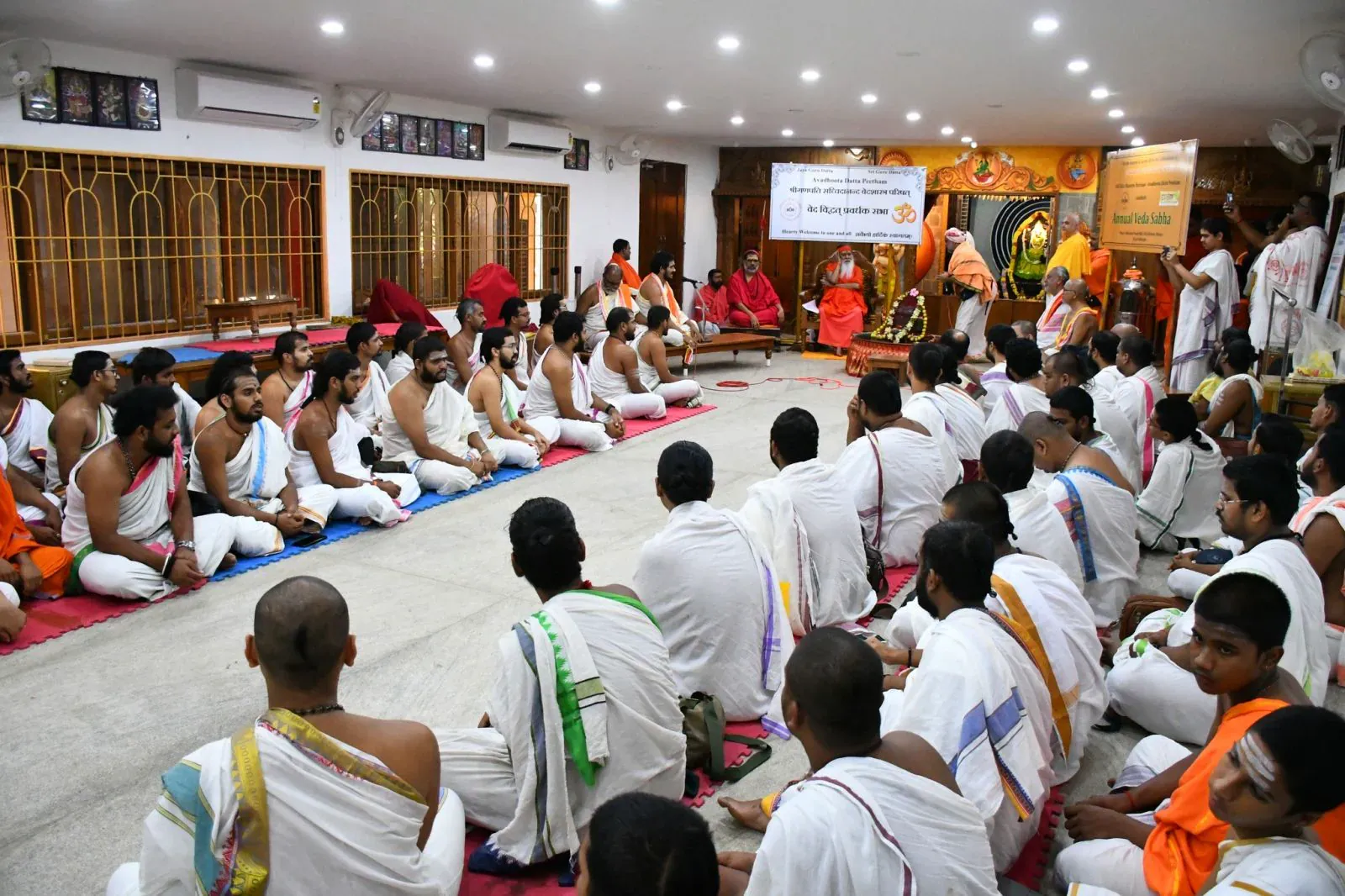
Legacy
The tradition shaped how Indian music thinks about sound. Indian classical music and dance are traced by musicologists to the sonic dimension of the Samaveda, and the structure of its chants inspired the organising principles of later classical arts. The method of exact oral transmission, with its cross-checking modes, is a distinctive achievement in its own right. Related practices include kirtan, the call-and-response devotional singing, and the two great classical systems, Hindustani classical music and Carnatic music.
Misconceptions
Vedic chant is not all music in the usual sense. The Samaveda is the Veda of melodies, while recitation of the other Vedas rests on the four-accent system described above.
It is also not a frozen relic. The tradition is taught and practised, with teachers who publish their recitations online and recordings that continue to appear. Some branches, such as the Jaiminiya Samaveda of Kerala, are at risk, but the larger tradition is living.
A third belief is that Vedic chanting is unsuitable for women. Srinivasan of the Challakere Brothers began his first women’s class on 4 November 1992 with three students and has rejected the idea that chanting harms women.
Frequently asked questions
What is Vedic chant?
Vedic chant is the recitation of Vedic hymns in Sanskrit on fixed pitch accents, learned by ear from a teacher. It preserves the Rigveda, the Samaveda, the Yajurveda and the Atharvaveda in their oral form.
How old is Vedic chant?
Its textual base, the Rigveda, dates to about 1500 BCE, and the tradition is often described as the oldest unbroken oral tradition. The Samaveda text is dated to roughly 1200 to 1000 BCE.
What is the difference between Vedic chant and Sama-gana?
Vedic chant covers recitation of all four Vedas. Sama-gana is the sung chanting of the Samaveda, in which Rigvedic verses are placed on melodies.
What is ghana patha?
Ghana patha, the bell mode, is a recitation style in which words are repeated back and forth in a bell shape. It is usually considered the most difficult of the eleven pathas.
Sound
Sound sheet
Anatomy of a track
| # | Part |
|---|---|
| 1 | Samhita patha, continuous text |
| 2 | Pada patha, word by word |
| 3 | Krama patha, linked word pairs |
| 4 | Jata and ghana patha, forward and back |
Signature sounds
- Pitch accent set by udatta, anudatta and svarita
- Verse repeated back and forth in the bell shape of ghana
- Exact Sanskrit pronunciation learned by ear from a teacher
- Unison group recitation in strict synchrony
Techniques
- Ghana patha
- Jata patha
- Krama patha
- Pada patha
Keys and modes
Four pitch accents. Udatta middle, anudatta lower, svarita higher and dirgha svarita high and extended.
Descending Sama scale. Sama melodies are conceived downward from the upper register.
Vocals
Solo or unison voices recite Sanskrit verses on fixed pitch accents, learned by ear from a teacher.
Scenes
Where it happened
Where and when the sound lived: one bar per city on a shared timeline.
Asia
Active scenes
Peak 2, 1996-2025
Site of the audio and video documentation of the Nambudiri Samaveda tradition of Kerala.
Then Madras, where the first Chants of India sessions were recorded with local singers and instrumentalists.
Venues and places
Chennai, 1996 to today. Madras studio where the first Chants of India sessions were held in January 1996.
Henley-on-Thames, 1996 to today. George Harrison's home studio, where Chants of India was finished from July 1996.
Culture
Culture markers
- Agnicayana fire-altar ritual
A twelve-day Nambudiri sacrifice in Kerala whose recitations and chants were recorded in 1975.
Ritual - Udgatr priests' singing
The Samaveda was the repertoire of the udgatr singer priests at the sacrifice.
Ritual - Temple and ceremony recitation
Purusha Suktam, Rudram and the Shanti mantras are chanted at temples and ceremonies.
Ritual
Glossary
Terms on this page
The bell mode, in which words are repeated back and forth in a bell shape and which is usually seen as the hardest.
A scholar who has learned a Veda up to the advanced ghana stage.
A mode of recitation; eleven were devised, among them samhita, pada, krama, jata and ghana.
The sung chanting of the Samaveda, which sets Rigvedic verses to melody.
The oldest layer of each Veda and also the continuous recitation of the text.
The pitch accents of Vedic chant, middle, lower and higher, with a fourth extended svarita called dirgha svarita.
South Asian family