Ghazal
Ghazal is a South Asian vocal genre that sets Urdu, Hindi or Persian love couplets to raga-based melody, shaped on record and radio from the 1930s.
India, Pakistan, around 1150
South Asian family
Born
around 1150
India, Pakistan
Links
20
Genres it drew on or shaped
Tempo
65-115 BPMLineage
Family tree
Grew out of
Influenced by
India, Pakistan
Ghazal
Led to (1)
Timeline
Era by era
From the first sparks to today. Select a dot to read the story behind it.
- Persian courts to Urdu verse
1150 to 1932
- Gramophone, film and radio
1933 to 1956
- Radio Pakistan and the film ghazal
1957 to 1976
- Cassette-era modernisation
1977 to 1990
- Heritage and tributes
1991 to today
Eras
Moments
- 1 Persian courts to Urdu verse, 1150 to 1932
- 2 Gramophone, film and radio, 1933 to 1956
- 3 Radio Pakistan and the film ghazal, 1957 to 1976
- 4 Cassette-era modernisation, 1977 to 1990
- 5 Heritage and tributes, 1991 to today
around 1150
Persian courts to Urdu verse
The Arabic and Persian ghazal reached the subcontinent in the 12th century, turned into Urdu verse by the 18th and 19th centuries, and was sung in courts, shrines and private gatherings.
- 1150Ghazal reaches the subcontinentThe Ghurid and Delhi Sultanate courts bring the Persian ghazal to India, spread further by Sufi mystics.
1933
Gramophone, film and radio
Singers such as Begum Akhtar moved ghazal onto records, films and All India Radio, while partition split the audience between India and Pakistan in 1947.
- 1933Begum Akhtar in Calcutta filmsShe acts in King for a Day and Nal Damayanti for East India Film Company before turning back to music.
- 1934First disc for MegaphoneAfter a benefit concert for earthquake victims, Begum Akhtar cuts her first disc for the Megaphone Record Company.
- 1942Roti features six ghazalsMehboob Khan's film Roti, scored by Anil Biswas, includes six of her ghazals, though several were cut from the release.
- 1947Partition moves Farida Khanum's familyHer family relocates from Amritsar to Lahore, where she later joins Radio Pakistan.
- 1949Begum Akhtar returns to the studioAfter five years away from singing she records three ghazals and a dadra at All India Radio Lucknow.
1957
Radio Pakistan and the film ghazal
Mehdi Hassan and Farida Khanum rose through Radio Pakistan and film playback, making the semi-classical ghazal a mass-market sound in Pakistan.
- 1957Mehdi Hassan on Radio PakistanMehdi Hassan sings on Radio Pakistan, first as a thumri singer and then increasingly as a ghazal performer.
- 1964Gulon Mein Rang Bhare in FarangiMehdi Hassan's film rendition of a Faiz Ahmed Faiz ghazal becomes his breakthrough and wins a Nigar Award.
- 1965Jagjit Singh moves to BombayHe arrives in March and works first on advertising jingles, then playback singing.
- 1972Sangeet Natak Akademi awardBegum Akhtar receives the Sangeet Natak Akademi Award for vocal music.
- 1974Begum Akhtar diesMallika-e-Ghazal dies on 30 October after nearly four hundred recorded songs.
1977
Cassette-era modernisation
Jagjit Singh and Chitra Singh recast ghazal with simple poems and Western instruments, while Ghulam Ali brought a raga-heavy style to Indian cinema and concert halls.
- 1977The UnforgettableJagjit and Chitra Singh's first LP uses modern arrangements, becomes a hit and turns them into stars.
- 1980Ghulam Ali first tours IndiaThe Pakistani vocalist's Indian visits begin and bring a new audience for raga-based ghazal.
- 1981Prem Geet soundtrackJagjit Singh composes and sings the songs of the film, including Hothon Se Chhulo Tum.
- 1982Chupke Chupke Raat Din in NikaahGhulam Ali's rendition of Hasrat Mohani's ghazal reaches Bombay cinema in B. R. Chopra's film.
- 1984Meeraj-E-GhazalGhulam Ali begins joint albums with Asha Bhosle, a cross-border pairing of Pakistani and Indian voices.
- 1990Jagjit and Chitra stop performing togetherTheir son Vivek dies in a road accident and Chitra withdraws from singing.
1991
Heritage and tributes
The great voices died between 1974 and 2012, and ghazal continues through reissues, concerts, television shows and cross-border collaborations.
- 2007Ghazal in the Indian ParliamentJagjit Singh sings Bahadur Shah Zafar's Lagta Nahin Hai Dil Mera at the 1857 anniversary event.
- 2010Sarhadein releasedSaregama issues the Mehdi Hassan and Lata Mangeshkar duet Tera Milna, recorded in two countries.
- 2011Jagjit Singh diesHe dies on 10 October, credited with reviving ghazal for mass audiences.
- 2012Mehdi Hassan diesThe Emperor of Ghazal dies on 13 June.
Listening path
Start listening
A short path from an easy way in to the deep end. Thumbnails come from YouTube; the player loads only when you press play.
- 01
Mehdi Hassan, 1988
A semi-classical Faraz ghazal in Hassan's baritone; listen for the slow build of each couplet.
- 02
Farida Khanum, 1978
Her signature piece, sung with light accompaniment and a close, conversational delivery.
- 03
Jagjit Singh, 1981
A simple melody and modern arrangement that brought ghazal to a mass audience.
- 04
Ghulam Ali, 1982
The film-famous setting of Hasrat Mohani's ghazal, showing his raga-shaped phrasing.
Facts
| Family | South Asian |
| Origin | India, Pakistan |
| Emerged | Poetic form 7th-century Arabic; music genre flourished 20th century in South Asia |
| Status | Active |
| Tempo | 65 to 115 BPM |
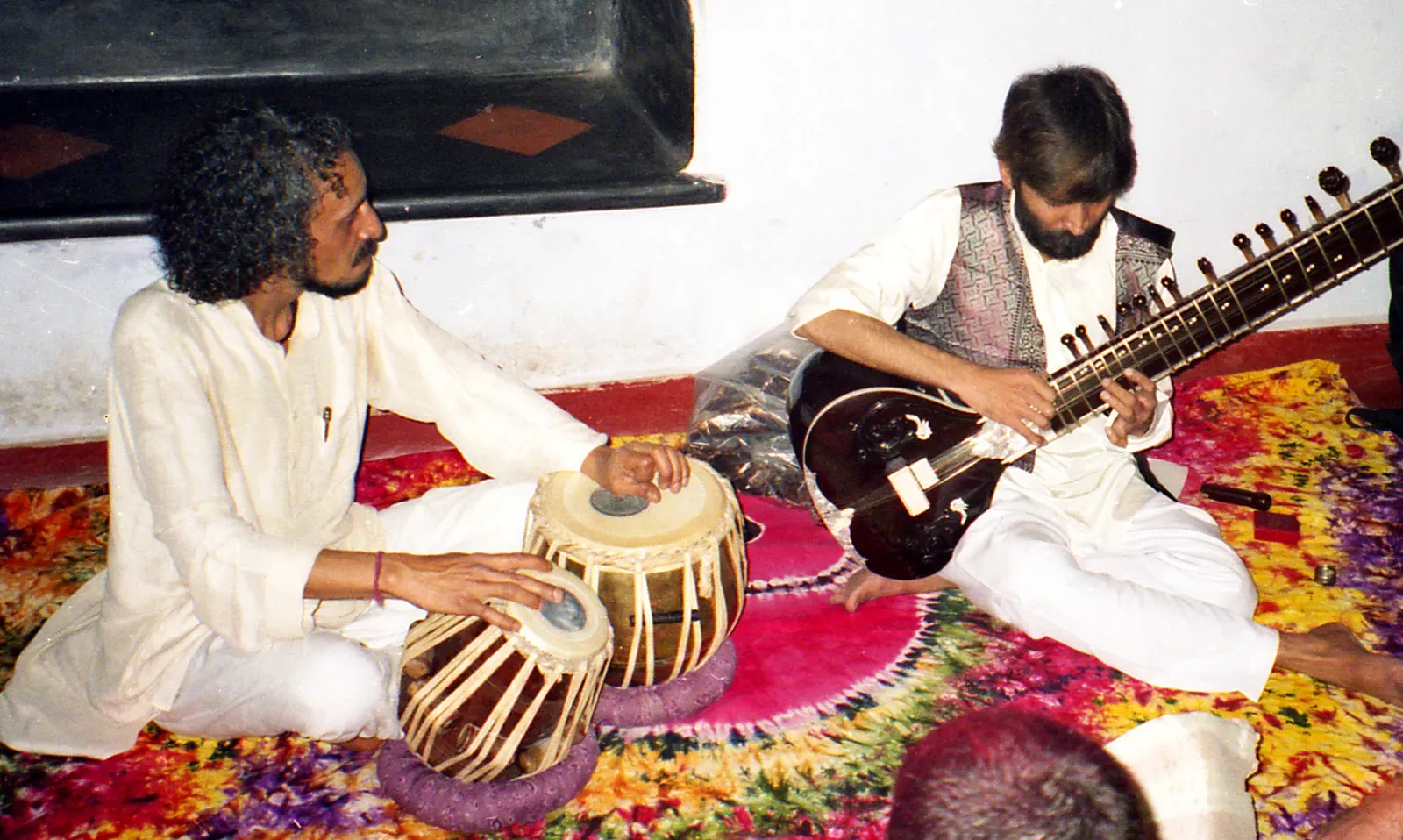
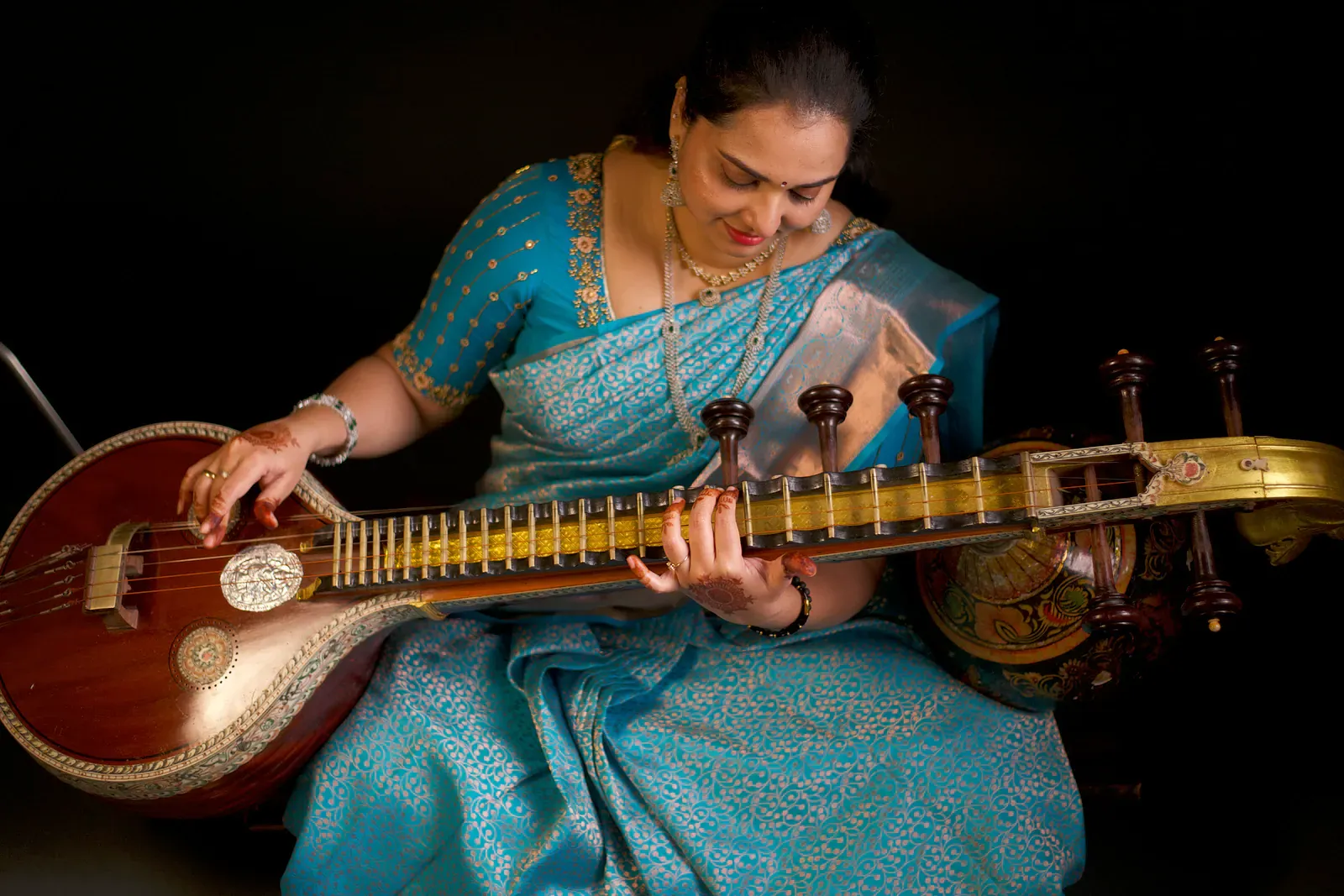
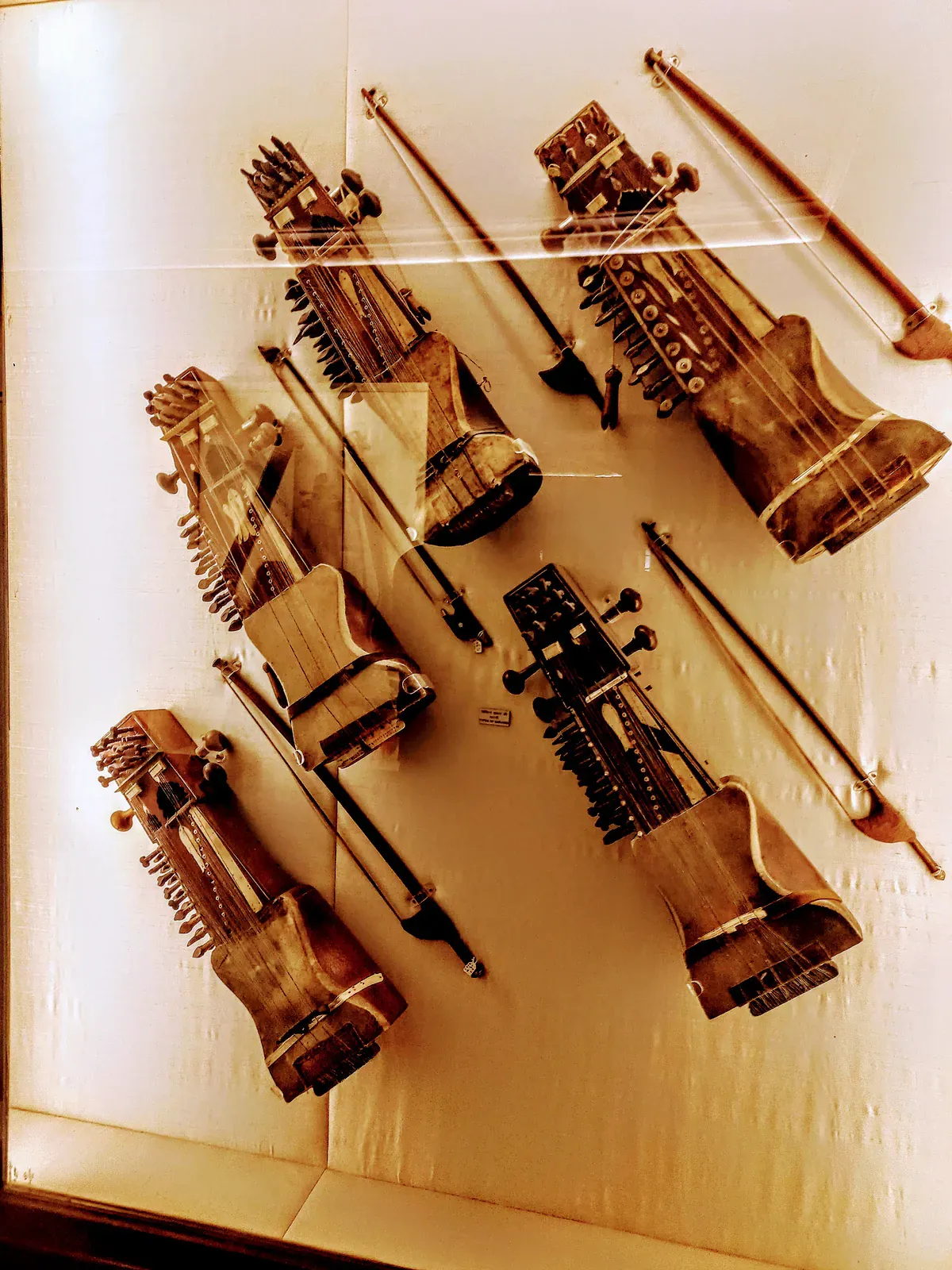
Ghazal is a South Asian vocal genre in which a poem of linked couplets, usually in Urdu, Hindi or Persian, is sung to a raga-based tune with harmonium, sarangi and tabla.
The poetic form began in 7th-century Arabic and spread through Persian courts to the Indian subcontinent, and the music genre took its modern shape on records, film and radio in the twentieth century. Its subject is love and longing, and the best-known voices are Begum Akhtar, Mehdi Hassan, Jagjit Singh, Ghulam Ali and Farida Khanum. It belongs to the South Asian family, close to qawwali and rooted in Hindustani classical music.
Origins
The ghazal is first a poem. It started as an Arabic love lyric, flourished in Persian under Sa’di and Hafez, and reached the subcontinent in the 12th century with the Ghurid dynasty and the Delhi Sultanate. Sufi mystics carried it further, using its language of the beloved to speak about divine love. In the thirteenth century Hasan Sijzi and Amir Khusrow blended Persian forms with the local Hindavi speech, a step toward the Urdu ghazal. By the eighteenth and nineteenth centuries Urdu verse had its golden age under poets such as Mir Taqi Mir and Mirza Ghalib.
The form has strict rules. A ghazal has at least five couplets, called sher or bayt, and most have between seven and twelve. Each couplet is a complete thought, yet all share a metre and a rhyme pattern. The opening couplet, the matla, sets the rhyme (qafiya) and the refrain (radif), and every later couplet ends on the same refrain. The closing couplet, the maqta, often carries the poet’s pen name. These rules explain how the music works: the singer treats each couplet as a unit and returns to the refrain, shaping it differently each time.
The form also spread beyond the Urdu world. Atul Prasad Sen and Kazi Nazrul Islam adapted it to Bengali, a line continued in Nazrul Geeti. Punjabi migrants brought it to the Malay world, where Singapore and Johor developed a Malay ghazal with violin in place of the sarangi.
From the mehfil to the gramophone, 1933-1956
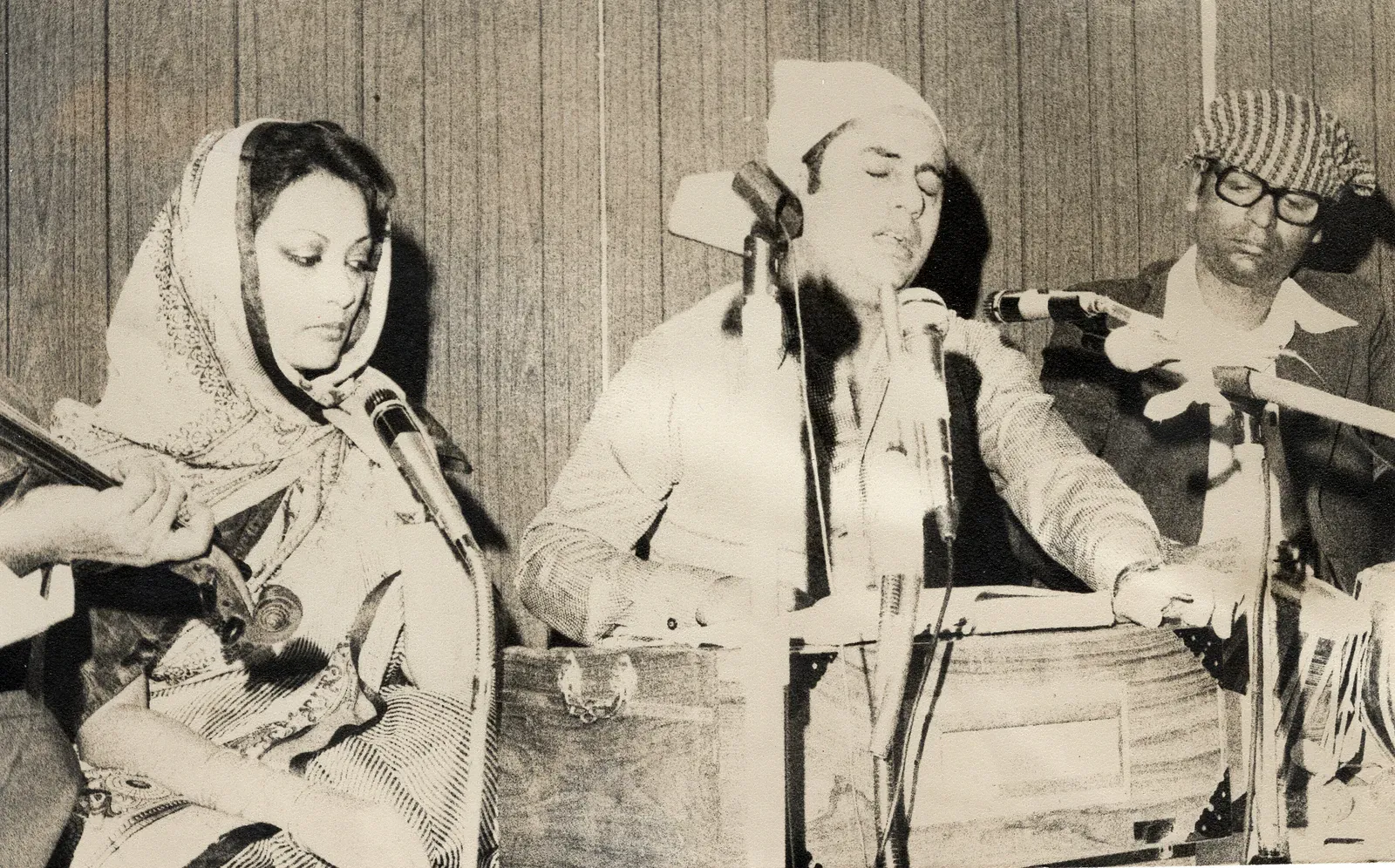
Ghazal was long sung in mehfils, small gatherings for a patron and a few listeners. Begum Akhtar, born Akhtari Bai Faizabadi, moved it into wider public life. She trained with sarangi master Imdad Khan and others, gave her first public performance at fifteen, and cut her first disc for the Megaphone Record Company after a benefit concert for earthquake victims in 1934. She acted in Calcutta films in 1933 and sang six ghazals in Mehboob Khan’s film Roti, released in 1942, though several were cut. After a break of about five years following her marriage, she returned to the studio at All India Radio in Lucknow in 1949. She sang ghazal, dadra and thumri in raga-based settings and became known as Mallika-e-Ghazal, Queen of Ghazal.
Radio, film and Pakistan, 1957-1976
Partition in 1947 split the audience, and Pakistan built its own ghazal stars. Farida Khanum’s family moved from Amritsar to Lahore, and she gave her first public concert in 1950 before joining Radio Pakistan. Her signature piece, Aaj Jaane Ki Zid Na Karo, was released on an EMI Pakistan album in 1978 and is still the song most tied to her name.
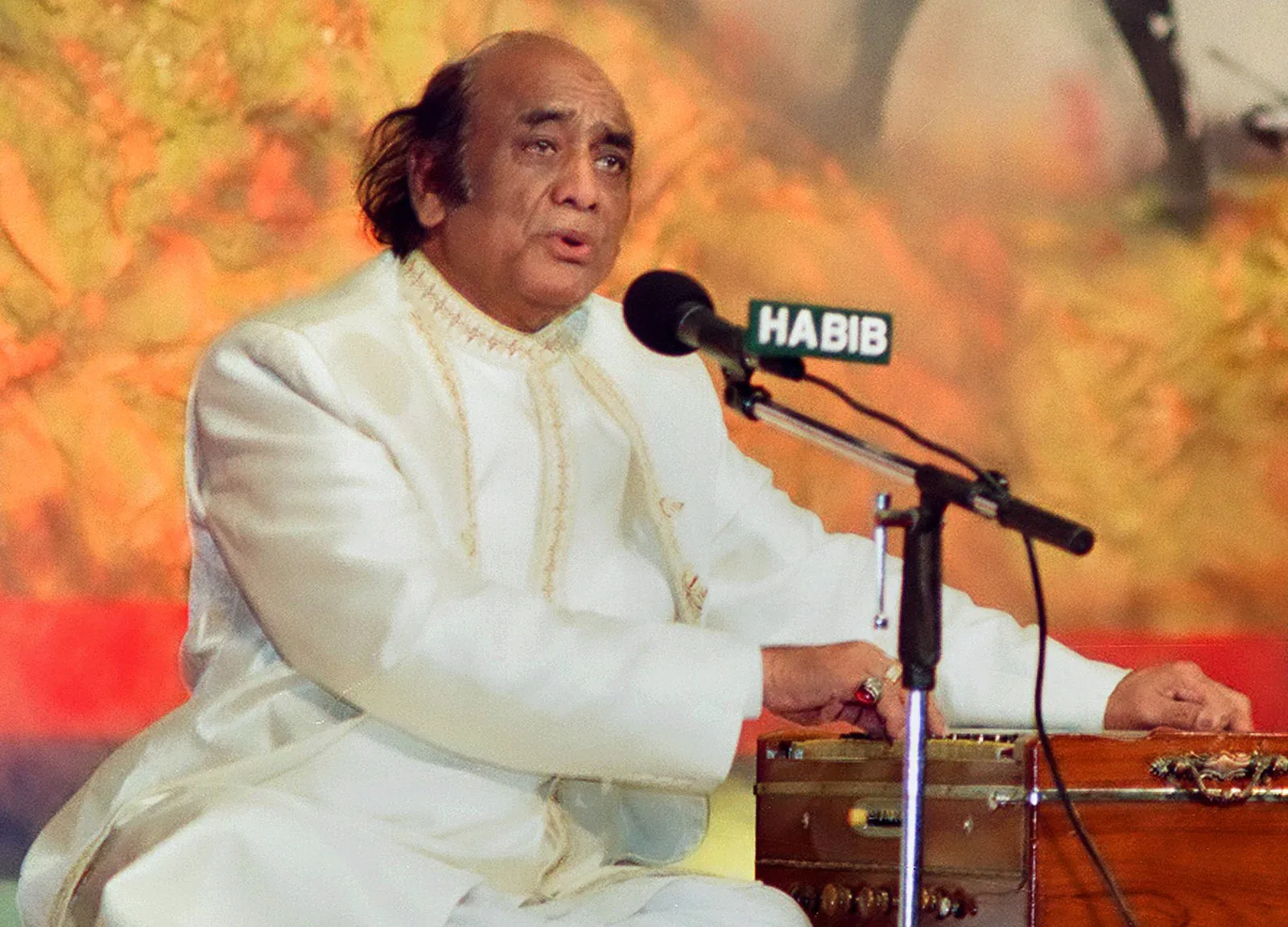
Mehdi Hassan sang on Radio Pakistan in 1957, first as a thumri singer and increasingly as a ghazal performer. His breakthrough came in 1964 with Gulon Mein Rang Bhare, a Faiz Ahmed Faiz ghazal in the film Farangi, which won him a Nigar Award. Faiz reportedly stopped reciting it at poetry gatherings and told audiences to ask Hassan to sing it. Hassan became known as the Emperor of Ghazal, and his slow, classically trained delivery set the standard for the Pakistani ghazal.
Modernisation, 1977-1990
In 1977 Jagjit Singh and his wife Chitra Singh released The Unforgettable, their first LP. It paired modern arrangements with solo and duet tracks and made them stars. Ghazal had been seen as the field of Muslim singers, especially from Pakistan, and Singh worked to widen its audience. He chose simple poems and set them to simple tunes, and he added Western instruments to give the songs a lighter feel. He also composed the film Prem Geet in 1981, which includes Hothon Se Chhulo Tum. The joint work ended in 1990 after the death of their son Vivek.
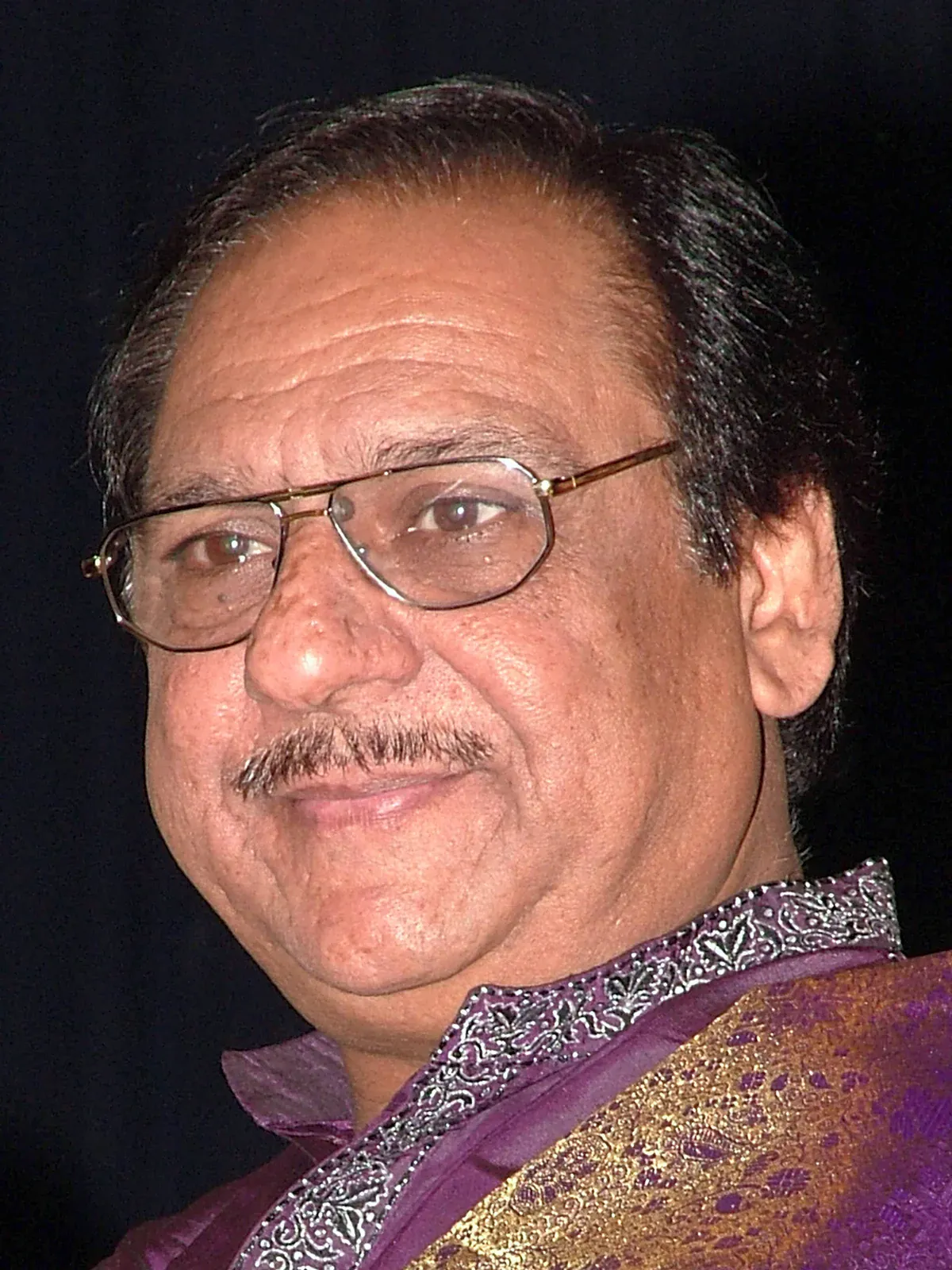
Ghulam Ali offered a harder, more classical alternative. A Pakistani singer of the Patiala gharana and a student of Bade Ghulam Ali Khan, he composes raga-based ghazals and sometimes mixes ragas within one piece. He first toured India in 1980, and his Chupke Chupke Raat Din, a ghazal by Hasrat Mohani, reached mainstream Indian audiences in B. R. Chopra’s film Nikaah in 1982. Joint albums with Asha Bhosle began with Meeraj-E-Ghazal in 1984.
Characteristics
The voice leads. The harmonium gives the drone and the opening phrase, the sarangi follows the singer closely, and the tabla keeps the rhythm cycle. Melodies come from ragas, though ghazal counts as light classical music and allows more freedom than a formal khayal performance. Singers are trained in khayal, thumri and dadra, and the best use their training to bring out the meaning of a couplet through small changes of phrasing in the refrain. Songs usually move at an unhurried pace. Words matter more than virtuosity, so the choice of poet is part of the art: singers choose Ghalib, Faiz, Hasrat Mohani or Bahadur Shah Zafar, or newer lyricists,.
Mainstream success
Ghazal reached the mass market mainly through cinema and cassettes. Mehdi Hassan’s Farangi song and Ghulam Ali’s Nikaah song both entered film soundtracks, and the Singhs’ records sold widely in India. Saregama, whose catalogue includes HMV releases, issued Hassan and Lata Mangeshkar’s duet Tera Milna on Sarhadein in 2010, recorded in two countries. Ghazal also moved into public ceremony: in 2007 Jagjit Singh sang Bahadur Shah Zafar’s Lagta Nahin Hai Dil Mera in the Indian Parliament at the 150th anniversary of the 1857 uprising. Many film singers also recorded ghazals alongside their filmi work.
Culture
The mehfil and the mushaira, a public poetry recital, are the two social settings of the form. Poets sign their work with a takhallus, a pen name, usually in the closing couplet. Begum Akhtar’s move from mehfils to concert halls marked a change in who could hear ghazal, and radio widened the audience again.
Legacy
Begum Akhtar died on 30 October 1974, Jagjit Singh on 10 October 2011 and Mehdi Hassan on 13 June 2012. Farida Khanum sang Aaj Jaane Ki Zid Na Karo on Coke Studio at the age of 80. Ghazal continues through reissues, television and concert tours, and young singers still draw on the same poets. The sound has also broadened to Afghan and Persian settings and to Bengali and Malay ghazal.
Misconceptions
The first myth is that a ghazal is a song type. It is a poem form with rules of rhyme, refrain and metre, and the music is a setting of that verse. The second is that every ghazal is sad. The central themes are love and longing, but the form also treats spiritual and Sufi meaning and social and metaphysical questions. The third is that ghazal is only Urdu and only Indian or Pakistani. It began in Arabic, flourished in Persian, and is also sung in Bengali, Malay, Afghan and Turkish traditions.
Frequently asked questions
What is ghazal music?
Ghazal music is the sung setting of a ghazal poem, usually in Urdu or Hindi, with harmonium, sarangi and tabla. Each couplet is complete in itself and ends on a shared refrain.
Who are the most famous ghazal singers?
Begum Akhtar, Mehdi Hassan, Farida Khanum, Ghulam Ali and Jagjit Singh are the best known, with Chitra Singh in duets with Singh.
How many couplets does a ghazal have?
A ghazal has at least five couplets, and most have between seven and twelve. Longer poems are more often called qasidas.
How is ghazal different from qawwali?
Ghazal is usually a solo or duet performance of a love poem with quiet accompaniment. Qawwali is a group devotional form with a larger ensemble and a strongly rhythmic, communal feel.
Sound
Sound sheet
Signature sounds
- Voice leads, with harmonium, sarangi and tabla underneath
- Couplets sung one at a time, each a complete thought
- Refrain (radif) closing every couplet
- Raga-based melody, sometimes mixing ragas
- Later light Western instrumentation
Drums and percussion
- Tabla
Techniques
- Refrain closing
- Couplet-by-couplet setting
- Raga mixing
- Light Western arrangement
Keys and modes
Raga-based modes. Melodies drawn from ragas, sometimes combined within one ghazal.
Vocals
Solo or duet voice singing Urdu, Hindi or Persian poetry, trained in khayal, thumri and dadra.
Scenes
Where it happened
Where and when the sound lived: one bar per city on a shared timeline.
Asia
Active scenes
Peak 5, 1965-2025
Begum Akhtar acted in films and made her first records here for Megaphone.
Home city of Farida Khanum after partition and a base for Radio Pakistan singers.
Begum Akhtar's base, where she returned to recording at All India Radio.
Film and recording centre where Jagjit Singh and Ghulam Ali reached large audiences.
Malay ghazal, led by violin and accordion, arrived with Punjabi migrants and spread through the Johor-Riau court.
Culture
Culture markers
- Mehfil
Private gatherings where ghazal was long sung; Begum Akhtar helped move it to public concerts.
Ritual - Mushaira
Poetry recitals; Faiz stopped reciting Gulon Mein Rang Bhare there and asked audiences to request Mehdi Hassan.
Ritual - Takhallus
A poet's pen name woven into the closing couplet, a signature of the form.
Slang
Media
Key media
- 1942Roti
by Mehboob Khan. Film with six Begum Akhtar ghazals, scored by Anil Biswas.
Film - 1981Prem Geet
by Jagjit Singh. Film whose songs were all composed by Jagjit Singh.
Film - 1982Nikaah
by B. R. Chopra. Film that made Ghulam Ali's Chupke Chupke Raat Din widely known in India.
Film
Glossary
Terms on this page
The closing couplet, which often includes the poet's pen name.
The opening couplet, in which both lines carry the rhyme and refrain.
An intimate gathering where ghazal is sung to a small audience.
The rhyme pattern that comes just before the radif.
The refrain word or phrase that ends each couplet.
A self-contained couplet, also called bayt; a ghazal has at least five.
The poet's pen name, usually placed in the maqta.
South Asian family