Kroncong
Kroncong is an Indonesian genre of interlocking ukulele strumming, cello and flute or violin, formed among Portuguese-descended Mardijkers near Batavia.
Indonesia, 1661
Southeast Asian family
Born
1661
Indonesia
Subgenres
2
Documented branches
Links
9
Genres it drew on or shaped
Tempo
80-110 BPMLineage
Family tree
Timeline
Era by era
From the first sparks to today. Select a dot to read the story behind it.
- Tugu and Portuguese roots
1661 to 1880
- Stamboel and Tempo Doeloe
1880 to 1920
- Solo, records and radio
1920 to 1960
- Beats, langgam jawa and pop
1960 to 2000
- Festivals and heritage
2000 to today
Eras
Moments
- 1 Tugu and Portuguese roots, 1661 to 1880
- 2 Stamboel and Tempo Doeloe, 1880 to 1920
- 3 Solo, records and radio, 1920 to 1960
- 4 Beats, langgam jawa and pop, 1960 to 2000
- 5 Festivals and heritage, 2000 to today
1661
Tugu and Portuguese roots
Freed Portuguese-descended Mardijkers settle Kampung Tugu in 1661. Their songs and small guitars move to major scales and Protestant hymnody, the base of later kroncong.
- 1661Tugu settlementThe Dutch East India Company frees Portuguese-descended prisoners and slaves from Goa in Kampung Tugu on condition they convert to Protestantism.
around 1880
Stamboel and Tempo Doeloe
Kroncong emerges as a distinct genre in port cities. Travelling Komedie Stamboel troupes play 16-bar stamboel songs between scenes at tempos up to about 110 BPM.
- 1880Kroncong takes shape as a genreAround 1880 the Tugu style, Hawaiian influence and street song merge into a recognisable genre in the port cities of Java.
- 1891Komedie Stamboel on tourThe Indo touring theatre company plays stamboel kroncong between scenes by rail and ship from 1891 to 1903, spreading it across Java and Malaya.
1920
Solo, records and radio
American ballroom songs bring 32-bar forms. Surakarta becomes the centre and tempos slow to about 80 BPM. Gesang writes Bengawan Solo and singers reach radio and film.
- 1925Orkes Poesaka Kerontjong Moresco ToegoeThe Tugu community forms a kroncong orchestra named for 1661, the oldest named Tugu ensemble.
- 1927Annie Landouw wins her first contestThe blind Surakarta singer wins a night-fair singing competition and is signed by the Beka label, then moves to Batavia.
- 1940Gesang writes Bengawan SoloThe self-taught Surakarta singer composes the song about the Solo River, the first widely popular song in Indonesian by a local composer.
- 1947Bengawan Solo in JapanToshi Matsuda's best-selling Japanese version follows soldiers carrying the song home, making it a symbol of Indonesian music in Japan.
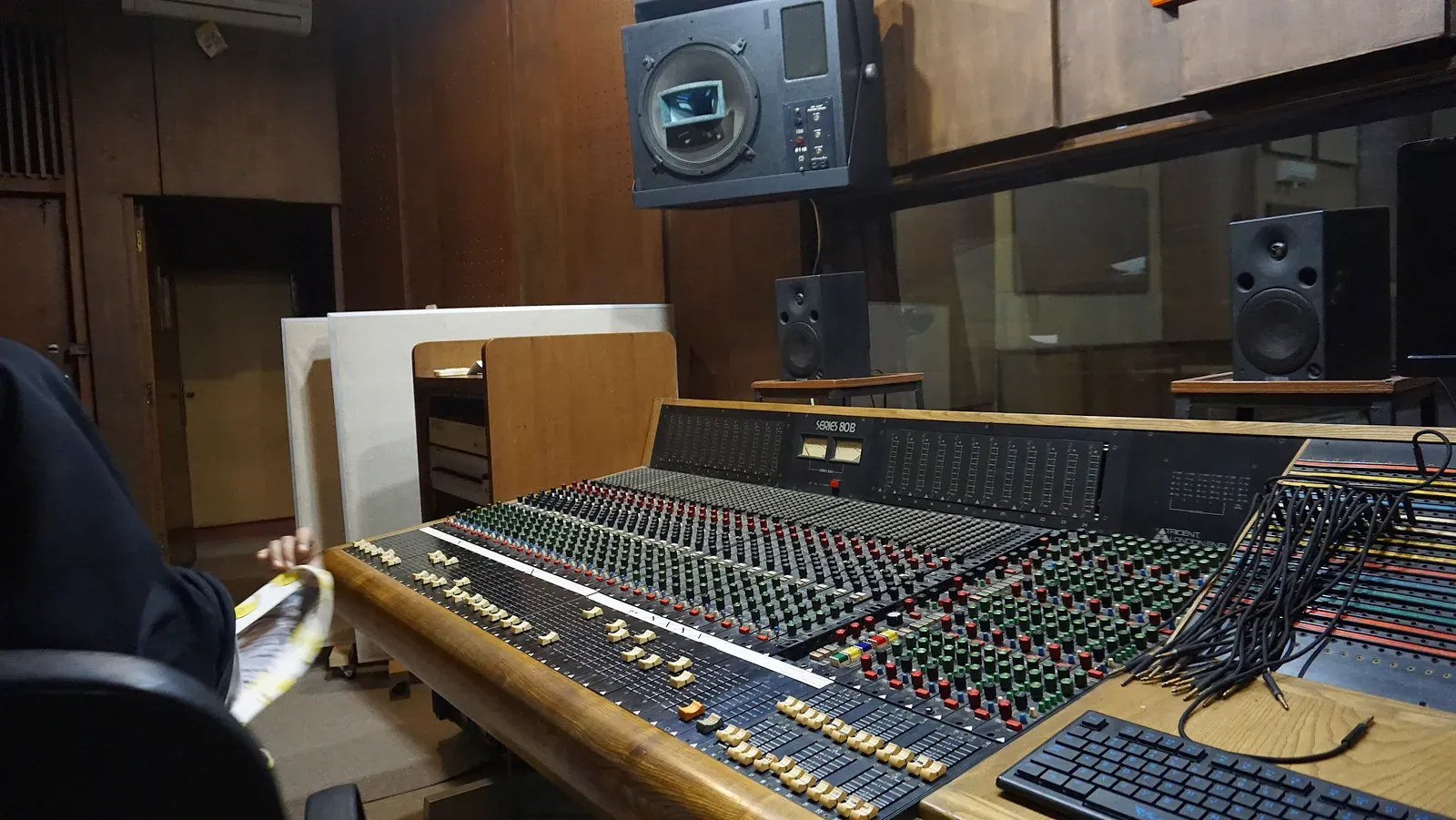
- 1956Lokananta founded in SurakartaIndonesia's first record label, state owned, later holds the largest archive of kroncong and gamelan recordings.
- 1958Yen Ing Tawang Ana LintangRadio contest winner Waldjinah performs Andjar Any's song, a landmark of Javanese langgam kroncong.
1960
Beats, langgam jawa and pop
Langgam Jawa takes gamelan scales, campursari mixes gamelan with kroncong, a keroncong beat backs foreign songs, and Koes Plus and Hetty Koes Endang add electric and pop sounds.
- 1967Ratu Kembang KatjangWaldjinah's EP on Lokananta builds her national name as queen of kroncong.
- 1968Walang KekekWaldjinah's title song makes Javanese kroncong known throughout Indonesia.
- 1968Campursari beginsManthous in Gunung Kidul near Yogyakarta mixes gamelan with kroncong, creating campursari.
- 1974Koes Plus plays kroncong as rockThe Surakarta-linked rock-pop group introduces kroncong-style songs with electric guitars and drums.
- 1980Pop Keroncong Lihat Air MataHetty Koes Endang's album defines pop keroncong with electric guitars, keyboards and drums on a kroncong rhythm.
- 1988Krontjong Toegoe formedArend J. Michiels founds the Tugu group on 12 July 1988 to keep Keroncong Tugu alive.
- 1991Gesang statue in SurakartaJapanese war veterans have a life-size statue of the composer erected in a Surakarta park.
2000
Festivals and heritage
Kroncong is treated as heritage music. Festivals in Solo, Tugu groups and hip-hop and Chinese-instrument experiments keep it in circulation.
- 2019Tanah Tugu wins an AMI AwardKrontjong Toegoe's single wins the Anugerah Musik Indonesia award for best keroncong production.
Listening path
Start listening
A short path from an easy way in to the deep end. Thumbnails come from YouTube; the player loads only when you press play.
- 01
Sundari Soekotjo, 2005
The best-known kroncong song in original style, with violin and the cak and cuk strum.
- 02
Waldjinah, 1994
The Javanese langgam signature song; listen for the siter-like arpeggios of the ukuleles.
- 03
Hetty Koes Endang, 1980
Pop keroncong: the kroncong rhythm under a pop arrangement.
Facts
| Family | Southeast Asian |
| Origin | Indonesia |
| Emerged | Late 19th century |
| Status | Active |
| Tempo | 80 to 110 BPM |
| Meter | 4/4 |
| Subgenres | 2 |
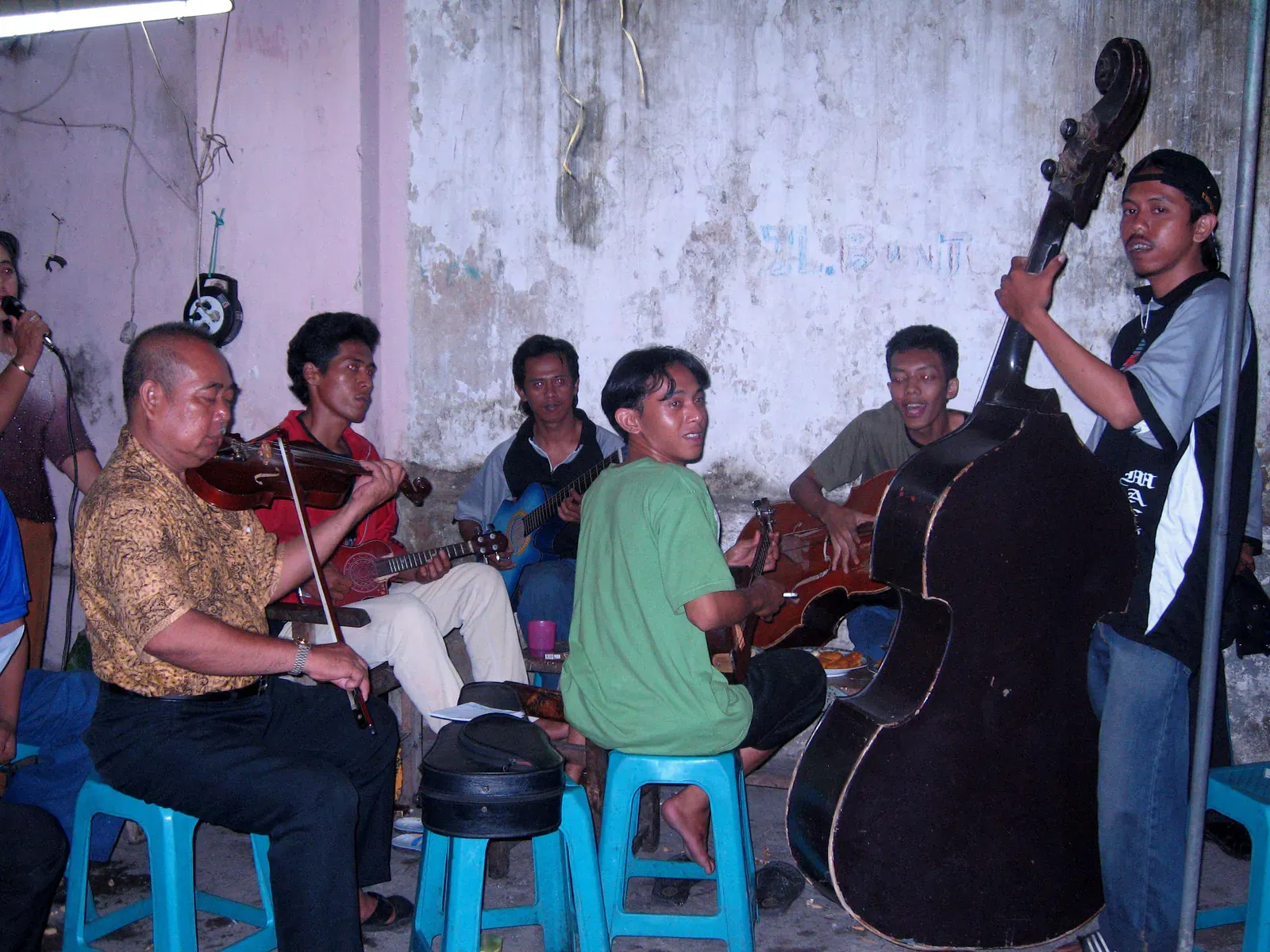
Kroncong, also spelled keroncong, is an Indonesian popular genre in which two small ukulele-like instruments, a plucked cello and a pizzicato bass strum an interlocking rhythm under a slow, sustained melody sung or played on voice, flute or violin.
It grew out of Portuguese songs and instruments kept by freed, Portuguese-speaking communities around Batavia and took recognisable shape around 1880. It belongs to the wider Southeast Asian family and stands beside dangdut as one of the country’s best-known popular styles.
Origins
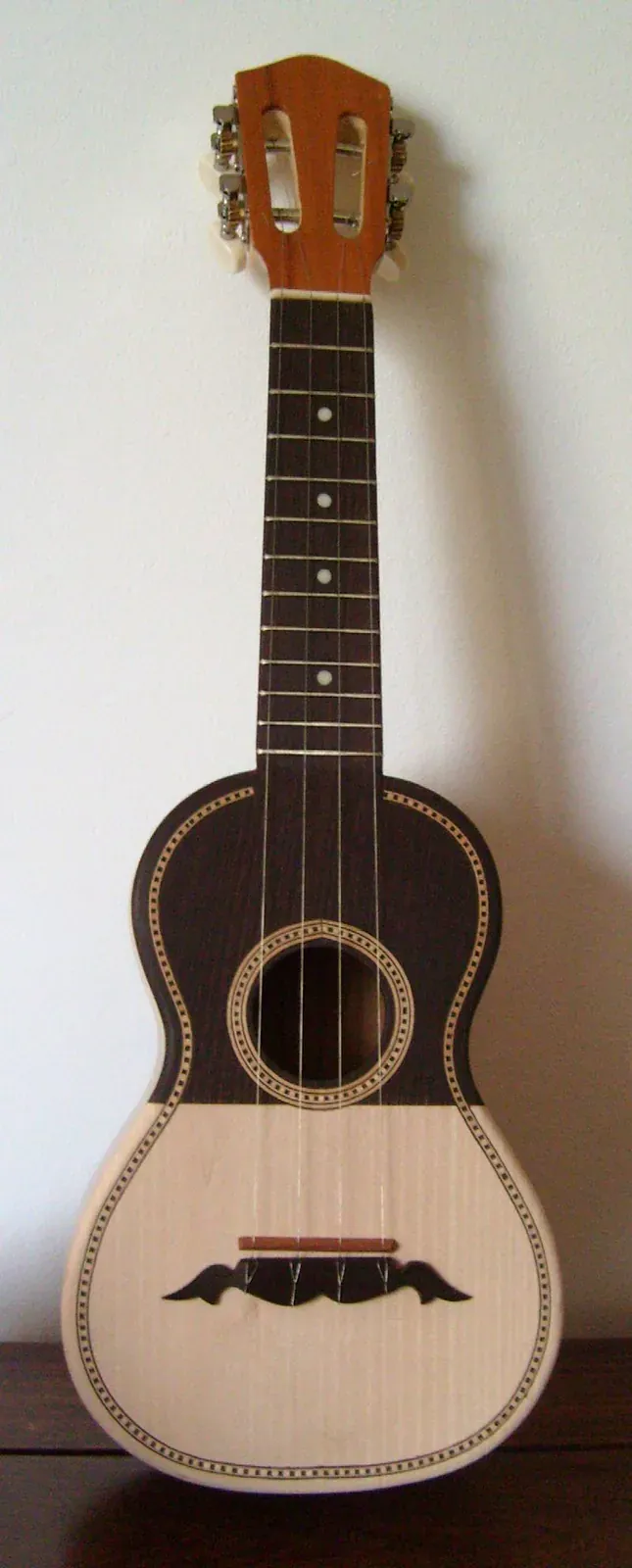
The word itself is Javanese and imitates a jingling, rumbling sound. It is commonly traced to the sound of the small ukulele-type instrument, whose rapid strumming gives the music its characteristic “kron” and “chong”. The instruments descend from the Portuguese cavaquinho, which also lies behind the Hawaiian ukulele, and the Portuguese music that came with sailors in the sixteenth century is usually cited as the seed.
The settled story starts in 1661. The Dutch East India Company freed Portuguese-descended prisoners and slaves from Goa who were living in Kampung Tugu, on the condition that they convert from Catholicism to Protestantism. The singing tradition shifted to fit Protestant church music, which used major scales rather than the minor modes associated with fado. These freed people were called Mardijkers, from the Dutch word for freeman, and Tugu stayed relatively isolated from Batavia for close to three centuries. The older Tugu style is known as Keroncong Tugu or keroncong moresco, and the Tugu creole survives mainly in its old song lyrics.
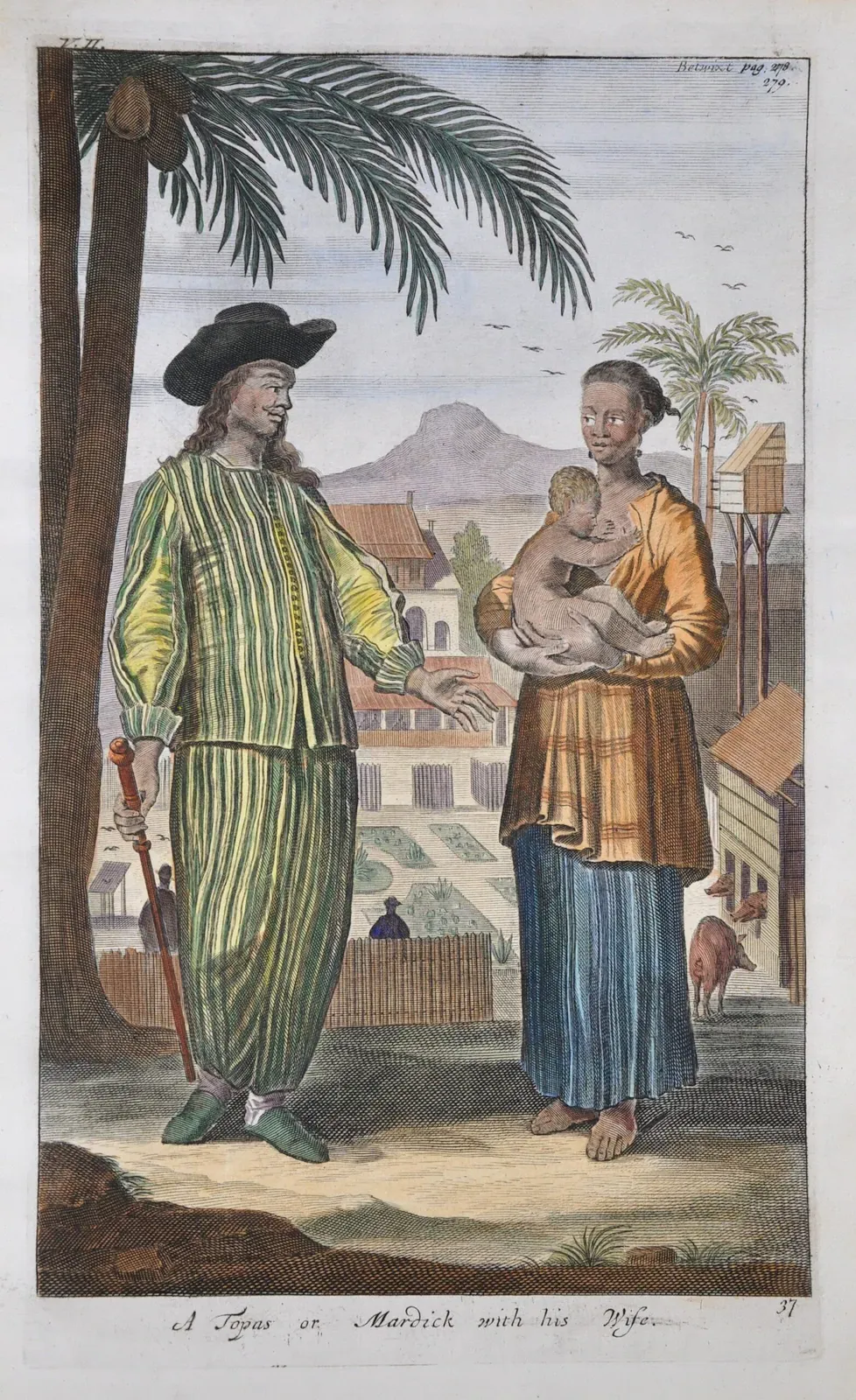
Lower-class urban groups, known as buaya (crocodiles) from the slang buaya darat for playboys, took up the new sound first, and the upper classes adopted it later. Hawaiian music, another major-key style that spread in the Indies, also left a mark on early ensembles. Accounts disagree on how Portuguese the genre really is, and some Indonesian writers argue it is original Indonesian music, but the instruments, the major-key hymn background and the Mardijker community are consistently named.
Stamboel and Tempo Doeloe, 1880-1920
Around 1880 kroncong became a genre of its own. The Komedie Stamboel, an Indo touring theatre company popular between 1891 and 1903, carried marches, polkas, waltzes and kroncong between scenes by railway and ship through East Java, Malaya and beyond. Its kroncong pieces, called stamboel, were 16 bars long and played fast, at up to about 110 beats per minute. Three stamboel types circulated, with songs such as Terang Bulan, Jali-Jali and Si Jampang.
Solo, records and radio, 1920-1960
American ballroom songs arrived through hotel dance bands after the First World War, many played by Filipino musicians, and 32-bar forms entered kroncong. The centre of the style moved to Surakarta, where tempos slowed to about 80 beats per minute. Three forms define the period. Langgam keroncong is a pop-style A-A-B-A song of 32 bars. Stamboel keroncong doubles the 16-bar stamboel. Keroncong asli has eight lines of four bars and opens with a four-bar instrumental prelude.
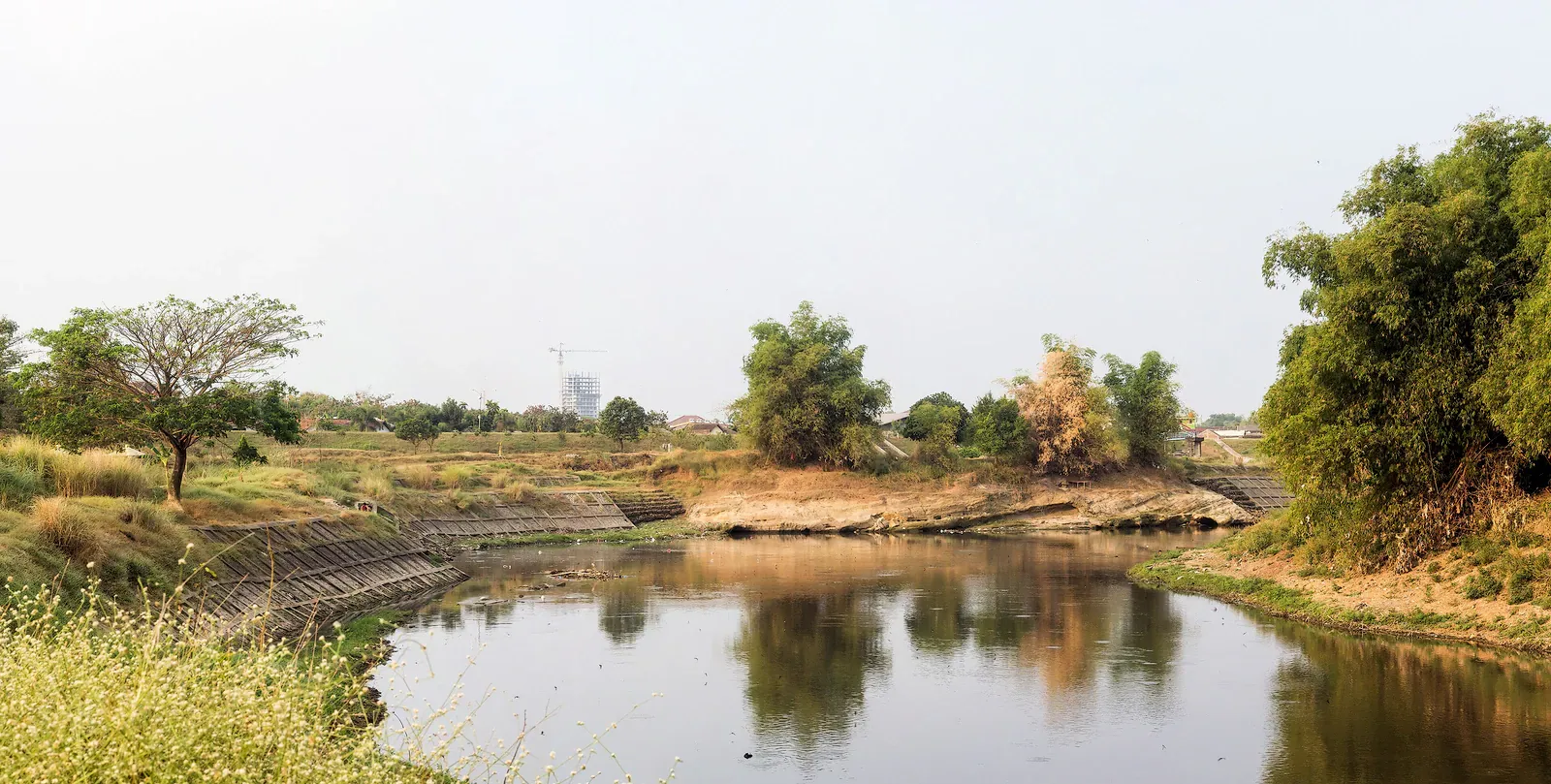
The decisive song came in 1940, when the self-taught Gesang Martohartono, a poor 23-year-old singer from Surakarta, wrote Bengawan Solo about the river that runs past the city. He sang it at weddings and local functions before it spread through radio. The lyrics were in a literary Malay proposed as the national language, and it became the first widely popular Indonesian-language song by a local composer. It was broadcast during the Japanese occupation and promoted nationally after independence. Soldiers carried it to Japan, where Toshi Matsuda’s 1947 version sold strongly and the song became almost synonymous with Indonesian music. In 2025 it was recognised as national intangible cultural heritage of Indonesia.
Voices of the era include Annie Landouw, a blind singer from Surakarta who won a singing contest in 1927, was signed by the Beka label, and went on to radio and film in the late 1930s. In 1956 the state-owned label Lokananta opened in Surakarta, and it later accumulated the largest collection of kroncong and gamelan recordings in the country.
Beats, langgam jawa and pop, 1960-2000
Kroncong began to absorb other styles. Gamelan scales shaped langgam jawa, the Javanese form closest to Surakarta. In a langgam jawa arrangement the ukuleles leave their interplay and both play arpeggios in the manner of the siter, the Javanese zither, while the cello imitates a drum. The composer Andjar Any wrote the best-known example, Yen Ing Tawang Ana Lintang, in 1958, performed by Waldjinah after she won a local radio contest. Waldjinah’s Walang Kekek, on the album of 1968, made Javanese kroncong known across Indonesia.
Other crossovers followed. In 1959 Rudy Pirngadie’s group used a kroncong beat to accompany local and foreign songs and brought kroncong to the 1964 New York World’s Fair. In 1968 Manthous in Gunung Kidul mixed gamelan with kroncong and named the result campursari, a Javanese blend that grew in the Surakarta region. In 1974 Koes Plus played kroncong in a rock style, in the same wider scene as Indorock. Pop keroncong, with electric guitar, keyboards and drums, belongs to Hetty Koes Endang, whose 1980 album Lihat Air Mata is a standard example.
Characteristics
The rhythm section runs faster than the voice. The cak, a small ukulele with steel or nylon strings, strums off-beat, up to eight strums per beat in 4/4. The cuk, larger with three nylon strings, plucks arpeggios and tremolo on the beat. Together they interlock the way instruments do in a gamelan orchestra. The cello is plucked quickly with a skipped beat, the guitar supplies running scalar lines, and the bass is played sparingly like a big gong. Flute or violin handles the introduction and ornaments.
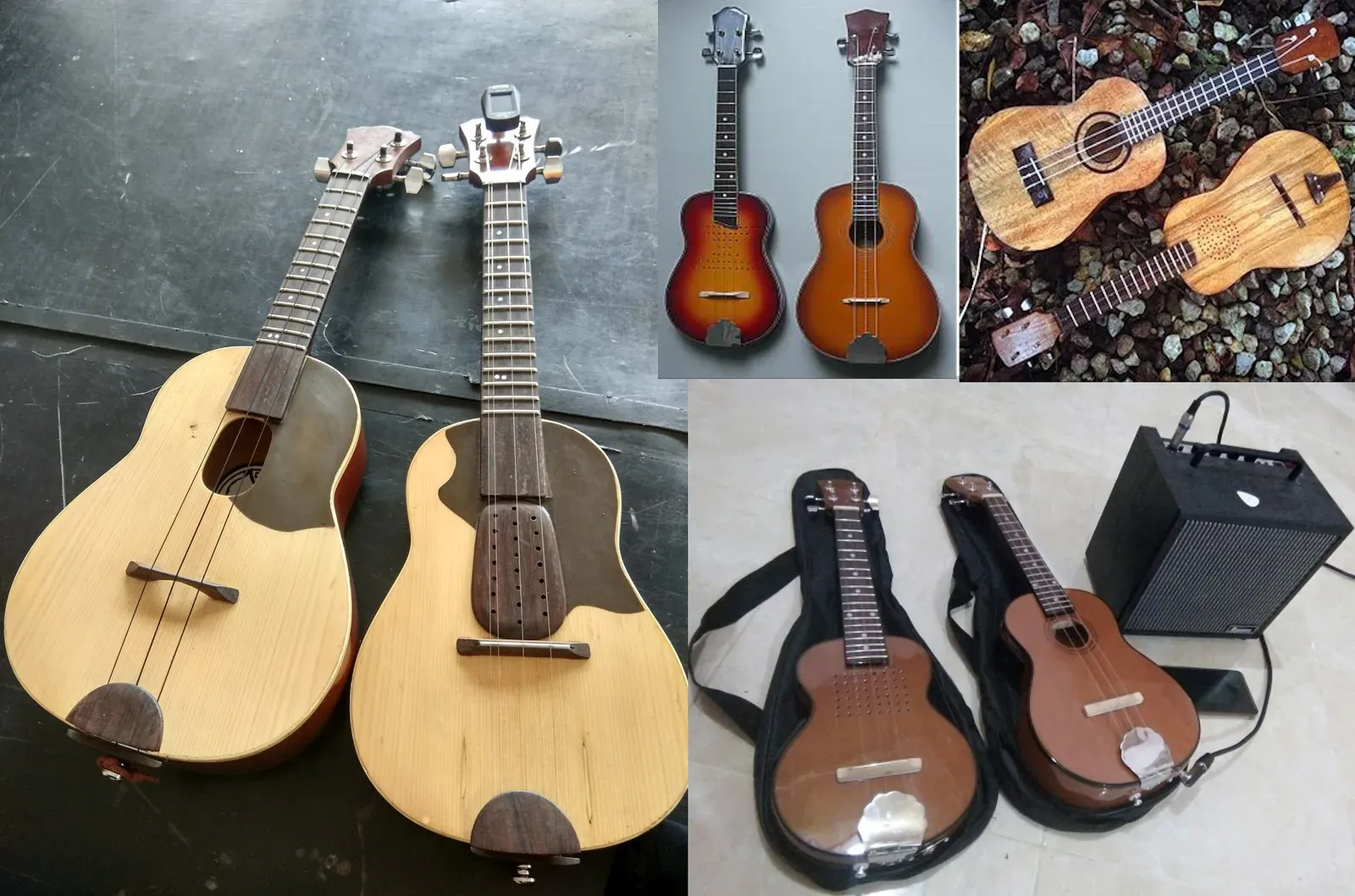
The repertoire mostly uses Western major keys, with some arrangements in minor. Typical tempo runs from about 80 to 110 beats per minute, from the slower Surakarta style to lively stamboel, but the felt pulse is steady rather than driving. Vocals are slow and sustained over the faster rhythm layer.
Culture
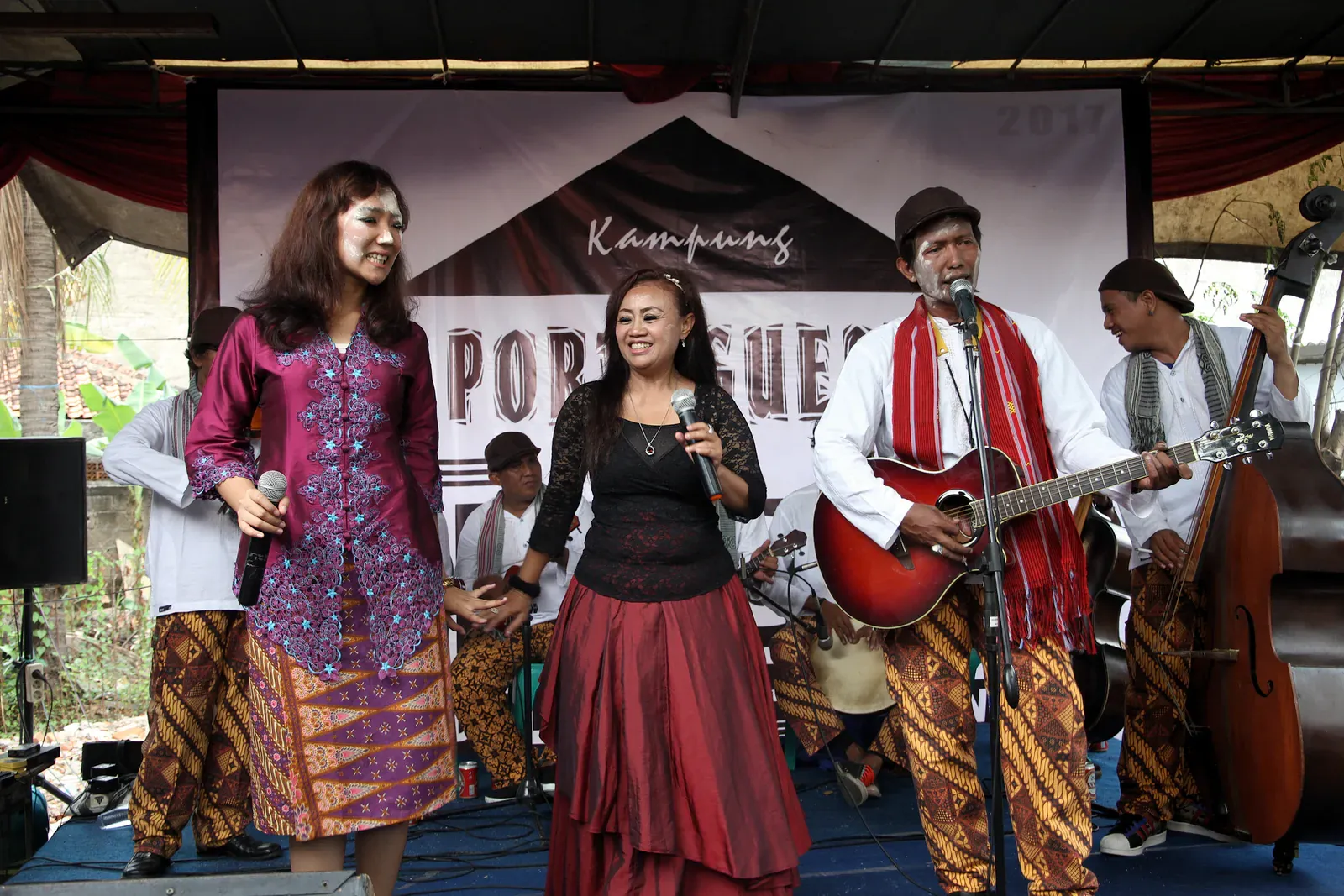
In Kampung Tugu, keroncong is played at weddings, New Year festivals and funeral processions. The annual Rabo-rabo marks Christmas and New Year: after church and a visit to the family tomb, residents visit every house in the neighbourhood, play keroncong songs and ask forgiveness of one another. Krontjong Toegoe, formed on 12 July 1988, carries the Tugu style, and its single Tanah Tugu won the Anugerah Musik Indonesia award for best keroncong production in 2019.
Legacy
Kroncong is often seen by younger Indonesians as old-fashioned folk music, and attempts at renewal have continued since the 1960s. Keroncong Merah Putih mixed in rap, Bondan Prakoso fused kroncong with hip-hop, and the Harmony Chinese Music Group added Chinese instruments at the Solo International Keroncong Festival in 2008. The 2015 recognition of keroncong as local heritage of Java and the 2016 recognition by Indonesia’s culture ministry mark its status as national heritage. It also lives on in the Netherlands, where Indo communities play it at events such as the Tong Tong Fair.
Misconceptions
Bengawan Solo is not a centuries-old folk song. Gesang composed it in 1940, and it was widely assumed in Japan to be traditional only because of its simple melody and nostalgic lyrics.
Kroncong is not always slow and mournful. Early stamboel songs ran up to about 110 beats per minute, and Javanese, pop and campursari variants carry different moods.
Kroncong is not simply Portuguese fado under another name. It shares the Portuguese instrument family and the Tugu legacy, but the genre was shaped in the Indies, with major keys, gamelan-like interlocking and Javanese forms of its own.
Frequently asked questions
What is kroncong music?
Kroncong is an Indonesian genre in which two small ukuleles, a plucked cello and a bass strum a fast interlocking rhythm under a slow, sustained melody on voice, flute or violin. It developed from Portuguese songs and instruments in Batavia.
Where does kroncong come from?
Kroncong comes from Java, especially Batavia and Surakarta. Its roots lie with the Portuguese-descended Mardijkers of Kampung Tugu, and it became a recognisable genre around 1880.
Who wrote Bengawan Solo?
Gesang Martohartono wrote Bengawan Solo in 1940 in Surakarta. It is the most famous kroncong song and was a hit in Japan after the Second World War.
What is the difference between kroncong and langgam jawa?
Langgam jawa is the Javanese form of kroncong, associated with Surakarta, that uses a gamelan-like scale and has the ukuleles play siter-style arpeggios. Standard kroncong keeps Western major harmony and the interlocking cak and cuk strum.
What instruments are used in kroncong?
A kroncong ensemble uses the cak and cuk ukuleles, cello, guitar and double bass, with flute or violin and a vocalist. Pop keroncong adds electric guitar, keyboards and drums.
Sound
Sound sheet
Anatomy of a track
| # | Part | Bars |
|---|---|---|
| 1 | Instrumental prelude (flute or violin) | 4 |
| 2 | Song body in eight lines of four bars | 32 |
Signature sounds
- Interlocking cak and cuk ukuleles
- Plucked cello and gong-like pizzicato bass
- Slow sustained vocal over a faster strummed rhythm
- Flute or violin runs between phrases
Techniques
- Cak and cuk interlock
- Skipped-beat cello pluck
- Siter-style arpeggios
- Melodic prelude
Keys and modes
Western major. The usual key world of the repertoire, with some minor arrangements.
Pentatonic Javanese colour. Langgam Jawa uses a five-tone scale near a Javanese gamelan scale while keeping Western intervals.
Vocals
A slow, sustained melody sung over a faster rhythmic layer, traditionally by a female singer drawn from the Javanese pasindhen tradition, though men sing it too.
Scenes
Where it happened
Where and when the sound lived: one bar per city on a shared timeline.
Asia
Active scenes
Peak 4, 1960-2025
Batavia and Kampung Tugu, home of the Mardijker roots, Keroncong Tugu and later radio, record and pop keroncong.
Solo, where the centre of kroncong moved in the 1920s and where Gesang, Waldjinah and Lokananta worked.
A second Javanese centre for modern kroncong and the home region of campursari.
East Javan port where Komedie Stamboel toured and Eurasian communities kept kroncong going.
Venues and places
Surakarta, 1956 to today. State record label and studio holding the largest archive of kroncong and gamelan recordings.
Culture
Culture markers
- Rabo-rabo
At Christmas and New Year Tugu residents go house to house playing kroncong after church and a visit to the family tomb.
Ritual - Buaya darat
Lower-class urban gangs called buaya, literally land crocodiles, took up the new music before the upper classes did.
Slang - Weddings and funerals in Tugu
Keroncong Tugu is played at weddings, New Year festivals and funeral processions.
Ritual
Media
Key media
- 1938Fatima
by Tan's Film. Annie Landouw provided the vocals, one of her early kroncong film credits.
Film - 1938NIROM radio
by NIROM. Annie Landouw joined its radio troupe to sing kroncong, one of the early radio platforms for the genre.
Radio
Glossary
Terms on this page
The interlocking pair of ukulele-like instruments that gives kroncong its sound.
The original form of eight lines of four bars with a four-bar instrumental prelude.
A 32-bar kroncong song form with an A-A-B-A pattern.
Freed people of Portuguese-speaking descent in Batavia, Dutch for freeman.
Early 16-bar kroncong songs played by Komedie Stamboel troupes.
Southeast Asian family