Kumina
Kumina is an Afro-Jamaican Kongo-derived tradition of drumming, song and spirit possession from Saint Thomas that shaped Nyabinghi and roots reggae.
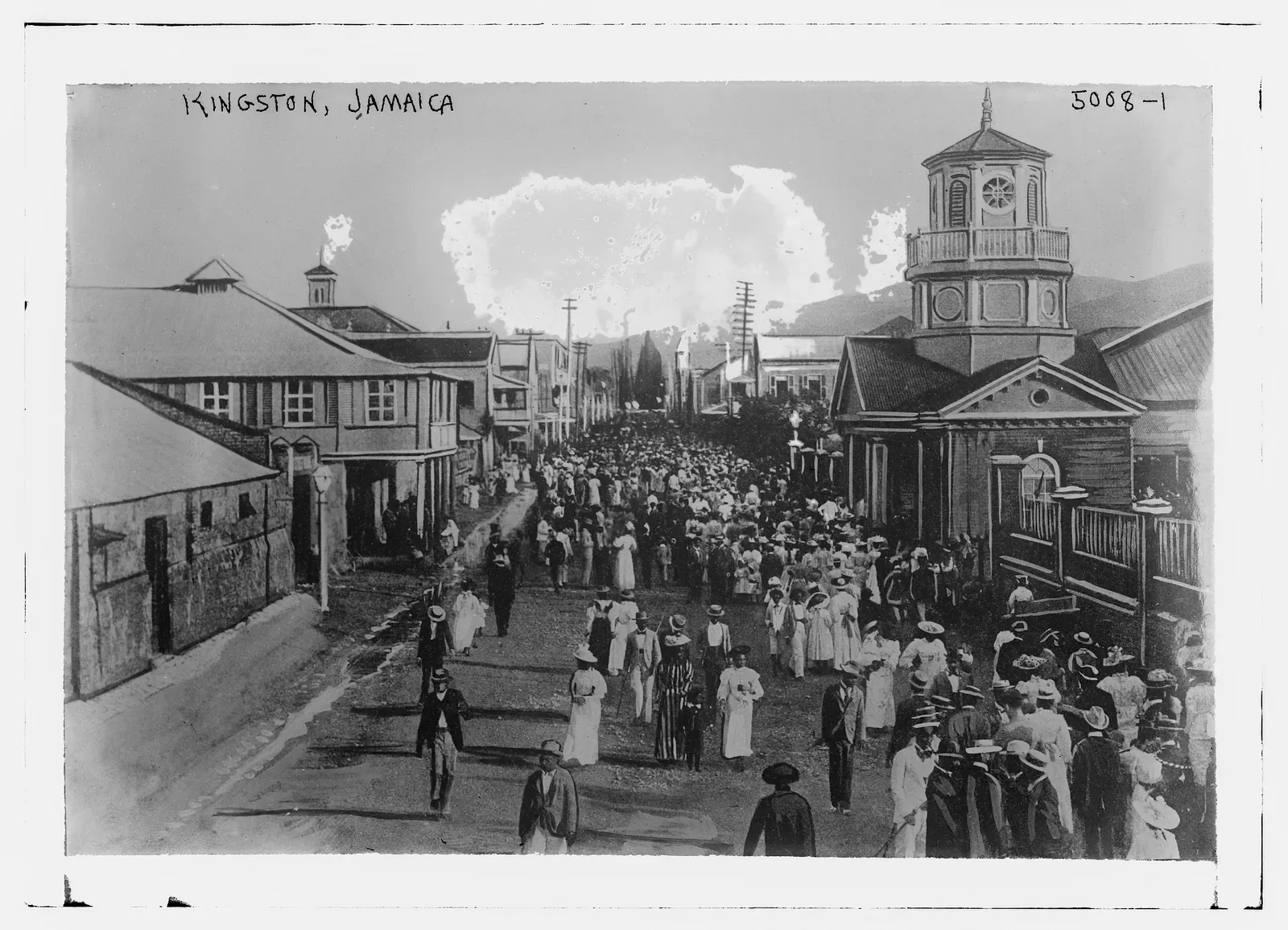
Saint Thomas, around 1850
Caribbean family
Born
around 1850
Saint Thomas
Links
6
Genres it drew on or shaped
Tempo
115-125 BPMLineage
Family tree
Timeline
Era by era
From the first sparks to today. Select a dot to read the story behind it.
- Kongo roots in Saint Thomas
1850 to 1949
- Kingston drumming and Rasta
1950 to 1976
- Folk record and heritage
1977 to today
Eras
Moments
- 1 Kongo roots in Saint Thomas, 1850 to 1949
- 2 Kingston drumming and Rasta, 1950 to 1976
- 3 Folk record and heritage, 1977 to today
around 1850
Kongo roots in Saint Thomas
Indentured labourers from the Kongo region brought drumming, singing and possession rites to eastern Jamaica after emancipation, and in the later 19th century the practice merged with Myalism.
- 1850Kongo labourers bring the ritesIndentured labourers from the Kongo region reach Jamaica after the abolition of slavery, and their religion shapes Kumina in Saint Thomas.
- 1870Merger with MyalismIn the second half of the 19th century Kumina syncretises with Myalism, sharing healing rites with later Revival groups.
- 1926Count Ossie is born in Saint ThomasThe future Rasta drummer first hears Kumina drumming in his home parish.
1950
Kingston drumming and Rasta
The Kumina drumming style evolved in urban Kingston and shaped Nyabinghi, as Count Ossie's Wareika Hills community carried it into the first Rasta recordings and into ska and reggae.
- 1950Wareika Hills Rasta communityCount Ossie sets up a community near Wareika Hill on the east side of Kingston, where Kumina-derived hand drumming evolves into Nyabinghi.
- 1956Folk Music of Jamaica on FolkwaysThe anthology sets Afro cult music such as kumina beside other Jamaican traditional forms.
- 1959Oh Carolina is recordedThe Folkes Brothers record the song at JBC studios with Count Ossie's Wareikas drumming, produced by Prince Buster.
- 1960Kumina Dance on Caribbean Folk MusicFolkways issues a Kumina singers track with two drums on Caribbean Folk Music, Vol. 1.
- 1973GrounationCount Ossie and the Mystic Revelation of Rastafari release a three-LP set fusing Nyabinghi drumming with jazz and chant.
- 1975Tales of MozambiqueA second large album from the Mystic Revelation of Rastafari continues the drumming legacy.
- 1976Count Ossie diesThe drummer dies in a road accident on 18 October, aged 50.
1977
Folk record and heritage
Kumina is collected as a folk tradition and documented by song collectors and festivals, led by queens such as Imogene Kennedy, while its drumming reappears in dancehall rhythm tracks.
- 1989Kumina band at the Smithsonian Folklife FestivalQueen Imogene Kennedy takes part in the festival programme on the Caribbean with a Kumina band from Jamaica.
- 2002Kumina riddimSly and Robbie produce a dancehall rhythm named for the tradition, later used by over 20 artists.
Listening path
Start listening
A short path from an easy way in to the deep end. Thumbnails come from YouTube; the player loads only when you press play.
- 01
Kumina singers, 1960
Singers and two drums in a ritual-style dance piece: listen for the steady kbandu under the fast playing cast.
- 02
The Folkes Brothers, 1959
A pop vocal trio over Count Ossie's hand drums, an early record to carry the Kumina-derived sound.
- 03
Count Ossie, 1973
Nyabinghi drumming with horns and chant from the Grounation set.
- 04
Count Ossie, 1973
The long title piece, where the drums carry the whole group.
Facts
| Family | Caribbean |
| Origin | Saint Thomas, Jamaica |
| Emerged | 19th century |
| Status | Active |
| Tempo | 115 to 125 BPM |
| Meter | 4/4 |
Kumina is an Afro-Jamaican religious tradition of drumming, call-and-response singing and spirit possession, rooted in the Kongo region of central Africa and practised since the 19th century, above all in the parish of Saint Thomas in eastern Jamaica. Its ceremonies are mainly healing rites.
Its drumming style, developed in urban Kingston, passed into Rastafari music and into popular Jamaican music. It belongs to the Caribbean family of traditions.
Origins
Kumina grew from the practices of Kongo labourers brought to Jamaica as indentured workers after slavery was abolished. In the second half of the 19th century it merged with Myalism, which gave it the healing and possession rites it shares with Revival Zion and Pocomania. It differs from Zion Revival in not treating the Bible as the central authority of worship. The names Pukkumina and Pocomania are sometimes applied to it, the latter largely as a slight.
Communities are small and family based, each called a nation, with names such as Mondongo, Moyenge, Machunde, Kongo, Igbo and Yoruba. A King and a Queen lead a nation. People from Kumina families carry the title Bongo, and others join by marriage into a family or by special initiation. Women act as the custodians of ritual knowledge, and Queen Imogene Kennedy of Saint Thomas, later of Kingston and Waterloo, was among the best known of the 20th century.
Characteristics
A ceremony combines singing, dancing, drumming, animal sacrifice and possession by ancestral spirits, in order to summon spirits to heal a sick person. Two skin-headed drums lead the music. The kbandu is the larger, with a ram skin head, and keeps a steady four-beat pattern. The playing cast is smaller and higher, with an ewe skin head, and answers with fast, urgent staccato figures; its player must know a wide repertoire of songs to control the spirits. Accents fall on beats 1 and 3, where reggae usually pushes 2 and 4. Songs are sung in call and response by a leader and a chorus.
Kingston and the Rasta drummers
The Kumina drumming style evolved in Kingston from the ceremonial music, and its strongest influence was on Nyabinghi, the Rastafari drumming style. Count Ossie, born in Saint Thomas in 1926, first heard Kumina drumming there. In the early 1950s he set up a Rasta community near Wareika Hill on the east side of Kingston, where many musicians learned of Rastafari and where hand drumming derived from Kumina developed into the Nyabinghi style. The ganja used in Kumina may also have influenced its adoption as a sacrament in Rastafari.
Recordings
Count Ossie’s drummers played on the Folkes Brothers’ Oh Carolina, recorded in 1959 at the JBC studios and produced by Prince Buster. The song is regarded by some historians as one of the first ska records, and it carried Rasta hand drumming onto record for the first time. Count Ossie later led the Mystic Revelation of Rastafari, whose three-LP set Grounation (1973) joined Nyabinghi drumming with jazz, chant and poetry; Tales of Mozambique followed in 1975. He died in a road accident on 18 October 1976.
The tradition itself was documented by folk collectors. Smithsonian Folkways issued the anthology Folk Music of Jamaica in 1956, setting kumina beside other traditional forms, and in 1960 a Kumina singers track with two drums on Caribbean Folk Music, Vol. 1. Olive Lewin’s collections of Jamaican folk songs list Kumina as one of eleven song groups, alongside mento, Revival and Rasta.
Legacy
The drum patterns that began in Kumina lie under ska and reggae through the Rasta drummers who played on early sessions. A Kumina rhythm track produced by Sly and Robbie in 2002 has been used by more than 20 dancehall artists. In 1989 Queen Kennedy took part in the Smithsonian Folklife Festival programme on the Caribbean with a Kumina band from Jamaica.
Misconceptions
Kumina is not the same as Pocomania or Revival Zion, although the three share healing and possession rites; Kumina keeps its Kongo-derived nation structure and drumming and does not centre worship on the Bible. It is not only a rural folk survival either, since its drumming developed a distinct urban form in Kingston. Nor is it a musical genre in the narrow sense: the music exists to serve the ceremony, and the popular styles that took its drumming are separate.
Frequently asked questions
What is Kumina?
Kumina is an Afro-Jamaican religion and music tradition of Kongo origin, built on two drums, call-and-response singing, dance and spirit possession for healing.
Where does Kumina come from?
Kumina developed in the 19th century among Kongo indentured labourers in Jamaica, especially in the parish of Saint Thomas, and later spread to Portland, Saint Mary, Saint Catherine and Kingston.
How is Kumina related to Nyabinghi and reggae?
The Kumina drumming style strongly influenced Nyabinghi, the Rastafari drumming style, which in turn fed Jamaican popular music from ska to roots reggae and dancehall.
Sound
Sound sheet
Anatomy of a track
| # | Part |
|---|---|
| 1 | Drum call and opening song |
| 2 | Call-and-response singing over kbandu and playing cast |
| 3 | Dancing and possession section |
Signature sounds
- Steady four-beat kbandu
- Fast staccato playing cast
- Accent on beats 1 and 3
- Call-and-response singing
Drums and percussion
- Kbandu
- Playing cast
Techniques
- Call-and-response singing
- Beat 1 and 3 emphasis
- Lead drum improvisation
Tuning
No fixed pitch standard; sung lines follow the drum patterns.
Vocals
Unison and call-and-response songs led by a queen or singer, with a chorus of participants.
Scenes
Where it happened
Where and when the sound lived: one bar per city on a shared timeline.
Caribbean
Active scenes
Peak 2, 1950-2025
Saint Thomas, the eastern parish most tied to Kumina, where the practice took shape.
Where the Kumina drumming style evolved in the city and met Rastafari and popular music.
Culture
Culture markers
- Healing ceremony
Singing, dancing, drumming, animal sacrifice and spirit possession are used to summon spirits to heal a sick person.
Ritual - Spirit possession
Dancers are possessed by ancestral spirits during the drumming.
Ritual - Bongo
Title for members of Kumina families; marrying in or special initiation are the ways to join a nation.
Slang
Media
Key media
- 1956Folk Music of Jamaica
by Various. Juxtaposes kumina cult music with other traditional forms.
Compilation - 1960Caribbean Folk Music, Vol. 1
by Various. Includes Kumina Dance - Jamaica.
Compilation
Glossary
Terms on this page
Title given to people from Kumina families.
Small family-based community with its own name, such as Mondongo, Moyenge, Machunde, Kongo, Igbo or Yoruba.
The higher-pitched lead drum, and its player.
Alternative name for Kumina, related to Pocomania, a term often used pejoratively.
Leader of a nation alongside a King, custodian of its rituals and knowledge.
Caribbean family