Protest song
Protest songs are songs tied to movements for social change, from medieval English rhymes to the folk revival, civil rights and anti-war music of the 1960s.
United Kingdom, United States, around 1381
Folk family
Born
around 1381
United Kingdom, United States
Subgenres
2
Documented branches
Links
8
Genres it drew on or shaped
Tempo
60-130 BPMLineage
Family tree
Timeline
Era by era
From the first sparks to today. Select a dot to read the story behind it.
- Broadsides and labour ballads
1381 to 1900
- Labour songs and the Popular Front
1901 to 1944
- Folk revival and civil rights
1945 to 1964
- Vietnam era and after
1965 to today
Eras
Moments
- 1 Broadsides and labour ballads, 1381 to 1900
- 2 Labour songs and the Popular Front, 1901 to 1944
- 3 Folk revival and civil rights, 1945 to 1964
- 4 Vietnam era and after, 1965 to today
around 1381
Broadsides and labour ballads
English rhymes, Digger hymns and Luddite ballads turned grievance into song, and industrial workers added mining and factory songs, long before a folk revival treated them as a repertoire.
- 1381The Peasants' Revolt rhymeWhen Adam delved and Eve span, who was then the gentleman? is attested from the English revolt, though no tune survives.
1901
Labour songs and the Popular Front
Union organisers and the left wrote strike songs, Billie Holiday recorded Strange Fruit, and the Almanac Singers with Woody Guthrie and Pete Seeger pushed topical songs into the cities.
- 1931Which Side Are You On? written in Harlan CountyFlorence Reece, wife of a United Mine Workers organiser in Kentucky, wrote the strike song that unions still sing.
- 1939Billie Holiday records Strange FruitAbel Meeropol's anti-lynching poem became a song that Holiday recorded after performing it in New York.
- 1940Guthrie writes This Land Is Your LandWoody Guthrie wrote the lyrics in answer to God Bless America, on a Carter Family melody.
1945
Folk revival and civil rights
Seeger's circle, Joan Baez, Peter, Paul and Mary and Bob Dylan took protest songs from union halls to concerts and charts while freedom songs such as We Shall Overcome carried the civil rights movement.
- 1950The Weavers release The Hammer SongWritten in 1949 by Pete Seeger and Lee Hays, it came out as a single on Hootenanny Records.
- 1958Aldermaston march in BritainThe Campaign for Nuclear Disarmament march from London produced new topical songs and pulled skiffle players toward protest.
- 1959We Shall Overcome reaches the civil rights movementGuy Carawan led the Seeger version at Highlander Folk School, and it became the movement's unofficial anthem.
- 1963Dylan's Freewheelin' album and the Peter, Paul and Mary coverBlowin' in the Wind appeared on Dylan's album in May, and the trio's cover three weeks later reached number two on the Billboard Hot 100.
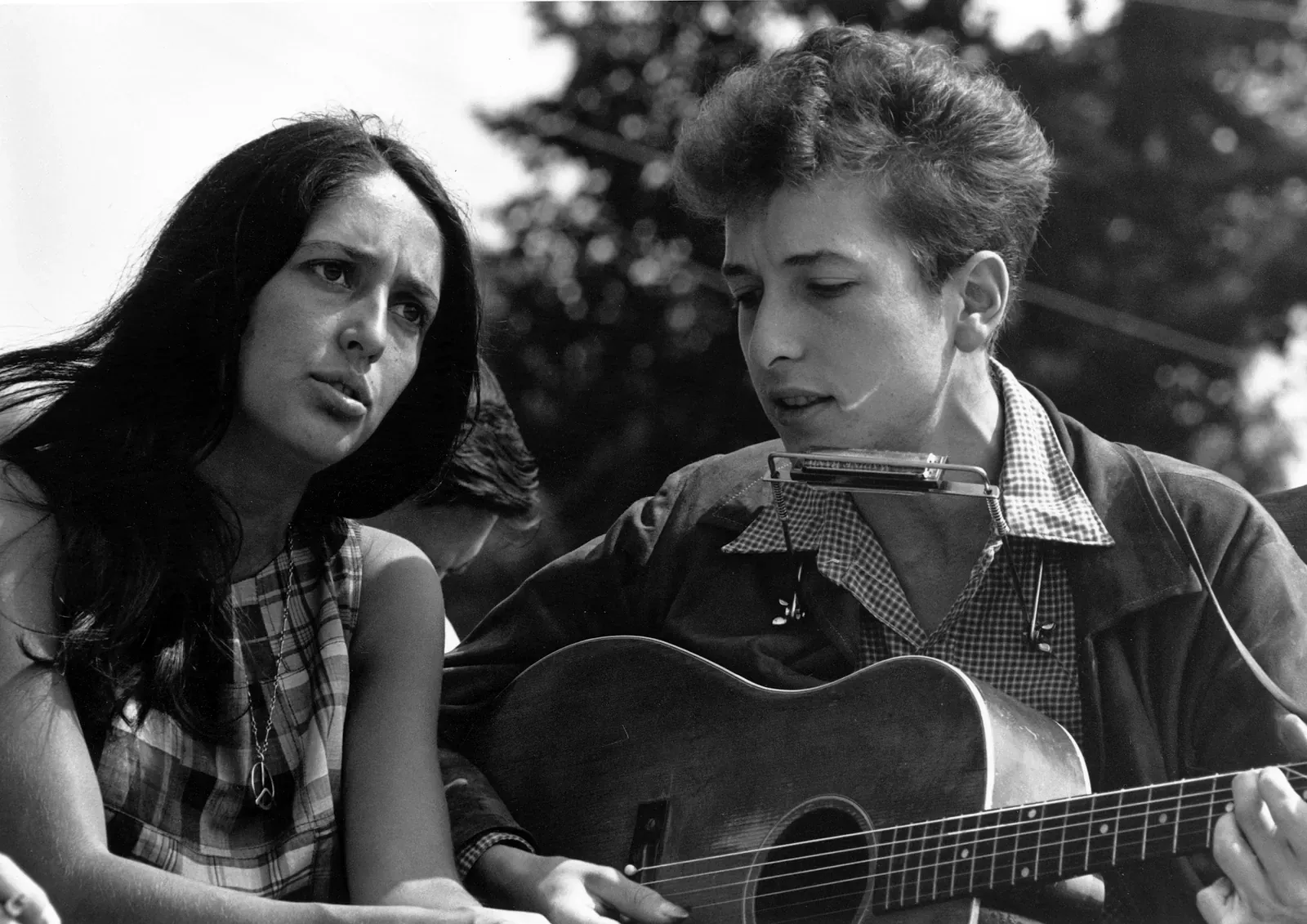
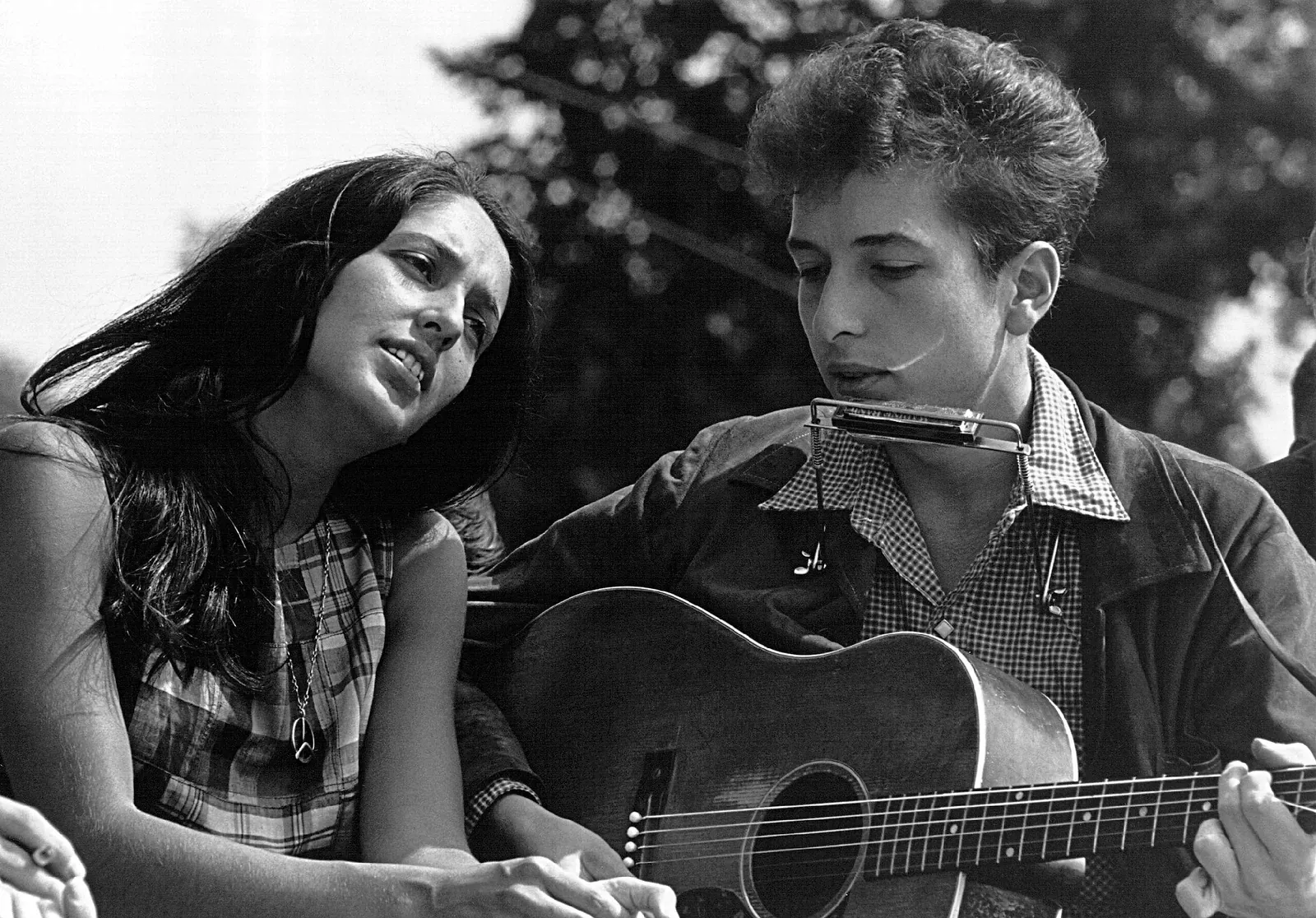
- 1963March on WashingtonFolk singers including Joan Baez and Bob Dylan sang for the crowd at the civil rights march in August.
- 1964Sam Cooke's A Change Is Gonna ComeCooke wrote the song after his party was turned away from a whites-only motel in Louisiana.
1965
Vietnam era and after
Anti-war songs moved into rock and pop, from Phil Ochs to John Lennon, and the form has since been revived by each new movement, with the older folk songs still sung at rallies.
- 1969Give Peace a Chance at the MoratoriumMore than half a million demonstrators sang John Lennon's song in Washington on 15 October.
- 2018We Shall Overcome copyright settlementAfter a lawsuit, the publisher agreed to stop asserting copyright over the song's lyrics.
Listening path
Start listening
A short path from an easy way in to the deep end. Thumbnails come from YouTube; the player loads only when you press play.
- 01
Bob Dylan, 1963
The best-known protest song of the folk revival; listen for the plain three-chord setting and the open questions.
- 02
Woody Guthrie, 1944
Guthrie's reply to God Bless America; listen for the unadorned voice and guitar.
- 03
Pete Seeger, 1955
A circular anti-war song built from a borrowed melody; listen for the repeating verse.
- 04
Joan Baez, 1963
The civil rights anthem as a slow group song; listen for the hymn-like pace.
- 05
Billie Holiday, 1939
A protest song staged as a torch song; listen for how little accompaniment gets in the way.
Facts
| Family | Folk |
| Origin | United Kingdom, United States |
| Emerged | 14th century onwards; peak 1930s to 1960s |
| Status | Active |
| Tempo | 60 to 130 BPM |
| Meter | 4/4 |
| Subgenres | 2 |
A protest song is a song associated with a movement for protest and social change. It belongs to the wider family of topical songs, can be folk, classical or commercial in style, and is defined by its use as much as by its words.
English and American folk song supplied most of its forms, and the genre peaked between the 1930s and the 1960s in the labour, civil rights and anti-war movements of the folk revivals.
Origins
Songs of complaint are as old as recorded English life. A rhyme asking who was the gentleman when Adam delved and Eve span is attested from the peasants’ revolt of 1381, although no tune for it has survived. The 17th-century Diggers left a hymn of their own. Songs about war and hardship from the same period are usually classed as songs of complaint, since they offer no remedy and no rebellion.
Industrialisation produced the first songs aimed at a cause. The Luddite ballad The Triumph of General Ludd built a folk hero out of the alleged leader of the early 19th-century cloth workers’ revolt, and miners and factory hands sang The Black Leg Miner and The Factory Bell as organised labour grew. The first English folk revival passed over these songs in favour of rural material, and they returned in the 1960s with A. L. Lloyd’s 1963 album The Iron Muse.
Labour songs and the Popular Front, 1901-1944
In the United States the form grew out of strikes. Florence Reece wrote Which Side Are You On? in 1931, as the wife of a United Mine Workers organiser in Harlan County, Kentucky, and union picket lines have used it since. In 1940 Millard Lampell, Lee Hays and Pete Seeger formed the Almanac Singers in New York, with Woody Guthrie joining later. The group sang anti-war, anti-racist and pro-union topical songs for the Popular Front, the alliance of liberals and leftists against fascism, and was active until 1943.
Guthrie wrote the lyrics of This Land Is Your Land in 1940 as an answer to Irving Berlin’s God Bless America, setting them to a Carter Family melody. The short version most people know was first released on a Folkways album in 1951.
Folk revival and civil rights, 1945-1964
After the war, People’s Songs and later Sing Out! magazine circulated new songs, and Seeger became the main carrier of the repertoire. He and Hays wrote If I Had a Hammer in 1949, and the Weavers released it as The Hammer Song on a 1950 single. Seeger published Where Have All the Flowers Gone? in Sing Out! in 1955, shaping a Cossack folk song and an Irish melody into an anti-war song.
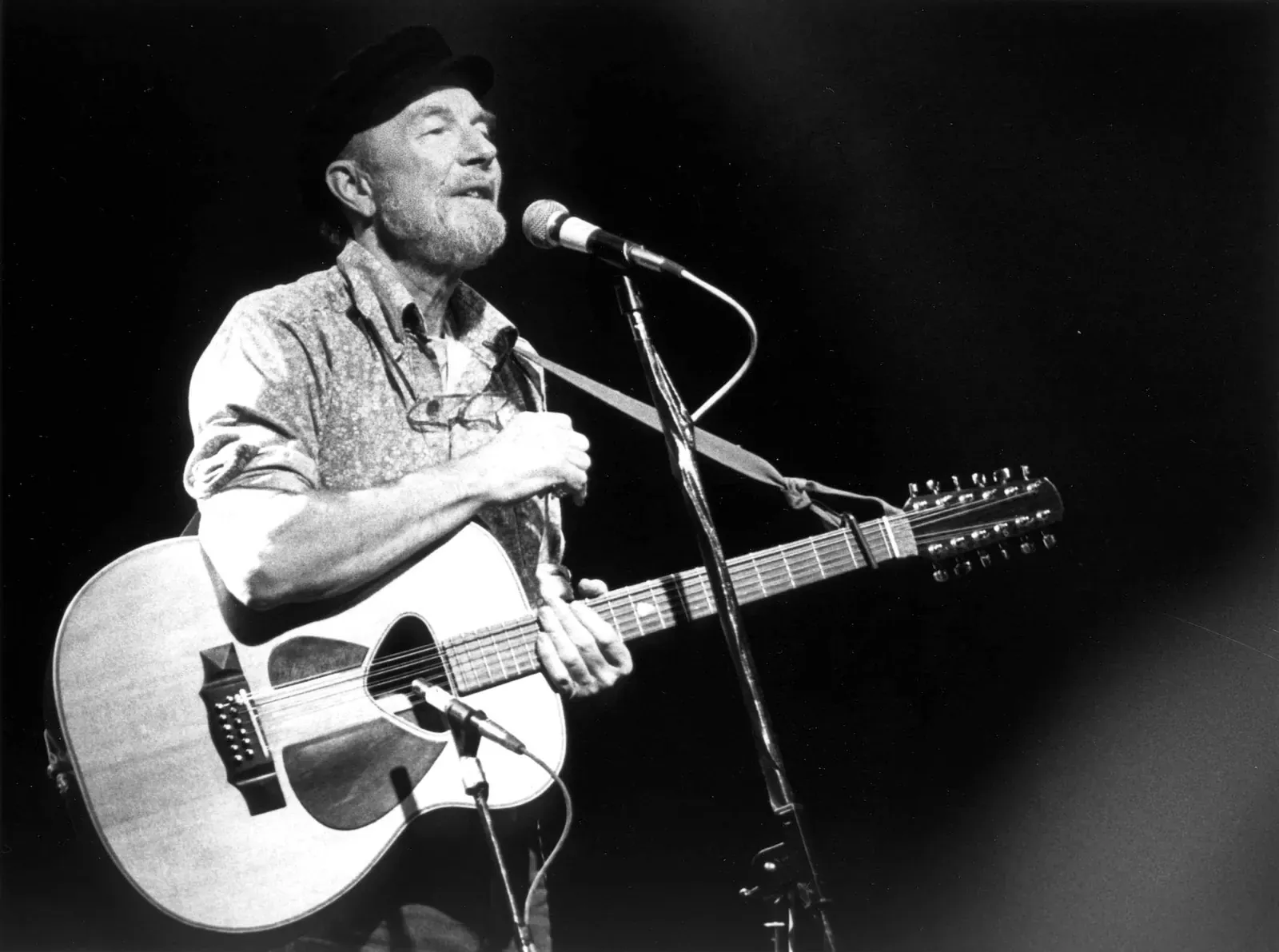
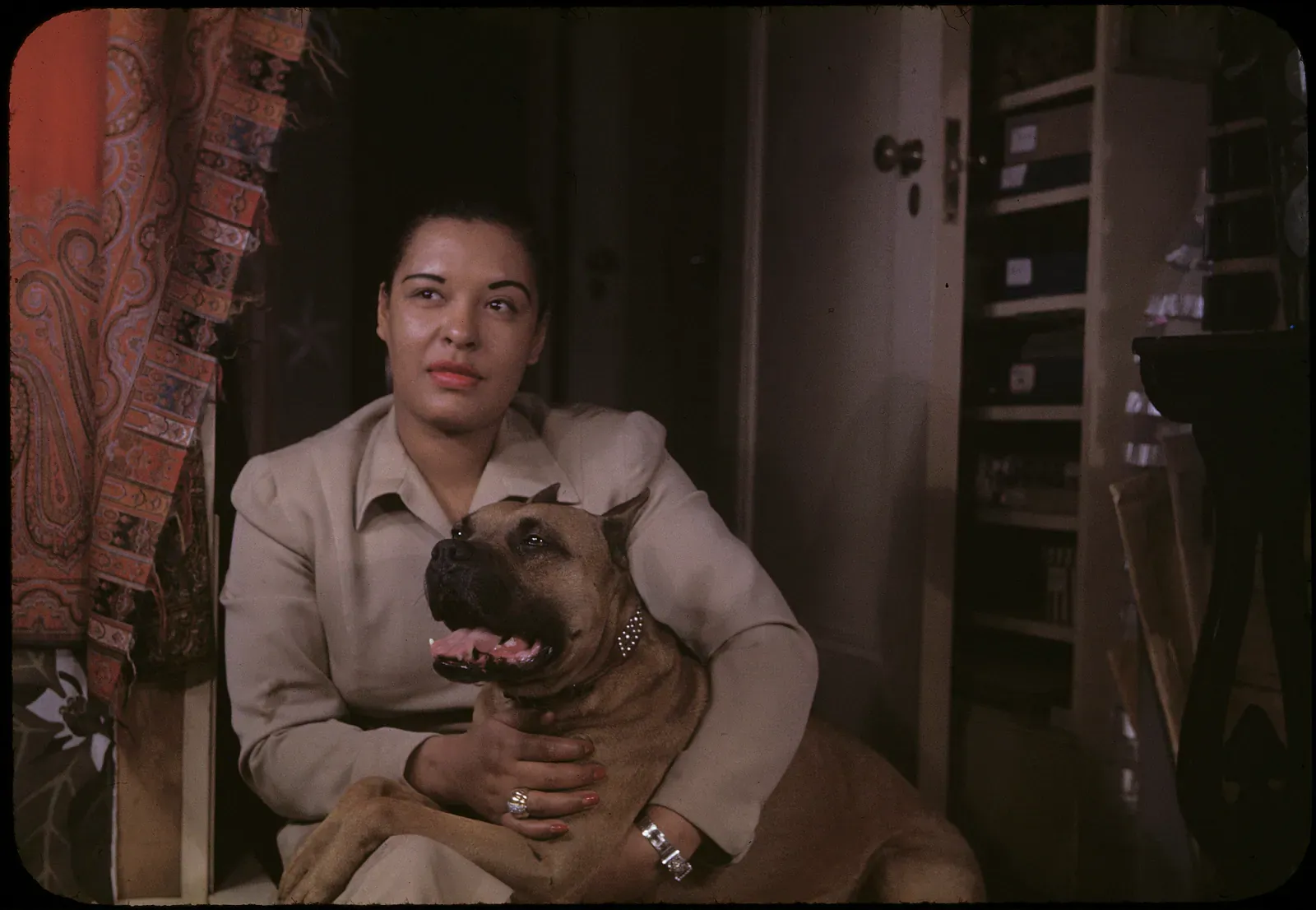
The civil rights movement made the most lasting use of the form. We Shall Overcome descends from a hymn by Charles Albert Tindley, and tobacco workers led by Lucille Simmons sang it on the picket line of the 1945-1946 Charleston cigar factory strike. Zilphia Horton of Highlander Folk School passed it to Seeger, and People’s Songs Bulletin printed it in 1947 as We Will Overcome. In 1959 Guy Carawan led the Seeger version at Highlander, the movement adopted it as its unofficial anthem, and Joan Baez and Seeger sang it at rallies and concerts in the North. Billie Holiday had already shown how far a protest song could travel. Abel Meeropol, writing as Lewis Allan, published the poem Strange Fruit in 1937, set it to music with his wife Anne Shaffer and the singer Laura Duncan, and performed it in New York. Holiday recorded it in 1939 and made it a nightclub piece.
Vietnam era and after, 1965 onward
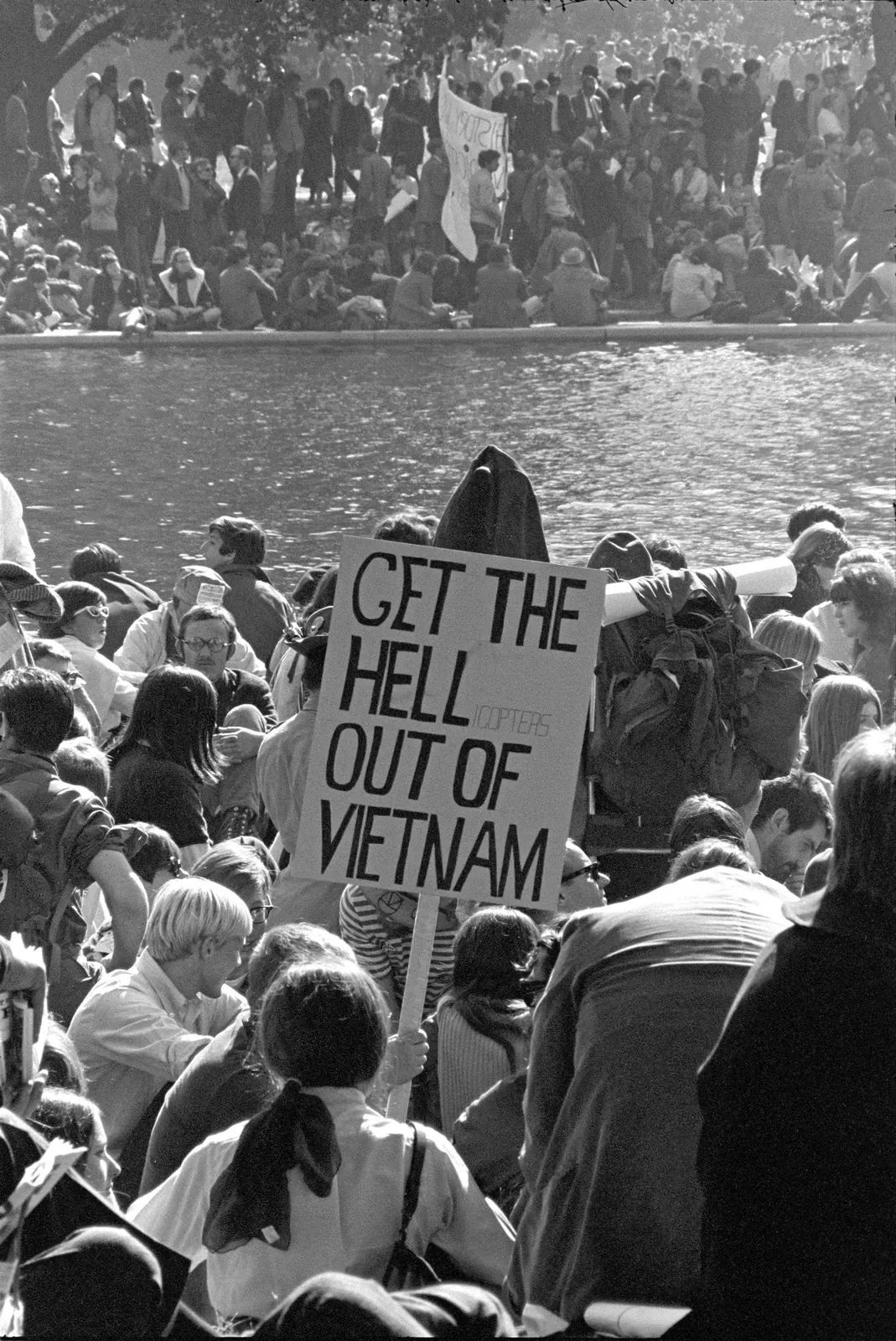
Opposition to the Vietnam War moved protest songs into rock and pop. Phil Ochs, the leading topical songwriter of the period, released I Ain’t Marching Anymore in 1965, the year Donovan had a hit with his cover of Buffy Sainte-Marie’s Universal Soldier. John Lennon recorded Give Peace a Chance at the June 1969 Montreal bed-in, and over half a million demonstrators sang it in Washington on 15 October 1969.
In Britain the movement began earlier. The Campaign for Nuclear Disarmament march from London to Aldermaston in 1958 produced songs such as The H-Bomb’s Thunder and drew skiffle players toward topical writing. Ewan MacColl, who issued The Ballad of Ho Chi Minh on Topic Records in 1953, became one of the main musical figures of the British disarmament movement. The form has been revived by each later movement, and the older folk songs are still sung at rallies.
Characteristics
Protest songs are mostly strophic: a run of verses, often five or more, around a refrain that a crowd can learn on one hearing. Many borrow an existing tune, which carries cultural weight into the new words, and the melodies are kept simple so that a leader and an audience can sing without rehearsal. Scholars separate “magnetic” songs, such as We Shall Overcome, which build group solidarity, from “rhetorical” songs, such as Masters of War, which press an argument. Some songs are protest songs only by context: Goodnight Irene reads as a love song, but audiences heard it in the light of its author, Lead Belly, a black convict and social outcast.
Instruments and production
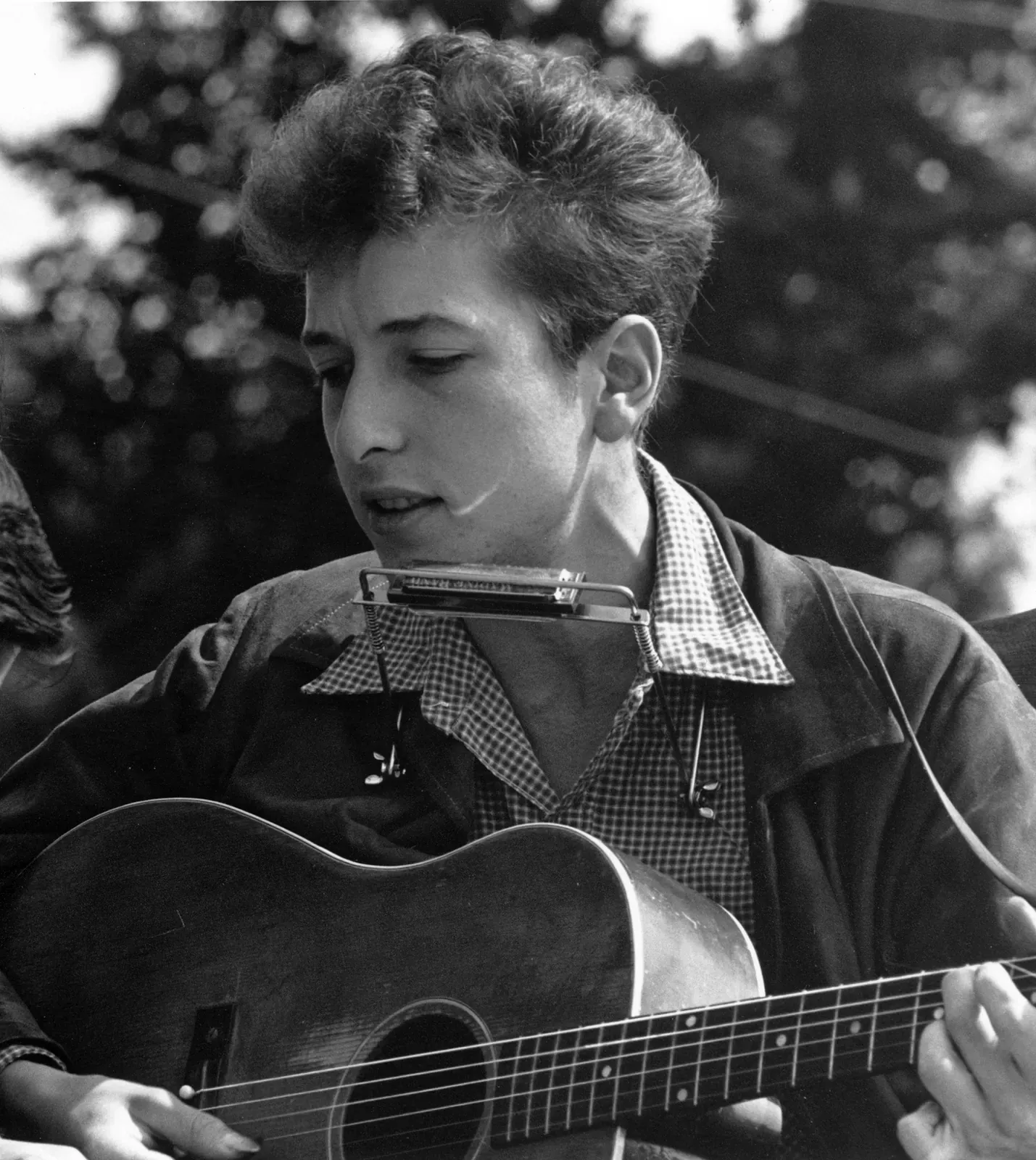
The accompaniment is portable by design: a steel-string guitar, a five-string banjo, a harmonica worn in a neck rack. Recordings kept the voice forward so that the words stayed clear. The long-playing record made it practical to issue a themed set of songs, as Dylan did on The Freewheelin’ Bob Dylan, and the Folkways label, Columbia and the British label Topic were the main outlets.
Mainstream success
Peter, Paul and Mary took the folk repertoire to the charts. Their version of If I Had a Hammer reached number 10 in 1962, and in 1963 Trini Lopez took it to number 3. Dylan released Blowin’ in the Wind on The Freewheelin’ Bob Dylan in May 1963; the trio’s cover came three weeks later, reached number two on the Billboard Hot 100 and won two Grammy Awards. Folk singers including Baez and Dylan appeared at the March on Washington that August.
Notable recordings
Strange Fruit is the clearest case of a song that changed what a recording could address. It describes the lynching of African Americans through an image of fruit on trees, and the Atlantic Records co-founder Ahmet Ertegun called it a declaration of war and the beginning of the civil rights movement. Holiday’s version entered the Grammy Hall of Fame in 1978.
Blowin’ in the Wind poses rhetorical questions about peace, war and freedom and never names its target, which let each movement fill it in. A Change Is Gonna Come, which Sam Cooke wrote after his party was turned away from a whites-only motel in Louisiana, appeared on his 1964 album and as a single in December of that year.
Culture
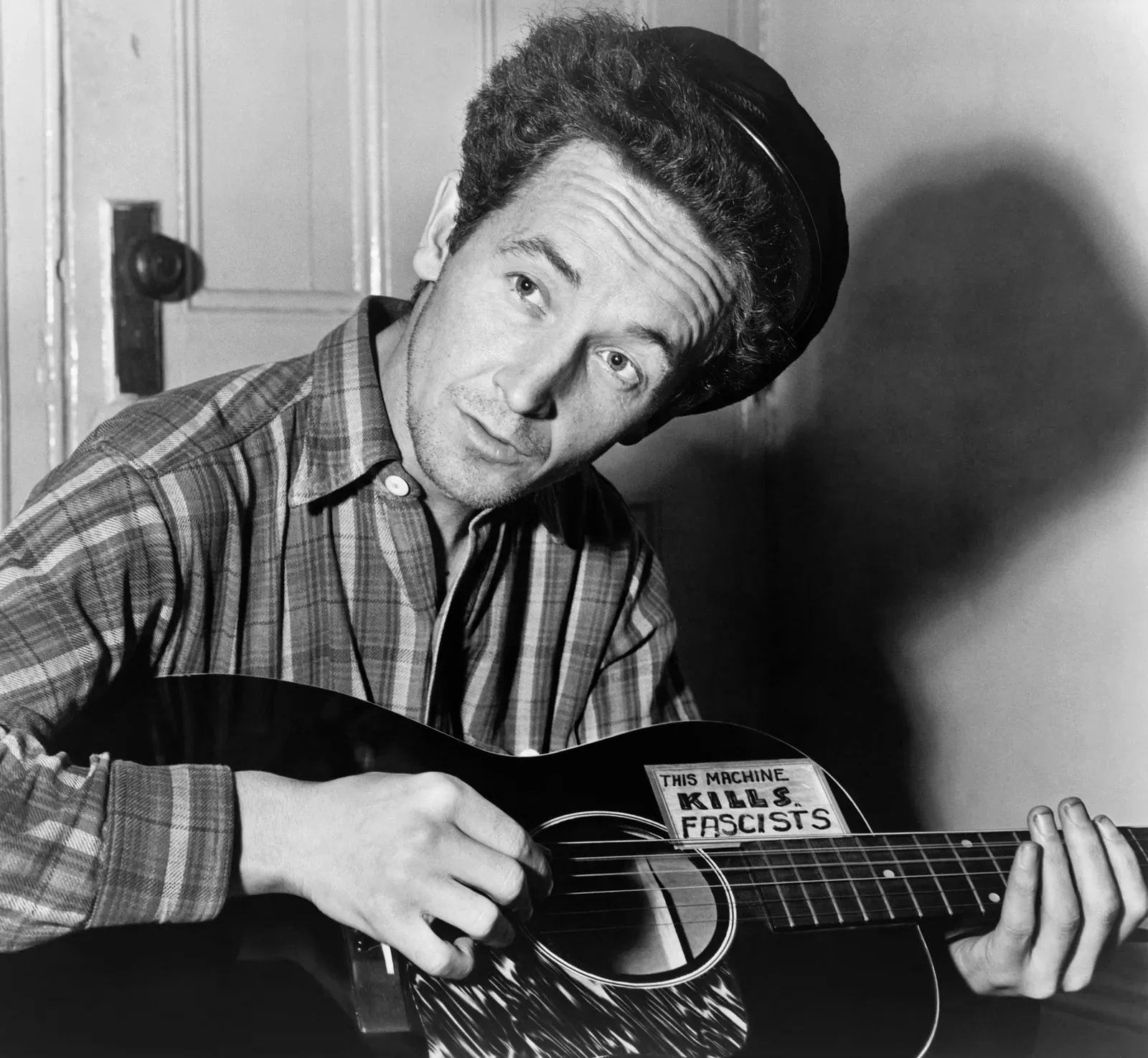
Guthrie’s guitar label gave the genre its image of the singer as an activist, and the hootenanny, an informal gathering where the audience joins in, became its social form. At rallies a song leader teaches a line and the crowd answers, the method Carawan used at Highlander.
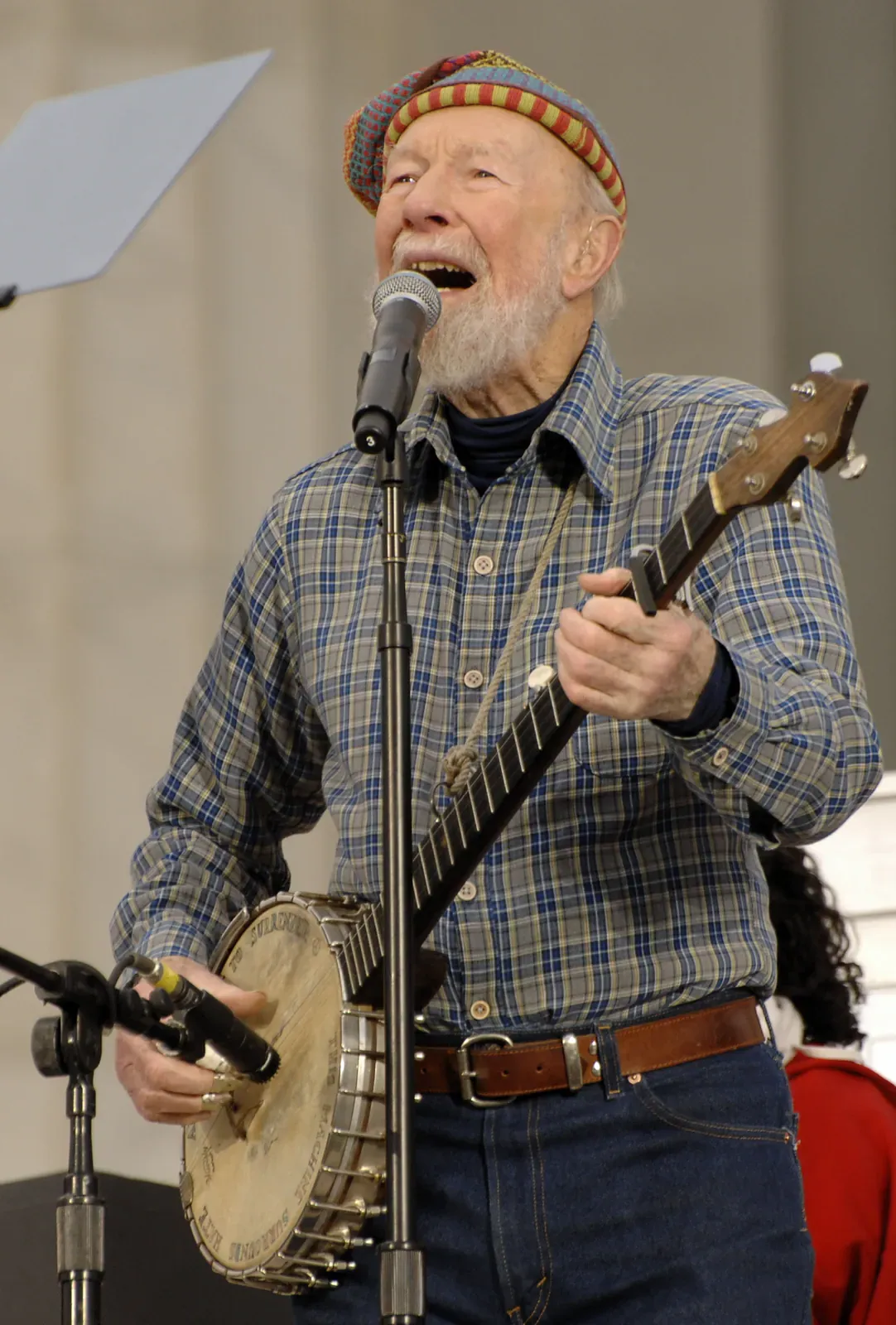
Politics could cost careers. The Weavers had a run of hits in the early 1950s, and the group was later blacklisted. Copyright also became a political issue: after a lawsuit over the publisher’s claim, We Shall Overcome was released from copyright assertions in a January 2018 settlement.
Legacy
Protest song supplied the template for later political music, and borrowing a known tune for new words remains common at demonstrations. Related pages: American folk, English folk and folk rock.
Misconceptions
Protest songs are sometimes described as a product of the 1960s. The form is far older, and the revival of the 1960s recovered English labour songs and American strike songs that were decades or centuries old. The Cutty Wren is said to date from the revolt of 1381, but that claim, made in 1944, came with no evidence, and no trace of the song exists before the 18th century. A third myth holds that We Shall Overcome was written for the civil rights movement; in fact it grew from a hymn and a 1945 strike song, and was adopted by the movement in 1959.
Frequently asked questions
What is a protest song?
A protest song is a song associated with a movement for protest and social change. It may name its target directly, as Strange Fruit does, or speak in general terms about peace and justice, as Blowin’ in the Wind does.
What is the most famous protest song?
We Shall Overcome is the best-known anthem of the civil rights movement, and This Land Is Your Land and Blowin’ in the Wind are the most widely sung folk songs of the genre.
Who wrote We Shall Overcome?
No single author is recorded. It descends from a hymn by Charles Albert Tindley, was sung by striking tobacco workers in 1945 and 1946, and was printed in 1947 as We Will Overcome. Seeger and Carawan’s version became the standard.
Are protest songs always folk songs?
No. Protest songs appear in classical music, soul, rock and pop, and Nina Simone, Sam Cooke and John Lennon wrote them outside folk.
Sound
Sound sheet
Anatomy of a track
| # | Part | Bars |
|---|---|---|
| 1 | Intro or count-in | 4 |
| 2 | Verse (repeated, often five or more) | 16 |
| 3 | Refrain, sung by the crowd | 8 |
| 4 | Final verse | 16 |
Signature sounds
- Strophic verses with a repeated refrain
- New words set to an older tune
- Unison chorus sung by the audience
- Voice with acoustic guitar or banjo
Techniques
- Contrafact
- Lining out and call and response
- Fingerpicking
- Neck-rack harmonica
Keys and modes
Major, three-chord. Blowin' in the Wind and This Land Is Your Land use plain I, IV and V chords.
Tuning
Standard guitar tuning; five-string banjo often in open G
Vocals
Plain, clearly worded solo or group singing, with the audience joining the refrain.
Scenes
Where it happened
Where and when the sound lived: one bar per city on a shared timeline.
North America
Europe
Active scenes
Peak 4, 1959-2025
Greenwich Village clubs, People's Songs and Sing Out! made it the hub of topical song.
Highlander Folk School trained union and civil rights organisers and taught them songs.
The folk festival gave protest singers a national summer stage.
The disarmament marches and Ewan MacColl's circle made British protest songs.
Venues and places
New York, 1938 to today. Greenwich Village club where Billie Holiday first sang Strange Fruit.
Monteagle, 1932 to today. Adult education school where Zilphia Horton and Guy Carawan taught We Shall Overcome.
Newport, 1959 to today. Annual festival where Baez, Seeger and Dylan reached large audiences.
Culture
Culture markers
- This Machine Kills Fascists
Woody Guthrie's slogan on his guitar became a symbol of the singing activist.
Artwork - Hootenanny
An informal gathering where audiences sing along, popularised by the left-wing folk circle.
Slang - Song leading
A leader teaches the verse line by line and the crowd answers, as at Highlander and rallies.
Ritual
Media
Key media
- 1947People's Songs Bulletin
by People's Songs. Printed We Will Overcome and gave activists new songs.
Zine - 1950Sing Out!
by Sing Out! magazine. Published new topical songs, including Where Have All the Flowers Gone.
Zine - 1963The Iron Muse
by A. L. Lloyd. Revived British industrial protest songs for the folk revival.
Compilation
Glossary
Terms on this page
A cheap printed sheet carrying song words, sold on the street in Britain from the 16th century.
New words set to an existing tune, the usual method of the form.
A song sung by participants in the civil rights movement, often a reworked hymn.
A folk gathering in which the audience joins the singing.
A song about current events, the broader category that protest songs belong to.
Folk family