Taiko
Taiko is Japanese drumming, from shrine and battlefield drums to the kumi-daiko ensemble founded by Daihachi Oguchi in 1951 and spread by Ondekoza and Kodo.
Japan, around 550
East Asian family
Born
around 550
Japan
Links
0
Genres it drew on or shaped
Tempo
75-125 BPMLineage
Family tree
Timeline
Era by era
From the first sparks to today. Select a dot to read the story behind it.
- Festival, court and battlefield drums
550 to 1950
- Birth of the drum ensemble
1951 to 1980
- Touring troupes and training villages
1981 to 1999
- Worldwide community
2000 to today
Eras
Moments
- 1 Festival, court and battlefield drums, 550 to 1950
- 2 Birth of the drum ensemble, 1951 to 1980
- 3 Touring troupes and training villages, 1981 to 1999
- 4 Worldwide community, 2000 to today
around 550
Festival, court and battlefield drums
Drums of the Kofun period reach Japan through China and Korea, then serve armies, Noh and kabuki, gagaku, Shinto kagura and Bon dances, usually as a supporting voice.
- 550Haniwa drummer of GunmaA clay figure with a barrel drum from the late Kofun period is the oldest evidence of taiko in Japan.
- 1849Hachijo-daiko recorded in an exile journalKakuso Kizan describes drums hung from a tree and women drummers, an exception to male-only practice.
1951
Birth of the drum ensemble
Daihachi Oguchi turns taiko into a stage ensemble with Osuwa Daiko in 1951, Oedo Sukeroku Daiko tours professionally from 1959, and Ondekoza takes the form abroad from 1969.
- 1951Daihachi Oguchi founds Osuwa DaikoThe first kumi-daiko group gives different drums different roles, apart from festival and ritual use.
- 1959Oedo Sukeroku Daiko forms in TokyoLed by Seido Kobayashi, it is regarded as the first taiko group to tour professionally.
- 1964Tokyo Olympics Festival of ArtsKumi-daiko performance becomes more visible to a worldwide audience.
- 1968San Francisco Taiko Dojo opensSeiichi Tanaka founds the first North American taiko group and is the first to admit women.
- 1969Den Tagayasu founds Ondekoza on Sado IslandMembers live communally, study folk arts and run long distances as part of training.
- 1975Ondekoza plays after the Boston MarathonThe first taiko group to tour the United States performs straight after finishing the race.
1981
Touring troupes and training villages
Kodo debuts in Berlin in 1981 and settles on Sado Island, Eitetsu Hayashi goes solo, groups such as Yamato appear in 1993, and North American taiko grows into a continental network.
- 1981Kodo debuts at the Berliner PhilharmonieFormer Ondekoza members form Kodo, named by Eitetsu Hayashi, and later base themselves on Sado.
- 1984Carnegie Hall and Los Angeles Olympic Arts FestivalHayashi is the first featured taiko performer at Carnegie Hall, and Kodo plays three sold-out shows in Los Angeles.
- 1990Kodo releases IrodoriThe album features Maki Ishii's Monochrome and the title piece composed by Leonard Eto.
- 1997First North American Taiko ConferenceHeld in Los Angeles, it becomes the continent's main gathering of taiko players.
2000
Worldwide community
Taiko is taught in schools, universities and community dojos on several continents, appears in Cirque du Soleil and at the 2009 Academy Awards, and gains a national alliance in North America in 2013.
- 2013Taiko Community Alliance foundedA virtual nonprofit that helps organise the conferences and promote the art in North America.
Listening path
Start listening
A short path from an easy way in to the deep end. Thumbnails come from YouTube; the player loads only when you press play.
- 01
Kodo, 1990
A composed piece by Leonard Eto, an easy way into Kodo's stage style.
- 02
Kodo, 1995
The Miyake-jima festival style, played low to the ground by two drummers on one drum.
- 03
Kodo, 1995
One of the early kumi-daiko pieces that groups still perform today.
- 04
Kodo, 1990
A contemporary composition by Maki Ishii, a long way from festival drumming.
Facts
| Family | East Asian |
| Origin | Japan |
| Emerged | Modernized 1951 |
| Status | Active |
| Tempo | 75 to 125 BPM |
Taiko (太鼓) is the Japanese word for drum, and outside Japan it names the family of Japanese drums called wadaiko and, more specifically, the ensemble style called kumi-daiko.
The drums reached Japan through China and Korea more than 1,400 years ago and served armies, theatres, courts and shrines before Daihachi Oguchi built the first stage ensemble in 1951. The tradition now belongs to the East Asian family and has active groups in Japan, North America, Europe, Australia, Taiwan and Brazil.
Origins
The origin of the taiko is unclear. Historical accounts from 588 CE mention young Japanese men travelling to Korea to study the kakko, a drum from South China, and court styles such as gigaku and gagaku arrived through both countries with drums close to taiko. Archaeology gives a firmer date: clay haniwa figures from Gunma Prefecture, made in the late Kofun period, show a man carrying a barrel drum on his shoulder and beating it with a stick. It is the oldest evidence of taiko performance in Japan.
Japanese mythology offers a different origin. In the Nihon Shoki the goddess Ame-no-Uzume lured Amaterasu out of her cave by dancing on an upturned sake barrel, a scene historians read as the mythical creation of taiko music.
For centuries the drum served other purposes than concerts. In feudal Japan it motivated troops, called out orders and set the marching pace, and in the Warring States period specific drum calls signalled advance and retreat. Noh and kabuki use it for rhythm and tension, with Noh schools such as Konparu teaching 65 basic patterns. Gagaku still uses it to guide dancers, and it is common in Shinto kagura and in the Bon festival, where drummers sit on a decorated tower while dancers circle below.
Osuwa Daiko and the ensemble, 1951-1980
Daihachi Oguchi, trained as a jazz musician in Nagano, was handed an old piece of taiko notation that he could not read. After having it transcribed he added rhythms and rearranged it for several players on drums of different sizes, each with its own function. His group, Osuwa Daiko, formed in 1951 in Okaya, was the first kumi-daiko ensemble and wrote pieces for concert halls rather than shrines.
Other groups followed. Oedo Sukeroku Daiko formed in Tokyo in 1959 under Seido Kobayashi and is regarded as the first group to tour professionally. The 1964 Tokyo Olympics featured kumi-daiko at its Festival of Arts, and in 1968 Seiichi Tanaka founded the San Francisco Taiko Dojo, the first North American group. San Jose Taiko followed in 1973 and Soh Daiko of New York in 1979.
The most influential group of the period was Ondekoza, founded in 1969 by Den Tagayasu on Sado Island. Den was not a drummer himself; he gathered young men and women who lived communally, studied taiko, shamisen, koto, folk song and dance, and began most days with a run. Ondekoza arranged village traditions into stage pieces, among them Yatai-bayashi, from the Chichibu festival, and the Hachijo and Miyake drum patterns, and it made the solo odaiko piece, built on a dialogue between shakuhachi and a large drum, a showpiece. In 1975 it became the first taiko group to tour the United States and played at the finish line of the Boston Marathon straight after running it.
Kodo and the touring troupes, 1981-1999
In 1981 disagreements over musical and professional goals split Ondekoza. Den kept the name and most of the drums, while a group of former members, led as a player by Eitetsu Hayashi, formed Kodo. The name carries two meanings, “heartbeat” and “children of the drum”. Kodo debuted at the Berliner Philharmonie that year, later settled on Sado Island, and played three sold-out shows at the 1984 Los Angeles Olympic Arts Festival. Its Its Kodo Juku workshops started in 1989.
Hayashi left Kodo soon after its founding and built a solo career, performing at Carnegie Hall in 1984 as its first featured taiko performer. Younger groups followed the Ondekoza and Kodo model. Wadaiko Yamato formed in Nara in 1993 under Masa Ogawa and won the Spirit of the Fringe award at the Edinburgh Festival Fringe in 1998.
Worldwide community, 2000 to the present
By the 1990s women equalled or exceeded men in kumi-daiko membership. Estimates of the number of groups in Japan vary from about 800 to as many as 5,000. In North America, estimates reached about 200 groups in the United States by 2005 and 2006, and the North American Taiko Conference has met since 1997. Collegiate taiko began with UCLA’s Kyodo Taiko in 1990. Taiko has been featured in Cirque du Soleil shows and at the 2009 Academy Awards and 2011 Grammy Awards.
Characteristics
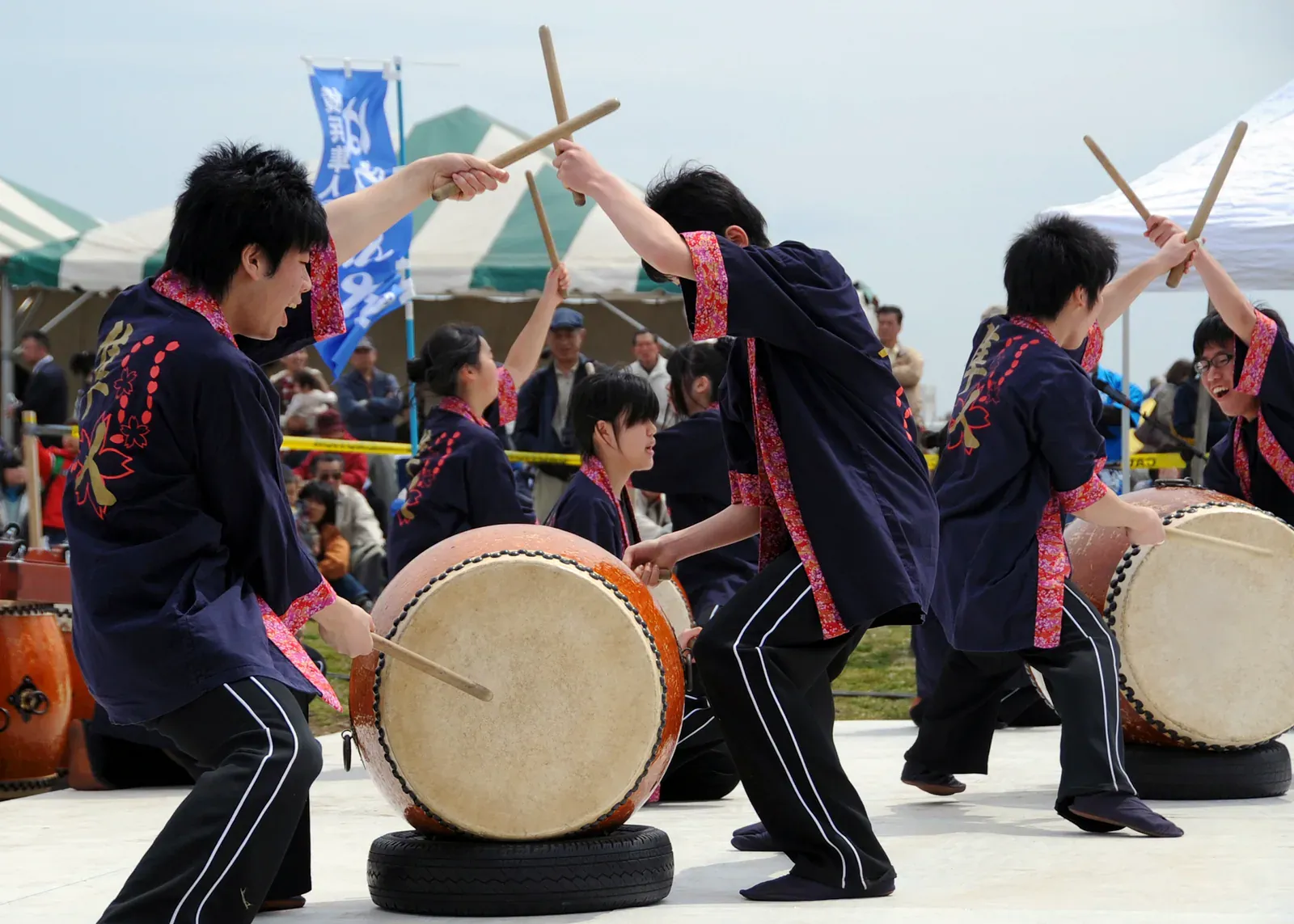
Taiko is as much movement as sound. The posture and motion of a player are called kata, and as in martial arts the centre of the body, the hara, is the base of the movement. Players keep a wide, low stance with relaxed shoulders, and many practice rooms have mirrors for checking form.
Silence matters as much as the strikes. The concept of ma, the space between hits, shapes each rhythmic phrase. Pieces often start with an oroshi, a roll that begins with widely spaced strokes and tightens until the hits merge. Players call out with kakegoe and kiai, shouts that encourage others or cue a change in dynamics or tempo.
Instruments and production
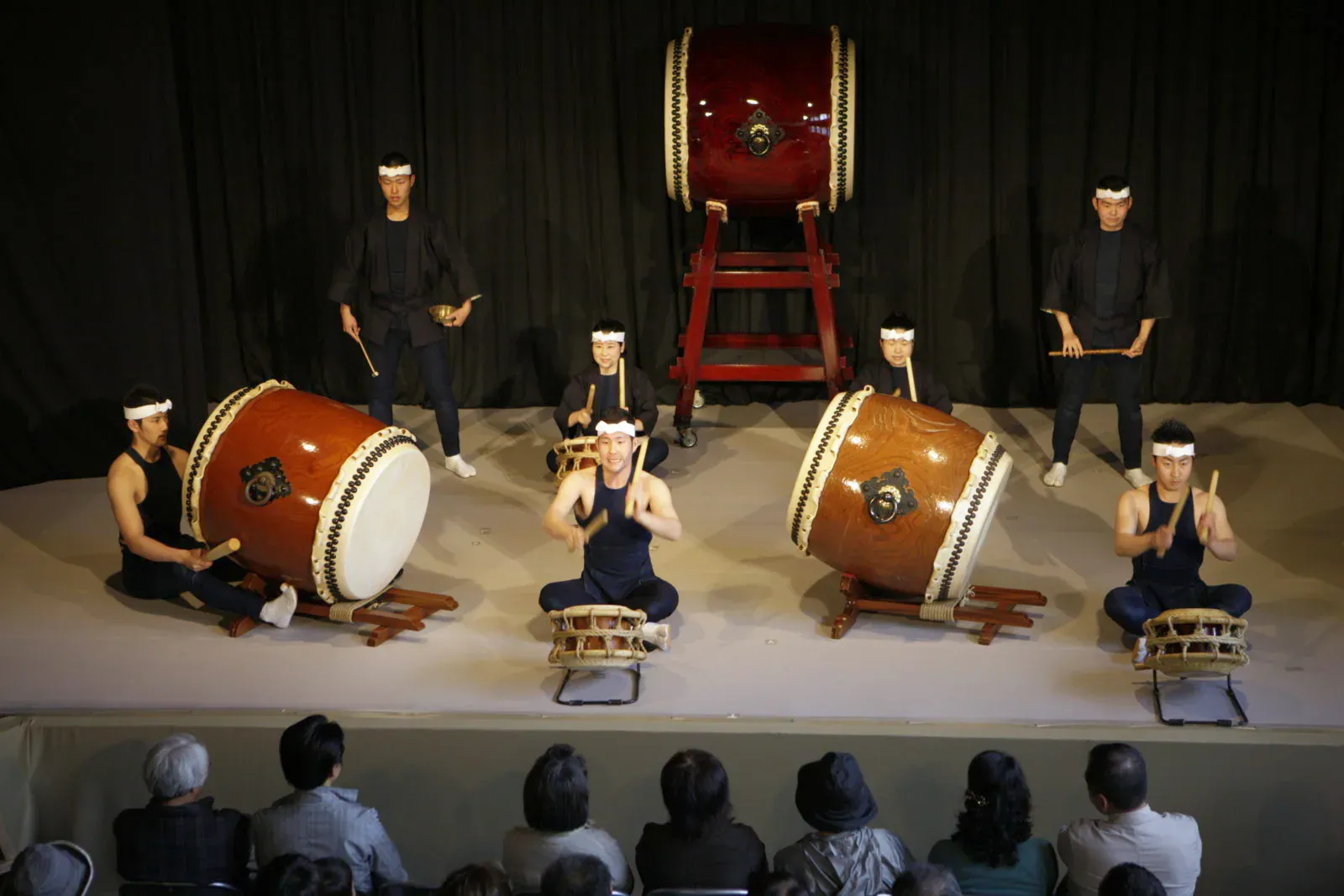
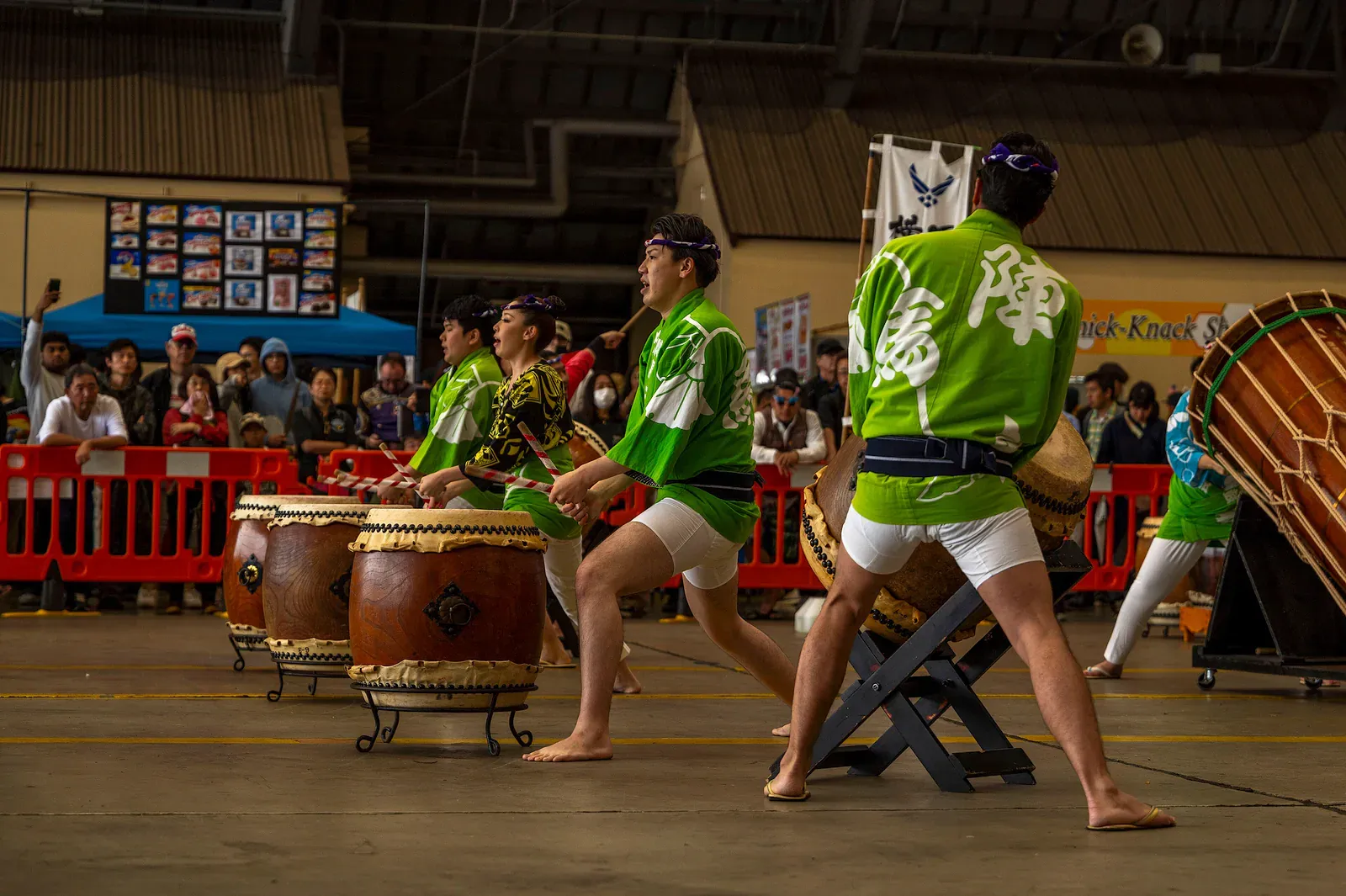
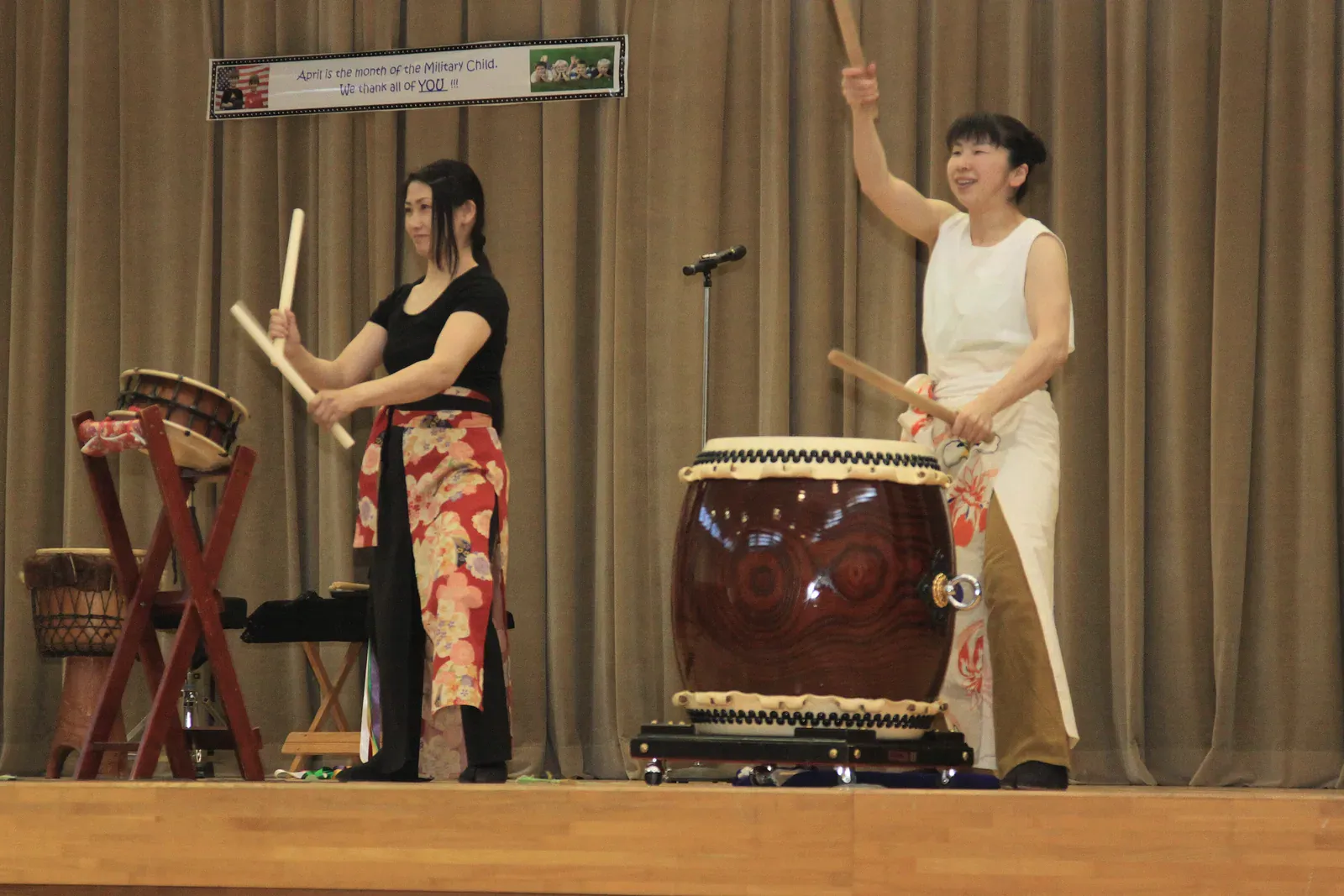
Most kumi-daiko drums are nagado-daiko, barrel-shaped drums. The mid-size chu-daiko carries the main rhythm, the large o-daiko supplies a steady pulse and counter-rhythm, and the small shime-daiko, tightly strung with rope, sets and changes the tempo and often plays the base pattern, the jiuchi. Some pieces add the atarigane gong or bamboo flutes such as the shinobue and shakuhachi.
Building a drum can take years, since both body and skin need long preparation. Drum makers, especially those who work with leather, have often been counted among the burakumin, a minority long subject to discrimination, and some have used their craft to campaign against it.
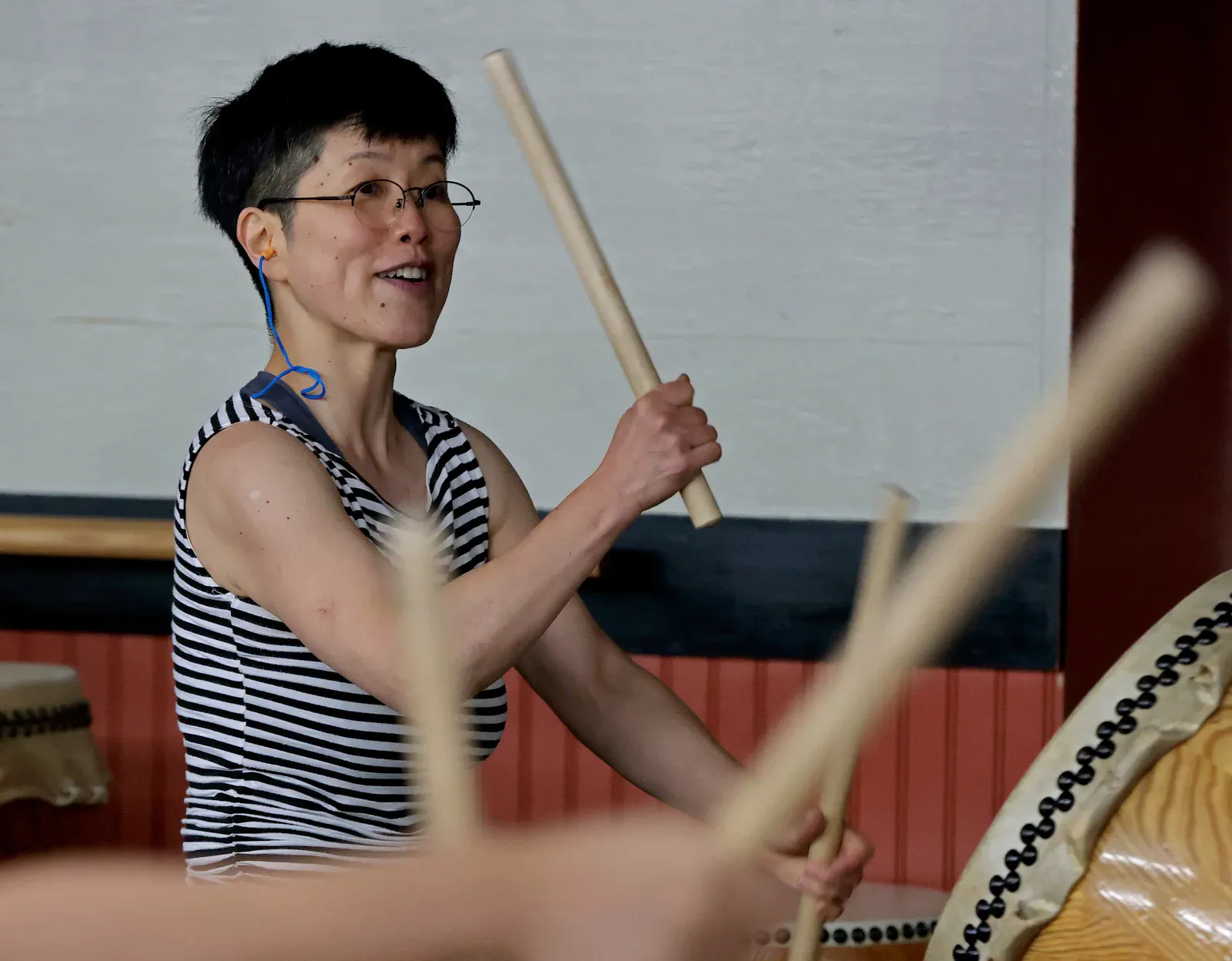
Sticks, called bachi, are cut from white oak, bamboo or Japanese magnolia.
Regional styles
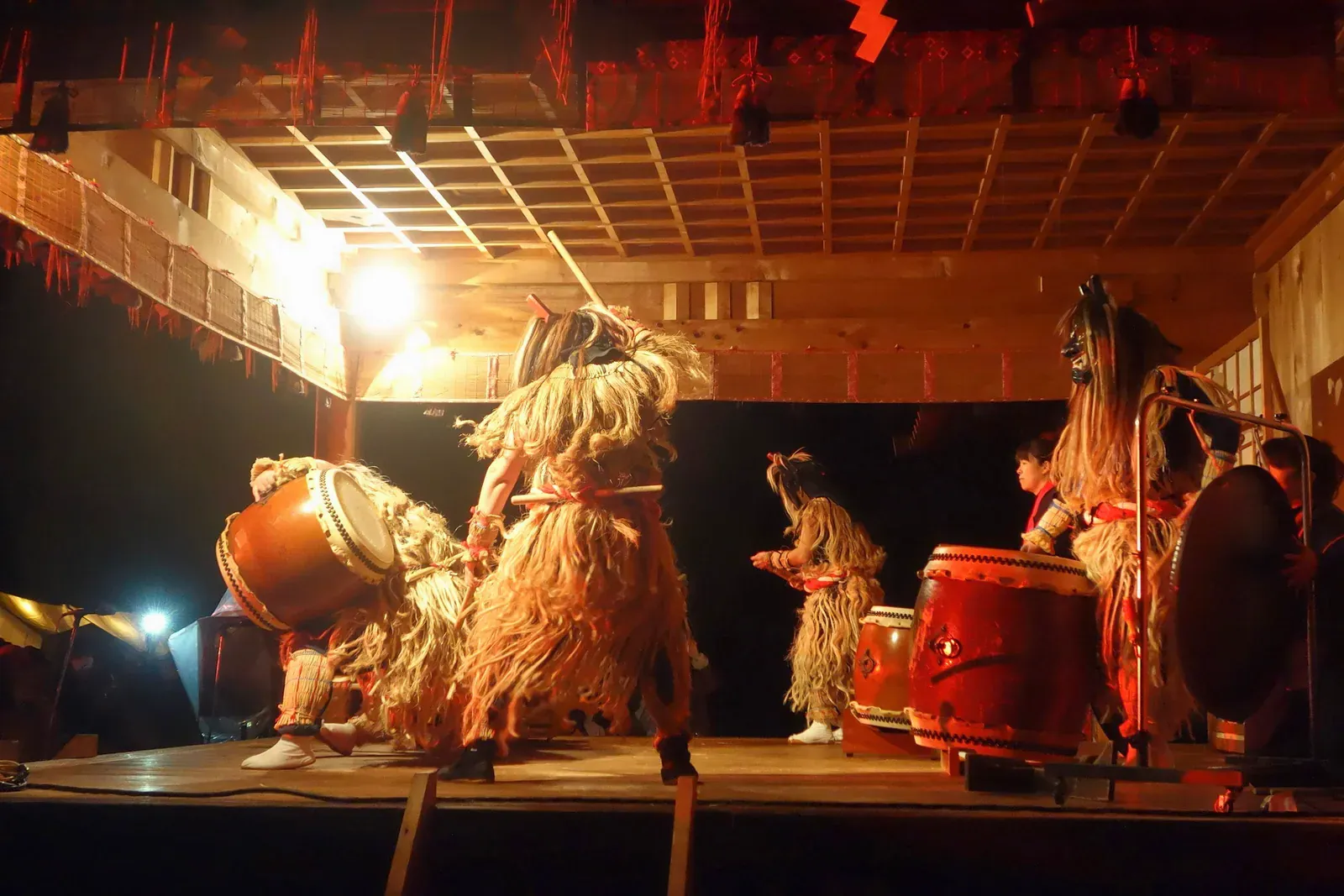
Several local traditions became standard repertoire. Miyake-daiko comes from the Miyake-jima festival for the deity Gozu Tenno, held every July since 1820: the drum is set low, two players stand on either side, and the stance is almost a kneel. Kodo helped spread it among groups. Hachijo-daiko, documented in 1849 on Hachijo-jima, features two players on one drum, one keeping the beat and the other improvising above it; unusually, women were its main performers. Okinawan eisa, a dance with small hand drums and shime-daiko, belongs to Okinawan music, and village songs that groups arrange come from min’yo.
Notable recordings
Zoku (tribe) is one of the early kumi-daiko pieces that has stayed in groups’ repertoires, alongside Ondekoza’s Yatai-bayashi and Osuwa Daiko’s Isami-goma. Kodo’s recording was composed by Leonard Eto. Its Miyake builds on the island festival style, which spread among groups through Kodo.
Kodo’s Irodori album of 1990 shows the other side of the form: composed works for concert stages. It includes the title piece, composed by Leonard Eto, and Monochrome, written by Maki Ishii. These recordings treat taiko as concert music rather than festival accompaniment, and they sit alongside Ondekoza’s albums such as Devils on Drums and Hayashi’s solo work.
Culture
Dress follows festival tradition: the happi coat, hachimaki headband, tabi socks, momohiki trousers and haragake aprons. Ondekoza’s fundoshi loincloth outfit began after the designer Pierre Cardin saw the group in 1975 and suggested showing the drummers’ physique; ordinary traditional drummers do not play in underwear alone.
Gender has been contested. Ondekoza, whose ideal player drew in part on the 1958 film Rickshaw Man, limited women to dance sections, as did early Kodo. Female membership rose after the 1980s, though some players still describe unequal roles.
Legacy
Taiko turned a festival and ritual instrument into a worldwide stage art. In North America it also became a community movement, with Japanese American and Japanese Canadian groups using it to explore their roots.
Misconceptions
Taiko is not an unbroken ancient concert tradition. The drum is old, but the ensemble style dates to 1951, and Ondekoza and Kodo built much of the stage repertoire by rearranging village festival pieces.
Taiko is not only for men. Hachijo-daiko was mainly played by women, the San Francisco Taiko Dojo admitted women from the start, and by the 1990s women made up half or more of kumi-daiko players.
Frequently asked questions
What does taiko mean?
Taiko means “drum” in Japanese. Abroad it refers to wadaiko, the Japanese drums, and to kumi-daiko, the ensemble style that began in 1951.
Who started kumi-daiko?
Daihachi Oguchi, a jazz-trained musician from Nagano, formed Osuwa Daiko in 1951 and devised the arrangement of different drums for different roles.
What is the difference between Ondekoza and Kodo?
Den Tagayasu founded Ondekoza on Sado Island in 1969. In 1981, former members split from him and formed Kodo, named by Eitetsu Hayashi, who soon began a solo career.
How many taiko groups are there?
No fixed count exists. Estimates for Japan range from about 800, based on membership of the Nippon Taiko Foundation, to as many as 5,000.
Sound
Sound sheet
Signature sounds
- Oroshi roll that accelerates from slow single strokes
- Shime-daiko base rhythm holding the ensemble together
- Kakegoe and kiai calls as cues and encouragement
- Wide, low stance and large synchronized arm movement
Drums and percussion
- Nagado-daiko
- Shime-daiko
- Atarigane
Techniques
- Oroshi roll
- Kata stance
- Ma
- Two players on one drum
Tuning
Unpitched percussion; melody, where present, comes from added bamboo flutes or shamisen
Vocals
Shouted kakegoe and kiai calls, with folk song vocals in some pieces
Scenes
Where it happened
Where and when the sound lived: one bar per city on a shared timeline.
Asia
North America
Active scenes
Peak 4, 1969-2025
Home of Osuwa Daiko, the first kumi-daiko ensemble.
Oedo Sukeroku Daiko formed here and set the Sukeroku style.
Ondekoza and later Kodo trained here in communal villages.
San Francisco Taiko Dojo started North American taiko.
Venues and places
Berlin, 1981 to today. Where Kodo made its debut in 1981.
New York, 1984 to today. Eitetsu Hayashi was the first featured taiko performer at this hall.
Culture
Culture markers
- Happi and hachimaki
Thin decorative coat and headband worn by many kumi-daiko groups.
Fashion - Fundoshi
Loincloth outfit adopted by Ondekoza after Pierre Cardin suggested showing the drummers' physique.
Fashion - Bon festival tower
Drummers on a decorated tower set the rhythm for dancers around them.
Ritual - Kakegoe and kiai
Shouts used to cue changes and encourage other players.
Slang
Media
Key media
- 1958Rickshaw Man
by Hiroshi Inagaki. Its character Muhomatsu shaped the image of the masculine peasant taiko player.
Film - 1999The Rough Guide to the Music of Japan
by Various. A world-music compilation that includes a contribution by Eitetsu Hayashi.
Compilation
Glossary
Terms on this page
The sticks used to play taiko, made from white oak, bamboo or Japanese magnolia.
Voiced calls given as encouragement or as cues for changes in the music.
Posture and movement of a player, similar to kata in martial arts.
Ensemble taiko playing on drums of different sizes, as opposed to festival or ritual use.
The space between drum strikes, used to shape rhythmic phrases.
A roll that starts slowly and speeds up until the strokes merge.
East Asian family