Tarantella
Tarantella is a group of fast 6/8 southern Italian folk dances and tunes from Campania, Apulia, Calabria and Sicily, tied to tambourines and the tarantism cure.
Calabria, around 1050
European folk family
Born
around 1050
Calabria
Subgenres
3
Documented branches
Links
5
Genres it drew on or shaped
Tempo
105-175 BPMLineage
Family tree
Timeline
Era by era
From the first sparks to today. Select a dot to read the story behind it.
- Tarantism and village dance
1050 to 1834
- Romantic and salon tarantella
1835 to 1958
- Fieldwork and the folk revival
1959 to 1997
- Taranta festivals and world music
1998 to today
Eras
Moments
- 1 Tarantism and village dance, 1050 to 1834
- 2 Romantic and salon tarantella, 1835 to 1958
- 3 Fieldwork and the folk revival, 1959 to 1997
- 4 Taranta festivals and world music, 1998 to today
around 1050
Tarantism and village dance
Southern Italian dances in fast 6/8 time, tied to the tarantism cure around Taranto and to courtship dances across the Kingdom of Naples, played on tambourines, guitars and mandolins.
- 1050Tarantism first describedThe dancing mania linked to the tarantula bite is first described in southern Italy in the 11th century.
- 1600Tarantism peaks around TarantoIn the 16th and 17th centuries tarantism is common in Apulia, with mass dancing at the church of Galatina on the feast of Saints Peter and Paul.
1835
Romantic and salon tarantella
Rossini's La danza and Chopin's Tarantelle carried the 6/8 dance into song and piano repertoire, while the village tradition went largely unrecorded.
- 1835Rossini's La danzaRossini's song in tarantella napoletana time closes the Les soirées musicales collection of 1830 to 1835.
- 1841Chopin's Tarantelle Op. 43Chopin writes his A-flat major tarantella in June, modelled on Rossini's 6/8 song, and publishes it in October.
1959
Fieldwork and the folk revival
De Martino's Salento research and the Neapolitan and Salentine revival groups (NCCP, Canzoniere Grecanico Salentino) turned the ritual repertoire into a recorded folk music.
- 1959De Martino's Salento expeditionErnesto de Martino leads a research expedition to Apulia to document tarantism and its music.
- 1961La terra del rimorsoDe Martino publishes his study of southern Italian tarantism, later translated as The Land of Remorse.
- 1969NCCP forms in NaplesEugenio Bennato, Carlo D'Angio and Giovanni Mauriello found the Nuova Compagnia di Canto Popolare.
- 1971NCCP debut albumThe group's self-titled debut revives lost songs from old manuscripts with tammorra and mandoloncello.
- 1975Canzoniere Grecanico Salentino formsWriter Rina Durante founds the Salento ensemble in Lecce.
- 1975Tarantella ca nun va 'bbonaNCCP's EMI Italiana album of the year takes the dance as its title.
- 1976Bennato leaves NCCP, Musicanova foundedEugenio Bennato departs and founds Musicanova while NCCP scores a large success with La gatta Cenerentola.
1998
Taranta festivals and world music
The Notte della Taranta festival, Bennato's Taranta Power and a new generation of Salento performers put tarantella on international stages.
- 1998Notte della Taranta beginsMunicipalities in Salento launch the pizzica festival that now draws about 120,000 people to its Melpignano finale.
- 1999Bennato's Taranta PowerEugenio Bennato's album gives the revival movement its best-known slogan.
- 2010Einaudi directs the Notte della TarantaComposer Ludovico Einaudi leads the festival in 2010 and 2011, later releasing the album Taranta Project (2015).
- 2015Quaranta, live to tapeCanzoniere Grecanico Salentino records its 40th anniversary album without overdubs, produced by Ian Brennan.
Listening path
Start listening
A short path from an easy way in to the deep end. Thumbnails come from YouTube; the player loads only when you press play.
- 01
Luciano Pavarotti, 1835
Rossini's 1835 tarantella napoletana, the song that made the dance a concert-hall staple; listen for the 6/8 patter.
- 02
Canzoniere Grecanico Salentino, 2015
Salento pizzica ensemble with Ludovico Einaudi, from the Notte della Taranta era; listen for tamburello and violin.
- 03
Antonio Castrignano, 2010
Title track of a pizzica album by a Salento singer and tamburello player.
- 04
Antonio Castrignano, 2014
Official clip of a modern pizzica song, directed by Emanuele Crialese.
Facts
| Family | European folk |
| Origin | Calabria, Italy |
| Status | Active |
| Tempo | 105 to 175 BPM |
| Meter | 6/8 |
| Subgenres | 3 |
Tarantella is a group of southern Italian folk dances, and the music that drives them, from Calabria, Campania, Sicily and Apulia. It is fast and usually in 6/8 time, sometimes 12/8 or 4/4, and is led by tambourines.
The name comes from Taranto and the tarantism cure, a dance said to heal the bite of a spider. Each region has its own form: the sonu a ballu of Calabria, the tammurriata of Campania and the pizzica of Salento.
Origins
The word points to Taranto, in Apulia, where the wolf spider Lycosa tarantula was popularly believed to be venomous and to cause tarantism, a state of agitation cured by dancing. The spider took its name from the region, and the similar names of the city, the spider, the sufferers (tarantati) and the dance have long blurred together.
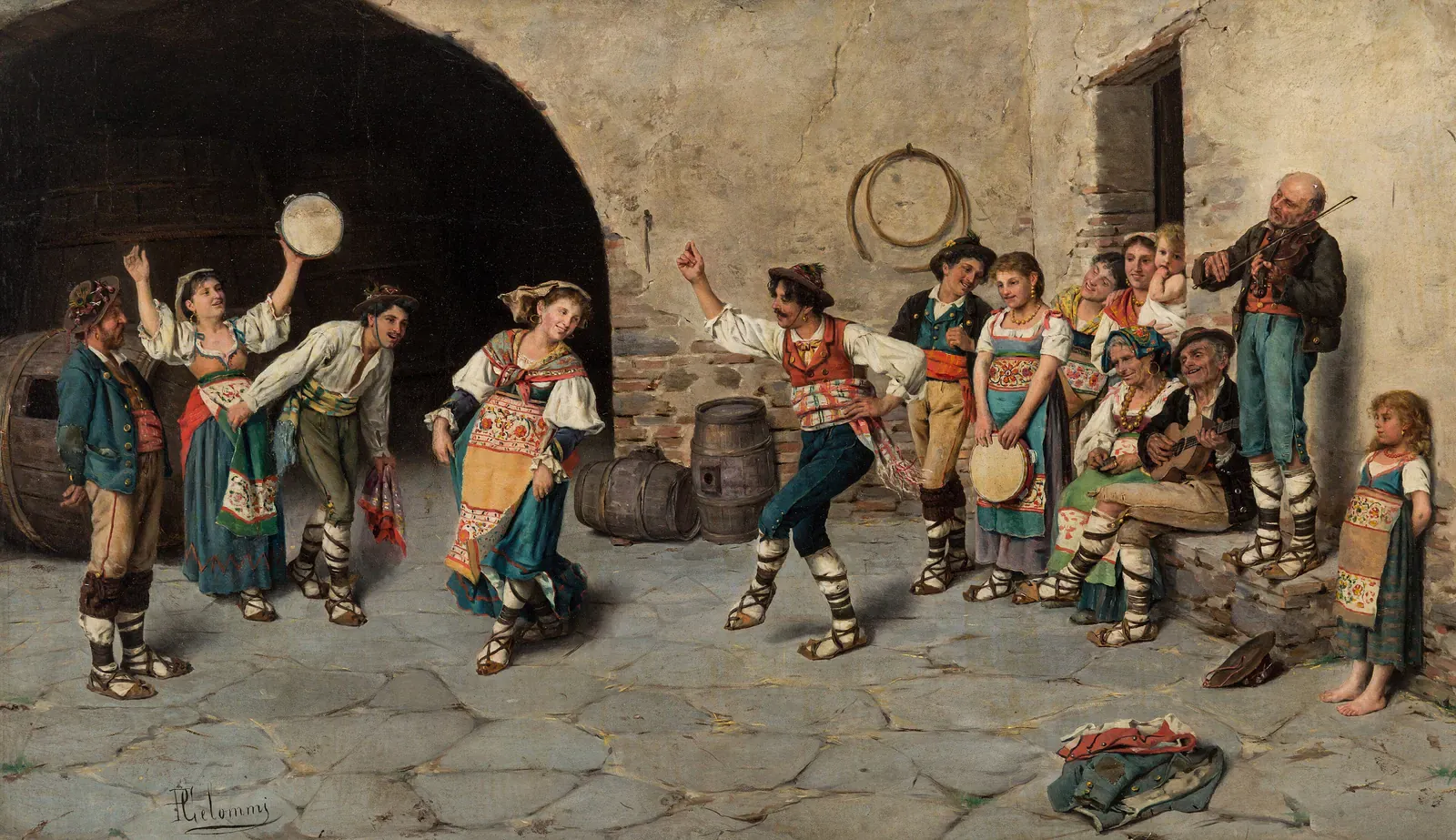
Two traditions run under one name. The courtship tarantella is a short, graceful couple dance. The curative form was danced alone by the afflicted for hours or days. The Neapolitan version, a lively couple dance with its own rhythms, gestures and sung verses, may descend from a fifteenth-century blend of the Spanish fandango and the moresque ballo di sfessartia. From Apulia the dance spread through the Kingdom of the Two Sicilies.
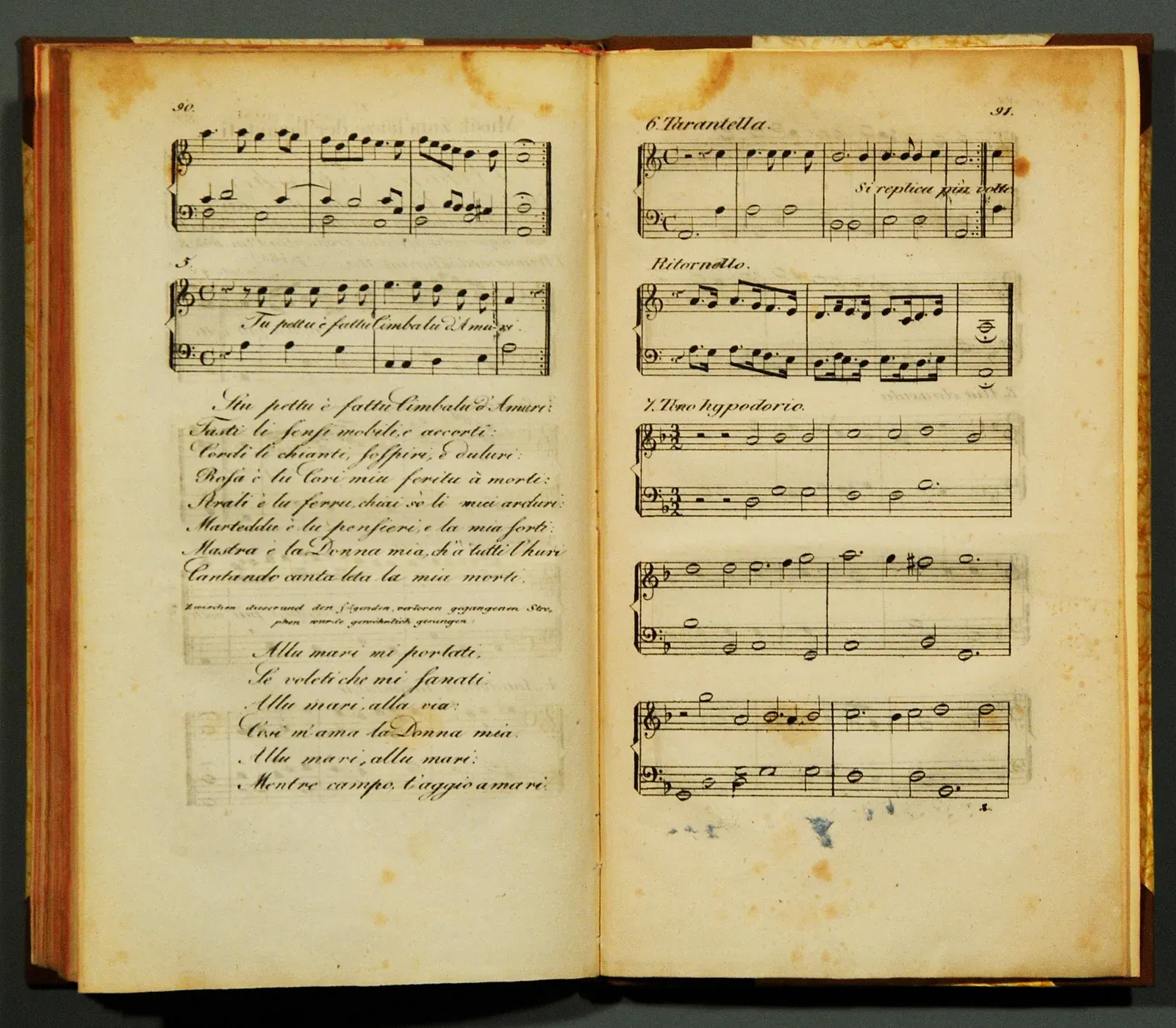
Tarantism and village dance, to 1834
Tarantism was first described in the eleventh century and was common around Taranto in the sixteenth and seventeenth centuries. Its centre was the church at Galatina, where afflicted women gathered on 29 June, the feast of Saints Peter and Paul. The dancing was placed under the sign of Saint Paul, and the women dressed as his brides. At the climax they uttered a stylised crisis cry, a drawn-out “ahiii”, and the music was the only remedy accepted.
Observers took the cure seriously. One treatise describes a peasant with laboured breathing who revived within the hour once a guitar was brought. A Naples doctor bitten by two tarantulas in August 1693, with six witnesses and a notary present, suffered no dancing illness at all.
The village repertoire sat on mandolins, guitars, accordions and tambourines, with flutes, fiddles, trumpets and clarinets added. The dancer and the drummer traditionally tried to outlast each other, one playing faster or the other dancing longer, until one tired first.
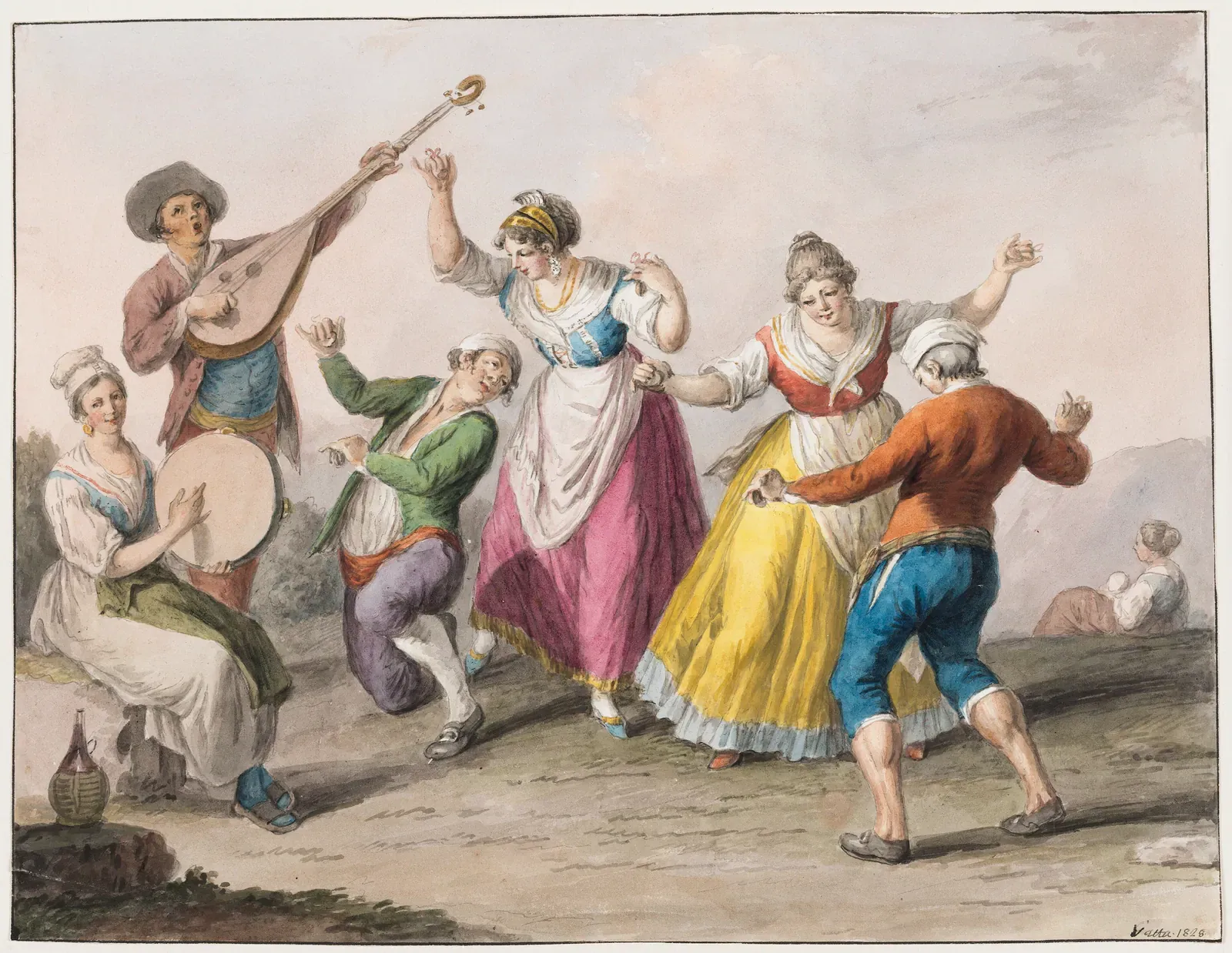
Romantic and salon tarantella, 1835 to 1958
In 1835 Gioachino Rossini closed his collection Les soirées musicales with “La danza”, a patter song in tarantella napoletana time to words by Count Carlo Pepoli. It became a stand-alone chamber piece, transcribed for piano by Franz Liszt and Charles-Valentin Alkan, and later quoted by Ottorino Respighi in La Boutique fantasque. Its tune loosely fed the wedding tarantella “C’è la luna mezzo mare” and the English “Oh! Ma-Ma!”.
Frédéric Chopin wrote his Tarantelle in A-flat, Op. 43, in June 1841 and published it in October. The tarantella became a concert genre in its own right, far from the healing ritual: the music used for tarantism, built around drums and clarinets and matched to the pace of the patient, is only weakly connected to the tarantellas of Chopin, Liszt, Rossini and Heller. Through the first half of the twentieth century the village tradition went largely unrecorded.
Fieldwork and the folk revival, 1959 to 1997
The tradition returned through scholarship. The anthropologist Ernesto de Martino led an expedition to Apulia in 1959 to study tarantism and its music, and his book La terra del rimorso followed in 1961. It was later translated as The Land of Remorse.
In Naples, Eugenio Bennato, Carlo D’Angio and Giovanni Mauriello founded the Nuova Compagnia di Canto Popolare in the late 1960s. Guided by the ethnomusicologist Roberto De Simone, the group researched Neapolitan vocal forms of the fifteenth and sixteenth centuries such as tammuriate, fronne and serenate. Its self-titled debut of 1971 revived songs known only from old manuscripts, played on forgotten instruments such as the tammorra and mandoloncello. It made its live debut at the Festival of Two Worlds in Spoleto in 1972, then recorded for EMI Italiana, including Tarantella ca nun va ’bbona in 1975. La gatta Cenerentola, De Simone’s musical, brought a large success in 1976, the year Bennato left to found Musicanova.
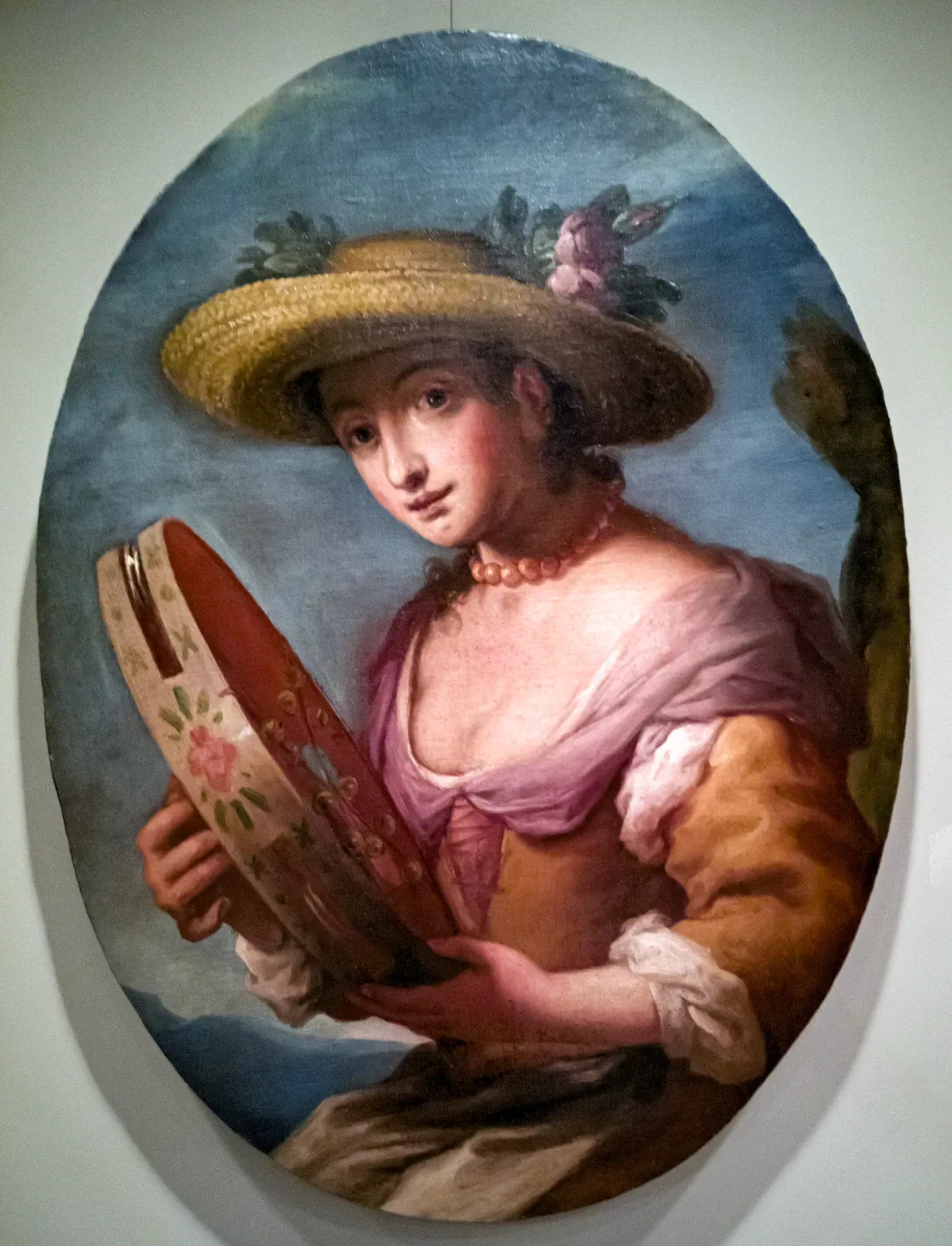
In Salento, the writer Rina Durante formed the Canzoniere Grecanico Salentino in Lecce in 1975, and the group’s first album followed in 1977. Other traditional groups include the Cantori di Carpino, Officina Zoé and the Tamburellisti di Torrepaduli. The NCCP revived in the early 1990s with world music and won the critics’ award at Sanremo in 1992.
Taranta festivals, 1998 onward
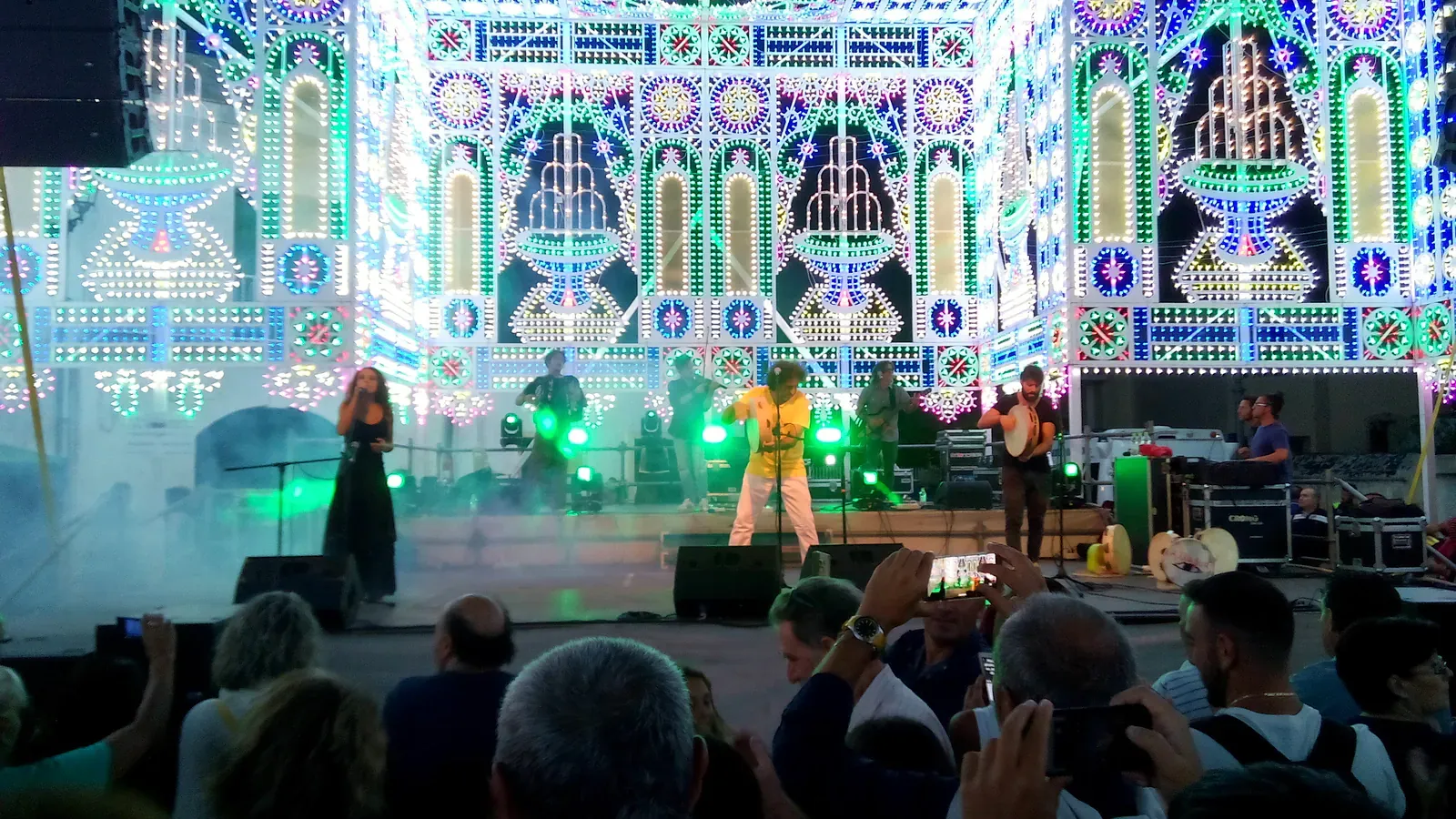
In 1998 municipalities in Salento launched the Notte della Taranta, a festival centred on pizzica that tours Lecce province and ends each August with a late-night concert in Melpignano, attended by about 120,000 people. A new musical director is chosen every year. Guests have included Stewart Copeland, Franco Battiato and Carmen Consoli. The composer Ludovico Einaudi directed it in 2010 and 2011 and released the album Taranta Project in 2015.
Bennato issued Taranta Power in 1999, giving the revival a slogan. Antonio Castrignano, a Salento singer, recorded the soundtrack for Emanuele Crialese’s film Nuovomondo in 2006, then the albums Mara la fatia (2010) and Fomenta (2014). In 2015 the Canzoniere Grecanico Salentino, now led by the violinist and drummer Mauro Durante, recorded its fortieth-anniversary album Quaranta live to tape without overdubs.
Characteristics
Tarantella is a family rather than a single piece. The sonu a ballu and its relatives in Calabria are played on the zampogna bagpipe or the organetto with a tambourine in a 12/8 triplet feel. Campanian tammurriata is driven by the tammorra and divides into local schools: Vesuviana, Nolana, Giuglianese, Agro Nocerino-Sarnese and Monti Lattari. Pizzica is traditionally a couple dance, though two women often dance together.
The common thread is a rolling compound pulse and a dancer who competes with the drummer.
Instruments and production
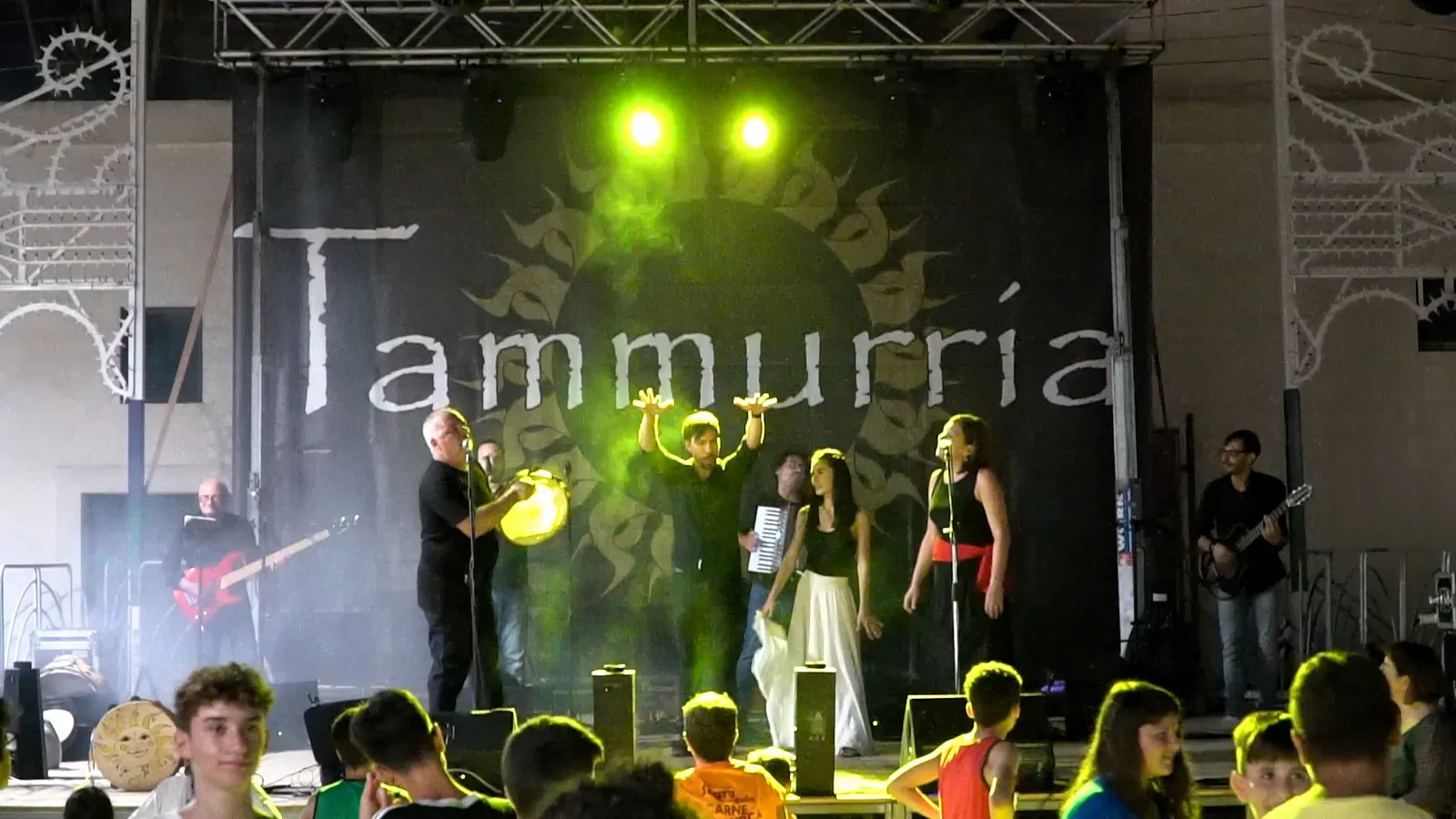
The core is the tambourine, which carries the dance, and the large tammorra frame drum in Campania. Melodies come from mandolin, violin, accordion or bagpipe, with guitar or bouzouki beneath. Revival groups reached for older instruments, while festival bands add electric bass and guitar. The 2015 live-to-tape album by the Canzoniere Grecanico Salentino shows the opposite, unprocessed approach.
Mainstream success
Tarantella has seldom charted as a folk genre. Its mass audiences arrived by other routes: Rossini’s “La danza” became a recital staple for tenors such as Luciano Pavarotti, Chopin’s piece entered the piano canon. The folk side found a public through the 1970s Neapolitan revival, the 1990s world music market and the Notte della Taranta.
Notable recordings
Rossini’s “La danza” is a patter song in tarantella napoletana time, a stand-alone chamber piece rather than part of a larger work. It later inspired Chopin, who took care over the time signature. His manuscript shows he changed it from 12/8 to 6/8, and he asked his friend Julian Fontana to check the best editions of Rossini’s score for that detail.
Chopin’s Op. 43 is a moto perpetuo marked Presto that lasts about three minutes. Robert Schumann heard in it a dancer “whirling as if possessed”, and Chopin himself hoped not to write anything so dreadful again soon.
Canzoniere Grecanico Salentino’s Quaranta marked forty years of the Lecce ensemble. It was produced by Ian Brennan and recorded live to tape without overdubs, a stripped-down contrast to studio-built albums.
Culture
Tarantism supplied images that spread far beyond Italy. The tarantella appears in Henrik Ibsen’s A Doll’s House, and the Harry Potter spell Tarantallegra borrows its name. In Salento the old rite survives as festival theatre, and the dancer-drummer duel and the sword-fight mime keep older meanings in view.
Legacy
Tarantella left both a concert-hall repertoire and a living folk tradition. A 2017 study, Global Tarantella, follows how its songs and steps were reinvented well beyond southern Italy. Related traditions include canzone napoletana, the revival currents covered in folk revival and the wider European folk family.
Misconceptions
A common belief is that the spider bite caused tarantism. No link between bites and the condition has ever been demonstrated, and Lycosa tarantula is not inherently deadly. The Mediterranean black widow is a better candidate for the spider once tied to Taranto’s grain harvest, but even that is unproven.
Another is that tarantella names a single dance or tune. It names a group of regional forms with their own instruments, steps and meters, from Calabria to Campania to Salento.
A third is that Chopin’s and Rossini’s tarantellas reproduce the healing music, which was drums and clarinets matched to the patient’s pace and only weakly linked to them.
Frequently asked questions
What time signature is tarantella in?
Tarantella is usually in 6/8, sometimes 12/8 or 4/4, played fast with tambourines.
Where does tarantella come from?
Tarantella comes from southern Italy, with roots in Apulia, where tarantism was recorded, and forms across Calabria, Campania and Sicily.
What is tarantism?
Tarantism is a dancing mania from southern Italy that was popularly blamed on a spider bite and cured by music.
Is pizzica the same as tarantella?
Pizzica is a Salento form of the tarantella. It is part of the larger tarantella family, alongside tammurriata in Campania and the sonu a ballu of Calabria.
Sound
Sound sheet
Signature sounds
- Fast compound 6/8 pulse
- Tambourine-led rhythm
- Dancer and drummer trying to outlast each other
Drums and percussion
- Tamburello
- Tammorra
Techniques
- Dancer-drummer duel
- Moto perpetuo in 6/8
- Patter-song delivery
- Stylised crisis cry
Keys and modes
A-flat major. Key of Chopin's Op. 43, the best-known concert tarantella.
Vocals
Sung in regional southern Italian dialects, from Neapolitan in Campania to Salentine in Apulia.
Scenes
Where it happened
Where and when the sound lived: one bar per city on a shared timeline.
Europe
Active scenes
Peak 4, 1998-2025
Home of the Neapolitan courtship tarantella, tammurriata and the NCCP revival group.
Town whose chapel of Saint Paul hosted the public tarantism rites on 29 June.
Base of Canzoniere Grecanico Salentino and the pizzica revival of Salento.
Final concert site of the Notte della Taranta festival.
Venues and places
Melpignano, 1998 to today. Grand finale concert of the Salento pizzica festival, with an average of 120,000 spectators.
Culture
Culture markers
- Tarantism rite at Galatina
Afflicted women danced to the music for hours or days, gathering on 29 June at the chapel of Saint Paul.
Ritual - Courtship tarantella
Short, graceful couple dance, in some places mimicking courtship or a sword fight.
Dance - Dancer versus drummer
Dancer and tambourine player try to outlast each other by playing faster or dancing longer.
Dance - Notte della Taranta
August festival in Salento that stages pizzica orchestras alongside guest musicians.
Ritual
Media
Key media
- 1961La terra del rimorso
by Ernesto de Martino. Study of southern Italian tarantism, translated as The Land of Remorse.
Book - 2017Global Tarantella
by Incoronata Inserra. Study of how southern Italian folk music and dance were reinvented worldwide.
Book
Glossary
Terms on this page
Salento variant of the tarantella, danced by couples and in the tarantism rite.
Calabrian name for the tarantella dance music.
Campanian tarantella variant driven by the tammorra frame drum.
People afflicted by tarantism, also called tarantolati.
Southern Italian dancing mania popularly blamed on a spider bite and cured by music.
European folk family