Mehter
Mehter is the Ottoman military band tradition of drums, zurnas and brass, played at court and on campaign, abolished in 1826, revived in the 20th century.
Türkiye, around 1300
Middle Eastern and North African family
Born
around 1300
Türkiye
Links
0
Genres it drew on or shaped
Tempo
100-135 BPMLineage
Family tree
Timeline
Era by era
From the first sparks to today. Select a dot to read the story behind it.
- Court and campaign bands
1300 to 1682
- Janissary fashion in Europe
1683 to 1825
- Abolition and revival
1826 to 1951
- Armed Forces Mehter Unit
1952 to today
Eras
Moments
- 1 Court and campaign bands, 1300 to 1682
- 2 Janissary fashion in Europe, 1683 to 1825
- 3 Abolition and revival, 1826 to 1951
- 4 Armed Forces Mehter Unit, 1952 to today
around 1300
Court and campaign bands
Bands of drums, zurnas and trumpets accompany the sultan and army. They sound at fixed hours each day and on campaign, and their pieces are passed on by ear in the palace schools.
- 1665Mehter on the streets of ViennaThe embassy of Kara Mehmed Pasha brings a mehter to Vienna, which plays in public parades and before the residence several times a day.
1683
Janissary fashion in Europe
After the siege of Vienna, courts from Poland to Russia copy the percussion and brass battery. Haydn, Mozart and Beethoven write Turkish-style music for the concert hall.
- 1683Siege of ViennaThe siege draws central European attention to the Ottoman battery of drums, cymbals and horns.
- 1699Janissary band at KarlowitzA Janissary band travels with the delegation that negotiates the Treaty of Karlowitz and plays in Vienna for several days.
- 1720A mehter sent to PolandSultan Ahmed III sends a mehter to King Augustus II of Poland, who works its instruments into his own military band.
- 1782Mozart's Abduction from the SeraglioMozart's opera, built around Turkish characters, uses an overture and two Janissary choruses in the Turkish style.
- 1783Mozart's Rondo alla TurcaThe finale of the Piano Sonata in A, K. 331, imitates the repeated notes and loud-soft blocks of Janissary music; the sonata is published in 1784.
- 1794Haydn's Military SymphonyThe second movement of the symphony pictures a battle with Turkish percussion.
- 1811Beethoven's Turkish MarchBeethoven writes The Ruins of Athens, whose fourth number is the Turkish March, premiered in Pest in 1812.
1826
Abolition and revival
Mahmud II abolishes the Janissary Corps and its bands in 1826. The repertoire is rebuilt after 1911 as marches for a new band, with Western winds in the line-up.
- 1826Janissary Corps abolishedSultan Mahmud II abolishes the Janissaries, and the oral chain of teaching that carried the mehter repertoire breaks.
- 1831Muzika-i Humayun beginsThe Western-style Royal Band starts as the official state band of the Ottoman armed forces, replacing the mehter.
- 1912First revival concertCelal Esad stages a concert of mehter music at the Tepebaşı Theatre in Istanbul on 29 February, using oboe and clarinet in place of the kaba zurna.
- 1914Mehterhâne-i Hâkânî foundedThe Ottoman Military Museum re-forms the band under this name, with Ali Rıza Şengel as bandmaster.
1952
Armed Forces Mehter Unit
A military museum band is formed in 1952, grows to the nine-tier standard in 1968, and plays daily in summer and at state ceremonies, led by the 29 May conquest concert.
- 1952Military Museum Mehter UnitThe Askerî Müze Mehter Takımı is founded on 2 March, with three tiers of players.
- 1953Conquest anniversary concertEnlarged to six tiers, the band gives its first major official concert on 29 May for the 500th anniversary of the conquest of Constantinople.
- 1968Nine-tier standardThe museum band reaches the standard nine-tier military structure, which it keeps today.
- 1992Edinburgh Military TattooThe Mehter Unit appears at the Royal Edinburgh Military Tattoo.
Listening path
Start listening
A short path from an easy way in to the deep end. Thumbnails come from YouTube; the player loads only when you press play.
- 01
Hasan Bitmez Project, 1993
The best-known mehter march, played on drums, zurnas and brass; its earliest catalogued recording dates to 1993.
- 02
Ivo Pogorelich, 1784
Mozart's piano finale, the clearest example of Janissary music in the concert hall.
- 03
Queensland Symphony Orchestra, 1811
Beethoven's march with orchestral percussion in the Turkish manner.
Facts
| Family | Middle Eastern and North African |
| Origin | Türkiye |
| Status | Revival |
| Tempo | 100 to 135 BPM |
| Meter | 2/4 or 4/4 |
Mehter is the military band music of the Ottoman Empire, played by ensembles of drums, double-reed zurnas, trumpets and cymbals. It began in the early Ottoman state, was heard daily at court and on campaign, and is counted among the oldest military band traditions in the world.
The Janissary Corps, the core of the bands, was abolished in 1826, and the music survives today as a ceremonial tradition kept by a unit of the Turkish Armed Forces. In Europe the sound was known as Janissary music and shaped the percussion sections of the orchestra.
Origins
The word mehter refers properly to a single musician; the band is called mehterân, and one attached to a vizier or prince is a mehterhâne. Military bands of this kind are traced to the Turkic bands of Central Asia and were not definitively recorded before the 13th century. The first mehter is believed to have been sent to Osman I by a Seljuk sultan, and from then on the mehter played for the Ottoman ruler every day after the afternoon prayer.
By the 17th century the palace band in Istanbul numbered in the hundreds, with smaller bands in fortresses and at the naval arsenal, each giving several concerts a day. The final form of the classical band, known as the nine-tier band, had nine players of each of its main instruments: davul, zurna, nakkare, cymbals and horns, plus kös timpani and a bandmaster. Composers and bandmasters such as Nefiri Behram, Emir-i Hac and Zurnazenbaşı İbrahim Ağa wrote its marches from the 16th century on, and the band also arranged folk melodies from the regions the players came from.
Vienna and Europe, 1665-1825
Europeans heard the mehter at close quarters in 1665, when the embassy of Kara Mehmed Pasha played it in public parades in Vienna. The siege of 1683 and the Treaty of Karlowitz in 1699, which a Janissary band accompanied to Vienna, kept the sound in the public ear. In 1720 Sultan Ahmed III sent a band to King Augustus II of Poland, and Russia, Prussia and Austria followed with bands of their own. The first bands used imported Turkish musicians; later local military players took over the instruments.
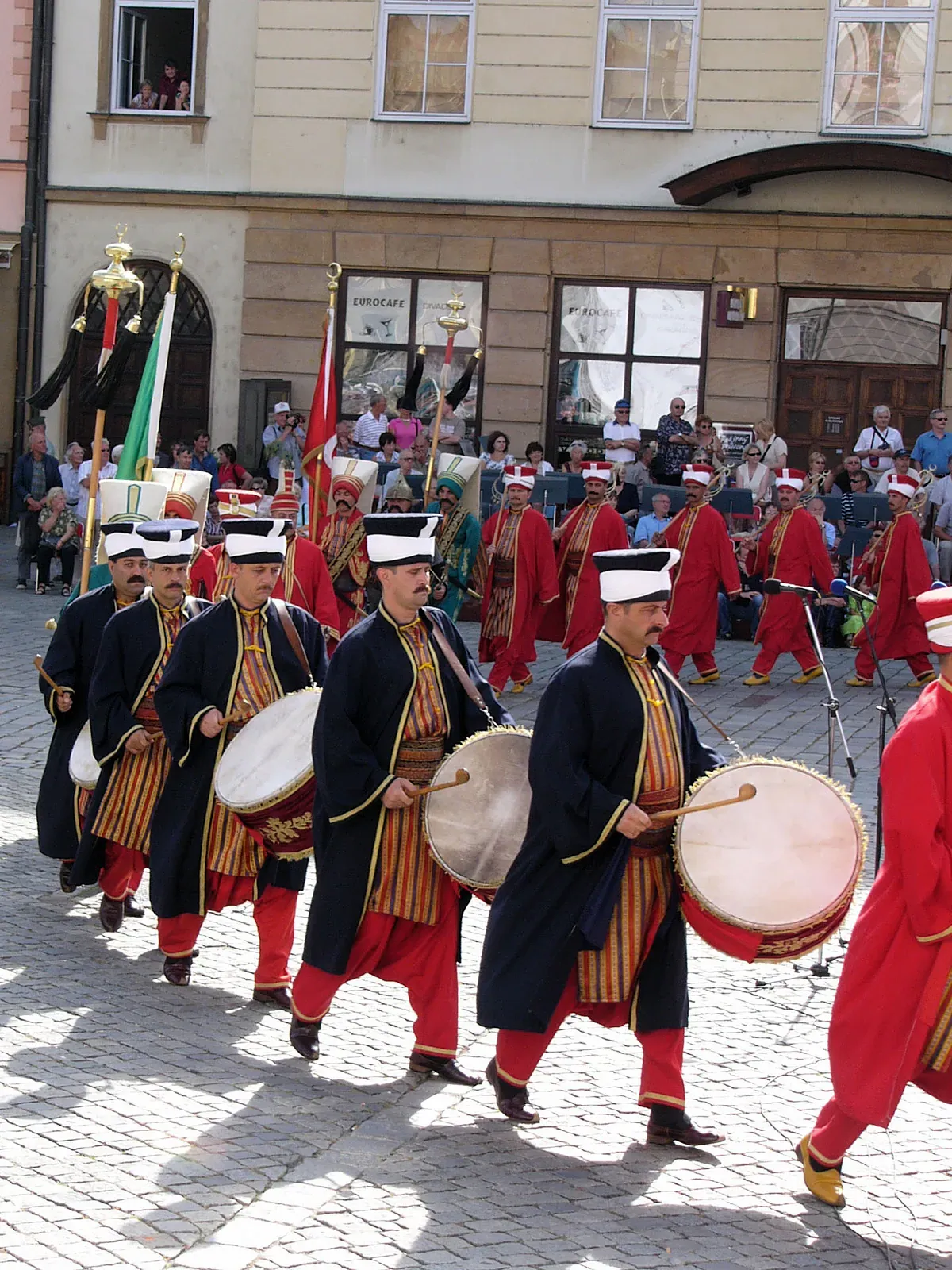
Composers answered with the alla turca style: repeated notes, grace notes, and sudden loud-soft blocks that imitate the band. Haydn used Turkish percussion in the Military Symphony of 1794. Mozart’s opera The Abduction from the Seraglio of 1782 and the Rondo alla Turca finale of his Piano Sonata in A, K. 331, published in 1784, are the best-known cases. Beethoven’s Turkish March from The Ruins of Athens dates from 1811, and he returned to the style in the finale of the Ninth Symphony. Pianos of the time even carried a Turkish stop, a pedal that rang a bell or struck a padded hammer to imitate a bass drum.
Abolition and revival, 1826-1951
In 1826 Sultan Mahmud II abolished the Janissary Corps, and the mehters went with it. The oral chain of teaching that carried hundreds of marches was broken, and much of the classical repertoire was lost. The Western-style Muzika-i Humayun began as the official state band in 1831. The revival came in the 20th century: Celal Esad held a first concert in Istanbul on 29 February 1912, using oboe and clarinet in place of the kaba zurna, and in 1914 the Ottoman Military Museum formed the Mehterhâne-i Hâkânî under Ali Rıza Şengel. Since the old pieces had not been handed down, the revival band worked from newly composed marches, and later scholars have called it a reinvention of tradition rather than a continuous one.
The Armed Forces Mehter Unit
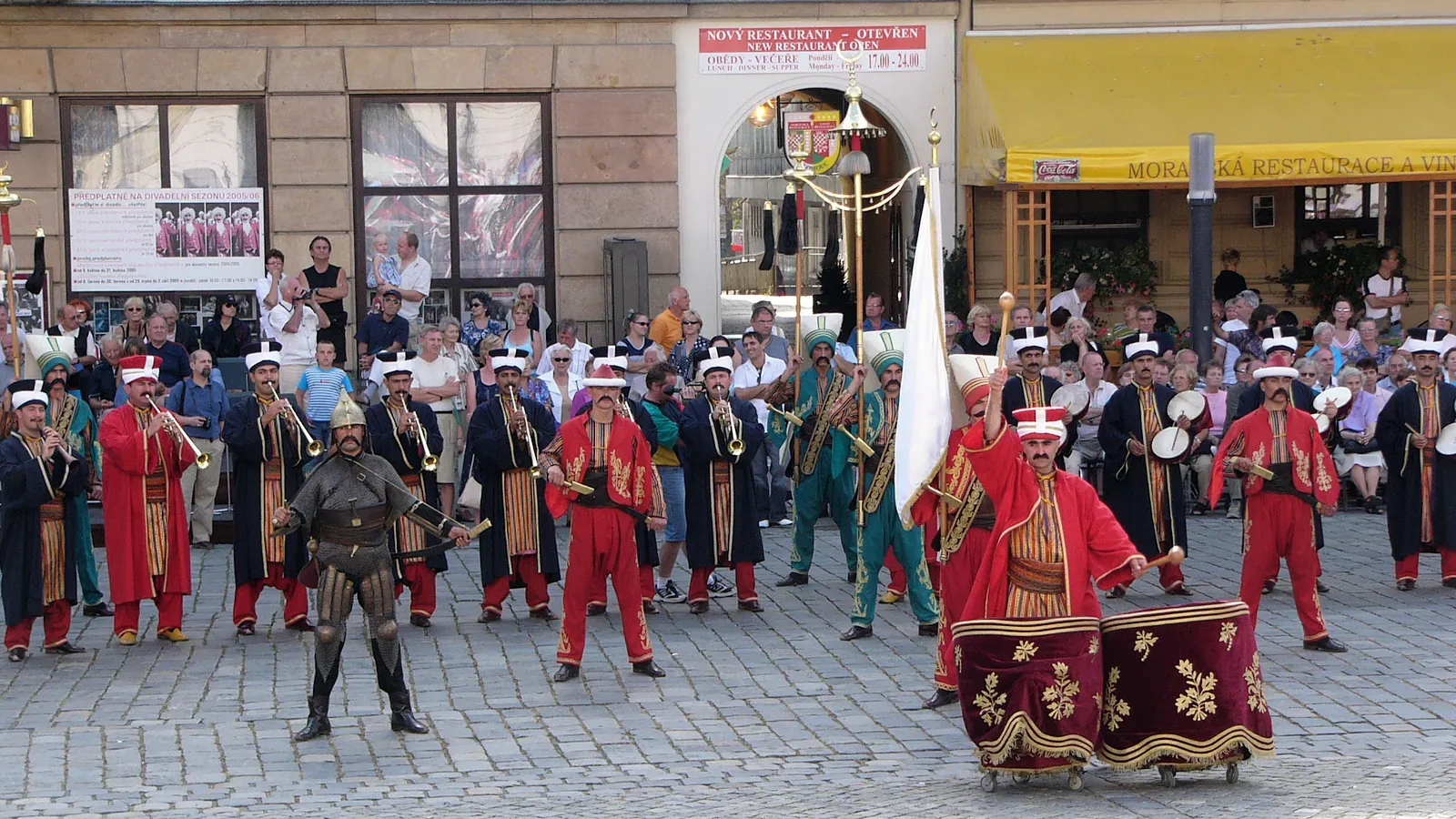
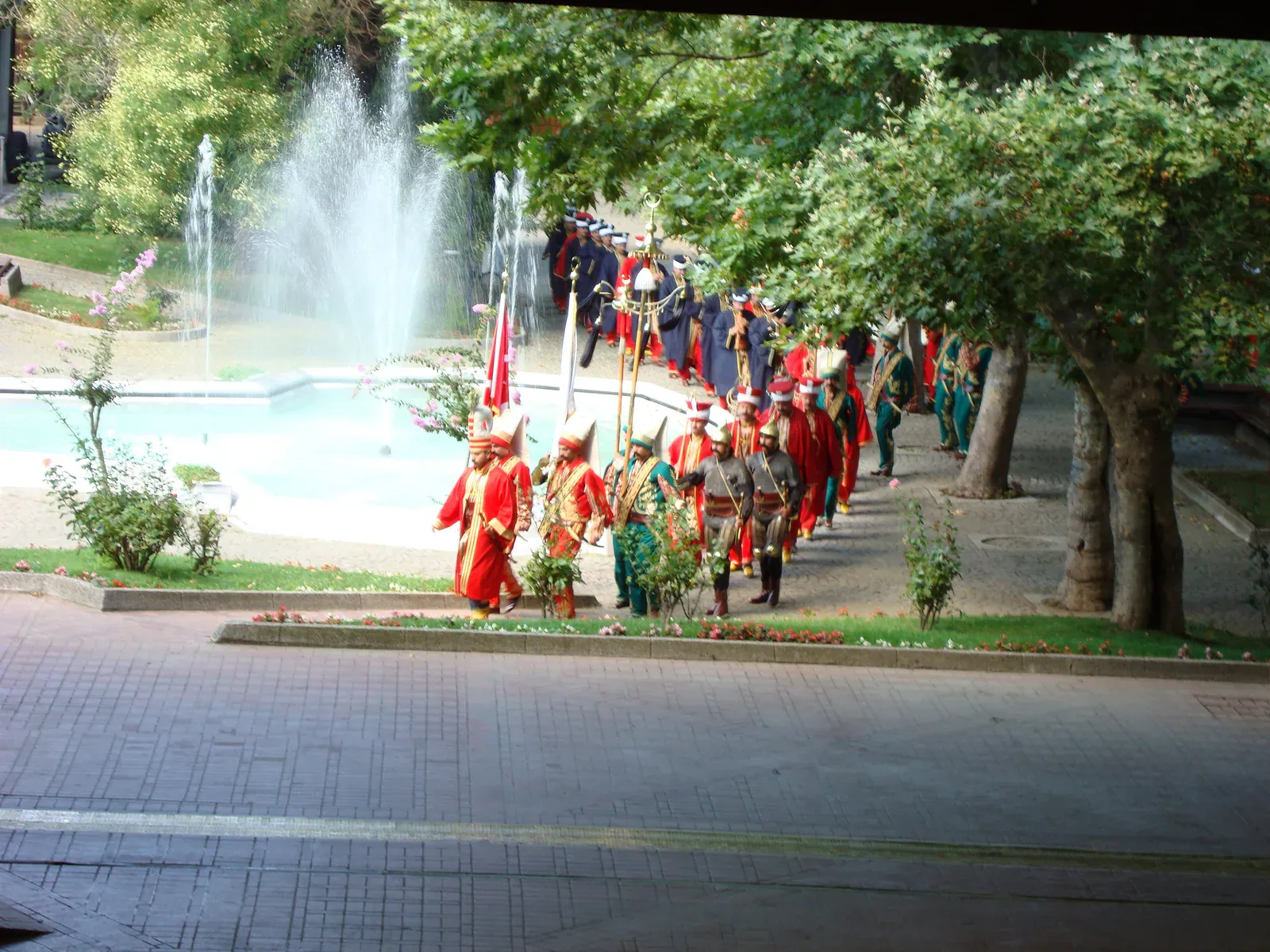
The present band was created after Turkey’s president and chief of the general staff watched Scottish bagpipe bands in London in 1952. The Askerî Müze Mehter Takımı was founded on 2 March 1952 with three tiers of players, and in 1953 it was enlarged to six tiers and gave its first big concert on 29 May for the 500th anniversary of the conquest of Constantinople. Its costumes, instruments and drill were reconstructed from palace manuscripts and from the reliefs on Ottoman gravestones. In 1968 the band reached the nine-tier standard that it keeps today.
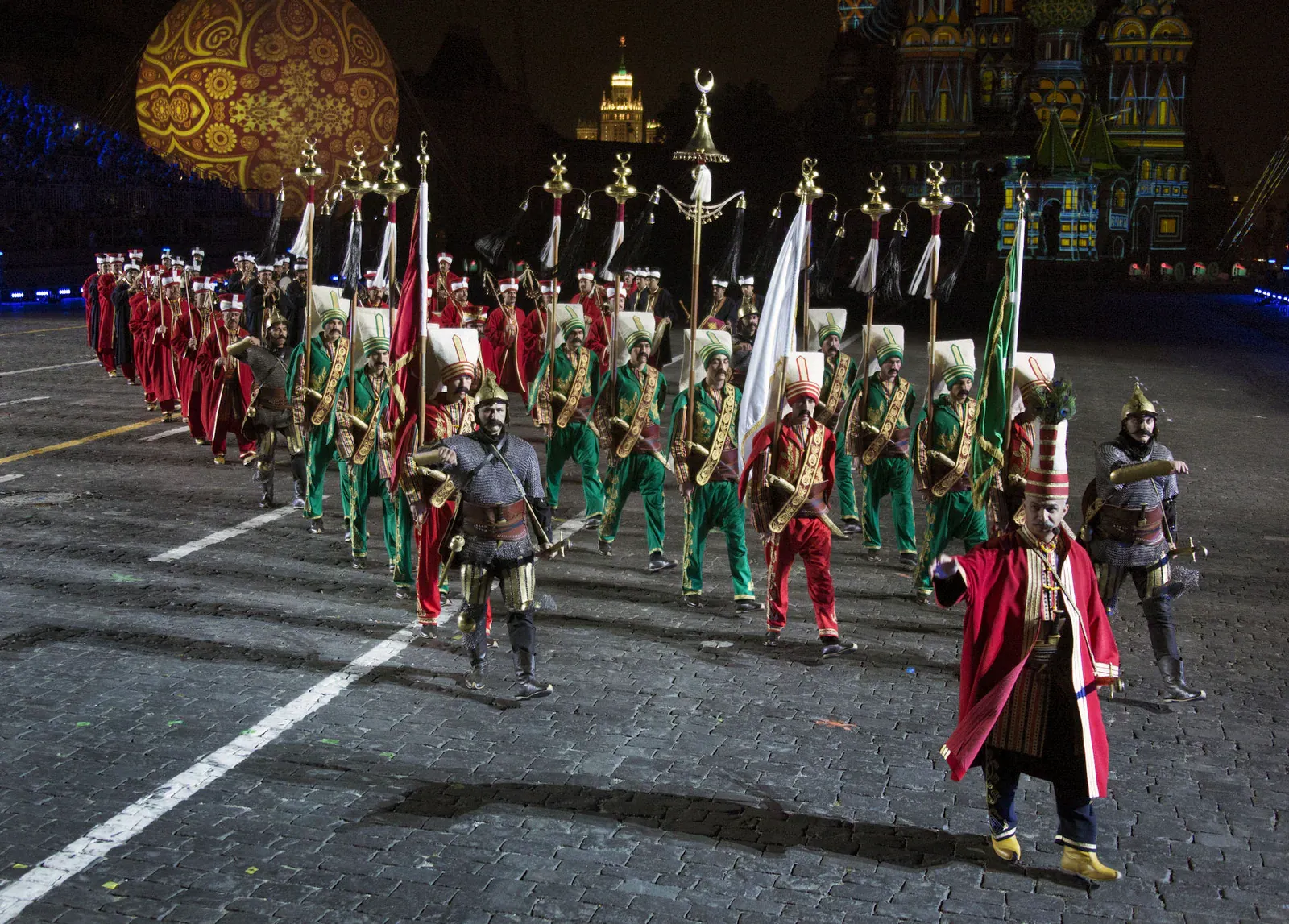
The unit plays every day in summer at the museum in Harbiye in Istanbul, gives indoor concerts in winter, and appears at state ceremonies and abroad, including the Royal Edinburgh Military Tattoo in 1992. Its largest event is the concert on 29 May. Local mehter groups play at holiday concerts across Turkey.
Characteristics
The band’s sound is loud and bright: bass drums and kettledrums under the shrill kaba zurna, with trumpets, cymbals and bells. Its music rests on the Turkish makam and usûl systems, and the usûl, the rhythmic cycle, sets the pace and the character of a piece more than anything else. A 17th-century manuscript lists 25 usûl, form and mode names played by the band, among them peşrev, semâî, kalenderî and ceng-i harbî. The ceng-i harbî is a war piece created by the mehter itself.
Melodies use classical makams, with Rast central in the military pieces. A piece is built in sections called hâne: the first stays low in the mode, the second, the miyan hâne, rises to the high register, and the third returns to the home mode or moves to a close one, as in the Hicaz family. Marches are mostly in two or four beats, with measured tempos from about 100 to 135 beats a minute.
Instruments and production
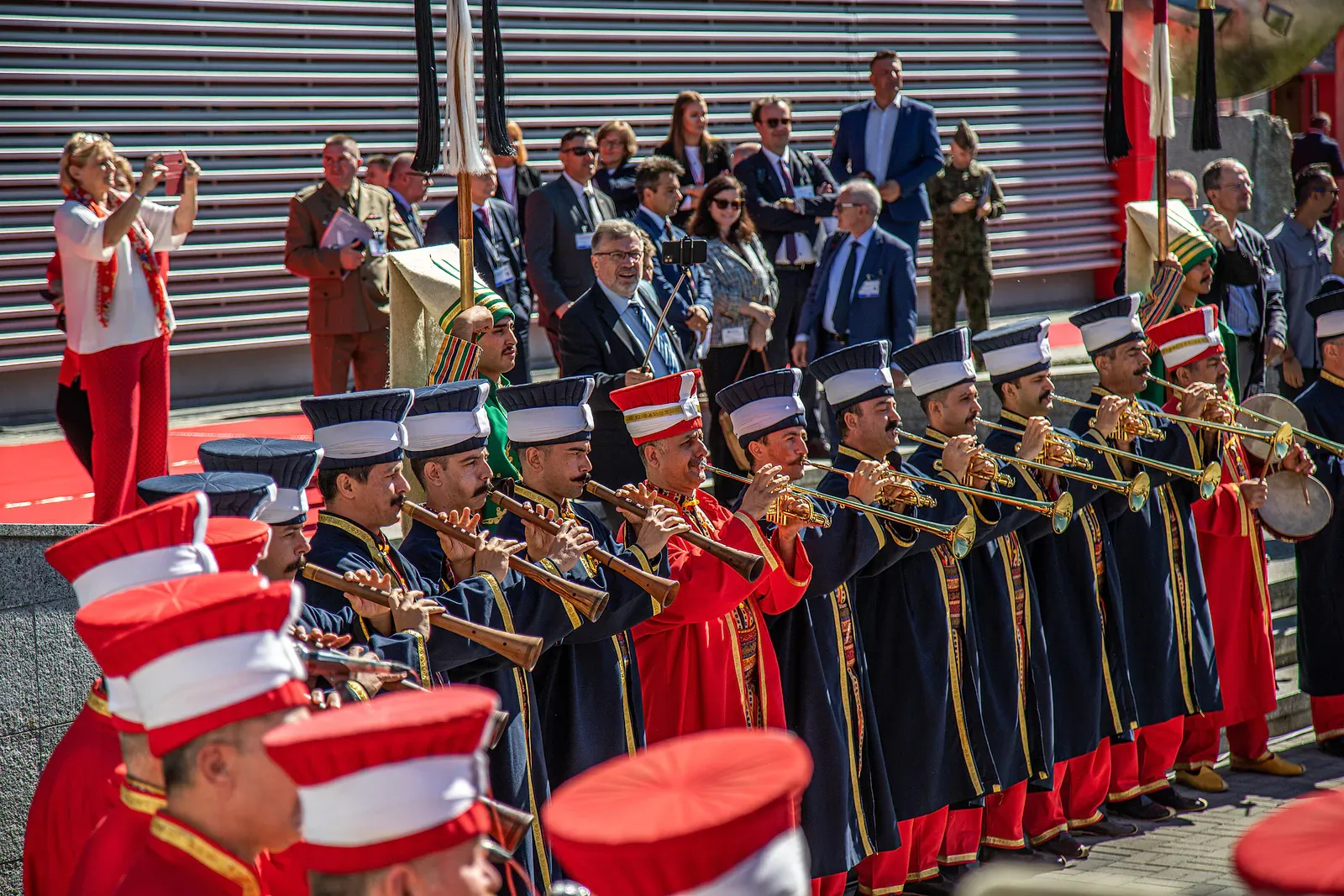
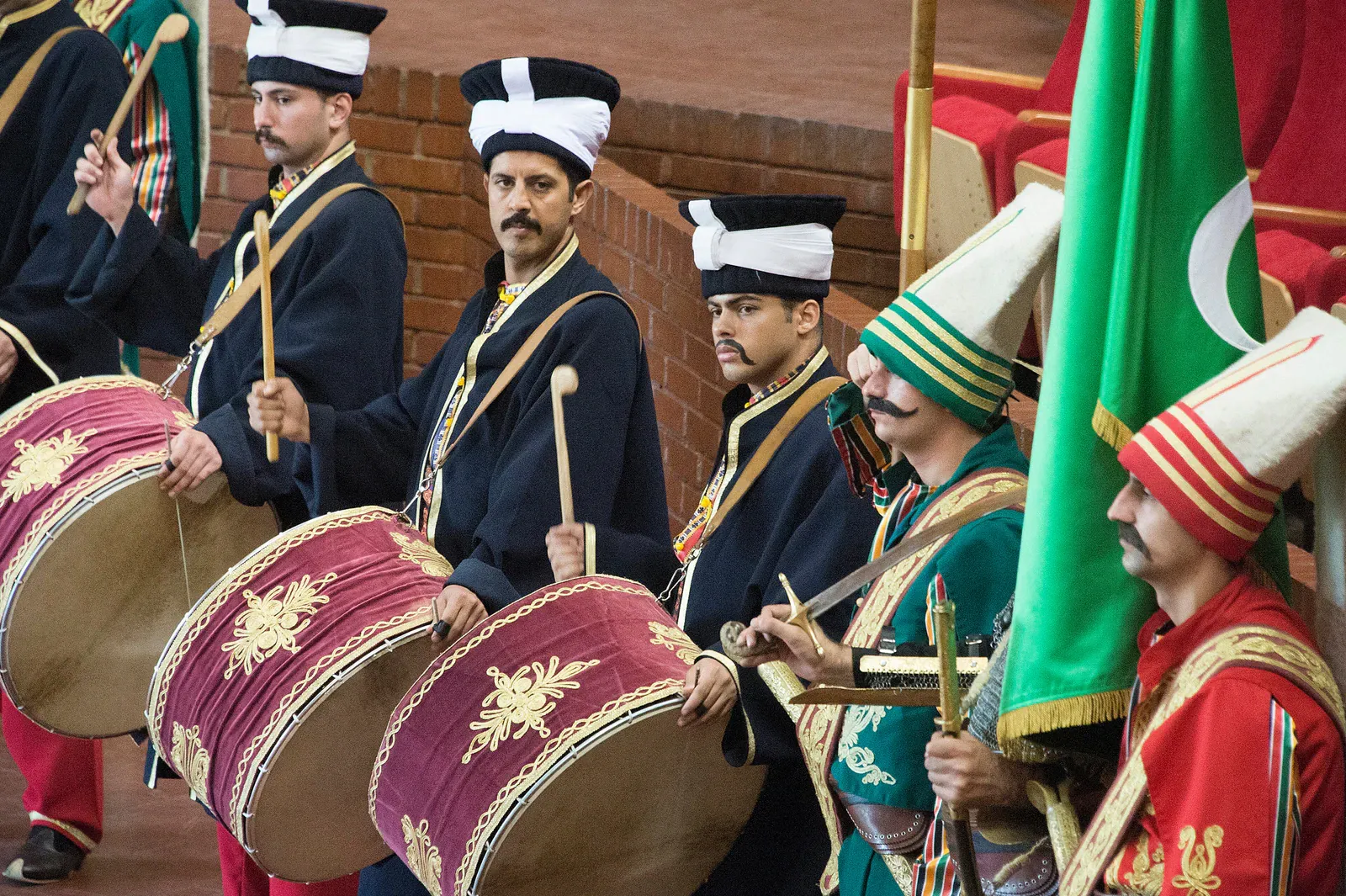
The kös is the giant kettledrum, the davul a bass drum and the nakkare a small kettledrum. The kaba zurna is a low-pitched double-reed pipe that can carry any melody alone, with slides and short sharp notes, and the smaller cura zurna was used with drums for lighter duty. The boru is a trumpet, and the çevgen is a staff hung with small bells that the players shook in time. A single section commanded each instrument, under a bölükbaşı, and the zurnazen led the whole band as conductor in red robes and cap.
Culture
The band’s calendar is ritual. In its heyday it sounded at fixed hours of the day, at daybreak and at sunset, in a scheduled concert called a nevbet. The modern unit still marks 29 May, the date of the conquest of Constantinople in 1453. Popular memory has attached an image to the mehter march, two steps forward and one back, which became a political metaphor, and a body of marches such as Ceddin Deden, in the Hüseynî mode, now stands as a national symbol of heroism. The choice of marches for the film Fetih 1453 set off a debate about authenticity.
Notable recordings
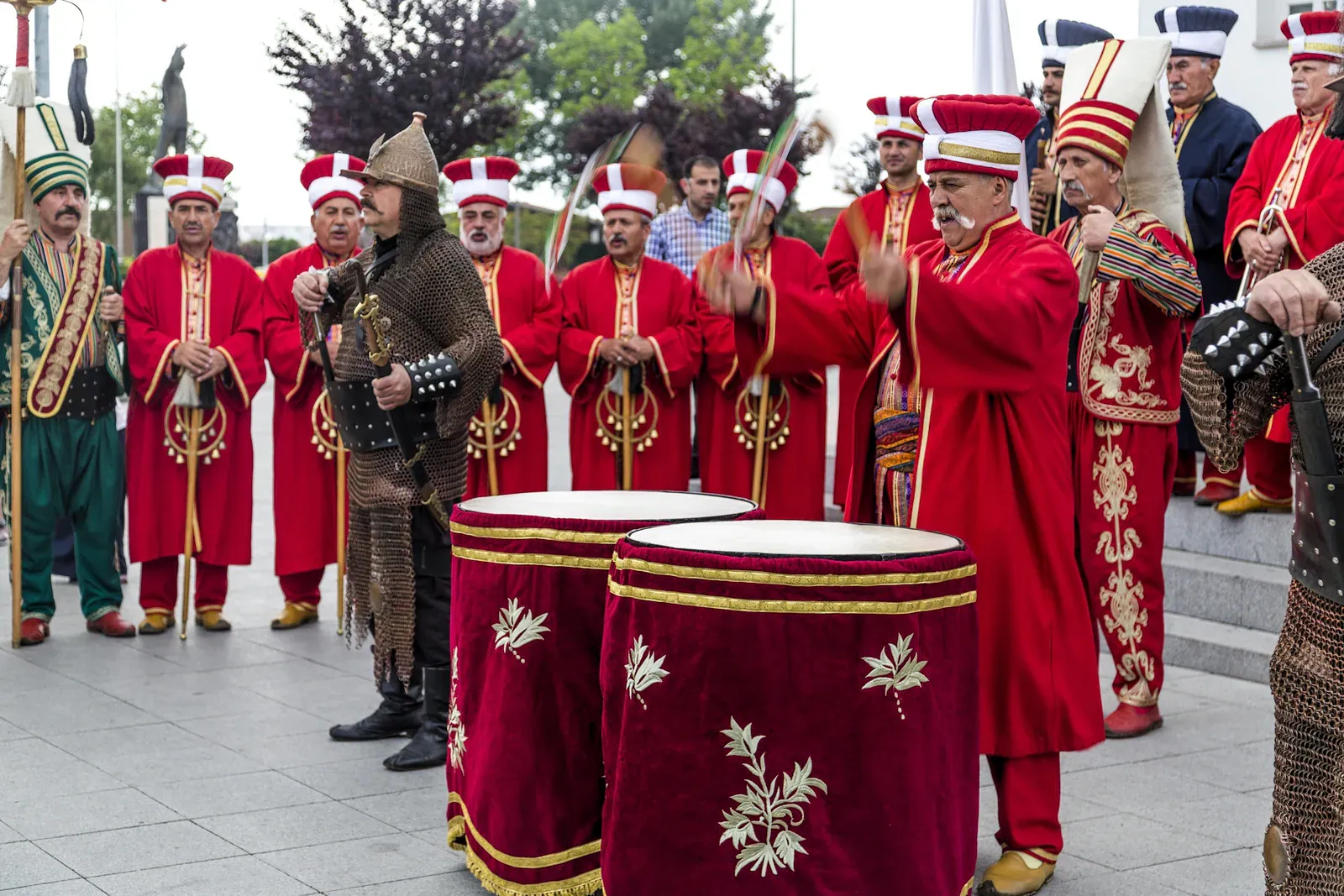
Ceddin Deden is the march best known today. It belongs to the revival era, not to the classical band, and its earliest catalogued recording dates to 1993; an instrumental album of the military band followed in 1996. The band’s war songs appeared on Cenk Türküleri in 2008 and its marches on two volumes of Mehter Marşları in 2015. In the concert hall the best-known pieces are Mozart’s Rondo alla Turca and Beethoven’s Turkish March, which carry the mehter’s pulse to a Western audience.
Legacy
The mehter is the root of the military marching band: the notion of a band of drums, brass and cymbals was borrowed from the Ottoman Empire in the 16th century. Its percussion, the bass drum, cymbals and triangle, entered the European symphony orchestra, and the term Turkish music was applied to the orchestra percussion section from the 1720s to the 1850s. The mehter stands beside Turkish classical music and Turkish folk music in the region covered by Middle Eastern and North African music. The European response is covered under Classical period.
Misconceptions
The first is that mehter names the band. It names a single player, and the band is the mehterân. The second is that the music passed down unbroken from the sultans. The chain was cut in 1826, and the repertoire played today was largely composed after 1911, which is why the current band is described as a reconstruction. The third is that the band played only marches. The classical mehterân also played forms such as peşrev and semâî, folk songs, hymns and dance tunes, in the palace, at fortresses and for festivals.
Frequently asked questions
What is mehter music?
Mehter music is the music of the Ottoman military band, written for drums, zurnas, trumpets, cymbals and bells, based on the Turkish makam and usûl systems.
What instruments does a mehter band use?
A mehter band uses the kös, davul, nakkare, cymbals, kaba zurna, boru and çevgen, with players in sections of nine in the full nine-tier band.
Who plays mehter music today?
The Armed Forces Mehter Unit of the Turkish Armed Forces plays it, mostly at the Military Museum in Istanbul and at state ceremonies, alongside local ensembles in Turkey.
Did mehter influence Mozart and Beethoven?
Yes. Mozart, Haydn and Beethoven all wrote pieces in the Turkish style, imitating the band’s percussion and brass; the Rondo alla Turca and the Turkish March are the best-known examples.
Sound
Sound sheet
Anatomy of a track
| # | Part |
|---|---|
| 1 | First hâne in the low register of the makam |
| 2 | Miyan hâne rising to the high register |
| 3 | Return to the main makam or a close one such as the Hicaz family |
Signature sounds
- Kös and davul beating a marching cadence
- Shrill kaba zurna and boru over the drums
- Cymbals and çevgen bells on the beat
- Nine players per instrument in the full band
Techniques
- Usûl-based cadence
- Hâne structure
- Ceng-i harbî
- Zurna soloing
Keys and modes
Rast makam. Central mode of the military pieces.
Hüseynî makam. Mode of the march Ceddin Deden.
Tuning
Makam system with microtonal intervals; the revival bands mix in Western winds
Vocals
Mostly instrumental; the çevgen players formed the band's choir, and the revival marches carry sung verses.
Scenes
Where it happened
Where and when the sound lived: one bar per city on a shared timeline.
Asia
Europe
Active scenes
Peak 3, 1720-2025
Seat of the palace mehterhane, and today of the Military Museum band and the Istanbul Historical Turkish Music Ensemble.
City where Ottoman bands were heard in 1665 and 1699, and where Haydn, Mozart and Beethoven answered them in the concert hall.
Court that received a full Turkish band in 1720, an early step in the spread of Janissary music across European armies.
Venues and places
Istanbul, 1952 to today. Military Museum in Harbiye, home of the Mehter Unit and its daily summer concerts.
Istanbul, 1912 to today. Hall of the 1912 concert that opened the twentieth-century revival.
Culture
Culture markers
- Mehter costume
Sections wear robes, sashes and turbans by rank, with the zurnazen in red robes and cap.
Fashion - 29 May concert
The band's largest event each year marks the conquest of Constantinople in 1453.
Ritual - Two steps forward, one step back
Popular image of the mehter march, used as a political metaphor.
Slang
Media
Key media
- 1911Türk Musîkîsi ve Yeniçeri Mehter Mûzikâsı Hakkında Mütâlaat
by Celal Esad. Treatise that described the mehter as a national music and prepared the revival.
Book - 2012Fetih 1453
by Faruk Aksoy. Film of the conquest of Constantinople, whose score avoided modern mehter marches and set off a debate about authenticity.
Film
Glossary
Terms on this page
Turkish style in European music, copying the percussion and brass of Janissary bands.
War piece in a form created by the mehter for the battlefield.
Plural of mehter, the name of the band; a single player is a mehter.
Ottoman name for the band attached to a palace, vizier or prince.
Scheduled concert by the band, played at fixed hours of the day.
Head of the zurna section, who was also the bandleader.
Middle Eastern and North African family