Novelty song
A novelty song is a popular song built on a gimmick, joke or pop-culture reference, a category of Tin Pan Alley pop that peaked in the 1920s-30s and 1950s-60s.
United States, 1890
Pop family

Born
1890
United States
Subgenres
6
Documented branches
Links
15
Genres it drew on or shaped
Tempo
95-155 BPMLineage
Family tree
Grew out of
- Tin Pan Alley
Derived from
Influenced by
United States, 1890
Novelty song
Led to (6)
Timeline
Era by era
From the first sparks to today. Select a dot to read the story behind it.
- Tin Pan Alley and vaudeville
1890 to 1939
- Spoofs, fads and monster hits
1940 to 1969
- Radio comedy and parody
1970 to 1999
- Viral and Christmas-chart novelties
2000 to today
Eras
Moments
- 1 Tin Pan Alley and vaudeville, 1890 to 1939
- 2 Spoofs, fads and monster hits, 1940 to 1969
- 3 Radio comedy and parody, 1970 to 1999
- 4 Viral and Christmas-chart novelties, 2000 to today
around 1890
Tin Pan Alley and vaudeville
Novelty was one of the three divisions of Tin Pan Alley output, with ballads and dance music. Stuttering, nonsense and exotic-land songs suited vaudeville stages and the first phonograph records.
- 1890Novelty becomes a Tin Pan Alley categoryPublishers sort pop output into novelty, ballads and dance music.
- 1921Zez Confrey's Kitten on the KeysStarts a decade-long fad for virtuoso novelty piano pieces.
- 1923Yes! We Have No BananasNonsense lyrics make a Tin Pan Alley novelty one of the year's biggest hits.
1940
Spoofs, fads and monster hits
Spike Jones spoofed wartime and pop standards, Tex Williams and Sheb Wooley topped charts, and tape tricks produced the Chipmunks, Monster Mash and break-in records.
- 1942Spike Jones' Der Fuehrer's FaceRaspberries in the chorus mock Nazi leadership; Jones goes on to build a career on sound-effect spoofs.
- 1953(How Much Is) That Doggie in the Window? tops the chartsHeavy airplay and a listener backlash make it a model for the novelty hit that annoys as it sells.
- 1956Buchanan and Goodman's The Flying SaucerFake news interviews built from snippets of hits create the break-in record; a lawsuit follows.
- 1958The Chipmunk SongRoss Bagdasarian's speeded-up tape vocals reach number one at Christmas and win Grammy awards.
- 1958Sheb Wooley's The Purple People EaterA comic rock and roll single about a one-eyed alien reaches number one.
- 1962Bobby Pickett's Monster MashA Boris Karloff impression over a dance beat reaches number one and becomes a yearly Halloween fixture.
- 1966Napoleon XIV's They're Coming to Take Me Away, Ha-Haaa!A spoken monologue over a snare and tambourine becomes a hit, then draws complaints about mocking mental illness.
1970
Radio comedy and parody
Dr. Demento gave novelty records a national radio outlet from 1970, Ray Stevens and Benny Hill had chart-toppers, and Weird Al Yankovic made parody a career across four decades.
- 1970Dr. Demento's radio show goes nationalThe syndicated show gives novelty records an outlet through the mid-2000s.
- 1974Ray Stevens' The StreakA comic song about public nudity reaches number one in the US.
- 1984Eat ItWeird Al Yankovic's Beat It parody becomes his first major hit.
2000
Viral and Christmas-chart novelties
Online video turned The Fox, Man's Not Hot and Baby Shark into hits, while the UK Christmas chart became the main annual stage for novelty releases.
- 2013The Fox (What Does the Fox Say?) goes viralA Norwegian comedy duo's video shows online virality replacing radio as the novelty engine.
Listening path
Start listening
A short path from an easy way in to the deep end. Thumbnails come from YouTube; the player loads only when you press play.
- 01
Spike Jones and His City Slickers, 1942
Listen for the raspberries and sound effects that interrupt the march.
- 02
Bobby "Boris" Pickett and the Crypt-Kickers, 1962
Listen for the horror-film voice laid over a plain dance groove.
- 03
Napoleon XIV, 1966
Listen for how little music the hit needs beyond a drum rhythm.
- 04
Ray Stevens, 1974
Listen for the banjo-led country setting around a fad joke.
- 05
"Weird Al" Yankovic, 1984
Listen for how closely the arrangement mirrors the original hit.
Facts
| Family | Pop |
| Origin | United States |
| Emerged | Late 19th century; peaks 1920s-1930s and 1950s-1960s |
| Status | Active |
| Tempo | 95 to 155 BPM |
| Meter | 4/4 |
| Grew out of | Tin Pan Alley |
| Subgenres | 6 |
A novelty song is a popular song built on a single gimmick, joke or reference to popular culture rather than on musical development. The term arose in Tin Pan Alley in the late 19th century, where novelty was one of three divisions of pop output, alongside ballads and dance music.
The category peaked in the 1920s and 1930s and again in the 1950s and 1960s, and it survives today in parody, viral clips and the UK Christmas chart. It overlaps with comedy songs and musical parody, and sits inside pop.
Origins
New York publishers sorted their catalogues into novelty, ballads and dance numbers, and novelty was the category that sold on surprise. Typical devices were a stutter (“K-K-K-Katy”), nonsense lyrics (“Yes! We Have No Bananas”, a 1923 hit), scat-like syllables that helped create the cartoon character Betty Boop, and invented foreign lands where exoticism mattered more than geography. Vaudeville suited all of these, and performers such as Eddie Cantor and Sophie Tucker built careers on them.
The phonograph added a second branch. Zez Confrey’s 1921 “Kitten on the Keys” and similar pieces turned speed itself into the gimmick and started a novelty piano fad that lasted through the decade, aimed at home listeners who wanted virtuoso playing on record rather than sheet music simple enough for an amateur.
Spoofs, fads and monster hits, 1940-1969
Spike Jones and His City Slickers set the template for the swing era. Their 1942 “Der Fuehrer’s Face” put raspberries in the chorus, and their spoofs of pop standards and classical pieces were punctuated by cowbells, whistles, horns and gunshots. Jones recorded for RCA Victor, and his records treated the arrangement itself as the joke.
The 1950s widened the field. “(How Much Is) That Doggie in the Window?” topped the charts in 1953 and drew a backlash from listeners who tired of it. In 1956 Buchanan and Goodman’s “The Flying Saucer” told a fake news story through snippets of real hits, creating the break-in record and, soon after, a lawsuit. Sheb Wooley’s “The Purple People Eater” reached number one in 1958, and The Coasters’ “Yakety Yak” also reached number one that July.
Ross Bagdasarian, recording as David Seville, found the decade’s most durable trick. Playing recorded voices back at higher speed gave “Witch Doctor” and “The Chipmunk Song” (1958) their squeaky characters, and the Christmas record reached number one and won Grammy awards. Bobby “Boris” Pickett’s “Monster Mash” followed in 1962, a Boris Karloff impression over a dance groove that reached number one.
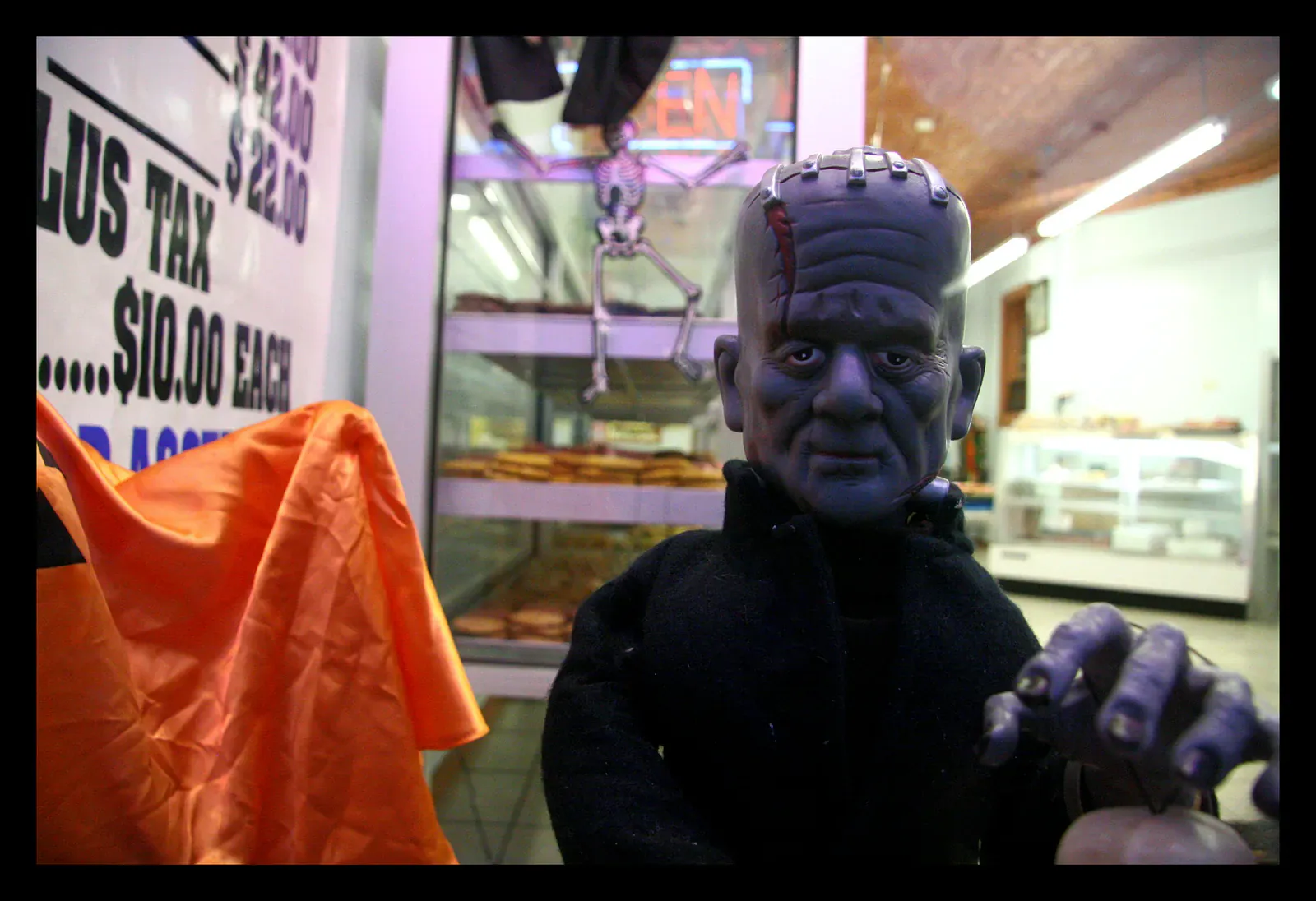
Napoleon XIV’s 1966 “They’re Coming to Take Me Away, Ha-Haaa!” went to the other extreme. It has almost no music, only a rhythm tapped out on a snare drum, a tambourine and the bare sides of the musicians’ legs under a spoken monologue. It reached the US top five and then drew complaints that it mocked mental illness.

Radio comedy and parody, 1970-1999
In 1970 Dr. Demento’s syndicated radio show gave novelty records a national outlet. It ran through the mid-2000s, and its host retired in 2025. Freeform and album-oriented rock stations also played novelty tracks, and for years it was normal for a novelty single to break into the US top 40.

Chuck Berry’s “My Ding-a-Ling” reached number one in 1972, Ray Stevens took “The Streak” to number one in 1974, and Cheech and Chong, Rick Dees (“Disco Duck”, 1976) and Dickie Goodman (“Mr. Jaws”, 1975) all had hits. In Britain, Benny Hill’s “Ernie (The Fastest Milkman in the West)” was the 1971 Christmas number one, and the novelty-country style Scrumpy and Western had a brief fad in the 1970s.
“Weird Al” Yankovic turned parody into a long career. His accordion-led spoofs began in the 1970s and “Eat It” (1984), his Scotti Brothers release, parodied Michael Jackson’s “Beat It”. He had at least one US top-40 hit in four consecutive decades and won a Grammy for Poodle Hat in 2004. His brand of comic rock is covered on the comedy rock page.

Viral and Christmas-chart novelties, 2000-present
Online video replaced radio as the main route to a novelty hit. The Norwegian duo Ylvis reached a worldwide audience with “The Fox (What Does the Fox Say?)”, Big Shaq’s “Man’s Not Hot” spread through memes in 2017, and Pinkfong’s children’s song “Baby Shark” reached the US top 40 after a viral video. These songs overlap with children’s music. In the UK the novelty hit now lives mainly in the Christmas chart race, where LadBaby took five consecutive number ones with sausage-roll parodies.
Characteristics
The premise comes first: a joke, a fad, a character or a sound trick that can be explained in one sentence. Lyrics are comic or topical, and delivery uses character voices, spoken asides and exaggerated emphasis. Melodies and harmony stay simple so that the gag lands, and the structure is usually plain verse and chorus with the punchline placed late. Many novelty songs apply to a current event, a holiday or a fad such as a dance craze or television show, which explains how quickly most of them date.
Instruments and production
Production tends to serve the gag. Spike Jones used percussion effects, Ross Bagdasarian used tape speed, Dickie Goodman used tape splicing, and Napoleon XIV used almost nothing but rhythm. Yankovic’s parodies, by contrast, copy the arrangement of the original hit closely so that the changed words stand out. Tempo ranges widely, from relaxed mid-tempo country comedy to fast rock and roll.
Mainstream success
Novelty singles sold on airplay and curiosity, so many artists charted once. Exceptions such as Ray Stevens and “Weird Al” Yankovic built long careers by treating the genre as a craft, and the KLF’s 1988 guide The Manual argued that a UK number one could come from market research, sampling and a gimmick over a danceable groove.
Notable recordings
“Der Fuehrer’s Face” shows how a wartime spoof could reach a mass audience through humor and sound effects, and “Monster Mash” shows how a seasonal song can outlive its moment. “They’re Coming to Take Me Away, Ha-Haaa!” proves how little music a hit can contain. “The Streak” tied a news-of-the-day fad to a country-flavoured single within weeks, and “Eat It” brought the music video into the genre.
Culture
Novelty songs are among the most ephemeral pieces of popular music, and the label “one-hit wonder” is rarely a surprise for them. The yearly rituals are a clear exception: Halloween playlists pick up “Monster Mash” each October, and the UK Christmas chart rewards comic or charity releases. A smaller underground scene also exists, with adult-oriented comedy records and satirists such as Tom Lehrer and Allan Sherman, who used novelty forms to poke fun at contemporary pop culture.
Legacy
The novelty song taught pop several techniques that outlasted the category itself: tape-speed vocals, sampling from other records, parody tied to a hit and the viral gimmick. Its descendants include comedy rock, children’s hits and the internet meme song.
Misconceptions
A humorous song is not automatically a novelty song, because a humor song with real musical development can fall outside the category. Novelty hits are also not trivial in sales terms: several reached number one in the US and UK. And they are not a purely American form, since British Christmas number ones, Irish and British comic songs and Scandinavian viral hits all belong to it.
Frequently asked questions
What is a novelty song?
A popular song built around a gimmick, joke or pop-culture reference, often with unusual lyrics, voices or sounds.
When did novelty songs begin?
In Tin Pan Alley in the late 19th century, with peaks in the 1920s and 1930s and in the 1950s and 1960s.
What are famous novelty songs?
“Der Fuehrer’s Face”, “The Purple People Eater”, “The Chipmunk Song”, “Monster Mash”, “The Streak” and “Eat It” are among the best known.
Who is the best-known novelty artist?
“Weird Al” Yankovic, whose parody career has covered four decades.
What is a break-in record?
A single that tells a comic story by cutting in clipped lines from current hit songs, an idea popularised by Buchanan and Goodman’s “The Flying Saucer” in 1956.
Sound
Sound sheet
Anatomy of a track
| # | Part | Bars |
|---|---|---|
| 1 | Intro with a gag or sound cue | 4 |
| 2 | Verse setting up the premise | 16 |
| 3 | Chorus hook | 8 |
| 4 | Verse with the punchline | 16 |
| 5 | Final chorus and tag | 8 |
Signature sounds
- A single repeated gimmick
- Spoken or character voices
- Sound-effect punctuation
- Parody of a familiar tune
Techniques
- Sound-effect punctuation
- Speed-shifted vocals
- Lyric parody
- Spoken narration
Keys and modes
Major keys, plain chords. Simple diatonic harmony keeps the hook and the joke easy to follow.
Tuning
12-TET, A=440; voices sometimes pitch-shifted on tape
Vocals
Character voices, spoken asides and exaggerated comic delivery
Scenes
Where it happened
Where and when the sound lived: one bar per city on a shared timeline.
North America
Europe
Active scenes
Peak 3, 1971-1990
Tin Pan Alley publishers and Broadway and vaudeville stages produced the first wave of novelty hits.
Spike Jones, Ross Bagdasarian, Bobby Pickett and Weird Al Yankovic all worked in or around Los Angeles.
Country performers such as Ray Stevens and Sheb Wooley made comic songs a regular part of country radio.
Benny Hill, Mr Blobby and charity singles made novelty a fixture of the UK Christmas chart.
Culture
Culture markers
- Christmas chart battle
UK acts compete each December for the Christmas number one, often with comic or charity records.
Ritual - Halloween playlists
Monster Mash and similar seasonal songs return to radio and streaming each October.
Ritual - One-hit wonder
Most novelty acts chart once, since the joke wears out after repeated listening.
Slang
Media
Key media
- 1970The Dr. Demento Show
by Barret Hansen. Syndicated radio program that played novelty records for decades until its host retired in 2025.
Radio - 1985Dr. Demento Presents: The Greatest Novelty Records of All Time
by Various. Compilation collecting classic novelty singles from the 1950s onward.
Compilation - 1988The Manual (How to Have a Number One the Easy Way)
by The KLF. A guide to building a gimmick hit, based on the group's own UK number one.
Book
Glossary
Terms on this page
A single that tells a comic story by interrupting an interview with clipped lines from current hits.
The UK chart topper of Christmas week, a yearly target for novelty and charity singles.
A song built on a gimmick, joke or pop-culture reference rather than musical development.
A song that keeps the music of an existing hit and rewrites the lyrics for comic effect.
The New York publishing district whose catalogs split into novelty, ballads and dance numbers.
Pop family