Twelve-bar blues
The twelve-bar blues is the standard blues chord form: three four-bar phrases on the I, IV and V chords, set in print by W. C. Handy in 1912.
United States, 1900
Blues family

Born
1900
United States
Subgenres
2
Documented branches
Links
4
Genres it drew on or shaped
Tempo
75-180 BPMLineage
Family tree
Timeline
Era by era
From the first sparks to today. Select a dot to read the story behind it.
- Folk frame
1900 to 1911
- Sheet music and race records
1912 to 1929
- Piano, jump and electric guitar
1930 to 1954
- Rock and roll and beyond
1955 to 2026
Eras
Moments
- 1 Folk frame, 1900 to 1911
- 2 Sheet music and race records, 1912 to 1929
- 3 Piano, jump and electric guitar, 1930 to 1954
- 4 Rock and roll and beyond, 1955 to 2026
around 1900
Folk frame
Rural Southern players settle on a three-line verse sung over twelve bars, passed on by ear at dances, juke joints and medicine shows before anyone prints it.
- 1900Twelve-bar frame settles in the rural SouthSouthern Black musicians combine field hollers, work songs and spirituals into a repeated three-line verse that fits twelve bars.
- 1903Handy hears a slide guitarist at TutwilerWaiting for a train in the Mississippi Delta, W. C. Handy hears a man play guitar with a knife as a slide, an experience he later cited as formative.
- 1909Handy's band moves to MemphisOn Beale Street Handy writes a campaign tune for mayoral candidate Edward Crump that he later reworks as The Memphis Blues.
1912
Sheet music and race records
W. C. Handy publishes the form, then classic blues singers and race-record labels spread it to Black record buyers across the country.
- 1912The Memphis Blues is publishedThe sheet music introduces the twelve-bar blues to print and is credited as the inspiration for the foxtrot.
- 1914Handy publishes St. Louis BluesA tango-style introduction leads into low-down blues strains, and the piece becomes one of the most recorded songs in American music.
- 1920Mamie Smith's Crazy Blues sells to Black buyersOkeh proves a market for blues records aimed at Black audiences and opens the race-record business.
1930
Piano, jump and electric guitar
Boogie-woogie pianists, Kansas City shouters, T-Bone Walker and the Chicago bands put the twelve bars behind a loud, danceable rhythm section.
- 1936Robert Johnson records Cross Road BluesCut in San Antonio in November 1936, it is a Delta-style twelve-bar blues for voice and guitar.
- 1940Amplified guitar enters the blues bandPlayers such as T-Bone Walker use amplification to turn the guitar into a lead voice over the twelve bars.
- 1947T-Bone Walker records Call It Stormy MondayA slow twelve-bar blues with jazz-tinged guitar fills that becomes a standard for later electric players.
- 1954Big Joe Turner records Shake, Rattle and RollA shouted twelve-bar blues for Atlantic that crosses to the pop audience and is covered by Bill Haley.
- 1954Bill Haley records Rock Around the ClockA fast twelve-bar blues played by a country-and-swing band, it becomes the first rock and roll record to top the US charts.
1955
Rock and roll and beyond
Chuck Berry, Bill Haley and others speed the form up for white teenagers, and blues-rock, soul and jazz players keep reworking the same twelve bars.
- 1958Chuck Berry cuts Johnny B. GoodeBerry's guitar introduction over a quick twelve-bar shuffle becomes one of the best-known riffs in rock.
Listening path
Start listening
A short path from an easy way in to the deep end. Thumbnails come from YouTube; the player loads only when you press play.
- 01
Robert Johnson, 1936
A bare Delta version of the form: one guitar and one voice.
- 02
Muddy Waters, 1954
The same twelve bars with a band, a stop-time hook and Chicago amplification.
- 03
Bill Haley and His Comets, 1954
The form at near 180 beats a minute, played as rock and roll.
- 04
Chuck Berry, 1958
Listen for the guitar riff that restates the opening phrase in each chorus.
- 05
B.B. King, 1969
A slow minor-key take on the form with a single-note guitar answer after each line.
Facts
| Family | Blues |
| Origin | United States |
| Emerged | 1900s to 1910s |
| Status | Active |
| Tempo | 75 to 180 BPM |
| Meter | 4/4 |
| Subgenres | 2 |
The twelve-bar blues, also called blues changes, is the standard chord form of the blues: twelve bars divided into three four-bar phrases, built mainly on the I, IV and V chords of a key.
It took shape among Black musicians in the American South around 1900 and was first printed by W. C. Handy in 1912. It is a compositional form rather than a style, and it underlies most blues, jump blues, rhythm and blues and early rock and roll.
Origins
The blues grew from work songs, field hollers, spirituals and early Southern country music, passed on by ear. No single recording or composer fixed the twelve-bar frame; it settled as a convenient shape for a sung statement, its repeat and an answer. A line sung over four bars, repeated over the next four, then resolved over the last four gave singers time to improvise a guitar or piano fill in each gap.
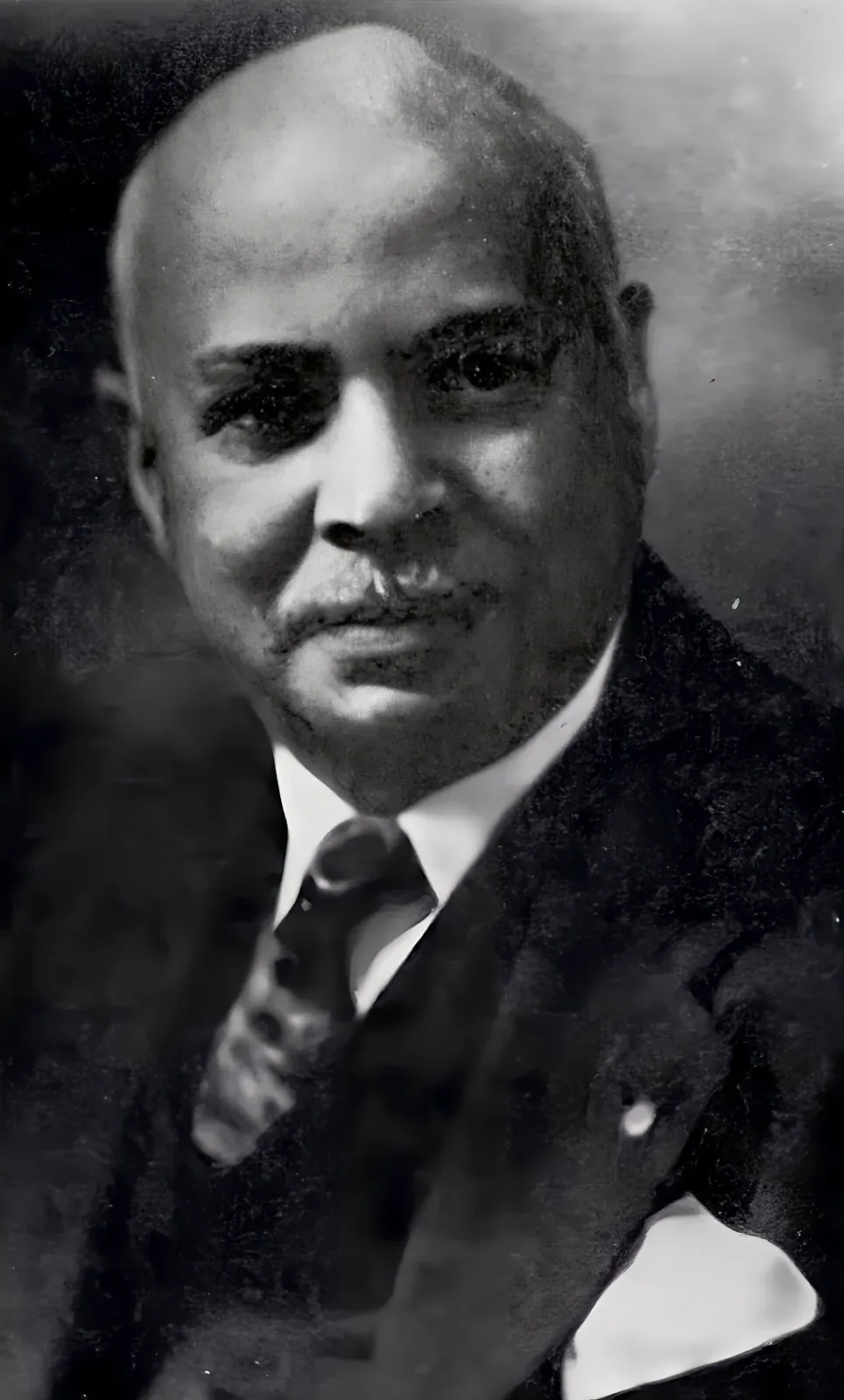
W. C. Handy, a trained cornet player and bandleader, gave the most detailed account of that folk material. In 1902 he travelled through Mississippi listening to local players, and in 1903, waiting for a train in Tutwiler, he heard a man playing guitar with a knife as a slide. He later wrote that he adopted the habit of making a statement, repeating it and then saying why it was made, a three-line lyric he adapted from a song he had heard performed. The musicians’ term for that lyric is the AAB verse.
Memphis and sheet music, 1909-1929
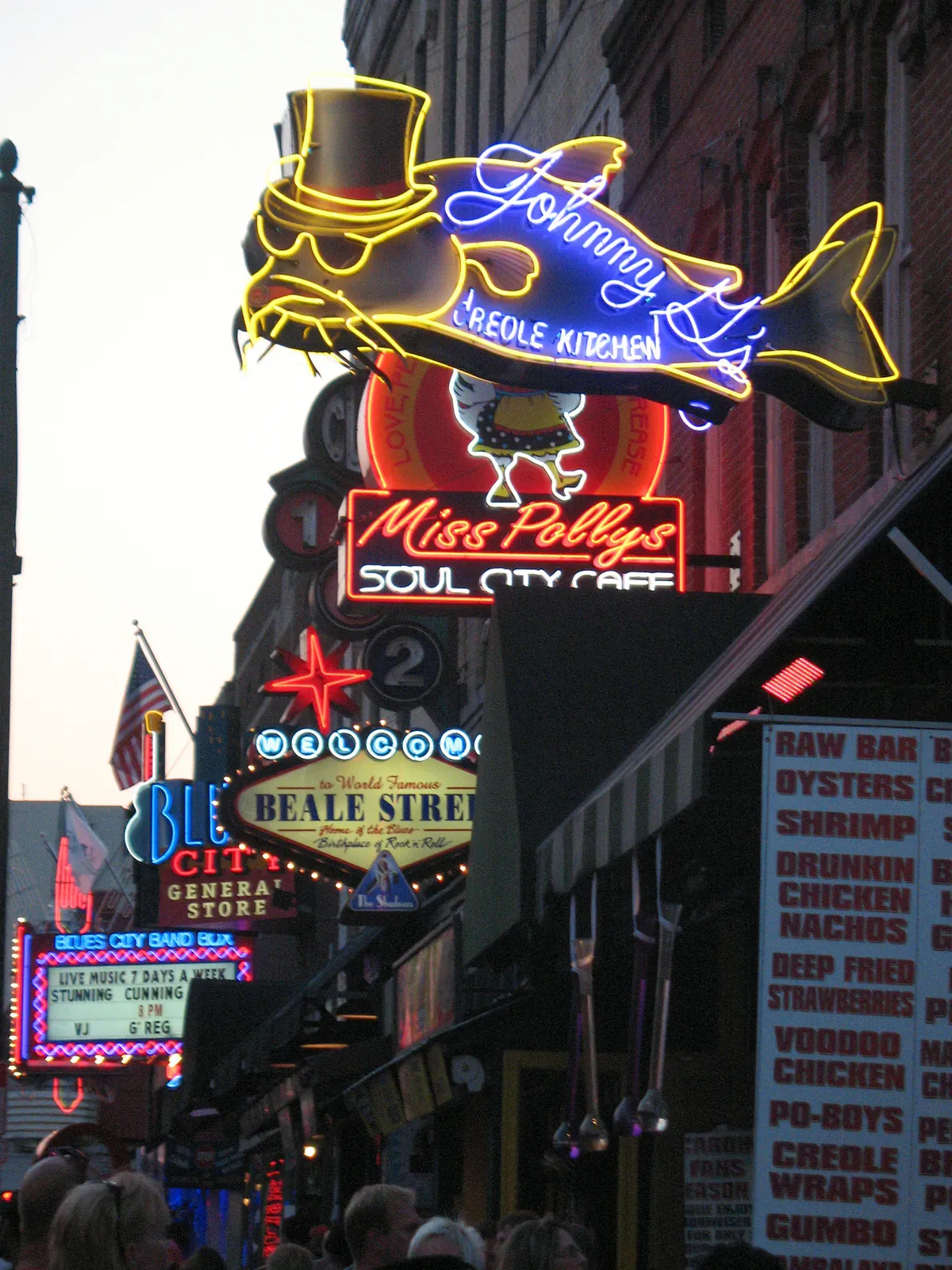
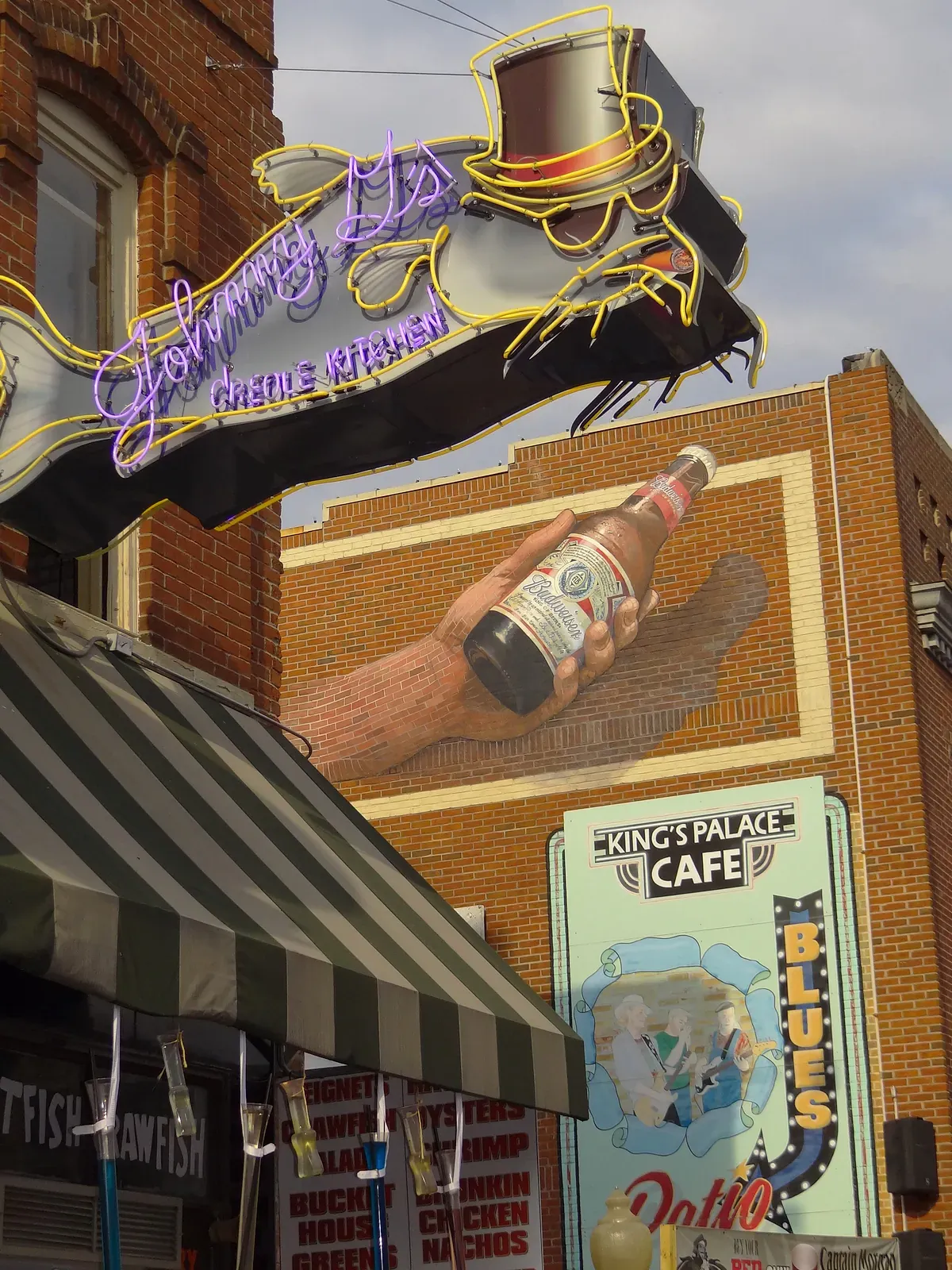
Handy moved his band to Memphis in 1909 and played on Beale Street. A campaign tune for the mayoral candidate Edward Crump became, after rewriting, The Memphis Blues. Its sheet music appeared in 1912 and is credited with introducing the twelve-bar blues in print. Handy sold the rights for 100 dollars, but the piece inspired the foxtrot danced by Vernon and Irene Castle.
In 1914 he published St. Louis Blues, opening with a tango-style passage before dropping into low-down blues strains. Print gave arrangers, bandleaders and jazz players a shared model, and the Memphis publishing business he built with Harry Pace made the city the first centre of printed blues.
Recording followed. In 1920 Okeh released Mamie Smith’s Crazy Blues and showed that Black buyers would pay for blues records. The label’s Okeh catalogue, with Paramount and Vocalion, became the core of the race-record business. Classic blues singers such as Bessie Smith and Ma Rainey made the sung form popular, while rural players recorded more loosely, sometimes adding or dropping a bar, a freedom that the country blues tradition kept.
Piano, jump and electric guitar, 1930-1954
Boogie-woogie pianists turned the changes into a rolling left-hand figure, and in Kansas City shouting singers such as Big Joe Turner sang over small bands in clubs. In the 1940s amplification let T-Bone Walker lead a band with the guitar. His 1947 Call It Stormy Monday set a slow, jazz-coloured template that later electric blues guitarists copied.
Chicago added volume. At the Chess studios Muddy Waters, Howlin’ Wolf and others recorded amplified bands with harmonica, piano, bass and drums, and Willie Dixon wrote songs such as Hoochie Coochie Man for them. The form remained the same, but the rhythm section now carried it. Records of this period are the foundation of rhythm and blues.
Rock and roll, 1954-1958
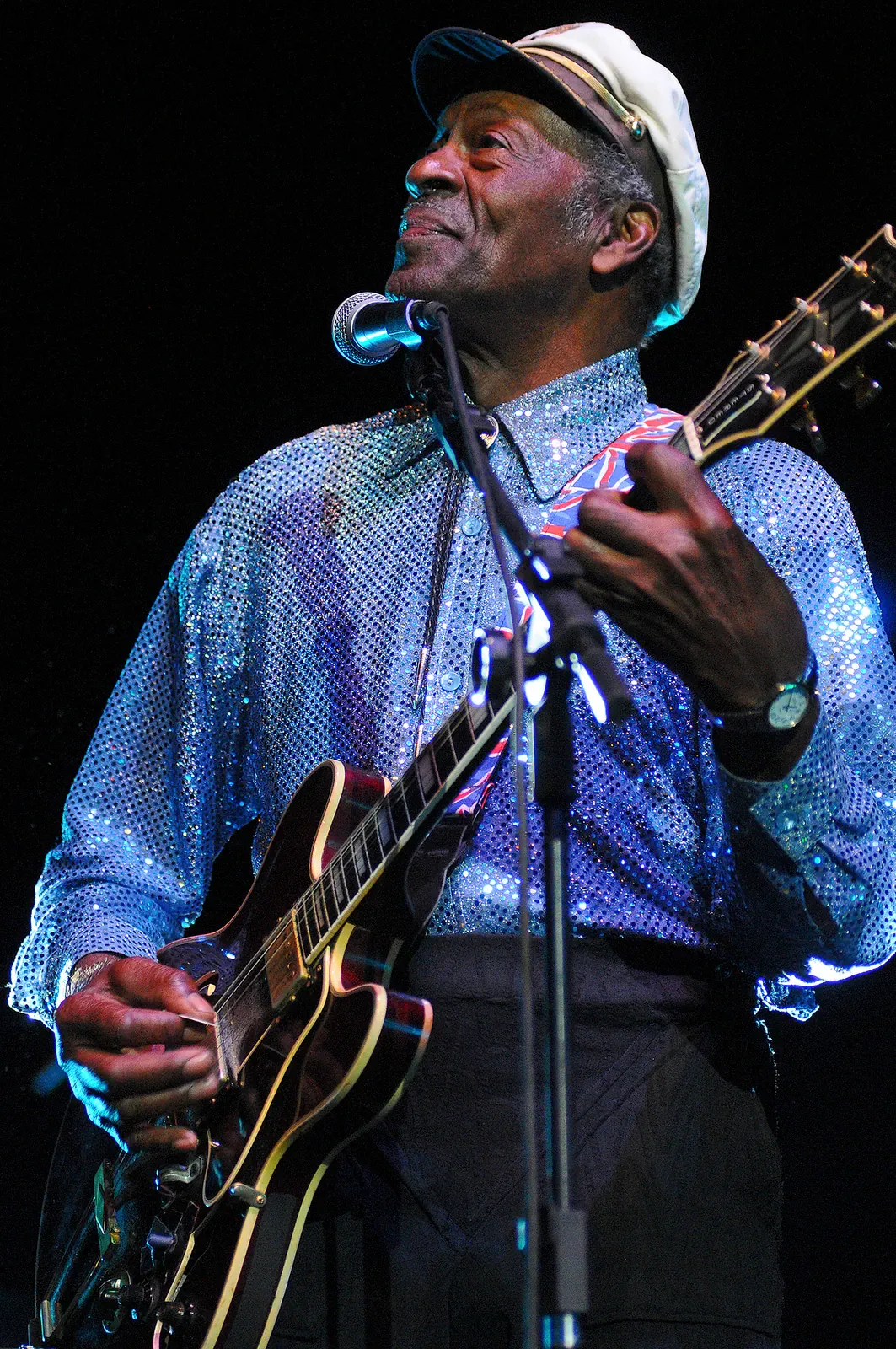
In 1954 Big Joe Turner recorded Shake, Rattle and Roll for Atlantic, and Bill Haley and His Comets recorded Rock Around the Clock, a twelve-bar blues at around 180 beats a minute. Chuck Berry, signed to Chess, built his songs on the same bars: Johnny B. Goode, cut in 1958, opens with a guitar line that restates the first phrase in every chorus. These records carried the twelve-bar frame to a teenage pop audience and are the basis of rock and roll.
Characteristics
In its simplest form the first four bars sit on the I chord, bars five and six move to the IV, bars seven and eight return to the I, and the last four bars run V, IV, I, with a turnaround that points back to the start. Players usually voice every chord as a dominant seventh. Over this plain frame the melody uses blue notes, bent or flattened pitches that sound against the chords.
Variations are many. The quick change goes to the IV chord in the second bar. The shuffle pattern ends with V, IV, I, I in the third phrase. Minor twelve-bar pieces use minor chords, and Charles Brown mixed a major and a minor V in the same piece. Jazz players expanded the changes into the bebop blues, as in Charlie Parker’s Now’s the Time and Billie’s Bounce, and wrote minor blues such as John Coltrane’s Equinox. Eight-bar and sixteen-bar blues shorten or lengthen the plan.
Instruments and production
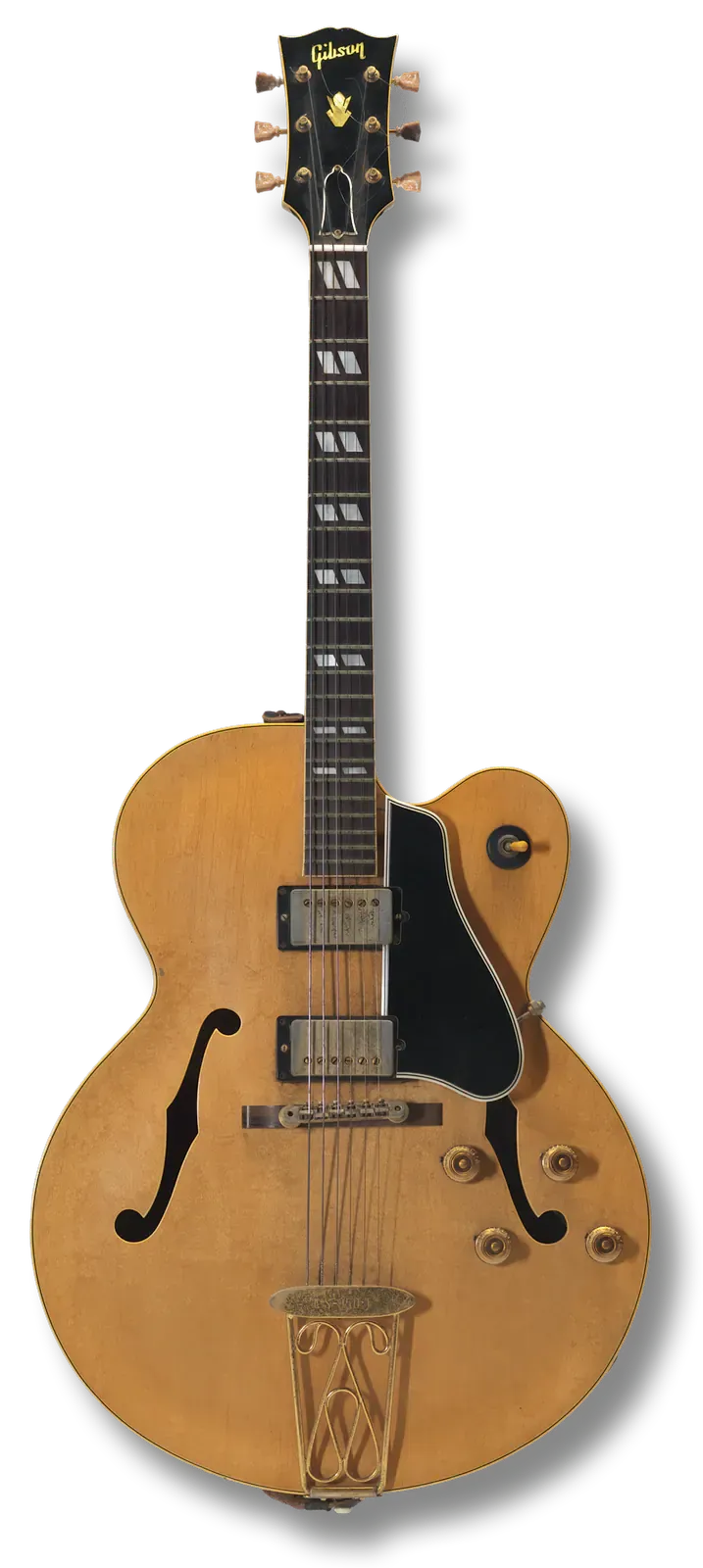
The form travels easily because it needs almost no equipment: a guitar and a voice are enough, and the harmonica and piano fit the changes by ear. In the band version a walking or shuffling bass and a swung drum pattern keep the pulse. Amplification changed the production: after the 1940s the guitar became a lead voice, and engineers in Chicago learned to record a loud band in a small room.
Notable recordings
Robert Johnson’s Cross Road Blues, recorded in San Antonio in November 1936, shows the form at its barest, one voice and one guitar. Muddy Waters’s Hoochie Coochie Man (1954) adds a band and a stop-time hook, where the group plays only on the first beat of the bar. B.B. King’s The Thrill Is Gone (1969) slows the form into a minor key and leaves each vocal line open for a single-note guitar answer.
Culture
Because every blues player knows the changes, the form is the common ground of the jam session: musicians who have never met can start together by naming a key. Swing-era and rock and roll dancers moved to the shuffle behind twelve-bar songs in jitterbug and jive. Handy’s 1941 autobiography, Father of the Blues, and the 1958 film St. Louis Blues, with Nat King Cole in the lead role, shaped how the public remembered his part in the story.
Legacy
The form has outlasted every style that used it. Its harmony turns up in jump blues, rhythm and blues, rock and roll, blues-rock, soul and jazz, and its AAB lyric pattern persists even in songs that change the chords. Few other musical frames have stayed in daily use for a hundred years, in settings as different as a street corner, a recording studio and a classroom.
Misconceptions
Handy did not invent the blues. He said so himself, describing what he collected from Southern players, and the form had circulated by ear before his sheet music appeared. His contribution was to write it down, publish it and help standardise it.
Not every blues has twelve bars. Eight-bar and sixteen-bar forms exist, and many early rural recordings stretch or shorten a phrase when the singer needs it, so the twelve-bar form is the most common frame and not a universal rule.
The form does not belong only to the blues. Rock Around the Clock and Johnny B. Goode follow it, and jazz musicians have used it for generations as a vehicle for improvisation.
Frequently asked questions
What is a twelve-bar blues?
A twelve-bar blues is a chord form lasting twelve measures, divided into three four-bar phrases. The chords are usually the I, IV and V of the key, played as dominant sevenths, and the lyric normally follows an AAB pattern.
What are the chords in a twelve-bar blues?
In the simplest version the chords are I for four bars, IV for two, I for two, then V, IV, I and I or V in the last four. Common additions are the quick change to IV in bar two and a turnaround in the final bars.
Who wrote the first twelve-bar blues?
No one person did. W. C. Handy published the form in The Memphis Blues in 1912, but the pattern was already in use among Southern musicians, and Handy said he took his material from what he heard them play.
Why is it called the twelve-bar blues?
The name counts the bars in one chorus of the form. It is also called blues changes, a musicians’ term for the chord sequence.
Which songs use the twelve-bar blues?
Cross Road Blues, Call It Stormy Monday, Hoochie Coochie Man, Shake, Rattle and Roll, Rock Around the Clock and Johnny B. Goode all follow the form, as do countless jazz themes. The wider history of the tradition is covered on the blues page, and jazz uses of the form on the jazz page.
Sound
Sound sheet
Anatomy of a track
| # | Part | Bars |
|---|---|---|
| 1 | First phrase: I chord | 4 |
| 2 | Second phrase: IV chord, back to I | 4 |
| 3 | Third phrase: V, IV, back to I (turnaround) | 4 |
Signature sounds
- I, IV and V chords, usually dominant sevenths
- Three four-bar phrases
- AAB lyric: line, repeat, answer
- Turnaround in the last bars
Drums and percussion
- Drum kit
Techniques
- Quick change
- Turnaround
- Shuffle feel
- Stop-time
- Boogie-woogie bass
Keys and modes
Major keys with dominant sevenths. The I, IV and V chords are usually played as seventh chords, with blue notes bent against them.
Minor twelve-bar. Minor I and IV chords with a major or minor V, as in slow minor blues.
Tuning
12-TET, A=440, with bent blue notes
Vocals
A three-line verse of a statement, its repeat and an answer, with instrumental fills in the gaps.
Scenes
Where it happened
Where and when the sound lived: one bar per city on a shared timeline.
North America
Active scenes
Peak 2, 1909-1945
Delta town where Handy led a band for six years and heard the local blues that shaped his writing.
Beale Street clubs and Handy's publishing business made the city the first hub of printed blues.
Piano boogie and shouting singers such as Big Joe Turner built the jump-blues sound on the twelve-bar frame.
Chess and other labels recorded electric bands that made the twelve-bar blues loud and amplified.
Venues and places
Chicago, 1957 to today. Home of Chess from 1957, where Muddy Waters and Chuck Berry cut twelve-bar blues and rock and roll.
Culture
Culture markers
- Jam sessions
Players who have never met can start together by naming a key and the twelve-bar form.
Ritual - Jitterbug and jive
Swing-era and rock and roll dancers moved to the shuffle rhythm behind twelve-bar songs.
Dance - The changes
Musicians call the chord sequence the changes, hence the alternate name blues changes.
Slang
Media
Key media
- 1941Father of the Blues
by W. C. Handy. Handy's autobiography, the main first-hand account of how he gathered and published blues.
Book - 1958St. Louis Blues
by Allen Reisner. Biopic of W. C. Handy with Nat King Cole in the title role.
Film
Glossary
Terms on this page
A lyric of a line, its repeat and a rhyming answer, one line to each four-bar phrase.
A measure of music; the form lasts twelve of them before the cycle repeats.
A flattened third, fifth or seventh that gives the melody its blues colour against the plain chords.
A variation where the second bar moves to the IV chord before returning to the I.
A swung long-short rhythm in the rhythm section, common behind the twelve-bar form.
A short chord figure in the last bars that leads back to the start of the next chorus.
Blues family