Contemporary blues
Contemporary blues is post-1980 American blues that mixes electric and acoustic roots with rock, pop, soul and folk and polished studio production.
United States, 1980
Blues family
Born
1980
United States
Subgenres
2
Documented branches
Links
7
Genres it drew on or shaped
Tempo
75-125 BPMLineage
Family tree
Grew out of
Derived from
Influenced by
United States, 1980
Contemporary blues
Led to (2)
Timeline
Era by era
From the first sparks to today. Select a dot to read the story behind it.
- Revival and Texas Flood
1980 to 1989
- Crossover and young guitarists
1990 to 1999
- Festival and television era
2000 to 2009
- New generation
2010 to today
Eras
Moments
- 1 Revival and Texas Flood, 1980 to 1989
- 2 Crossover and young guitarists, 1990 to 1999
- 3 Festival and television era, 2000 to 2009
- 4 New generation, 2010 to today
1980
Revival and Texas Flood
Stevie Ray Vaughan's 1983 debut and Robert Cray's 1986 Strong Persuader showed that a polished, guitar-led blues could sell records and win Grammys.
- 1971Alligator Records founded in ChicagoBruce Iglauer's independent label became a long-running home for new blues artists.
- 1983Texas Flood releasedStevie Ray Vaughan's debut helped launch the 1980s blues guitar revival.
- 1986Strong Persuader releasedRobert Cray's breakthrough album on Mercury and Hightone went on to sell over two million copies.
- 1988Grammy category for contemporary blues beginsBest Contemporary Blues Performance was first awarded at the 1988 ceremony.
- 1989Nick of Time releasedBonnie Raitt's album reached a mass audience and set up her pop success.
- 1989Buddy Guy's Legends opens in ChicagoThe South Loop club became a showcase for working blues players.
1990
Crossover and young guitarists
Bonnie Raitt and Keb' Mo' reached pop and folk audiences, while teenagers Kenny Wayne Shepherd and Jonny Lang took blues-rock to radio.
- 1991Luck of the Draw releasedBonnie Raitt's follow-up carried Something to Talk About and I Can't Make You Love Me.
- 1994Keb' Mo' debut album releasedThe self-titled Okeh/Epic album introduced his acoustic, songwriter-led blues.
- 1995Ledbetter Heights releasedKenny Wayne Shepherd's debut arrived when he was 18.
- 1997Blue on Black and Lie to MeKenny Wayne Shepherd's Blue on Black and Jonny Lang's Lie to Me brought blues-rock to radio.
2000
Festival and television era
Blues stayed alive on independent labels, festival circuits and television series, with a separate Grammy category running until 2011.
- 2003Martin Scorsese Presents the BluesThe television series spotlighted blues history and current players, with a Keb' Mo' episode.
2010
New generation
Gary Clark Jr. and Christone Kingfish Ingram brought younger audiences, and the Grammy contemporary category returned in 2017.
- 2010Bright Lights EP releasedGary Clark Jr.'s EP started his rise from the Austin club scene.
- 2012Grammy blues categories mergedBest Contemporary Blues Album was folded into Best Blues Album.
- 2017Contemporary blues Grammy returnsThe Recording Academy restored separate traditional and contemporary blues categories.
- 2019Christone Kingfish Ingram debut releasedThe Clarksdale guitarist's first album came out on Alligator.
Listening path
Start listening
A short path from an easy way in to the deep end. Thumbnails come from YouTube; the player loads only when you press play.
- 01
Robert Cray, 1986
Polished, soul-edged blues that took Cray's band to a mainstream audience.
- 02
Bonnie Raitt, 1991
Blues-tinged pop-rock single with Raitt's slide guitar that crossed over.
- 03
Keb' Mo', 1994
Gentle acoustic blues that showed the songwriter side of the style.
- 04
Kenny Wayne Shepherd, 1997
Radio hit that carried blues-rock to a younger audience.
Facts
| Family | Blues |
| Origin | United States |
| Emerged | 1980s to 1990s onwards |
| Status | Active |
| Tempo | 75 to 125 BPM |
| Meter | 4/4 |
| Grew out of | Electric blues |
| Subgenres | 2 |
Contemporary blues is the blues made since about 1980, mostly in the United States. It descends from electric blues and keeps the twelve-bar form, but smooths the sound with rock, pop, soul and folk influence and modern studio production.
It is usually electric, rarely purist, and built around songwriting as much as guitar playing.
Origins
The style grew out of the blues revival of the early 1980s. Stevie Ray Vaughan’s debut Texas Flood arrived in 1983 and made a blues guitarist an international name. Three years later Robert Cray’s Strong Persuader, released in November 1986 on Mercury and Hightone, became his mainstream breakthrough and went on to sell over two million copies. Cray’s records favoured clean guitar tone, soul-style singing and tightly arranged songs over the raw Chicago approach of earlier decades.
The recording industry then gave the style a name. The Grammy Awards began a Best Contemporary Blues Performance category at the 1988 ceremony, separating players like Cray from traditional and country blues. The label of the period matters too: the independent Chicago label Alligator, founded by Bruce Iglauer in 1971, kept signing new blues artists while major labels dipped in and out.
Revival and Texas Flood, 1980-1989
The decade tied blues to existing rock audiences. Texas became a base for blues-rock guitarists, with Austin clubs such as Antone’s, opened in 1975, giving players a stage. In Chicago, Buddy Guy’s Legends opened in 1989 and gave working musicians a permanent showcase. Blues societies formed in major cities, magazines such as Living Blues and Blues Revue launched, and outdoor blues festivals became more common.
Bonnie Raitt completed the decade in 1989 with Nick of Time, a record that mixed blues, rock and folk and won the Grammy for Album of the Year. Her slide guitar and warm alto voice proved that a blues-trained artist could be a pop star without abandoning her roots.
Crossover and young guitarists, 1990-1999
In 1991 Raitt followed up with Luck of the Draw, which carried Something to Talk About and I Can’t Make You Love Me. Keb’ Mo’ released his self-titled debut in 1994 on Okeh and Epic, offering an acoustic, Delta-rooted blues with a pop songwriter’s sense of melody. He later won the contemporary blues Grammy four times, tied with Buddy Guy for the record.
The decade also produced teenage prodigies. Kenny Wayne Shepherd released Ledbetter Heights in 1995 at 18, and his follow-up Trouble Is… in 1997 carried Blue on Black to rock radio. Jonny Lang’s Lie to Me appeared in 1996 and 1997 and brought a teenage singer and guitarist to a rock audience. These records sat closer to blues rock than to the traditional form, and critics argued over where the border lay.
Festival and television era, 2000-2009
By the 2000s the market for blues albums was small compared with rock and pop, and the touring festival circuit carried much of the economics. Martin Scorsese Presents the Blues, a television series broadcast in 2003, put current players next to historic ones, and Keb’ Mo’ was among the featured artists. The Grammy category continued until 2011, when the Academy merged blues categories into Best Blues Album.
New generation, 2010 onward
Gary Clark Jr. broke out of the Austin scene with his Bright Lights EP in 2010 and the 2012 album Blak and Blu, mixing blues with soul, rock and hip-hop. Christone Kingfish Ingram, from Clarksdale, Mississippi, issued his debut on Alligator in 2019, tying the new generation back to the Delta and to the Chicago label. The Grammy Awards reinstated separate traditional and contemporary blues categories in 2017.
Characteristics
Most songs follow the twelve-bar form or a variation of it, set in a shuffle or a backbeat groove at moderate tempos. Arrangements are compact, with an intro, two verses, a guitar solo and a final verse, and the guitar often answers the vocal line. The key difference from older electric blues lies in finish. Takes are cleaner, vocals sit higher in the mix, and songs lean towards soul and pop structures, with lyrics that cover relationships, regret and everyday life rather than only hardship.
Instruments and production
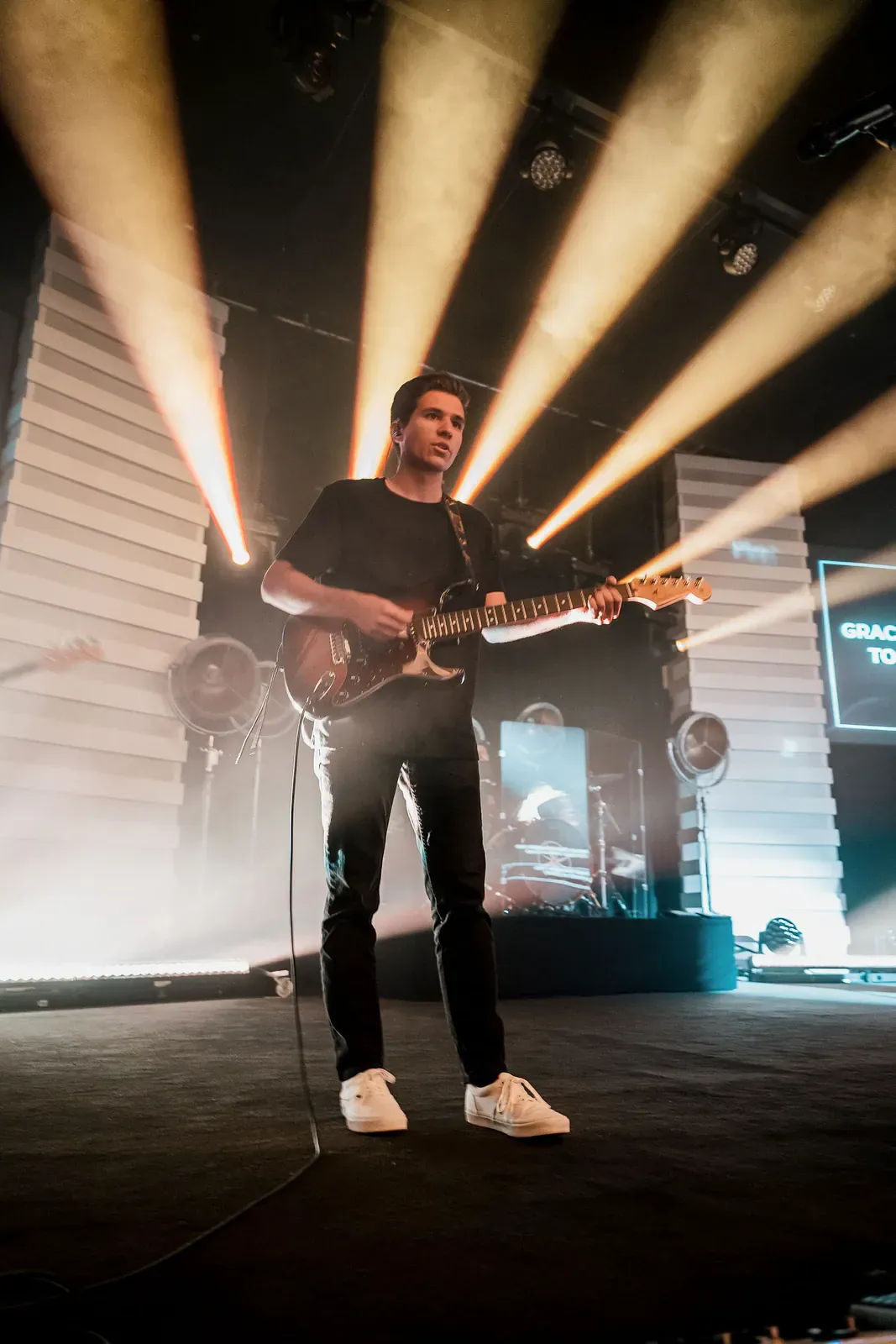
The core band is guitar, bass and drums, often with organ or piano. Clean Stratocaster tones are common, while acoustic players use resonator and flat-top guitars. Production relies on multitrack recording and digital editing, which gave the style a smooth finish but also raised costs and made spontaneous, improvised takes harder to preserve.
Culture
The audience is spread across festivals, club residencies and societies rather than concentrated in one city. Chicago, Austin, Los Angeles and the Mississippi Delta each host separate scenes, and independent labels such as Alligator do much of the recording work. Awards such as the Blues Music Awards and the Grammys give the field its yearly landmarks.
Misconceptions
Contemporary blues is not simply blues rock. Blues rock treats blues as raw material for a rock band, while contemporary blues keeps the blues form and singing at the centre and uses rock as seasoning. It is also not a purely electric style: Keb’ Mo’ and others work largely on acoustic and resonator guitars. And it is not a white rock style, since Cray, Keb’ Mo’, Gary Clark Jr. and Kingfish Ingram are all Black artists who built their careers inside the form.
Legacy
The style defined how blues sounds on modern radio and at festivals and kept the category alive in the awards system. It also set up the crossover paths now used by new artists, who move between blues, soul and rock without choosing one.
Frequently asked questions
What is contemporary blues?
Contemporary blues is blues made since the 1980s that blends the traditional form with rock, pop, soul and folk and uses modern production. It is usually electric and songwriting-led.
Who are the main contemporary blues artists?
Robert Cray, Bonnie Raitt, Keb’ Mo’, Kenny Wayne Shepherd and Gary Clark Jr. are central figures, with Jonny Lang and Christone Kingfish Ingram also prominent.
How is contemporary blues different from electric blues?
Electric blues grew out of the amplified Chicago and Texas styles of the 1940s and 1950s. Contemporary blues is the later, more polished descendant, with cleaner tone, pop and soul arrangements and studio production.
What tempo is contemporary blues?
Most recordings sit between roughly 80 and 125 beats per minute in a shuffle or backbeat groove.
Sound
Sound sheet
Anatomy of a track
| # | Part | Bars |
|---|---|---|
| 1 | Intro | 4 |
| 2 | Verse (12-bar) | 12 |
| 3 | Verse (12-bar) | 12 |
| 4 | Guitar solo | 12 |
| 5 | Final verse | 12 |
| 6 | Outro | 4 |
Signature sounds
- Clean, vibrato-rich guitar leads
- Gospel and soul-inflected vocals
- Organ or horn pads under solos
- Slide or resonator guitar on acoustic tracks
Drums and percussion
- Drum kit
Techniques
- String bending
- Slide guitar
- Shuffle rhythm
- Call and response
Keys and modes
Minor pentatonic with blue notes. Core scale for guitar leads and fills.
Major pentatonic. Brighter melodies in acoustic and soul-leaning songs.
Vocals
Smooth, soulful lead vocals with gospel and pop influence, often songwriter-led.
Scenes
Where it happened
Where and when the sound lived: one bar per city on a shared timeline.
North America
Active scenes
Peak 4, 2010-2025
Home of Alligator Records and the club circuit that kept new blues visible.
Texas blues-rock capital where Stevie Ray Vaughan and later Gary Clark Jr. built followings.
Studio base for Cray's Strong Persuader sessions and home to Bonnie Raitt and Keb' Mo'.
Mississippi Delta town that produced Christone Kingfish Ingram.
Venues and places
Chicago, 1989 to today. Blues club opened by guitarist Buddy Guy in Chicago's South Loop.
Austin, 1975 to today. Austin blues club that hosted touring legends and local newcomers.
Culture
Culture markers
- Blues festivals
Outdoor festivals became more common in the 1980s and 1990s and anchor the touring circuit.
Ritual - Blues societies
Local societies formed in major cities as Living Blues and Blues Revue launched in the same decades.
Ritual - Blues Music Awards
Annual awards that recognise the broad range of current blues recordings.
Ritual
Media
Key media
- 2003Martin Scorsese Presents the Blues
by Various. Seven-part television series covering blues history and modern players.
Film
Glossary
Terms on this page
A guitar with a metal cone that makes it louder and brassier.
A swung rhythm pattern with a rolling triplet feel.
Playing with a glass or metal slide against the strings for gliding pitch.
A short phrase at the end of a chorus that leads back to the start.
The standard 12-measure chord form behind most blues songs.
Blues family