Musique Concrète
Musique concrète is music composed from recorded sounds edited on disc and tape, begun by Pierre Schaeffer at French radio in Paris in 1948.
Paris, 1948
Experimental family
Born
1948
Paris
Subgenres
2
Documented branches
Links
25
Genres it drew on or shaped
Tempo
70-105 BPMLineage
Family tree
Grew out of
Influenced by
Cut-up (music)
Paris, 1948
Musique Concrète
Led to (7)
Timeline
Era by era
From the first sparks to today. Select a dot to read the story behind it.
- Radio studio and first studies
1942 to 1950
- Tape and the GRMC
1951 to 1957
- Schaeffer's GRM
1958 to 1974
- Acousmatic music and INA
1974 to 1999
- Digital and archive
2000 to today
Eras
Moments
- 1 Radio studio and first studies, 1942 to 1950
- 2 Tape and the GRMC, 1951 to 1957
- 3 Schaeffer's GRM, 1958 to 1974
- 4 Acousmatic music and INA, 1974 to 1999
- 5 Digital and archive, 2000 to today
1942
Radio studio and first studies
Pierre Schaeffer founds the Studio d'Essai at French radio in 1942, premieres Cinq études de bruits in 1948 and builds the Symphonie pour un homme seul with Pierre Henry from shellac discs.
- 1942Studio d'Essai foundedPierre Schaeffer starts the Studio d'Essai at French radio, a Resistance base that later became his laboratory.
- 1944The Expression of Zaar in CairoHalim El-Dabh processes a recorded zaar ceremony with reverb and re-recording, an early tape-style work outside France.
- 1948Cinq études de bruitsSchaeffer's five noise studies, including Étude aux chemins de fer, are premiered in Paris on 5 October.
- 1950Symphonie pour un homme seulSchaeffer and Henry's twelve-movement suite is built mostly from records, with voices, footsteps and prepared sounds.
1951
Tape and the GRMC
The Groupe de Recherches de Musique Concrète opens the first purpose-built studio in 1951. Tape editing, the phonogène and visiting composers such as Boulez, Messiaen, Stockhausen and Varèse shape the repertoire.
- 1951GRMC founded at RTFSchaeffer, Henry and engineer Jacques Poullin gain official recognition and the first purpose-built electroacoustic studio.
- 1952A la recherche d'une musique concrèteSchaeffer publishes the journals of his 1948 work, laying out the vocabulary of the new music.
- 1953Phonogènes builtChromatic and sliding phonogènes give composers keyboard and continuous control of tape speed.
- 1953Orphée 53 at DonaueschingenThe Schaeffer and Henry opera is met with a hostile reception at the festival.
- 1954Varèse records tape parts for DésertsEdgard Varèse works at the GRMC studio on the tape interludes for Déserts, one of several outside composers to do so.
1958
Schaeffer's GRM
After Henry and others resign in 1958, Schaeffer founds the Groupe de Recherches Musicales. The Traité des objets musicaux appears in 1966 and Henry's Psyché Rock reaches pop audiences in 1967.
- 1958GRM foundedHenry and colleagues resign in April; Schaeffer creates the Groupe de Recherches Musicales with Ferrari, Xenakis, Parmegiani and others.
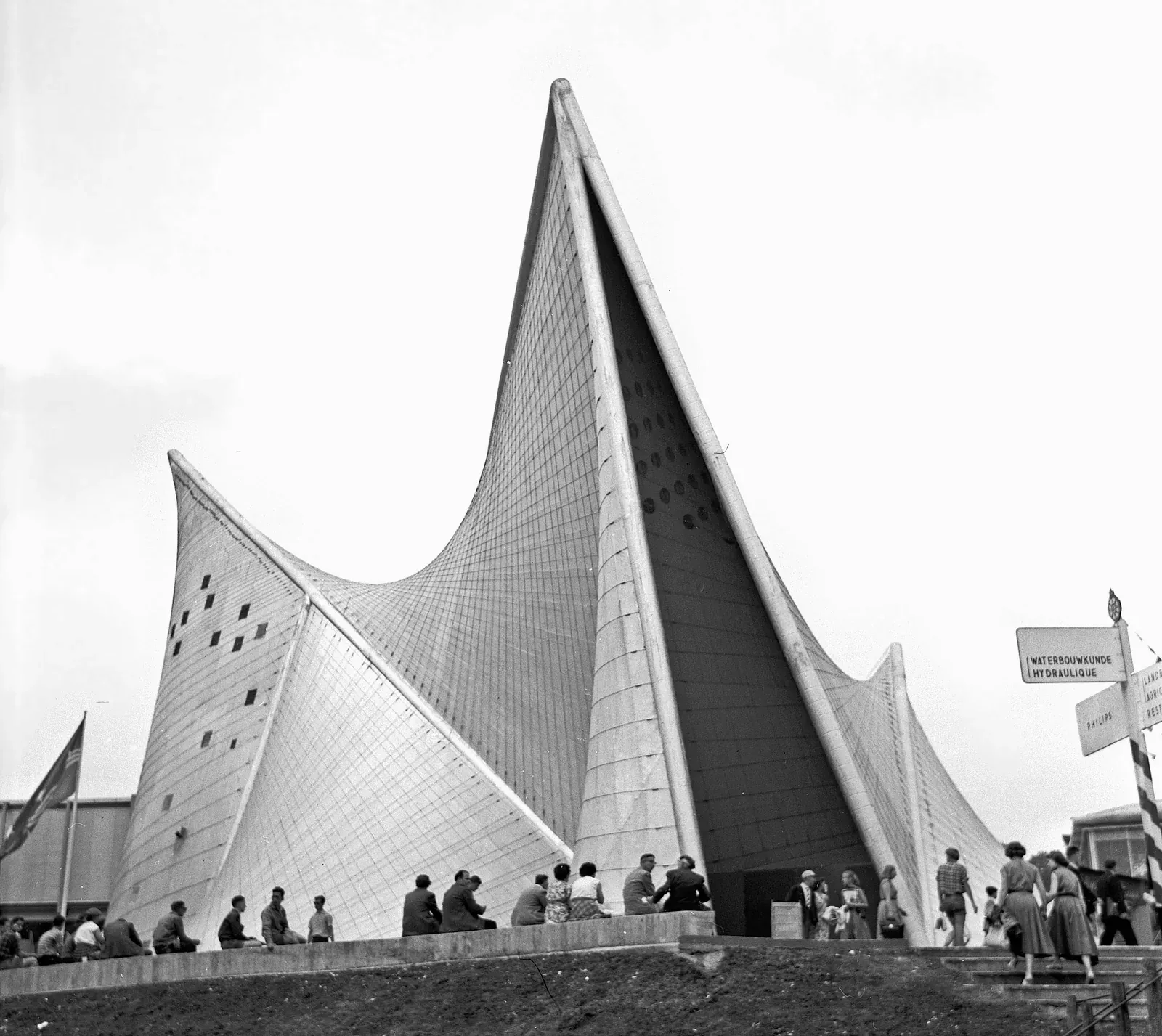
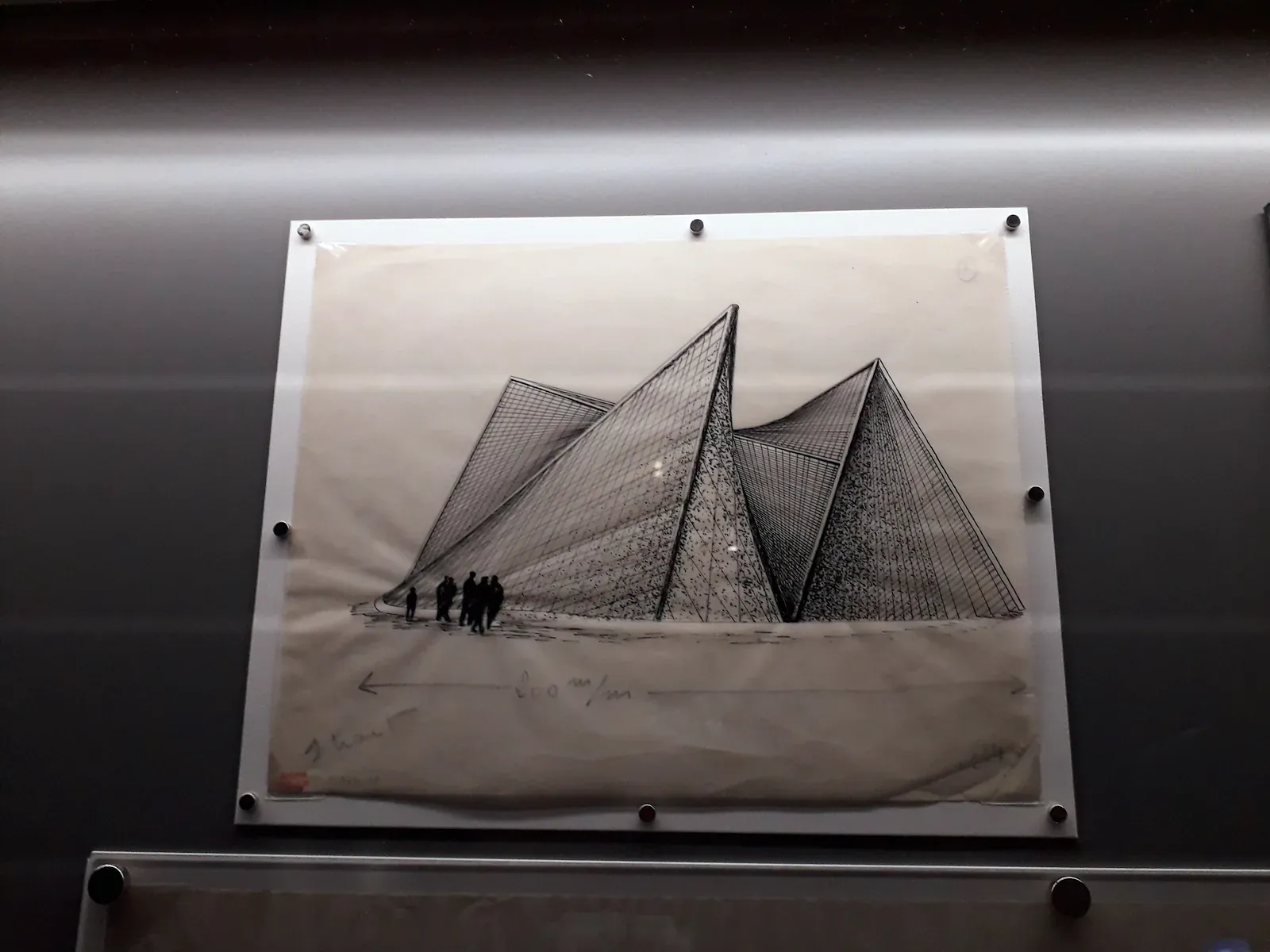
- 1958Concret PH at the Philips PavilionIannis Xenakis builds a tape piece from burning charcoal crackles to fill the gaps between spatialised works at the Brussels fair.
- 1966Traité des objets musicauxSchaeffer publishes the culmination of two decades of research, with the sound examples of Le solfège de l'objet sonore.
- 1966Bayle takes over GRMFrançois Bayle directs the group for 31 years, to 1997.
- 1966The Beatles use tape loopsTomorrow Never Knows brings tape loops, speed change and reversed sound into a pop single.
- 1967Messe pour le temps présentPierre Henry and Michel Colombier's score for a Maurice Béjart ballet contains Psyché Rock, later a pop hit and remix staple.
- 1968Revolution 9The Beatles release a pure concrète collage of tape loops on the White Album.
- 1970Presque rien no. 1Luc Ferrari condenses a dawn on a seaside beach into a field recording that is edited but barely altered.
- 1970Studio 54 and the Coupigny synthesiserGRM adds a combined mixing desk and modular synthesiser designed for concrète composition.
1974
Acousmatic music and INA
François Bayle's Acousmonium loudspeaker orchestra debuts in 1974, GRM joins INA in 1975, and the practice is increasingly called acousmatic music, with sampling carrying the idea into pop.
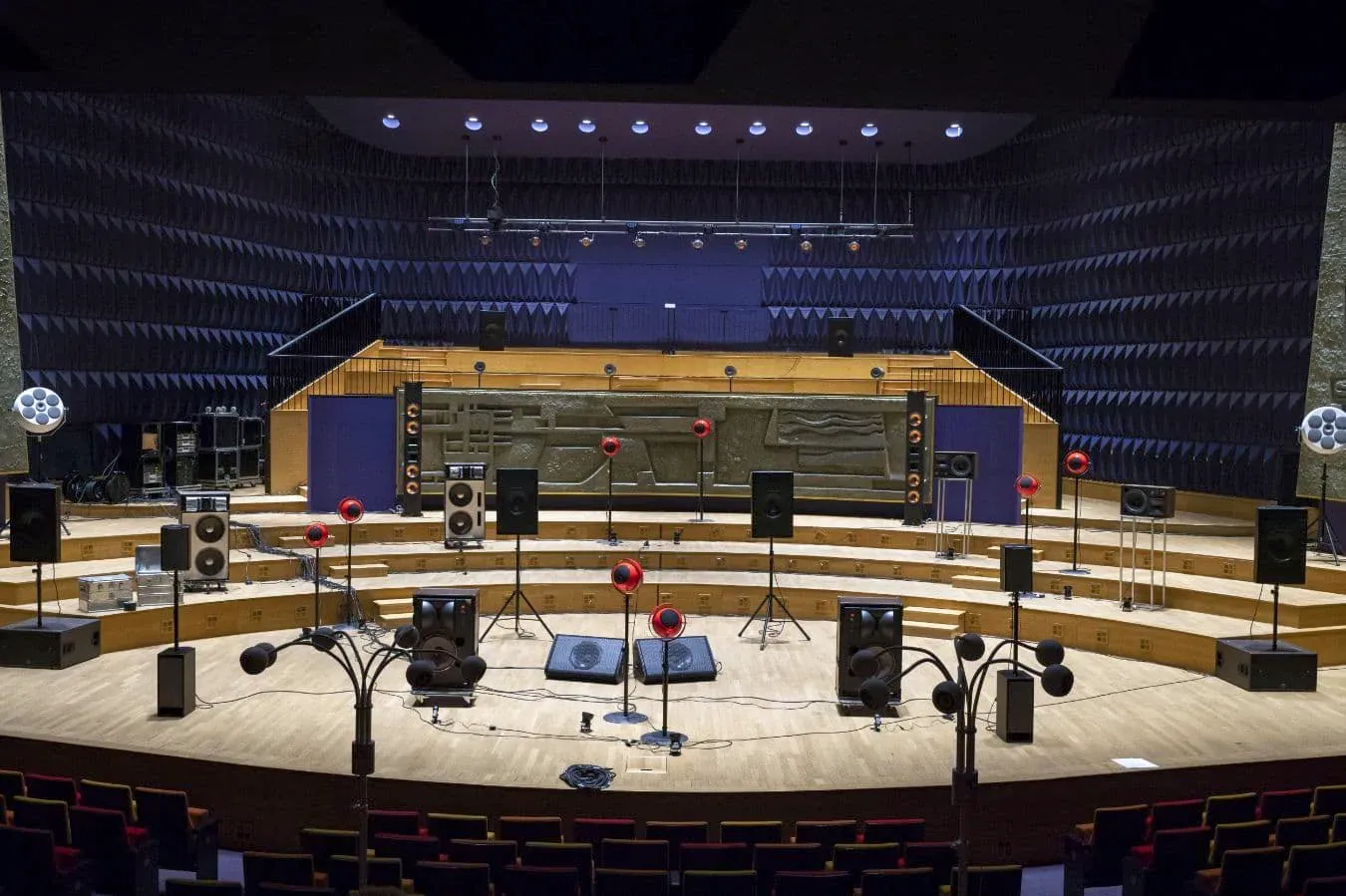
- 1974Acousmonium premiereBayle and Jean-Claude Lallemand present an orchestra of loudspeakers at Espace Pierre Cardin on 14 February.
- 1975GRM joins INAThe group is integrated into the new Institut national de l'audiovisuel, with Bayle at its head.
- 1975De natura sonorumBernard Parmegiani premieres his twelve-movement study of sound types at Salle Wagram in Paris.
- 1981My Life in the Bush of GhostsBrian Eno and David Byrne combine tape samples with synthesised sound, carrying concrète into pop.
- 1990L'Œuvre musicaleINA-GRM issues Schaeffer's collected works as a box set.
2000
Digital and archive
Composers work in software while INA GRM reissues the founders' tape works digitally, including Schaeffer's Œuvres 1948-1952 in 2023.
- 2023Schaeffer reissuesINA GRM releases Œuvres 1948-1952 and Œuvres 1958-1979 digitally.
Listening path
Start listening
A short path from an easy way in to the deep end. Thumbnails come from YouTube; the player loads only when you press play.
- 01
Pierre Schaeffer, 1948
The first concrète study, made from locomotive recordings.
- 02
Pierre Schaeffer and Pierre Henry, 1950
Voices, footsteps and objects composed as a suite.
- 03
Pierre Henry and Michel Colombier, 1967
The pop face of concrète: a beat built over a tape loop.
- 04
Luc Ferrari, 1970
A dawn on a beach, edited into music.
- 05
Bernard Parmegiani, 1975
Acousmatic sound shaping at its most refined.
Facts
| Family | Experimental |
| Origin | Paris, France |
| Emerged | 1948 |
| Status | Historical |
| Tempo | 70 to 105 BPM |
| Meter | Free; metered sections in 3/4 and 4/4 |
| Subgenres | 2 |
Musique concrète is a way of composing with recorded sound instead of written notes: the composer collects sounds from voices, objects, instruments or the street, then edits, transposes and layers them on disc or tape.
It began in Paris in 1948 in the studios of French radio under Pierre Schaeffer, and its methods spread into electronic music, film sound and, through sampling, pop and hip-hop. The word concrète refers to working from concrete sound material rather than from an abstract score.
Origins
The idea had precedents. Writers and composers of the 1920s and 1930s, among them Stravinsky, imagined music made specifically for the gramophone, and Walter Ruttmann’s 1930 sound film Weekend assembled recordings of Berlin into a collage. In Cairo in 1944 the student Halim El-Dabh recorded a zaar ceremony and processed it with reverb and re-recording, a tape-style experiment unknown in Europe at the time.
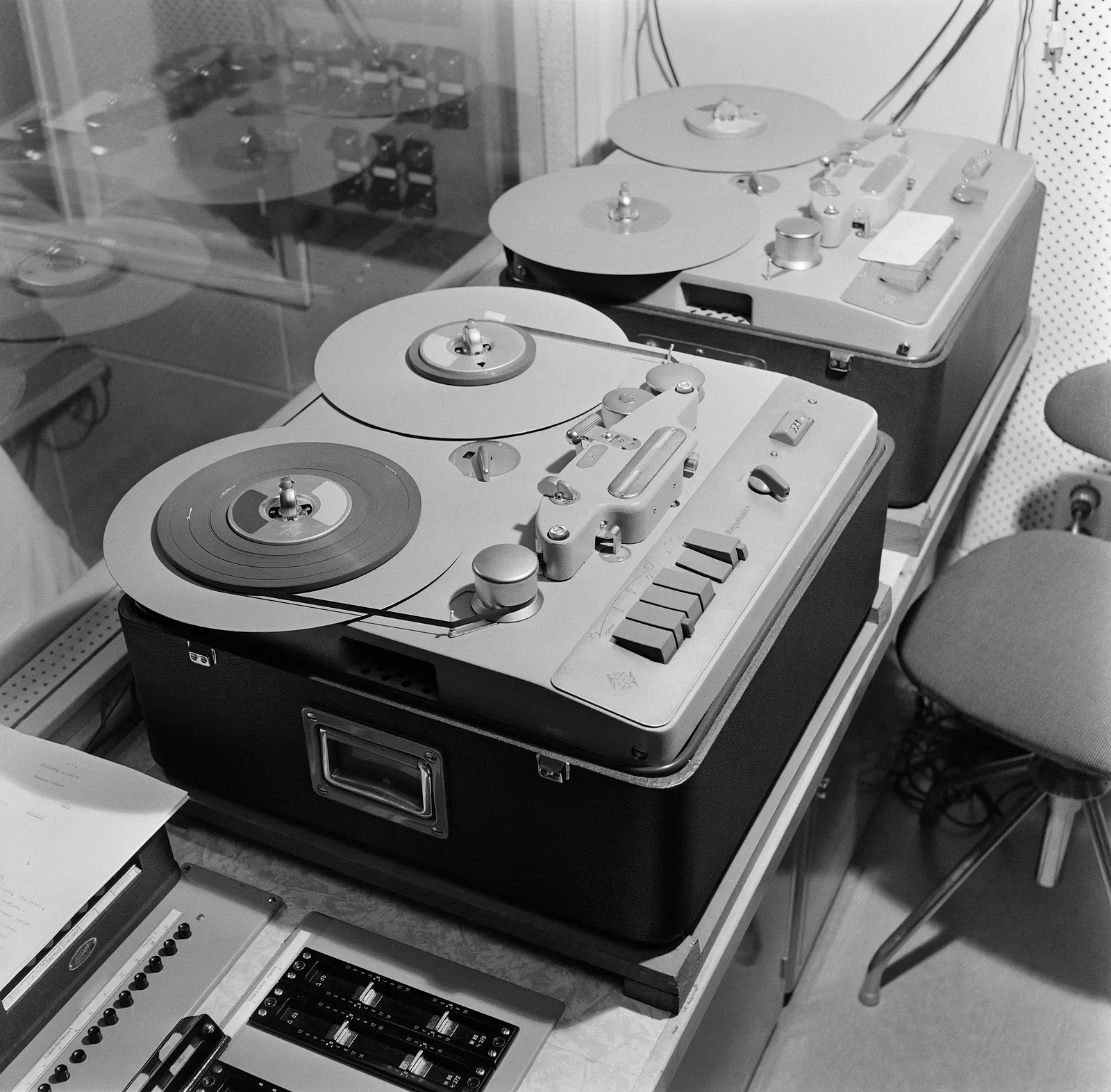
The movement itself grew out of radio. Schaeffer, an engineer and broadcaster, set up the Studio d’Essai at French radio in 1942, first as a Resistance base and then as a workshop for radio art. In 1948 he began what he called research into noises, working with shellac disc players, a mixing desk and microphones. On 5 October 1948 his Cinq études de bruits were presented in Paris, including the Étude aux chemins de fer built from locomotive recordings. He published the journals of this work in 1952 as A la recherche d’une musique concrète.
Paris, 1949-1957
In 1949 Schaeffer was joined by the composer-percussionist Pierre Henry, and together they made the Symphonie pour un homme seul, performed in 1950, a suite of voices, footsteps, breath and prepared sounds. It was assembled mostly from discs, because the first tape recorders that reached the broadcaster in 1949 were still unreliable. Once they worked, tape splicing allowed precise cuts and short fragments joined into new phrases, a method called micromontage.
In 1951 Schaeffer, Henry and the engineer Jacques Poullin gained official recognition as the Groupe de Recherches de Musique Concrète, with the first studio built specifically for the purpose. It drew outside composers, among them Boulez, Messiaen, Stockhausen, Varèse and Xenakis. Machines built for the studio included the phonogènes of 1953, which changed pitch and duration by keyboard or sliding control, and a three-head tape recorder that played three synchronised tapes through separate speakers. The group’s public record was uneven: Orphée 53, the Schaeffer and Henry opera presented at Donaueschingen that year, met a hostile reception.
The GRM, 1958-1974
Disagreement over direction led Henry and several colleagues to resign in April 1958. Schaeffer answered by founding the Groupe de Recherches Musicales (GRM), recruiting Luc Ferrari, Iannis Xenakis, Bernard Parmegiani, Michel Chion and others. The same year Xenakis, then also working as an architect with Le Corbusier, made Concret PH from the crackle of burning charcoal. It played between performances of Varèse’s Poème électronique inside the Philips Pavilion at the Brussels world’s fair.
The group turned to theory in 1966 with Schaeffer’s Traité des objets musicaux, which set out the sound object and reduced listening. The same year François Bayle took over the direction of the GRM and held it until 1997. In 1970 the studio added a combined mixing desk and modular synthesiser designed for concrète work, a sign that the old rivalry with the electronic music of the Cologne studio had cooled.
Acousmatic music and INA, 1974-1999
In the late 1960s, particularly in France, the term acousmatic music came into use for fixed-media works that combine concrète techniques with live spatialisation. On 14 February 1974 Bayle and the engineer Jean-Claude Lallemand presented the Acousmonium, an orchestra of loudspeakers, at the Espace Pierre Cardin in Paris. The GRM joined the new Institut national de l’audiovisuel in 1975, with Bayle at its head. The following decades belong to composers such as Parmegiani and Ferrari, to a second French centre in Bourges, and to university studios abroad.
Characteristics
Concrète composers treat a recorded sound as an object with its own shape, grain and duration, apart from what made it. Schaeffer called this attention reduced listening. Source sounds are often recognisable, and a door, a train or a voice can carry meaning, but transformation can also disguise them until the cause is unclear. The result is not bound by melody, harmony or fixed metre, although rhythmic and tonal passages appear in many works.
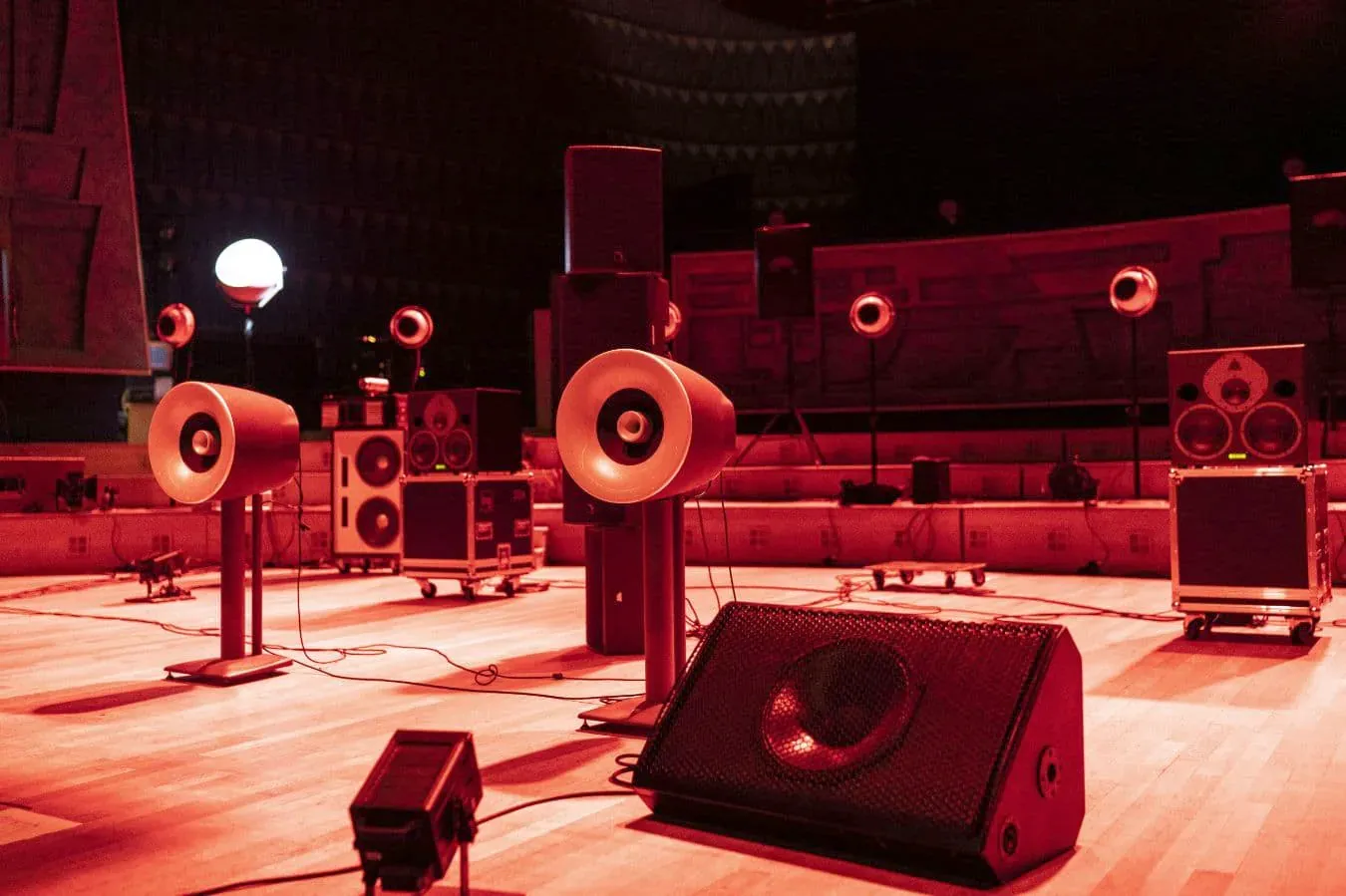
Form usually follows the sound itself. Pieces move through gestures and textures, contrasting short attacks with long drones, close recorded detail with distant reverberant space. Because the final work exists only as a recording, it is performed by playback, which is why concerts centre on the placement of speakers.
Instruments and production
The first studio kit was ordinary radio equipment: shellac record players that could play forward, backward or at fixed speed ratios, a recorder to capture the mix, filters and mechanical reverberation. Tape from about 1950 added looping, splicing and continuous speed change. The Morphophone, a rotating disc with ten playback heads, built echo and feedback structures. Later GRM tools combined synthesis with recording, although Schaeffer distrusted synthesisers that favoured preconceived music over listening.
Composers now work with computers, but the core operations remain: speed transposition, which changes pitch and length together, reversal, filtering, looping, layering and spatial placement.
Notable recordings
Étude aux chemins de fer (1948) is the founding study: sampled locomotive sounds cut into a rhythmic piece lasting under three minutes. Symphonie pour un homme seul followed as the first extended work, and Henry’s Variations pour une porte et un soupir (1963) later showed that a creaking door and a sigh could sustain a long composition.
Luc Ferrari’s Presque rien no. 1 (1970) compressed the dawn on a coastal beach into about twenty minutes of edited field recording, with little transformation, and became a reference for soundscape composition. Parmegiani’s De natura sonorum, premiered at Salle Wagram in Paris in 1975, organised twelve movements by sound types and is still a standard teaching piece for acousmatic music.
Mainstream success
Concrète reached pop mostly through borrowed techniques. The Beatles used tape loops, speed change and reversed sound on Tomorrow Never Knows in 1966 and released the pure collage Revolution 9 in 1968. Pierre Henry and Michel Colombier’s Messe pour le temps présent, written for a Maurice Béjart ballet performed at Avignon in 1967, contained Psyché Rock, a beat-driven piece later remixed by several dance producers.
Later, the German band Faust and Kraftwerk used found sound and tape collage, and Brian Eno and David Byrne mixed tape samples with synthesis on My Life in the Bush of Ghosts in 1981. With affordable samplers in the 1980s, hip-hop and industrial producers rebuilt the practice outside the academy, and critics have called sample-based pop a distant descendant.
Culture
The concert ritual is unusual: listeners sit facing loudspeakers, often with the lights low and no performer to watch, while a diffusion artist at a mixing console moves sounds around the room. The word acousmatic was borrowed from a legend about Pythagoras, whose pupils listened to him from behind a curtain. Henry’s work reached audiences through ballet and film, while the GRM’s training program taught the do-and-listen method to a generation of studio composers.
Legacy
Musique concrète supplied the vocabulary of studio composition: loops, speed change, reversal and sound collage are everyday tools in film scoring, sound design and electronic production. It shaped electroacoustic music, and its methods continue in field recording compositions and in noise and industrial music. For the broader context, see electroacoustic music and the experimental family. INA GRM released Schaeffer’s tape works digitally in 2023, which keeps the original repertoire available.

Misconceptions
Concrète is sometimes treated as the same thing as electronic music. In the early 1950s the two were opposed: the Paris school worked from recorded sounds, the Cologne school from purely electronic ones. Later composers combined both approaches, which is why the terms have blurred.
The word does not refer to cement. It describes working from concrete sound material, where traditional composition starts from abstract notation performed by musicians.
It is also not defined by tape. The first works were made from shellac discs, and tape arrived in the studio only around 1950. The practice is defined by the material and the listening, not by the medium.
Frequently asked questions
What is musique concrète?
Musique concrète is music built from recorded sounds that are edited, transformed and arranged by the composer, rather than written for performers. It started at French radio in Paris in 1948.
Who invented musique concrète?
Pierre Schaeffer is credited with originating the theory and practice, working at French radio in Paris from the 1940s, with Pierre Henry as his main early collaborator.
What is the difference between musique concrète and electronic music?
Musique concrète starts from recorded sounds of any origin, whereas the Cologne tradition of elektronische Musik started from sounds generated electronically. The distinction has largely disappeared and electronic music now covers both.
What does acousmatic mean?
Acousmatic describes a sound heard without seeing its source. In music it names fixed-media works played through loudspeakers, a tradition that grew out of concrète.
Sound
Sound sheet
Anatomy of a track
| # | Part |
|---|---|
| 1 | Source sounds (voices, objects, instruments, noise) |
| 2 | Transformation by speed change, reversal, filtering, looping |
| 3 | Montage into sections by timbre and gesture |
| 4 | Spatialisation in concert |
Signature sounds
- Recognisable everyday source sounds, often disguised
- Varispeed pitch glides
- Loops and repeated fragments
- Sound movement across loudspeakers
Synths and software
- Coupigny synthesiser
Techniques
- Micromontage
- Varispeed transposition
- Reverse playback
- Looping
- Sound diffusion
Tuning
Non-tonal; pitch comes from recorded sources and tape speed, not equal temperament
Vocals
Mostly absent; recorded speech, sighs and singing serve as raw material
Scenes
Where it happened
Where and when the sound lived: one bar per city on a shared timeline.
Europe
Africa
Active scenes
Peak 4, 1982-2025
French radio studios, the GRMC, GRM and INA GRM made Paris the centre of the practice.
Halim El-Dabh processed zaar recordings at Middle East Radio in 1944.
The Groupe de musique experimentale de Bourges and its festival grew into a second French acousmatic centre.
The University of Birmingham's BEAST loudspeaker orchestra carried acousmatic diffusion to Britain.
Venues and places
Brussels, 1958 to today. Expo 58 building where Xenakis's Concret PH played between the performances of Varèse's Poème électronique.
Paris, 1974 to today. Hosted the first Acousmonium concert on 14 February 1974.
Paris, 1975 to today. Where Parmegiani premiered De natura sonorum on 3 June 1975.
Culture
Culture markers
- Acousmatic concerts
Audiences listen to a loudspeaker orchestra with no performer to watch.
Ritual - Béjart's Messe pour le temps présent
Maurice Béjart's ballet used Henry's score and brought concrète to the Avignon festival in 1967.
Dance - Sound object
Schaeffer's term (objet sonore) for a sound heard for its own qualities, apart from its source.
Slang
Media
Key media
- 1952A la recherche d'une musique concrète
by Pierre Schaeffer. The composer's journals from 1948, the founding text of the practice.
Book - 1956Panorama of Musique Concrète
by Various. Early record series presenting Schaeffer, Henry and others to the public.
Compilation - 1966Traité des objets musicaux
by Pierre Schaeffer. A treatise on the sound object and reduced listening.
Book
Glossary
Terms on this page
Describes a sound heard without seeing its source.
Precise tape splicing that builds a work from very short fragments.
Attending to a sound's qualities rather than what produced it.
Live distribution of fixed-media sound across a loudspeaker array.
A sound considered for its own shape and texture, independent of its cause.
Experimental family