Neoclassical metal
Neoclassical metal is a virtuoso style of heavy metal built on classical harmony and violin-like guitar technique, codified in the 1980s by Yngwie Malmsteen.
Sweden, United States, United Kingdom, 1978
Metal family
Born
1978
Sweden, United States, United Kingdom
Subgenres
1
Documented branches
Links
11
Genres it drew on or shaped
Tempo
110-180 BPMLineage
Family tree
Grew out of
Derived from
Derived from
Influenced by
Sweden, United States, United Kingdom, 1978
Neoclassical metal
Led to (4)
Timeline
Era by era
From the first sparks to today. Select a dot to read the story behind it.
- Classical seeds in hard rock
1969 to 1979
- Shrapnel and the shred boom
1980 to 1989
- Out of fashion in the US, new life in Europe
1990 to 1999
- A lasting vocabulary
2000 to today
Eras
Moments
- 1 Classical seeds in hard rock, 1969 to 1979
- 2 Shrapnel and the shred boom, 1980 to 1989
- 3 Out of fashion in the US, new life in Europe, 1990 to 1999
- 4 A lasting vocabulary, 2000 to today
1969
Classical seeds in hard rock
Deep Purple's 1969 orchestral concert, Ritchie Blackmore's arpeggios and harmonic minor lines, Uli Jon Roth's Scorpions solos and Randy Rhoads' classical studies prepared the style inside hard rock.
- 1969Concerto for Group and OrchestraDeep Purple and the Royal Philharmonic record Jon Lord's concerto at London's Royal Albert Hall in September.
- 1972Highway Star on Machine HeadDeep Purple open Machine Head with a fast track built around classically inspired guitar and organ solos.
- 1974Uli Jon Roth joins Scorpions on recordRoth's playing on Fly to the Rainbow, and a year later on In Trance, is described as a prototype of shred guitar.
- 1978Malmsteen's Powerhouse demoA 15-year-old Yngwie Malmsteen records the Powerhouse demo in Sweden, later heard by Mike Varney.
1980
Shrapnel and the shred boom
Mike Varney's Shrapnel Records and Yngwie Malmsteen's 1984 debut made neoclassical guitar a defined metal style, with Cacophony, Tony MacAlpine, Vinnie Moore and Jason Becker following.
- 1980Blizzard of OzzRandy Rhoads plays on Ozzy Osbourne's first solo album, with Crazy Train and Mr. Crowley.
- 1980Shrapnel Records foundedProducer Mike Varney starts a guitar-oriented label in California that becomes the home of 1980s shred.
- 1982Randy Rhoads diesRhoads is killed in a plane crash in Florida on 19 March, while on tour with Ozzy Osbourne.
- 1983Varney brings Malmsteen to the USMalmsteen plays on Steeler's debut and on Alcatrazz's No Parole from Rock 'n' Roll.
- 1984Rising ForceMalmsteen's debut album reaches no. 60 on the Billboard chart and gets a Grammy nomination for Best Rock Instrumental.
- 1987Cacophony's Speed Metal SymphonyJason Becker and Marty Friedman record a twin-guitar album for Shrapnel.
- 1988Odyssey and the signature StratocasterOdyssey becomes Malmsteen's most successful album and Fender releases his signature Stratocaster in late 1988.
1990
Out of fashion in the US, new life in Europe
Shredding fell from favour in the United States, but Malmsteen kept an audience in Europe and Asia while Finnish and Italian power metal bands such as Stratovarius and Rhapsody carried the harmony into keyboard-led songs.
- 1990Shred loses ground in the USBy the early 1990s neoclassical metal and shredding go out of fashion in the US, with grunge and nu metal rising.
- 1997Stratovarius release VisionsThe Finnish band's album includes Black Diamond and puts keyboards and guitar in classical-style duels.
- 1997Rhapsody's Legendary TalesThe Trieste band led by Luca Turilli and Alex Staropoli issues its debut album.
2000
A lasting vocabulary
Malmsteen has issued 22 studio albums over four decades, Stratovarius and Rhapsody of Fire still record, and the scales and sweeps of the style are standard equipment for metal lead guitar.
- 2006Rhapsody become Rhapsody of FireThe Italian symphonic power metal band changes its name in 2006.
Listening path
Start listening
A short path from an easy way in to the deep end. Thumbnails come from YouTube; the player loads only when you press play.
- 01
Deep Purple, 1972
Fast hard rock with classically inspired guitar and organ solos, a model for the style.
- 02
Rainbow, 1976
Blackmore's Rainbow on its second album, mixing classical colour with heavy rock.
- 03
Yngwie Malmsteen, 1984
An instrumental from Rising Force, with Malmsteen's violin-like runs and arpeggios.
- 04
Stratovarius, 1997
Finnish power metal where keyboards and guitar share the classical-style lines.
- 05
Rhapsody, 1998
Italian symphonic power metal at its most orchestral, from Symphony of Enchanted Lands.
Facts
| Family | Metal |
| Origin | Sweden, United States, United Kingdom |
| Emerged | Late 1970s to early 1980s |
| Status | Active |
| Tempo | 110 to 180 BPM |
| Meter | 4/4 |
| Grew out of | Heavy metal, Speed metal |
| Subgenres | 1 |
Neoclassical metal is a style of heavy metal that borrows the scales, chords and virtuoso phrasing of European classical music, above all the harmonic minor scale, diminished seventh chords and baroque-style arpeggios.
It took shape between the late 1970s and the mid-1980s, with roots in British hard rock, a Swedish guitarist at its centre and a California label as its engine. Yngwie Malmsteen is regarded as its originator, and the style is tied to shred guitar and the faster branches of the metal family.
Origins
The classical idea entered rock before metal had a name. In September 1969 Deep Purple recorded Jon Lord’s Concerto for Group and Orchestra with the Royal Philharmonic at London’s Royal Albert Hall, a landmark for any hard rock band that wanted to speak the language of the concert hall. Guitarist Ritchie Blackmore, who founded Deep Purple in 1968 and later Rainbow, combined blues, jazz and classical elements in fast playing built on complex arpeggios and harmonic minor scales. “Highway Star”, opening Machine Head in 1972, has long guitar and organ solos with classical shape and is the fastest track on that album.
Blackmore was not alone. Uli Jon Roth’s playing on the Scorpions albums Fly to the Rainbow (1974) and In Trance (1975) is described as a prototype for shred, with sweep-picked arpeggios, harmonic minor runs, tapping and whammy bar dives. Randy Rhoads, who studied classical guitar, brought the same vocabulary into a heavier setting on Ozzy Osbourne’s Blizzard of Ozz in 1980. Together these players supplied the techniques.
Shrapnel and the shred boom, 1980-1989
In 1980 producer Mike Varney founded Shrapnel Records in California, a guitar-oriented label that became the base of 1980s shred. In 1982 Varney heard a demo by a teenager in Stockholm, probably the 1978 Powerhouse tape recorded when Yngwie Malmsteen was 15. Malmsteen, born Lars Johan Yngve Lannerbäck, had fallen under the spell of Niccolò Paganini and Johann Sebastian Bach as a teenager, and has said his playing comes from the classical violin rather than from blues or from Blackmore. A demo he sent to Varney was published by Guitar Player in February 1983, and that year Varney brought him to the United States to play on records by Steeler and Alcatrazz.
After a fight with Alcatrazz singer Graham Bonnet in 1984, Malmsteen was fired and went solo. His debut Rising Force, issued the same year on Polydor, had Jens Johansson on keyboards and Jeff Scott Soto on vocals. It reached no. 60 on the Billboard album chart, won Guitar Player’s Best Rock Album award and was nominated for a Grammy as a rock instrumental. Marching Out followed in 1985 and Trilogy in 1986, before a serious car accident stopped a tour. Odyssey (1988), with Joe Lynn Turner singing and the single “Heaven Tonight”, became his most successful album, and the shows he played in the Soviet Union that year came out as Trial by Fire: Live in Leningrad in 1989. Fender released his signature Stratocaster in late 1988, making him and Eric Clapton the first artists the company honoured that way.
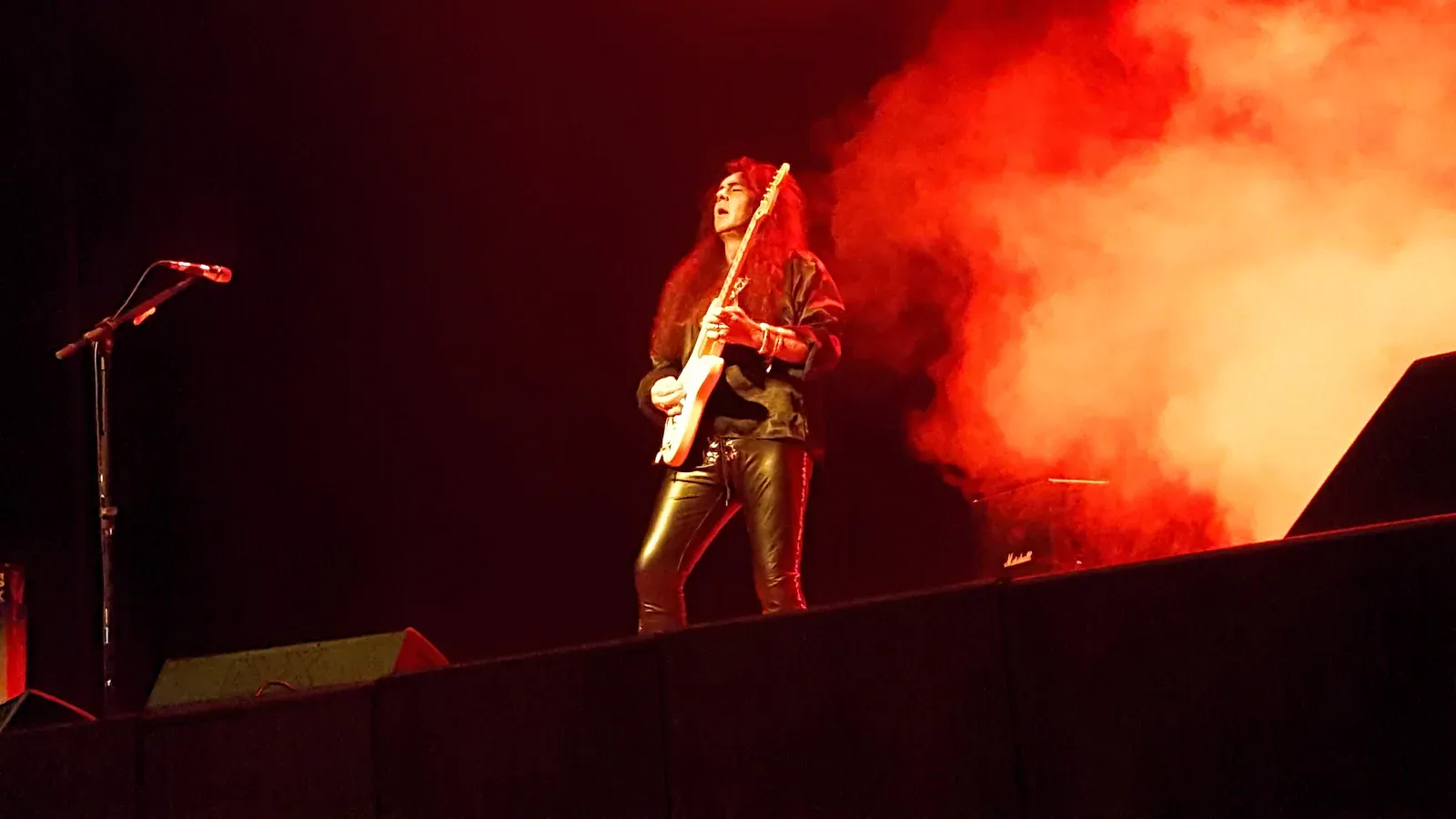
Around him a whole roster of Shrapnel guitarists worked in the same idiom, among them Tony MacAlpine, Vinnie Moore, Paul Gilbert, Marty Friedman and Jason Becker. Becker and Friedman recorded Speed Metal Symphony as Cacophony in 1987, and Becker released his solo debut Perpetual Burn the next year. Much of this output was instrumental, and the audience was as much guitar players as metal fans.
Out of fashion in the United States, 1990-1999
By the early 1990s neoclassical metal and shredding had gone out of fashion in the United States, pushed aside by grunge and nu metal, which both avoided flashy lead guitar. Malmsteen carried on regardless. Albums such as Eclipse (1990), Fire & Ice (1992), The Seventh Sign (1994) and Magnum Opus (1995) kept their audience in Europe and Asia, with releases on the Japanese label Pony Canyon.
The harmony found a second home in Europe. Stratovarius, formed in Helsinki in 1984, made keyboards as important as guitar, and their 1997 album Visions includes “Black Diamond”. In Trieste, guitarist Luca Turilli and keyboardist Alex Staropoli formed Rhapsody, whose debut Legendary Tales appeared in 1997 and whose “Emerald Sword” came out in 1998. Keyboardists such as Jens Johansson, Alex Staropoli and Janne Wirman are among the key figures of the style as much as guitarists. These bands belong as much to power metal as to neoclassical metal.
Characteristics
The grammar is classical. The harmonic minor scale, a natural minor with a raised seventh, supplies the exotic leading-tone colour. Diminished seventh chords, stacked in minor thirds, serve as pivots: a player moves through them in minor-third steps and resolves to the tonic. Pentatonic scales remain common, as in most rock, and modes appear on occasion. The surface is made of fast alternate picking, sweep-picked arpeggios, tapping and whammy bar effects.
Much of the output is instrumental, and sung records such as Rising Force and Odyssey add a singer to guitar-led songs.
Instruments and production
The electric guitar is the lead voice, and the Fender Stratocaster is the instrument most tied to the style through Malmsteen’s signature model. Keyboards double or answer the guitar, as Jens Johansson did in Rising Force and later with Stratovarius. In Deep Purple’s early model the organ held that place, and the drum kit drives the fast tempos under the soloist.
Mainstream success
Commercial success was real but narrow. Rising Force charted in the United States and earned a Grammy nomination, and Odyssey, with “Heaven Tonight”, became Malmsteen’s most successful album. The 1988 signature Stratocaster showed how far the style had entered guitar culture. The turn of the decade ended American interest, while Europe and Asia stayed loyal.
Notable recordings
“Highway Star” shows the idea before it had a name: a fast song with long, classically inspired guitar and organ solos.
“Black Star”, from Rising Force in 1984, is an instrumental led by Malmsteen’s guitar.
“Black Diamond”, from Stratovarius’s Visions in 1997, adapts the approach to a band in which keyboards and guitar share the lines. “Emerald Sword” by Rhapsody, from Symphony of Enchanted Lands in 1998, belongs to the Italian symphonic branch.
Culture
The word “shredding” names fast, virtuosic lead guitar and is attached to the style and its players. Randy Rhoads adopted a black-and-white polka-dot theme with Quiet Riot, which became an emblem. Guitar magazines mattered: Malmsteen’s demo reached Varney through a magazine column, and Guitar Player gave Rising Force its award.
Legacy
Neoclassical metal gave metal guitar much of its technical vocabulary. Its scales and sweeps are standard material for lead guitar, in power metal, progressive metal and extreme metal as well. Malmsteen has now released 22 studio albums across more than four decades, Stratovarius has made sixteen studio albums, and Rhapsody, renamed Rhapsody of Fire in 2006, is still active.
Misconceptions
One myth says the style is simply fast playing. Speed matters, but its defining features are harmonic: the harmonic minor scale and diminished seventh chords, which borrow from classical practice rather than from the blues.
A second myth says Malmsteen invented classical influence in rock. He did not: Deep Purple, Blackmore, Uli Jon Roth and Randy Rhoads were all using classical ideas before his first record in 1984. He is widely seen as the one who turned these ideas into a complete style.
A third myth holds that neoclassical metal is a single guitar scene. In practice it joined hard rock in Britain, shred in California, and keyboard-led power metal in Finland and Italy, and its important figures include keyboardists as much as guitarists.
Frequently asked questions
What is neoclassical metal?
Neoclassical metal is heavy metal that uses classical European harmony and violin-style technique, including harmonic minor scales, diminished chords and arpeggios, and often features long instrumental showpieces.
Who started neoclassical metal?
Ritchie Blackmore, Uli Jon Roth and Randy Rhoads prepared the ground in the 1970s, and Yngwie Malmsteen, whose debut Rising Force came out in 1984, is regarded as the originator of the finished style.
What is the difference between neoclassical metal and power metal?
Neoclassical metal describes a harmonic and technical approach to guitar, while power metal is a broader style defined by fast, melodic, anthemic songs. Bands such as Stratovarius and Rhapsody of Fire belong to both.
What scales does neoclassical metal use?
The harmonic minor scale is the most characteristic, together with diminished seventh chords and arpeggios. Pentatonic scales and occasional modes also appear.
Sound
Sound sheet
Signature sounds
- Harmonic minor and diminished seventh runs
- Sweep-picked arpeggios
- Classically inspired guitar and keyboard solos
Techniques
- Sweep picking
- Fast alternate picking
- Tapping
- Whammy bar
Keys and modes
Harmonic minor. A minor scale with a raised seventh, the main scale of the style.
Diminished seventh arpeggios. Used to modulate and to build dramatic runs.
Vocals
Many records are instrumental; sung albums such as Rising Force and Odyssey add a singer to guitar-led songs.
Scenes
Where it happened
Where and when the sound lived: one bar per city on a shared timeline.
Europe
North America
Active scenes
Peak 4, 1993-2025
Malmsteen's home city, where he played his first show in 1976 and recorded early demos.
Base of Shrapnel Records, whose roster defined 1980s shred.
Home of Stratovarius, formed in 1984.
Rhapsody's base, where Luca Turilli and Alex Staropoli formed the band.
Culture
Culture markers
- Shredding
The word for fast, virtuosic lead guitar, widely used for the style and its players.
Slang - Polka-dot guitars
Randy Rhoads adopted a black-and-white polka-dot theme with Quiet Riot, which became an emblem.
Fashion
Media
Key media
- 1983Guitar Player, February 1983 issue
by Guitar Player. Published Malmsteen's demo, which led Shrapnel's Mike Varney to bring him to the US.
Zine
Glossary
Terms on this page
A chord stacked in minor thirds, used to modulate by moving through the chord and resolving to the tonic.
A minor scale with a raised seventh degree, giving the exotic leading-tone sound of the style.
The name of Yngwie Malmsteen's band, after his 1984 debut album.
A virtuosic electric guitar style using fast alternate picking, sweeps, tapping and whammy bar.
Playing a rapid run of notes by raking the pick across strings, used for arpeggios.
Metal family