Power metal
Power metal is fast, melodic heavy metal with clean high vocals, double bass drumming and fantasy lyrics, codified in Hamburg in 1987 by Helloween.
Hamburg, 1984
Metal family
Born
1984
Hamburg
Subgenres
4
Documented branches
Links
12
Genres it drew on or shaped
Tempo
150-200 BPMLineage
Family tree
Grew out of
Derived from
Derived from
- New wave of British heavy metal
Derived from
Derived from
Influenced by
Hamburg, 1984
Power metal
Led to (5)
Timeline
Era by era
From the first sparks to today. Select a dot to read the story behind it.
- Precursors
1976 to 1986
- German founding years
1987 to 1994
- European wave
1995 to 2004
- Festivals and video games
2005 to today
Eras
Moments
- 1 Precursors, 1976 to 1986
- 2 German founding years, 1987 to 1994
- 3 European wave, 1995 to 2004
- 4 Festivals and video games, 2005 to today
around 1976
Precursors
Rainbow's fantasy lyrics, Judas Priest's high vocals and Iron Maiden's anthemic twin guitars, plus a first US wave of power metal bands, set the pieces before the style had a name.
- 1976Rainbow releases RisingRonnie James Dio's fantasy lyrics for Rainbow, including Stargazer, are often cited as an early model for power metal themes.
- 1984Helloween forms in HamburgKai Hansen, Markus Grosskopf, Michael Weikath and Ingo Schwichtenberg start the band that later defines the style.
- 1985Helloween release Walls of JerichoTheir debut album is fast speed metal with a melodic streak, before the sound turned to power metal.
1987
German founding years
Helloween's two Keeper of the Seven Keys albums fused speed metal riffs with melody and clean high vocals, while Blind Guardian, Gamma Ray and Stratovarius built their own versions.
- 1987Keeper of the Seven Keys, Part IThe album with Michael Kiske on vocals is usually named the first proper European power metal record.
- 1988Keeper of the Seven Keys, Part II and I Want OutThe second Keeper album and its single I Want Out confirm the template of fast tempos and singalong choruses.
- 1988Blind Guardian release Battalions of FearThe Krefeld band's debut brings thrash-edged speed metal with fantasy lyrics.
1995
European wave
Symphonic and keyboard-heavy bands such as Rhapsody, Sonata Arctica and HammerFall spread the style across Europe and beyond, and the European branch overtook the US one.
- 1995Gamma Ray release Land of the FreeKai Hansen's post-Helloween band issues one of the best-known albums of the German scene.
- 1997Stratovarius release VisionsThe Finnish band's Black Diamond album on Noise Records puts Jens Johansson's keyboards at the centre.
- 1997Rhapsody release Legendary TalesThe Italian band's debut opens the symphonic, film-score branch of power metal.
- 1999Sonata Arctica release EclipticaThe Finnish debut becomes a staple of keyboard-led power metal.
2005
Festivals and video games
DragonForce reached a mass audience through a video game tie-in, and festival circuits kept the genre active across continents.
- 2007Through the Fire and Flames in Guitar Hero IIIThe DragonForce song's use as the hardest track in the video game brings the genre to a mainstream audience.
Listening path
Start listening
A short path from an easy way in to the deep end. Thumbnails come from YouTube; the player loads only when you press play.
- 01
Helloween, 1987
A bright, fast opener from the Keeper album that set the style.
- 02
Blind Guardian, 1989
Layered vocals and a crowd-chant chorus show the epic side of the genre.
- 03
Rhapsody, 1998
The symphonic branch, with orchestral arrangements and a fantasy story.
- 04
DragonForce, 2005
The extreme-speed end of the genre, known from Guitar Hero III.
Facts
| Family | Metal |
| Origin | Hamburg, Germany |
| Emerged | Mid-1980s |
| Status | Active |
| Tempo | 150 to 200 BPM |
| Meter | 4/4 |
| Grew out of | Heavy metal, Speed metal, New wave of British heavy metal, Neoclassical metal |
| Subgenres | 3 |
Power metal is a branch of heavy metal that joins the speed of speed metal to melody, clean high-pitched vocals, major-key harmony and fantasy or heroic lyrics.
It took shape in the mid-1980s, with a harder American style and a lighter, keyboard-friendly European one, and the European form was fixed in Hamburg in 1987 by Helloween. It belongs to the metal family and sits next to thrash metal as a faster offshoot of the traditional style.
Origins
The pieces came from the 1970s. Ronnie James Dio wrote fantasy-themed lyrics for Rainbow, and the songs on Rising (1976) and Long Live Rock ‘n’ Roll (1978) are often named as early models. Judas Priest’s Rob Halford supplied the high, nearly constant singing that became the genre’s vocal blueprint, and the twin-guitar partnership of K. K. Downing and Glenn Tipton shaped its lead style. Iron Maiden added epic, singalong songwriting, and is sometimes called the main prototype. The German scene owed its start to Scorpions and Accept, while Yngwie Malmsteen’s precise neoclassical playing and the keyboards of his bandmate Jens Johansson, who modernised the organ sound of Deep Purple’s Jon Lord, reached later players. Manowar’s sword-and-sorcery lyrics influenced a number of bands.
In the United States, a first wave grew in the early 1980s from traditional metal, the new wave of British heavy metal and speed or thrash backgrounds. Cirith Ungol, Jag Panzer, Manilla Road, Omen, Riot, Savatage, Metal Church and Warlord are generally counted among the early influences. The American style stayed close to its roots: faster and more energetic than traditional metal, riff-driven, with few keyboards and often operatic high vocals. The early records of Queensrÿche and Fates Warning shaped a number of bands later in the decade, and the style lost popularity at the start of the 1990s.
Hamburg and the Keeper albums, 1984-1994
Helloween formed in Hamburg in 1984, named after the film Halloween, with Kai Hansen, Markus Grosskopf, Michael Weikath and Ingo Schwichtenberg in the original line-up. The band appeared on a compilation in 1984 and released the album Walls of Jericho in 1985, still a fast speed metal record. With Michael Kiske singing, Keeper of the Seven Keys, Part I (1987) and Part II (1988) on Noise Records fused speed metal riffs with melody and uplifting themes. They are usually considered the first proper European power metal albums, and the single I Want Out from the second became the band’s best-known song. Schwichtenberg’s steady sixteenth-note double bass drumming set a blueprint that later drummers followed.
Other German bands developed their own versions. Running Wild, Rage and Grave Digger worked beside Helloween, Blind Guardian began in Krefeld in 1984 with the thrash-edged Battalions of Fear (1988), and Kai Hansen formed Gamma Ray, which mixed palm-muted speed riffs with high vocals and positive themes. In Finland, Stratovarius built a more keyboard-driven sound, with lyrics about emotions and personal issues. Blind Guardian’s route was different: layered vocal and guitar overdubs for an epic mood, and lyrics drawn from fantasy novels, myths and legends. Somewhere Far Beyond (1992) carried the Hobbit-themed The Bard’s Song.
The European wave, 1995-2004
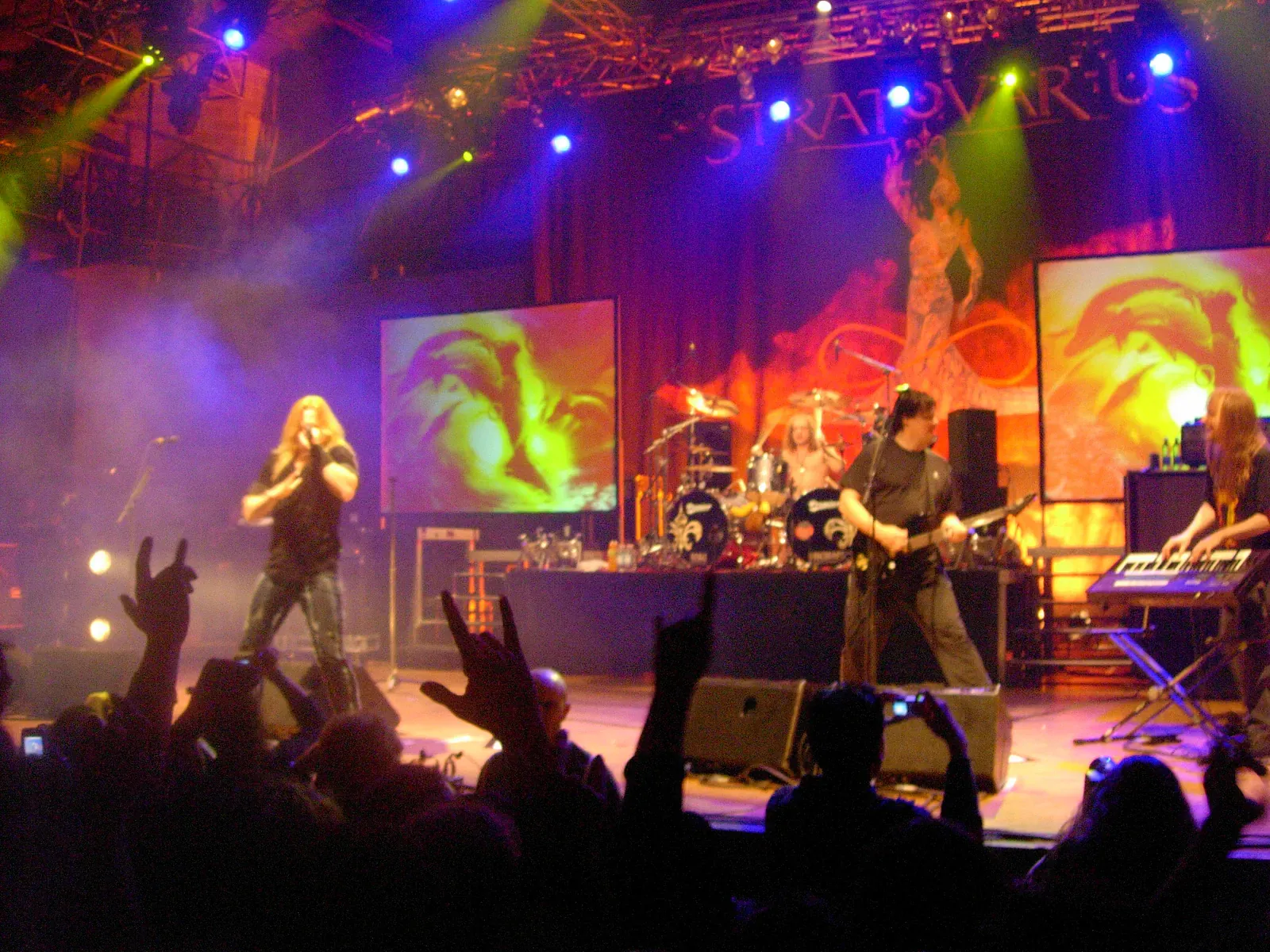
By the middle of the 1990s the European style was spreading and the US one was fading. Gamma Ray’s Land of the Free appeared in 1995, and Stratovarius released Visions, with Black Diamond, in 1997 on Noise. Jens Johansson’s keyboards became a model for the genre, and a Stratovarius concert usually ends with the crowd singing that song.
Symphonic and neoclassical elements entered through Rhapsody, formed in Trieste in 1993 as Thundercross and renamed Rhapsody of Fire in 2006, with Legendary Tales (1997) and Symphony of Enchanted Lands (1998). Nightwish and Serenity followed. HammerFall, founded in Gothenburg in 1993 by Oscar Dronjak, simplified the formula to sit closer to traditional heavy metal, and its debut Glory to the Brave appeared in 1997. Sonata Arctica, from the Finnish town of Kemi, debuted with Ecliptica in 1999.
The style then picked up other influences. Elvenking, Falconer, Mägo de Oz and Wuthering Heights added folk music, Angra, Kamelot and Symphony X combined it with progressive metal, and Children of Bodom were among the first to blend it with early melodic death metal. A number of North American bands, including Kamelot, adopted the European model, which is why it is sometimes called the second wave.
Characteristics
The genre is faster and lighter than extreme metal, with songs built around anthemic, strongly melodic choruses and a dramatic, theatrical feel. Guitarists play fast note streams but change chords slowly, about once per measure, and often use major chord progressions and circle progressions. Fast, technical guitar solos are nearly guaranteed. Drummers use two bass drums or a double pedal for a steady stream of sixteenth notes, though Blind Guardian and Iced Earth use a more thrash-like pattern of bursts of three to six kicks. Typical tempos sit between 150 and 200 beats per minute, measured on the felt pulse. Vocals are clean, high and often operatic, supported by choir-like backing parts.
Lyrics lean on fantasy, mythology, heroism and war, an inheritance from Dio and Manowar, while Stratovarius turned toward emotion and personal themes. The sound sheet on this page lists the instruments, keys and techniques in more detail.
Instruments and production
Keyboards are common but not universal, and orchestral power metal replaces or doubles them with a full orchestra and choir. Overdubbing is a production tool in its own right: Blind Guardian stack many vocal and guitar tracks to build a dense choral mood. Bass is often mixed low behind the rhythm guitars, which is why it matters when a band, such as Helloween, writes it as its own line.
Mainstream success
The European style became far more widespread than the American one. The main crossover came in 2007, when DragonForce’s Through the Fire and Flames, from the album Inhuman Rampage (2005), appeared as the hardest song in the video game Guitar Hero III. The band describes its own music as extreme power metal, and its retro video game sound and very long solos reached many listeners who never followed the genre. Labels such as Nuclear Blast, founded in 1987 in Donzdorf, first for hardcore punk and later for power metal among other styles, carried the genre in the following decades.
Notable recordings
Helloween’s Future World opens Keeper of the Seven Keys, Part I with a bright, fast chorus and sets the template for much of what followed. Blind Guardian’s Valhalla, from Follow the Blind (1989), shows the band’s early speed metal side with a chant-like chorus. Rhapsody’s Emerald Sword (1998) shows the symphonic end of the style, and DragonForce’s Through the Fire and Flames the extreme-speed end, at about 200 beats per minute.
Culture
Album covers lean on fantasy art: knights, dragons and mascots, such as HammerFall’s paladin Hector, who appears on most of their albums. Singalong choruses are central to live shows, and festivals across Europe and beyond keep the circuit alive.
Legacy
Power metal left a clear mark on later styles. Symphonic, folk, progressive and melodic death metal hybrids all draw on its melodic language, and its fantasy imagery is still a reference point for heavy music with a theatrical side. Helloween, Blind Guardian, Stratovarius and Rhapsody of Fire remain defining names, and the label history, from Noise to Nuclear Blast, shows how a small German scene became an international network.
Misconceptions
Power metal is sometimes thought of as simply fast. Many songs have a slow harmonic rhythm, and tempo does not separate it from speed or thrash metal as clearly as melody, major-key harmony and vocals do. It is also assumed to be a purely European style, but a harder American version developed in the early 1980s, before Helloween’s Keeper albums. A third idea is that Helloween invented the style alone: its Keeper albums codified the European form, but Dio, Judas Priest, Iron Maiden, Accept and Manowar had already supplied its vocal, guitar and lyrical elements.
Frequently asked questions
What is power metal?
Power metal is a form of heavy metal that combines the speed of speed metal with melodic songwriting, high clean vocals, major-key harmony and fantasy or heroic lyrics. It is generally played between 150 and 200 beats per minute.
Which band started power metal?
The European style was codified by Helloween’s Keeper of the Seven Keys albums in 1987 and 1988, while American bands such as Cirith Ungol, Jag Panzer and Manilla Road had developed an earlier US form.
What is the difference between power metal and thrash metal?
Power metal is lighter and more melodic, with clean vocals and uplifting themes, while thrash metal is harder, more aggressive and built on heavy riffs and shouted vocals.
What is symphonic power metal?
Symphonic power metal adds orchestra, choir and film-score style arrangements to the power metal frame, as heard in Rhapsody’s Legendary Tales and Symphony of Enchanted Lands.
Sound
Sound sheet
Anatomy of a track
| # | Part |
|---|---|
| 1 | Intro (keyboard or twin-guitar theme) |
| 2 | Verse over double bass |
| 3 | Chorus (anthemic, harmonised) |
| 4 | Guitar and keyboard solo trade |
| 5 | Final repeated chorus |
Signature sounds
- Harmonised twin-guitar leads
- Sixteenth-note double bass gallop
- High-register clean vocals in the chorus
- Fantasy or heroic lyric themes
Drums and percussion
- Double bass drum kit
Techniques
- Fast palm-muted riffing
- Slow harmonic rhythm
- Vocal and guitar overdubbing
- Harmonised twin leads
Keys and modes
Major chord progressions. Common, often with circle progressions and about one chord change per measure.
Vocals
High-pitched, clean and often operatic singing, with choir-style backing choruses.
Scenes
Where it happened
Where and when the sound lived: one bar per city on a shared timeline.
Europe
Active scenes
Peak 4, 1993-2025
Home of Helloween and the centre of the first European wave.
Blind Guardian's home town in the Rhine region.
Stratovarius formed here and Finland became a leading power metal country.
Birthplace of Rhapsody and a base of Italian symphonic power metal.
Culture
Culture markers
- Fantasy album covers
Covers show knights, dragons and mascots, such as HammerFall's paladin Hector on most of their albums.
Artwork - Concert singalongs
Stratovarius' Black Diamond is usually sung by the crowd at the end of their shows.
Ritual
Media
Key media
- 2011Metal Evolution
by Sam Dunn. A documentary series whose power metal episode traces the style from Rainbow and Judas Priest to Helloween.
Film
Glossary
Terms on this page
A fast kick-drum pattern, often steady sixteenth notes, that drives most power metal songs.
Shorthand for Helloween's two Keeper of the Seven Keys albums, the reference point of European power metal.
Faster, riff-driven metal that supplied the tempo and palm-muted riffing of power metal.
A branch that adds orchestra, choir and film-score writing to the power metal frame.
US power metal: the earlier, riff-driven American style with fewer keyboards than the European one.
Metal family