Thrash metal
Thrash metal is a fast, aggressive style of heavy metal that emerged in the early 1980s, fusing NWOBHM riffing with hardcore punk speed.
San Francisco Bay Area, 1981
Metal family
Born
1981
San Francisco Bay Area
Subgenres
13
Documented branches
Links
47
Genres it drew on or shaped
Tempo
140-225 BPMLineage
Family tree
Grew out of
- New wave of British heavy metal
Derived from
Derived from
Derived from
Influenced by
Skate punkProgressive rock
San Francisco Bay Area, 1981
Thrash metal
Led to (20)
Timeline
Era by era
From the first sparks to today. Select a dot to read the story behind it.
- Underground beginnings
1979 to 1983
- Breakthrough and second wave
1984 to 1989
- Peak and decline
1990 to 1999
- Revival and reunions
1999 to today
Eras
Moments
- 1 Underground beginnings, 1979 to 1983
- 2 Breakthrough and second wave, 1984 to 1989
- 3 Peak and decline, 1990 to 1999
- 4 Revival and reunions, 1999 to today
around 1979
Underground beginnings
Exodus, Metallica and Slayer formed in California, Venom and Motorhead supplied the template, and demo tapes and the Metal Massacre compilation carried the sound before the first albums.
- 1981Metallica and Slayer formHetfield and Ulrich meet through a classified advertisement in Los Angeles, and Hanneman and King form Slayer the same year.
- 1982Exodus circulates its first demoDemo 1982 spreads through tape trading and is credited with paving the way for the Bay Area scene.
- 1982Metal Massacre compilationBrian Slagel's compilation for Metal Blade carries an early Metallica recording of Hit the Lights.
- 1983Kill 'Em AllMetallica's debut, issued on Megaforce in July, is widely regarded as the first thrash metal album.
- 1983Show No MercySlayer's debut follows in December on Metal Blade.
1984
Breakthrough and second wave
Ride the Lightning, Bonded by Blood, Pleasure to Kill, Reign in Blood and Peace Sells arrived, German bands joined in, and MTV and radio pushed the Big Four from clubs to arenas.
- 1985German bands debutKreator's Endless Pain and Destruction's Infernal Overkill appear, with Sodom and Tankard following in 1986.
- 1986Master of PuppetsMetallica's major-label debut becomes the first thrash album certified platinum; Cliff Burton dies in a bus accident six months later.
- 1986Reign in BloodSlayer's Rick Rubin-produced album, delayed over its opening track, is considered by some to have inspired death metal.
1990
Peak and decline
Rust in Peace, Seasons in the Abyss and the Clash of the Titans tour marked the peak, then grunge and alternative metal pushed many bands to split or soften their sound.
- 1990Clash of the Titans tourMegadeth and Slayer co-headline, with Testament and Suicidal Tendencies in Europe and Anthrax in North America.
- 1991The Black AlbumMetallica's Bob Rock-produced album drops speed and long structures as grunge and alternative metal rise.
1999
Revival and reunions
Testament's The Gathering signalled a return to classic thrash, 1980s bands reunited, and the Big Four played together in Sofia in 2010.
- 1999Testament's The GatheringThe album, widely credited with sparking a thrash resurgence, returns to the classic sound.
- 2010The Big Four play SofiaMetallica, Slayer, Megadeth and Anthrax share one bill on 22 June at Sonisphere, shown live in cinemas.
Listening path
Start listening
A short path from an easy way in to the deep end. Thumbnails come from YouTube; the player loads only when you press play.
- 01
Metallica, 1986
The album-length epic that made thrash platinum; listen for the chromatic downpicked opening riff.
- 02
Megadeth, 1986
Megadeth's breakthrough single, with a more punk-edged delivery.
- 03
Slayer, 1986
The closer of Reign in Blood, at the extreme edge of thrash speed and darkness.
- 04
Metallica, 1983
From Kill 'Em All, one of the first songs of the genre.
- 05
Kreator, 1986
The German scene's landmark, influential on death metal.
Facts
| Family | Metal |
| Origin | San Francisco Bay Area, United States |
| Emerged | Early 1980s |
| Status | Active |
| Tempo | 140 to 225 BPM |
| Grew out of | New wave of British heavy metal, Speed metal, Hardcore punk |
| Subgenres | 11 |
Thrash metal is an extreme subgenre of heavy metal defined by fast tempos, low-register palm-muted guitar riffs, double bass drumming and shredding lead guitar.
It took shape in the early 1980s, mainly in the San Francisco Bay Area, Los Angeles, New York and West Germany, when musicians fused the double bass drumming and riffing of the new wave of British heavy metal with the speed and attitude of hardcore punk. Its best-known acts are the American “Big Four” of Metallica, Slayer, Megadeth and Anthrax.
Origins
Early thrash had no single birthplace or founding band. Writers point to proto-thrash moments in the 1970s, such as Deep Purple’s 1970 album Deep Purple in Rock, but the direct line runs through the new wave of British heavy metal. Diamond Head, Iron Maiden, Venom and Motorhead brought fast, intricate playing to metal, and Phil Taylor’s double bass drumming on Motorhead’s 1979 song “Overkill” is cited by many thrash drummers, Lars Ulrich among them, as a primary influence.
The second ingredient was punk. Punk acts such as the Ramones and hardcore bands such as Discharge supplied the pace and attitude, while Rush and other progressive rock bands fed the technical side. The name itself began as a word for fast hardcore: a 1982 compilation was titled New York Thrash, and by 1983 “thrash metal” was in colloquial use for the fusion.
It was also a reaction against the conservatism of the Reagan years and the polished glam metal rising at the same time.
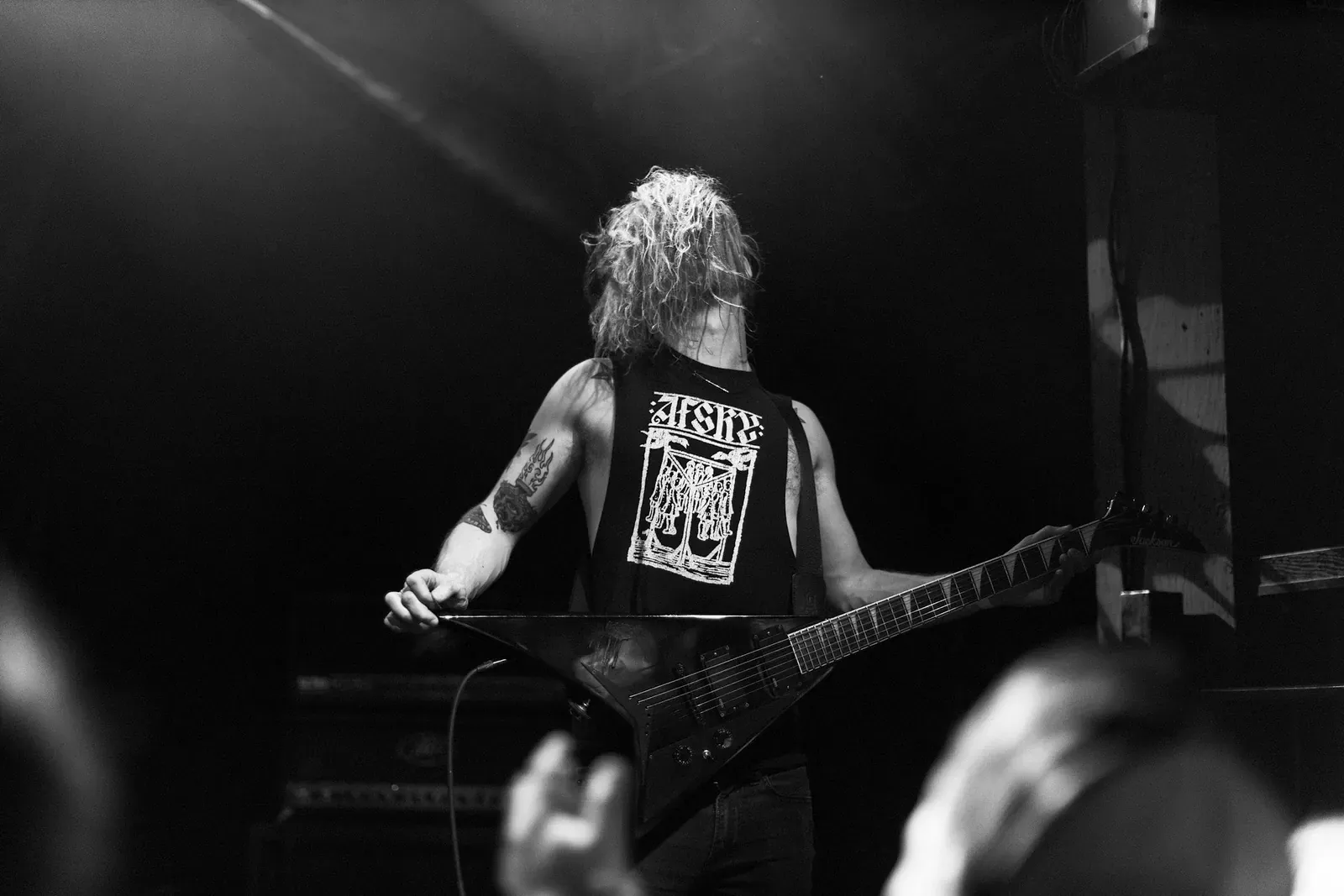
Underground beginnings, 1979-1983
Critics disagree about the first thrash band; Venom, the Big Four and Exodus, formed in the Bay Area in 1979, all have advocates. What is clear is the route the music took: independent labels and tape trading. Exodus’s Demo 1982 circulated through the tape-trading network and is credited with paving the way for the Bay Area scene.
In Los Angeles in 1981, James Hetfield and Lars Ulrich met through a classified advertisement and formed Metallica, while Jeff Hanneman and Kerry King formed Slayer after meeting at an audition. Metal Blade executive Brian Slagel, who discovered both bands, included Metallica’s “Hit the Lights” on the 1982 Metal Massacre compilation and Slayer on Metal Massacre III. Metallica then moved to the Bay Area, where bassist Cliff Burton wanted to be and where Kirk Hammett of Exodus replaced the fired Dave Mustaine. Their debut Kill ’Em All, released on the independent Megaforce label in July 1983, is widely regarded as the first thrash metal album. Slayer’s Show No Mercy followed on Metal Blade in December.
Breakthrough, 1984-1989
The first wave arrived in 1984 with Metallica’s Ride the Lightning, and Anthrax’s Fistful of Metal. In 1985 the sound got heavier on Exodus’s Bonded by Blood, Slayer’s Hell Awaits and Anthrax’s Spreading the Disease, with debut albums from Megadeth and Overkill. Germany joined in: Kreator’s Endless Pain and Destruction’s Infernal Overkill came out in 1985, followed in 1986 by Sodom’s Obsessed by Cruelty and Tankard’s Zombie Attack. Together Kreator, Destruction, Sodom and Tankard became known as the Big Teutonic Four. Combat Records in New York and Noise Records in Berlin carried much of the output.
Metallica’s Master of Puppets, Slayer’s Reign in Blood and Megadeth’s Peace Sells… but Who’s Buying? all appeared in 1986, and the Bay Area scene deepened in 1987 with debuts from Testament and Death Angel. Anthrax’s Among the Living the same year secured its place in the Big Four. Success came partly through media: MTV’s Headbangers Ball, radio stations such as KNAC in Long Beach and Z Rock in Dallas, and magazines like Kerrang! moved bands from clubs to arenas.
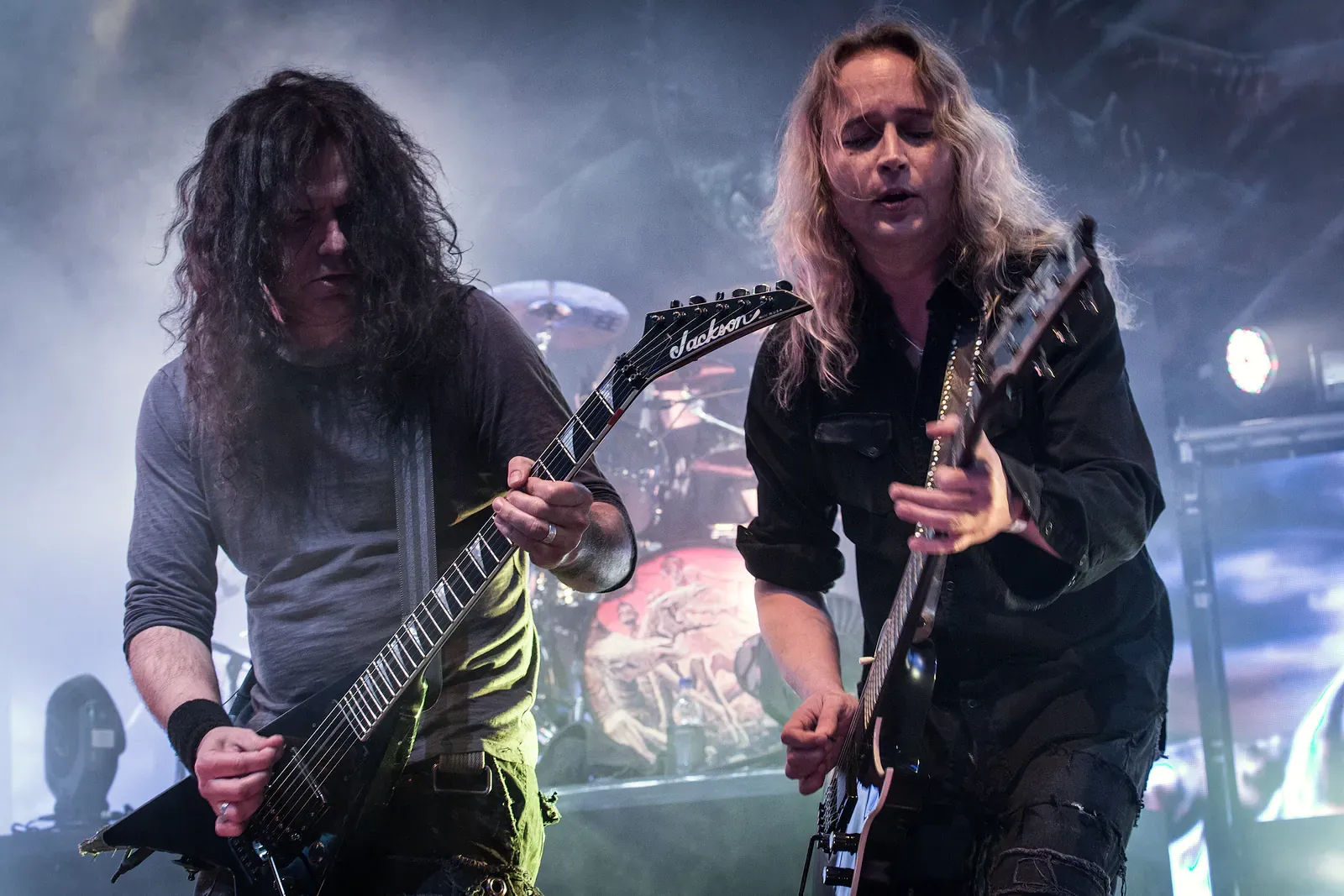
Peak and decline, 1990-1999
1990 was the commercial high point for many acts: Megadeth’s Rust in Peace, Slayer’s Seasons in the Abyss, Anthrax’s Persistence of Time, Testament’s Souls of Black and Kreator’s Coma of Souls all appeared. Megadeth and Slayer co-headlined the Clash of the Titans tour in 1990 and 1991, supported by Testament, Suicidal Tendencies, Anthrax and the then-emerging Alice in Chains. The tour is considered one of the most successful in heavy metal history and also bridged thrash and the rise of grunge.
That rise ended the commercial peak. Grunge and alternative metal drew the audience away, and many bands split or went on hiatus. Metallica’s 1991 album, produced by Bob Rock, dropped much of the speed and the long song structures and became the band’s best seller. Megadeth moved toward a more accessible sound from 1992’s Countdown to Extinction, and others turned to melodic, progressive or groove-oriented music.
Revival, 1999 onward
The turn came with Testament’s 1999 album The Gathering, widely credited with sparking a revival. Sodom and Destruction also returned to the classic sound, and the 2001 Thrash of the Titans benefit festival reunited Bay Area bands including Exodus and Death Angel, followed by reunions of Anthrax, Dark Angel and Nuclear Assault. On 22 June 2010, Metallica, Slayer, Megadeth and Anthrax played on one bill at the Sonisphere festival in Sofia, shown live in cinemas and released as a concert video.
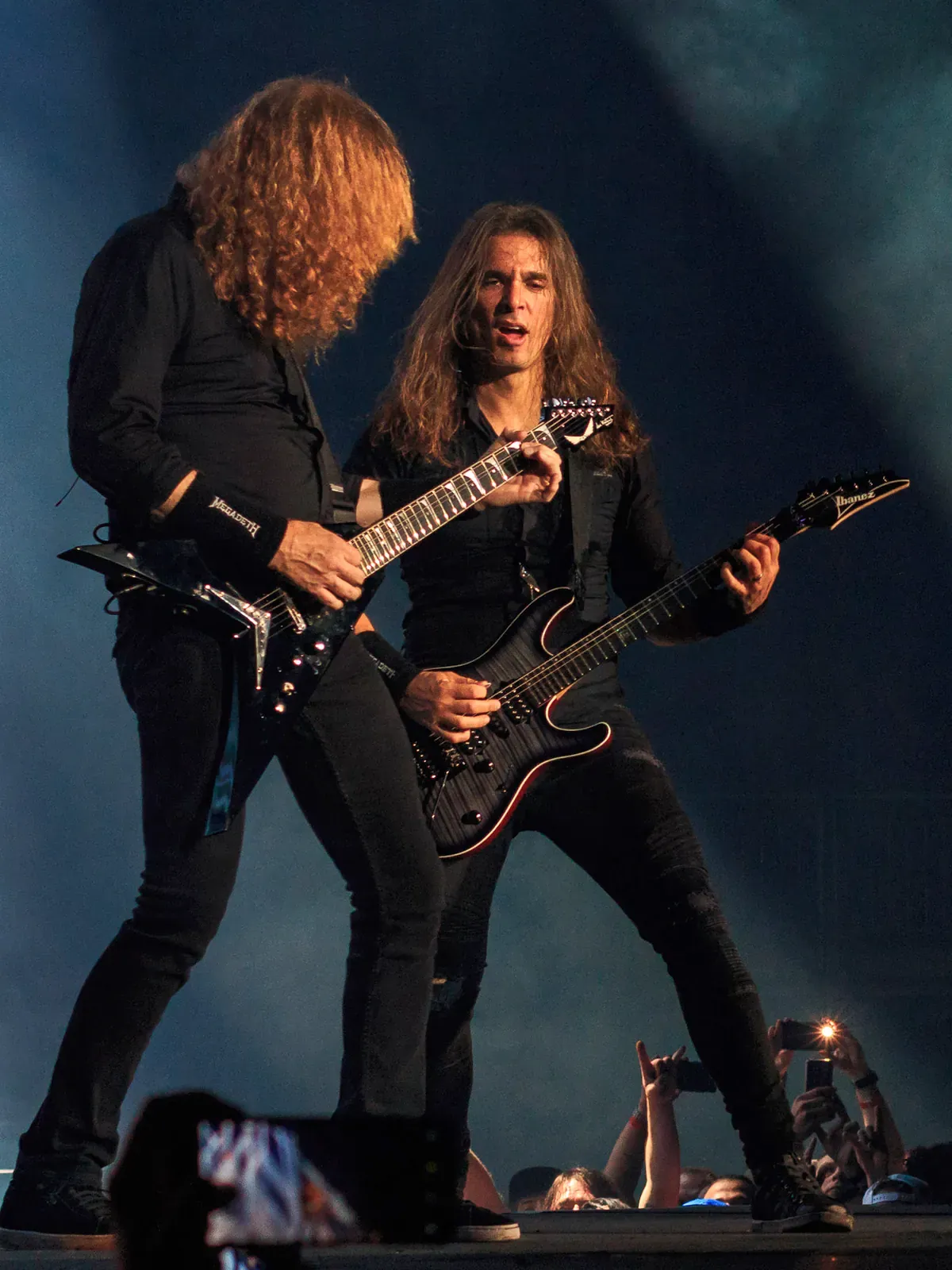
Characteristics
Thrash is built on fast tempos, low-register rhythm guitar played with heavy distortion, power chords and palm muting, and high-register solos that use sweep picking, legato, tremolo picking, string skipping and two-hand tapping. Riffs often rely on chromatic scales and on tritone and diminished intervals rather than one conventional scale; the opening of Metallica’s “Master of Puppets” is a chromatic descent followed by a tritone-based ascent. Cymbal chokes commonly mark the switch from one riff to the next or precede a tempo increase. Tempos on well-known recordings run from roughly 140 to 225 beats per minute.
Vocals range from melodic singing to shouting and screaming. Lyrics deal with war, corruption, injustice, addiction and alienation. Megadeth’s David Ellefson summed the style up as the attitude of punk with the riffs and complexity of traditional metal.
Instruments and production
The core line-up is two guitars, bass, drums and a lead vocalist, who often plays rhythm guitar. The kit is built around double bass pedals, which carry the fast pulse. Many bassists use a pick to keep pace, while Cliff Burton played fingerstyle and, with Motorhead’s Lemmy, popularised a distorted bass tone.
Notable recordings
Master of Puppets, released in March 1986, was Metallica’s major-label debut and the first thrash album to be certified platinum; it was also the last with Cliff Burton, who was killed in a bus accident six months after its release. Reign in Blood, produced by Rick Rubin for Def Jam, was held back over concerns about “Angel of Death”, a song about Josef Mengele and the Auschwitz camp, which the band defended as exploration rather than endorsement. It is considered by some to have single-handedly inspired death metal.
Kreator’s Pleasure to Kill, released in April 1986, became a major influence on the death metal scene, and Megadeth’s Peace Sells… but Who’s Buying? the same year was the band’s commercial and critical breakthrough. Possessed’s Seven Churches and Celtic Frost’s To Mega Therion, both from 1985, are credited with pioneering the extreme metal that became black metal and death metal.
Culture
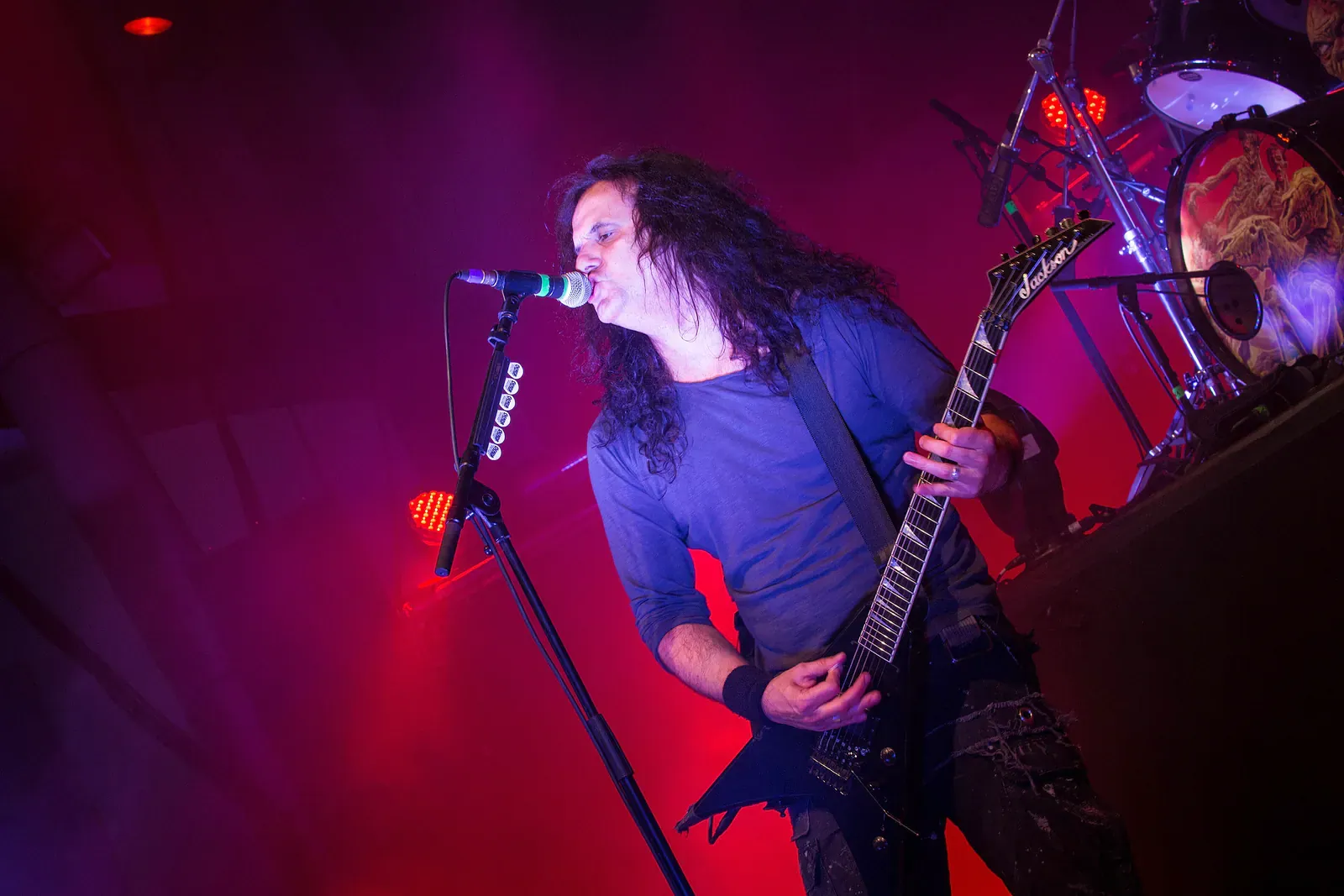
The scene ran on tape trading and independent labels long before mainstream media noticed. Its look sat closer to punk than to the capes of progressive rock: leather jackets. At shows, fans threw themselves about, which is where the word is said to come from,. Crossover thrash, a fusion with hardcore punk, grew from bands such as Suicidal Tendencies and S.O.D., a group that included three members of Anthrax.
Legacy
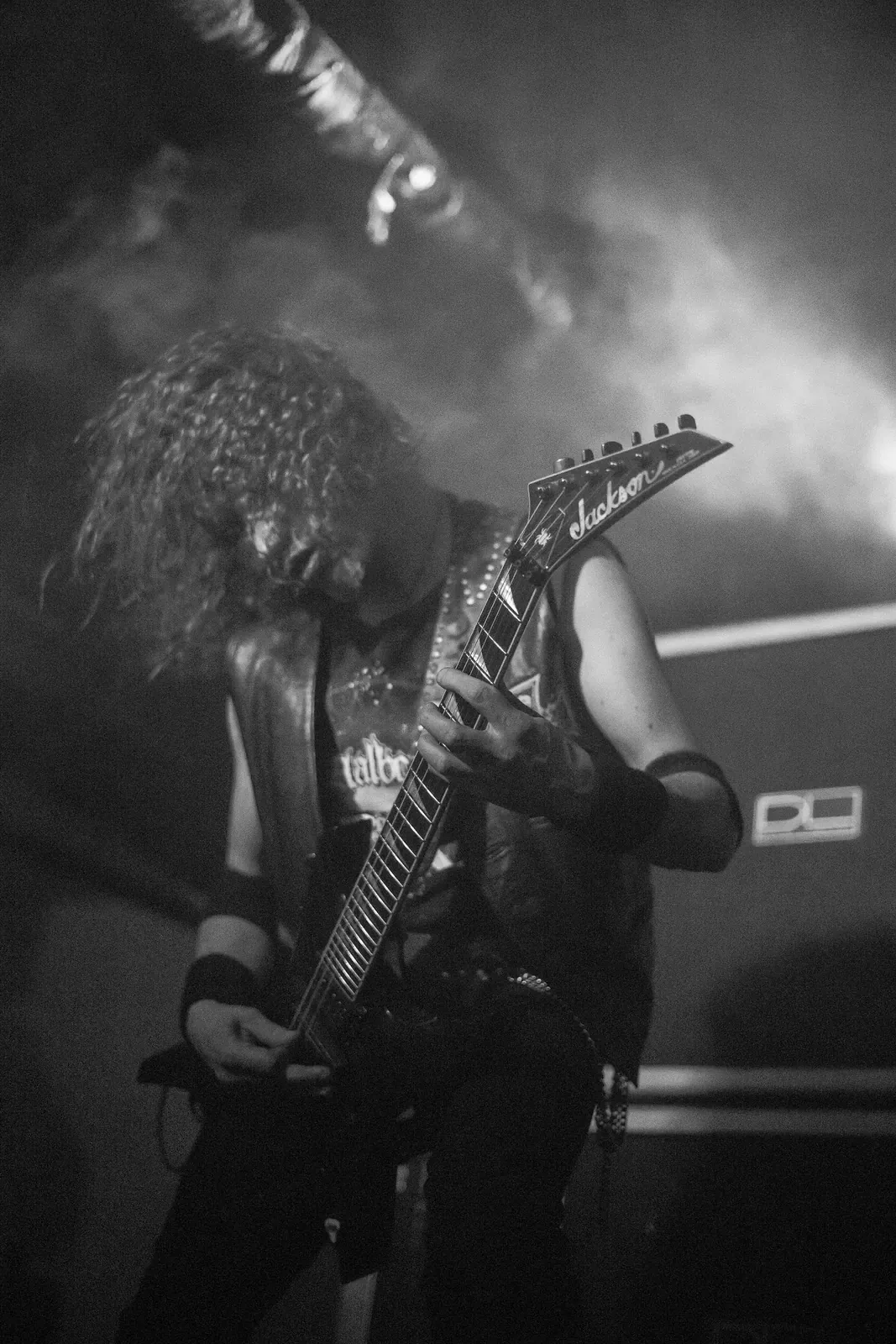
Thrash gave rise to death metal and fed groove metal, and it spawned technical thrash, a branch with complex structures often traced to Watchtower’s Energetic Disassembly. Regional scenes grew in Australia, Brazil, Canada, Poland and the United Kingdom, and the 1999 revival and the Sofia concert show the style outlasting its commercial peak.
Misconceptions
Thrash and speed metal are not the same style by definition. The terms were synonyms for most of the 1980s, and speed metal was defined separately only in the 1990s, for bands bridging thrash and power metal.
Metallica did not unquestionably start it all. Kill ’Em All is widely regarded as the first thrash album, but writers also credit Venom, Exodus, Overkill and Metal Church.
The term was not coined in a 1984 Kerrang! article. That claim is sometimes made for a piece by Malcolm Dome on Anthrax’s “Metal Thrashing Mad”, but “thrash” already labelled hardcore on a 1982 compilation and was applied to metal by 1983.
Frequently asked questions
What is thrash metal?
Thrash metal is a fast, aggressive type of heavy metal built on palm-muted riffs, double bass drumming, shredding solos and shouted vocals.
Who are the Big Four of thrash metal?
The Big Four of American thrash metal are Metallica, Slayer, Megadeth and Anthrax.
What is Teutonic thrash?
Teutonic thrash is the German scene, led by the Big Teutonic Four of Kreator, Destruction, Sodom and Tankard.
How fast is thrash metal?
Typical recordings run from about 140 to 225 beats per minute.
Sound
Sound sheet
Signature sounds
- Palm-muted, downpicked low-register riffs
- Chromatic and tritone-based riffs
- Double bass drumming
- Cymbal chokes into tempo acceleration
- Fast shredding lead guitar
Techniques
- Palm muting
- Double bass drumming
- Shredding solos
- Cymbal choke transitions
Keys and modes
Chromatic and tritone riffing. Riffs often use chromatic scales and diminished intervals instead of one conventional scale.
Vocals
Anything from melodic singing to shouted or screamed delivery.
Scenes
Where it happened
Where and when the sound lived: one bar per city on a shared timeline.
North America
Europe
Active scenes
Peak 4, 1982-2025
Exodus, later Testament and Death Angel, plus Metallica after it moved north for Cliff Burton.
Where Metallica and Slayer formed and where Metal Blade discovered them.
Anthrax's home and the base of Combat Records.
Kreator's hometown, part of the German scene of Kreator, Destruction, Sodom and Tankard.
Culture
Culture markers
- Tape trading
Demos like Exodus's 1982 tape spread through the European and North American underground.
Ritual - Leather jackets
The look was closer to punk than to prog rock capes.
Fashion - Thrash
Originally a term for fast hardcore, because people thrashed around when playing or hearing it.
Slang
Media
Key media
- 1982Metal Massacre
by Various. Brian Slagel's Metal Blade compilation that carried early Metallica and Slayer recordings.
Compilation - 1983Metal Forces
by Various. Its first issue used the term thrash metal for bands on early US metal compilations.
Zine - 1987KNAC Long Beach
by KNAC. Radio station, with Z Rock in Dallas, that gave thrash heavy rotation.
Radio - 2010The Big Four: Live from Sofia, Bulgaria
by Various. Concert film of Metallica, Slayer, Megadeth and Anthrax on one bill, shown in cinemas.
Film
Glossary
Terms on this page
Metallica, Slayer, Megadeth and Anthrax, the US bands that gained the widest success.
A fusion of thrash metal and hardcore punk.
Underground swapping of demos and live tapes in North America and Europe.
A branch with complex structures, often traced to Watchtower's Energetic Disassembly.
German scene led by Kreator, Destruction, Sodom and Tankard.
Metal family