Avant-garde metal
Avant-garde metal is metal built on experiment, from Celtic Frost and Voivod in the 1980s to Ulver, Sigh and Mr. Bungle, drawing on jazz and classical music.
Oslo, 1985
Metal family
Born
1985
Oslo
Subgenres
1
Documented branches
Links
11
Genres it drew on or shaped
Tempo
85-165 BPMLineage
Family tree
Grew out of
Derived from
Oslo, 1985
Avant-garde metal
Led to (1)
Timeline
Era by era
From the first sparks to today. Select a dot to read the story behind it.
- Outliers inside thrash and gothic metal
1984 to 1992
- Oslo, Tokyo and Boston
1993 to 1999
- Beyond the metal frame
2000 to 2009
- Elders and new experiments
2010 to today
Eras
Moments
- 1 Outliers inside thrash and gothic metal, 1984 to 1992
- 2 Oslo, Tokyo and Boston, 1993 to 1999
- 3 Beyond the metal frame, 2000 to 2009
- 4 Elders and new experiments, 2010 to today
1984
Outliers inside thrash and gothic metal
Celtic Frost in Zurich, Voivod in Quebec and Mr. Bungle in California bent extreme metal with orchestras, vocoders, odd meters and genre collage, before the label existed.
- 1974King Crimson's RedThe title track is cited as defining an early avant-metal style that Robert Fripp later revisited.
- 1982Voivod forms in JonquiereDenis Belanger, Denis D'Amour, Michel Langevin and Jean-Yves Theriault start a Quebec band that moves from speed metal to progressive thrash.
- 1984Celtic Frost forms in ZurichThomas Gabriel Fischer and Martin Eric Ain form the band in June after Hellhammer, and debut with Morbid Tales.
- 1985Mr. Bungle forms in EurekaThe California band grows into a cycle of metal, jazz, ska and disco within single songs.
- 1987Into the PandemoniumCeltic Frost's third album, with a Wall of Voodoo cover, industrial rhythms and female vocals, is the record the term avant-garde metal was coined for.
- 1987Voivod's Killing TechnologyReleased on 2 April, the album brings progressive rock ideas and vocoder effects into the band's thrash.
- 1989Nothingface reaches the Billboard 200Voivod's fifth album, with a Pink Floyd cover, peaks at number 114, the band's only entry on that chart.
- 1989Sigh forms in TokyoMirai Kawashima's band starts as Nordic-style black metal and later adds symphonic and Japanese elements.
1993
Oslo, Tokyo and Boston
Black metal's Norwegian and Japanese fringe (Ulver, Arcturus, Sigh) and Boston's Maudlin of the Well pushed symphonic, jazz and electronic ideas into metal, while Mr. Bungle released Disco Volante.
- 1993Ulver forms in OsloKristoffer Rygg founds the band, which debuts with the Vargnatt demo in November.
- 1995Ulver's BergtattThe debut album joins black metal to quiet acoustic folk passages and is released in February.
- 1995Disco VolanteMr. Bungle's second album for Warner replaces the funk metal label with avant-garde, shifting genre mid-song.
- 1997Arcturus's La Masquerade InfernaleThe Oslo band drops growls for semi-operatic singing and adds jungle beats and instrumentals.
- 1997Ulver signs to Century MediaThe label issues Nattens madrigal and the Trilogie box before Ulver founds its own Jester Records.
2000
Beyond the metal frame
Ulver left metal for cinematic electronica, Maudlin became Kayo Dot on Tzadik, and specialty labels backed a self-aware avant-garde metal scene.
- 2000Ulver's Perdition CityA trip hop, jazz and ambient album subtitled Music to an Interior Film, issued in March, marks Ulver's exit from metal.
- 2003Kayo Dot's Choirs of the EyeToby Driver's new band, born from Maudlin of the Well's split, debuts on John Zorn's Tzadik label.
2010
Elders and new experiments
Pioneers kept working and winning awards, with Voivod's 2019 Juno and Sigh drawing on traditional Japanese instruments, while the style stayed a loose, band-by-band tradition.
- 2019Voivod wins a JunoThe Wake wins the Juno for Metal/Hard Music Album of the Year, after the band's 2017 Visionary award.
Listening path
Start listening
A short path from an easy way in to the deep end. Thumbnails come from YouTube; the player loads only when you press play.
- 01
Voivod, 1987
Thrash with a progressive rock structure, an early model of the style.
- 02
Mr. Bungle, 1995
Extreme metal intercut with jazz and film-score fragments.
- 03
Arcturus, 1997
Black metal roots with operatic vocals and circus-like arrangement.
- 04
Ulver, 2000
Where an extreme metal band ends up: slow, cinematic electronica.
Facts
| Family | Metal |
| Origin | Oslo, Switzerland |
| Emerged | Mid-1980s |
| Status | Active |
| Tempo | 85 to 165 BPM |
| Meter | Varies, often odd meters |
| Grew out of | Progressive metal |
| Subgenres | 1 |
Avant-garde metal, also called experimental metal, avant-metal or art metal, is a branch of metal defined by experiment: unconventional instruments, free-jazz and modern-classical devices, extreme and operatic vocal techniques, and song forms that ignore verse and chorus.
It took shape from the mid-1980s in Switzerland, Canada, Norway, Japan and the United States, and it is a loose tradition of individual bands rather than a single scene.
Origins
Avant-garde metal grew out of extreme metal, as musicians dropped its tightly wound structures and played with the pieces. Progressive rock was an earlier source: King Crimson’s Red (1974) is cited as defining an avant-metal style that Robert Fripp later revisited, and Led Zeppelin’s Presence (1976) is named as another early case.
An early pioneer was Celtic Frost. Thomas Gabriel Fischer and Martin Eric Ain formed it in Zurich in June 1984 after their earlier band Hellhammer, and its early records fed death metal, black metal and doom. Fischer named two main influences, heavy metal (Black Sabbath, Venom) and new wave (Bauhaus, Siouxsie and the Banshees), and came from a jazz and progressive rock background himself. The term avant-garde metal was coined for their third album, Into the Pandemonium (1987).
Outliers in thrash and gothic metal, 1984-1992
Celtic Frost’s Into the Pandemonium came out on 1 June 1987 through Noise Records in Europe and Combat in the United States. It opened with a cover of Wall of Voodoo’s “Mexican Radio”, added industrial-tinged tracks and gothic rock leanings, and kept the band’s habit of orchestral flourishes with female vocals. Reviews were mixed at first, but it became the band’s most successful record. It also ended the Noise relationship: the band accused the label of sabotaging promotion, and a costly legal battle followed.
Canada produced the other founding force. Voivod formed in Jonquiere, Quebec, in 1982 and moved from speed metal toward progressive thrash. Killing Technology (2 April 1987) brought in progressive rock structure, and the band developed robotic vocal effects, unusual time signatures and fractured, dissonant guitar. Its influences ranged from Bela Bartok and Stravinsky to Yes and Pink Floyd. Nothingface (13 October 1989), with a Pink Floyd cover, reached number 114 on the Billboard 200, the band’s only entry on that chart.
In California, Mr. Bungle formed in Eureka in 1985 and spent its early years moving between metal, ska, funk and jazz.
Oslo, Tokyo and Boston, 1993-1999
The 1990s moved the experiment to the black metal fringe. In Oslo, Kristoffer Rygg founded Ulver in 1993. Its debut Bergtatt (February 1995) set black metal against quiet acoustic passages, the follow-up Kveldssanger (1996) dropped electric instruments for classical guitars, cello and choir, and Nattens madrigal (1997) returned to raw black metal on Century Media. Arcturus, also from Oslo and sharing members with Mayhem, Ulver and Dimmu Borgir, released Aspera Hiems Symfonia in 1996 and La Masquerade Infernale in 1997, which swapped growls for semi-operatic singing and added jungle beats.
In Tokyo, Mirai Kawashima’s Sigh formed in 1989 as Nordic-style black metal. Euronymous signed it to Deathlike Silence, which issued the debut Scorn Defeat in 1993 shortly after his murder. Later Sigh albums added classical and avant-garde music, and Imaginary Sonicscape (2001, Century Media) was praised as surrealist black metal.
In Boston, Maudlin of the Well formed in 1996 around Jason Byron, Greg Massi and Toby Driver. The band built its songs around astral projection and lucid dreams, saying it found its music rather than composed it, and released My Fruit Psychobells…A Seed Combustible (1999) and the companion pair Bath and Leaving Your Body Map (2001).
Mr. Bungle released Disco Volante in October 1995, four years after its debut, delayed by artwork problems and side projects. The earlier self-titled album had been called funk metal; this one was called avant-garde, and its songs changed genre mid-track, some in foreign languages, with a Middle Eastern techno number beside songs about death and children’s rhymes. Its influences included contemporary classical composers, avant-garde jazz, John Zorn and 1960s and 1970s European film music. A first world tour followed through North America, Europe and Australia in 1995 and 1996.
Beyond the metal frame, 2000-2009
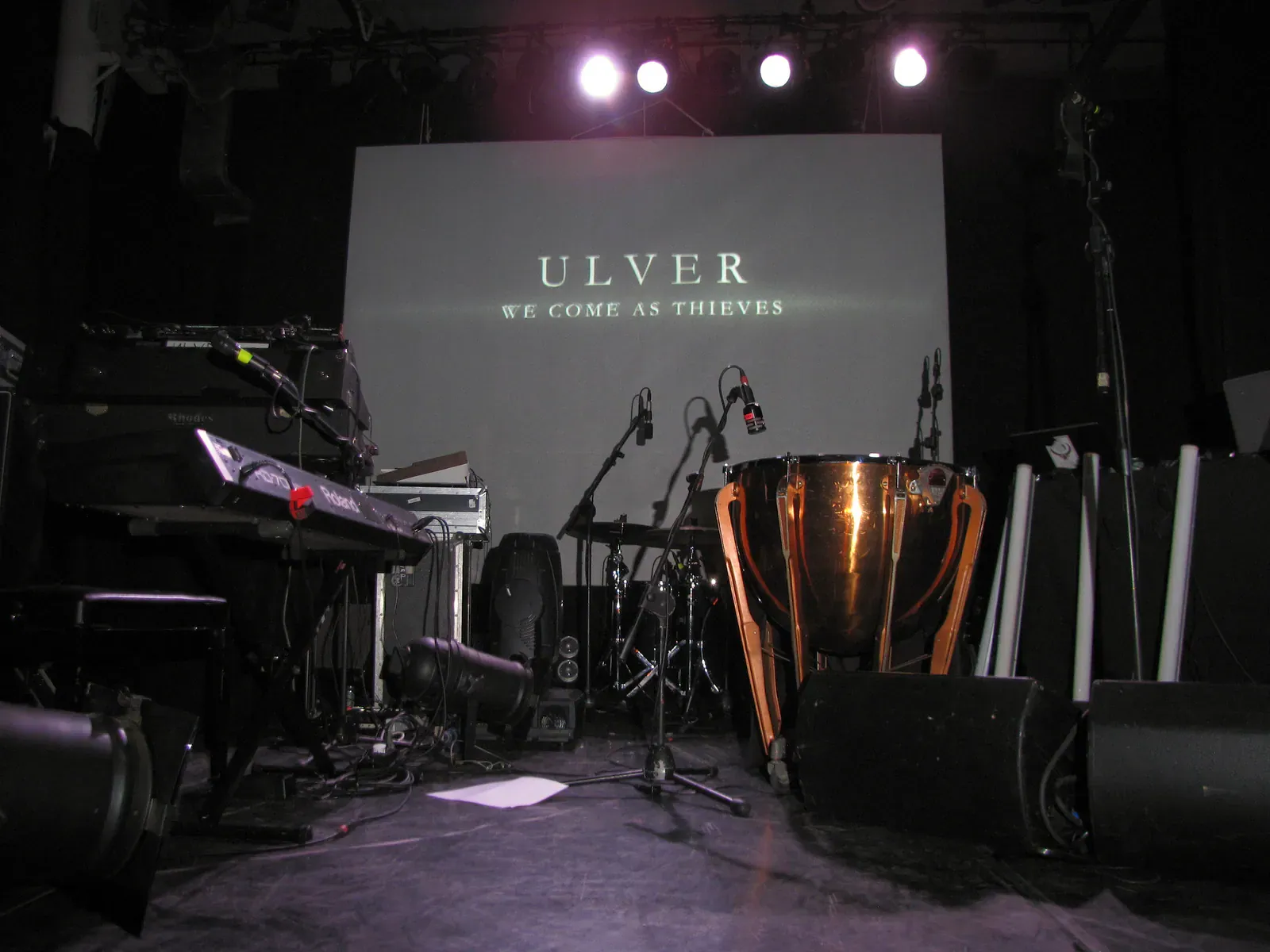
Ulver left metal altogether. Rygg and the composer Tore Ylwizaker recorded Themes from William Blake’s The Marriage of Heaven and Hell (1998), then the Metamorphosis EP (September 1999), whose sleeve note said the band was not a black metal band and did not wish to be stigmatized as one. Perdition City (March 2000), subtitled Music to an Interior Film, drew on trip hop, jazz, ambient music and spoken word. It alienated fans of the first three albums but placed in a metal magazine’s top ten of its year.
Maudlin of the Well broke up in 2003, and Driver formed Kayo Dot, whose Choirs of the Eye (2003) came out on John Zorn’s Tzadik. Specialty labels now backed the style. Misanthropy Records promoted Norwegian avant-garde metal until it folded in 2000, and The End Records led what was called a new wave of avant-garde metal in the early 2000s.
Elders and new experiments, 2010 onward
The pioneers kept working. Voivod won a Visionary award in 2017 and a Juno Award for Metal/Hard Music Album of the Year in 2019 for The Wake, and released the re-recorded Morgoth Tales in 2023. Sigh moved toward progressive metal, using traditional Japanese instruments and Kawashima’s flute on Heir to Despair (2018) and Shiki (2022), and issued Goh-Ka in 2026. Scenes took root in the San Francisco Bay Area (Giant Squid, Grayceon, Ludicra) and in Boston (Isis, Kayo Dot).
Characteristics
Avant-garde metal is close to progressive metal, but it experiments more, while progressive metal keeps a tighter focus on conventional metal instrumentation and technical complexity. Its lyrics and imagery are as varied as its sound. Other pioneers include Gorguts, Boris, Earth, Helmet, Neurosis, Sunn O))) and Today Is the Day. Tempo has no norm, from slow cinematic pieces to fast thrash.
Instruments and production
Electronic percussion and drum machines are widely used, a habit traced to Celtic Frost’s example, as are female and operatic voices. Voivod added processed, robotic vocals. Saxophone brings free-jazz color, from Mr. Bungle’s early lineup to Sigh’s Dr. Mikannibal, and Ulver’s Kveldssanger relied on cello and classical guitars. Perdition City was recorded and produced by Rygg and Ylwizaker.
Mainstream success
Avant-garde metal never crossed over in volume. Nothingface’s Billboard 200 entry and Mr. Bungle’s Warner Bros. contract were the nearest approaches, and a video for Voivod’s Pink Floyd cover aired on MTV’s Headbangers Ball. The style’s reach came through awards, press and influence instead: Voivod’s Juno, the 2008 documentary Global Metal featuring Sigh in Japan, and the metal-press placing of Perdition City. Backlash was common, mostly from fans of a band’s earlier sound. Ulver’s early listeners objected to its turn, and Mr. Bungle’s critics split between those hearing virtuosity and those hearing self-indulgence.
Notable recordings
Into the Pandemonium is the founding case. It stretched well beyond the band’s thrash and doom reputation. The Noise dispute ended the band’s deal, yet the album became its most successful record.
Disco Volante is the style’s most extreme collage. It took four years to appear, and its mix of contemporary classical devices, jazz and film music made each song unpredictable.
Perdition City shows the genre’s exit door. Recorded by two people after a black metal beginning, it sounds like a film soundtrack and leaves guitars and growls behind entirely.
Culture
Imagery is individual. Voivod built a cyberpunk and science-fiction world around itself, Arcturus wore flamboyant costumes at odds with black metal’s corpse paint, and Maudlin of the Well framed its music as dream-found.
Legacy
Voivod is cited as an influence by Tool, Pantera, Soundgarden, Mastodon, Meshuggah, Fear Factory and Dave Grohl, and Mike Patton of Mr. Bungle has also praised it. The style’s larger legacy is permission: thrash metal, black metal and doom bands from the 1990s on could add strings, electronics, saxophone or jazz harmony and still be metal. Jazz metal sits among its offshoots.
Misconceptions
Avant-garde metal is not just progressive metal with more notes. The two share roots, but progressive metal stays closer to standard instrumentation and technical display, while the avant-garde side bends the form.
Mr. Bungle is not simply a joke band. Its self-titled album was called funk metal, but Disco Volante moved to avant-garde and experimental, with a lineup that also took in Mike Patton, Trevor Dunn and Trey Spruance.
Ulver did not record Nattens madrigal with a budget spent on suits and a car. The story is a rumor, possibly started by the label, and Rygg denied it.
Frequently asked questions
What is avant-garde metal?
Avant-garde metal is a style of metal marked by experiment: unusual instruments, jazz and classical devices, unconventional vocals and non-standard song structures. Bands include Celtic Frost, Voivod, Mr. Bungle, Ulver, Sigh and Arcturus.
Which band started avant-garde metal?
Celtic Frost’s Into the Pandemonium (1987) is the record the term was coined to describe. Voivod and Mr. Bungle were pioneering at the same time.
How does avant-garde metal differ from progressive metal?
Avant-garde metal experiments more and often uses unusual sounds. Progressive metal keeps closer to conventional metal instruments and favors technical complexity.
Sound
Sound sheet
Signature sounds
- Unconventional instruments such as saxophone, cello or flute
- Genre shifts inside a single song
- Processed, operatic or spoken vocals beside growls
- Dissonant, fractured guitar writing
Techniques
- Robotic vocal effects
- Unusual time signatures
- Genre switching within a song
- Operatic and female vocals
Keys and modes
Dissonant, non-diatonic harmony. Voivod's fractured, unorthodox guitar sounds broke from standard minor-key riffing.
Vocals
Growls and shrieks beside operatic, spoken, sung and robotic voices.
Scenes
Where it happened
Where and when the sound lived: one bar per city on a shared timeline.
North America
Europe
Asia
Active scenes
Peak 5, 1996-2025
Celtic Frost's home, source of the orchestral and industrial detours that earned the avant-garde label.
The Quebec town where Voivod formed and built its science-fiction thrash.
Home of Ulver and Arcturus, whose experiments grew out of Norwegian black metal.
Sigh's base, a Japanese branch that mixes extreme metal with symphonic and traditional sounds.
Scene of Maudlin of the Well, Kayo Dot and Isis, leaning toward chamber and progressive ideas.
Culture
Culture markers
- Cyberpunk and science fiction
Voivod's imagery and lyrics built a distinct retro-futurist world around the band.
Artwork - Flamboyant stage costume
Arcturus wore ornate, theatrical costumes at odds with black metal's corpse paint.
Fashion - Music from lucid dreams
Maudlin of the Well framed songs as found rather than composed, through astral projection and lucid dreaming.
Ritual
Media
Key media
- 2008Global Metal
by Sam Dunn and Scot McFadyen. Documentary on metal around the world that features Sigh in Japan.
Film
Glossary
Terms on this page
Concept behind Maudlin of the Well's music, which the band said it brought back from lucid dreams.
Short form of avant-garde metal, also called experimental metal or art metal.
Ulver's first three albums: Bergtatt, Kveldssanger and Nattens madrigal.
Label applied to Sigh's Imaginary Sonicscape for its odd, dreamlike arrangements.
Complex thrash of the 1980s, with Voivod among its progenitors, that fed the avant-garde side.
Metal family